Showing posts with label Ruby-throated Hummingbird. Show all posts

Wednesday, November 11, 2015

Migration


With the advent of fall the leaves change colors (at least here in the Midwestern U.S.) signaling that it is migration time.

Many bird species will be flying south for the colder months of the year.  There are about 4,000 species of birds in the world that migrate.  Not all birds migrate, but of the ones that do, their migrations are very different from bird to bird. 

The Arctic Tern does a round trip migration of over 40,000 miles (photo: wikipedia)

Some birds only migrate a short distance, while others have a very long way to go.  For example, the Arctic Tern will do a round trip migration of over 40 THOUSAND miles.  It is the longest migration of any bird.  The Ruby-throated Hummingbird only migrates about 600 miles. 
The Ruby-throated Hummingbird travels about 600 miles (photo: wikipedia)

The record for the bird with the longest non-stop flight is the Bar-tailed Godwit.  It flew almost 7,000 miles over a period of eight days.  Some birds even fly over oceans and gulfs during their migrations, spending 100 hours or more in the air before they reach land.  These birds are known as transoceanic migrants. 
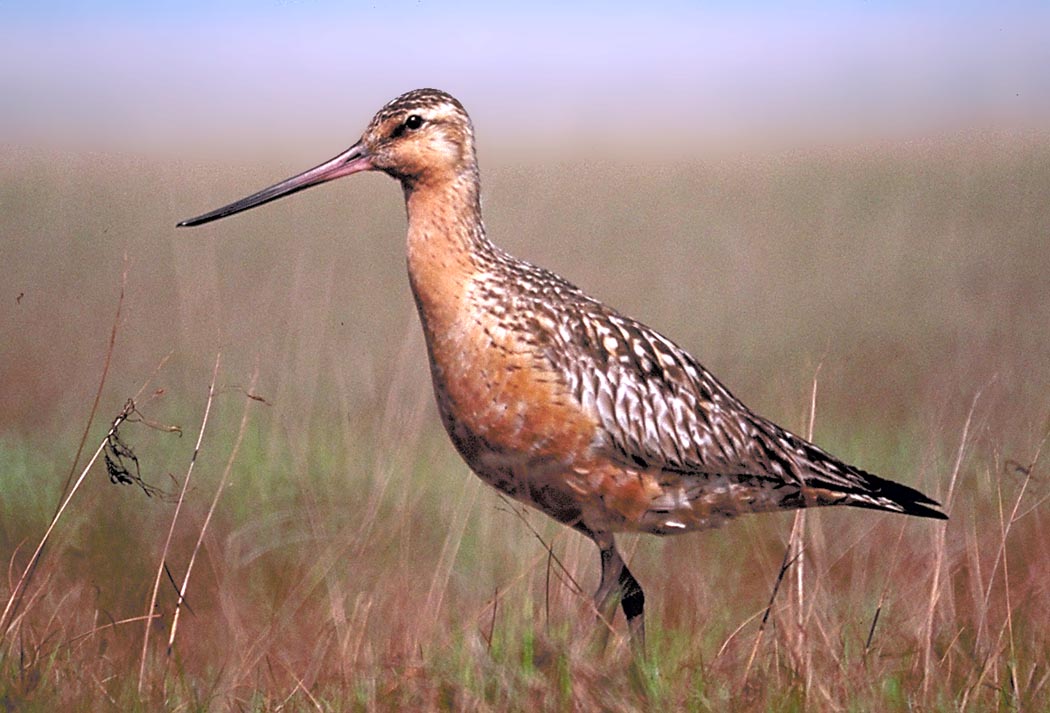
The Bartailed Godwit holds the record for the longest non-stop flight (photo: wikipedia)

Some birds only fly 20 or so miles a day, where others have been known to fly for around 600 miles in a day.  The Great Snipe is the fastest migrator, traveling at 60 miles per hour during its migration.  Most raptor species, like hawks, migrate during the day, whereas many songbirds will migrate at night, mostly to stay away from becoming hawk food. 

Speaking of food, many birds go through a stage of hyperphagia before their migration.  This is the technical term for eating A LOT of food.  Some birds, like the Blackpoll Warbler, will even double their body weight for the long trips. 

Flying birds aren’t the only ones that migrate.  Many penguins will swim for their migrations, and Emus will run for miles.  Migrating birds face a lot of threats though.  Weather, temperature, endurance, predators, but most migration deaths are because of people.  Billions of birds die every year due to collisions with windows, TV and radio towers, and power lines.  Even the bright lights of a city can alter a bird’s migration. 

A few things we as individuals can do to help these birds out include: keeping cats indoors all the time (cats are one of the leading causes of bird deaths), put up window stickers or tint your windows to prevent collisions, keep your bird feeders and birdbaths clean, and create a good pit stop for the birds in your backyard.  Keeping native grasses, plants, and trees will greatly help the birds and their environment as they migrate.

Submitted by Mike Cerutti, World Bird Sanctuary Naturalist/Trainer


Sunday, October 12, 2014

Birdlore: The Charming Hummingbird


 In mythology across the world, traditional folklore and stories share a common theme of creatures such as dragons, mighty eagle-like birds, ravens, big cats, or man-like apes.  However, one creature may be found unique to Native American mythology.

The Ruby-throated Hummingbird (Arcilochus colubris) is a common sight at feeders in Missouri during summer months (photo: the Wikipedia files)
The spectacular Hummingbird is native to habitats only in the Western Hemisphere.  Among Native American tribes, these charming birds have inspired a rich cache of myths with their beautiful colors and even the tenacity they display when protecting their territory.
Hummingbirds will guard what they consider "their territory" with unbelievable ferocity (photo: Gay Schroer)
The Aztecs honor the hummingbird as part of their warrior culture.  The aggressive behavior hummingbirds display in fighting other hummingbirds or larger birds of prey in their territory is similar to the fearlessness of Aztec warriors.  The hummingbird’s nimble and swift flight ability is also reminiscent of an Aztec warrior’s agility in battle.  The Aztecs also believe that warriors fallen in battle rise to the sky and orbit the sun for four years, before transforming into a hummingbird.

Referred to as the Colibri (hummingbird) in the Caribbean, the smallest Colibri, Guani, is known to the mountain people of the Taino Indians as the most noble of the valiant Colibri (also known as the Bee Hummingbird, the smallest of all birds).

The Hummingbird is often associated with stories relating to the sun or light, bringing the rain, or gifting tobacco to the people. 

According to Mojave legend, the early people lived in a world of darkness.  The little hummingbird was sent to search for light.  Finding a twisting path to the bright upper world, the hummingbird showed the people the way to where they live today.  A Mayan myth mentions that the hummingbird is actually the sun in disguise trying to court the moon, who is disguised as a beautiful woman.

The tribes of the Hopi and Zuni will often decorate water jars with the images of hummingbirds, because it was believed the hummingbirds would intervene for the humans and convince the gods to send rain to the lands below.  A Hopi story tells of a time during a famine; a boy and girl were left at home alone while their parents went out in search of food.  The young boy made a toy hummingbird, which his sister threw into the air and it came to life.  The hummingbird flew to the center of the earth, pleading with the got of fertility to return the rains to the land.  The rains came back over the land, plants grew once more, and the children's parents returned home.

One Cherokee legend tells of a medicine man transforming into a hummingbird to recover lost tobacco seeds.  To the Pueblo people, the hummingbird is called the tobacco bird.  The hummingbird meets with Caterpillar, guardian of the tobacco plant, to receive smoke from him.  The hummingbird delivers the smoke to the shaman, so they may purify the earth.  The Arawaks, an extinct tribe of the Caribbean, also believed it was the hummingbird who brought tobacco to humans, calling him the Doctor Bird.

There are many more amazing stories and myths regarding these dimunitive, but charming birds.  So, the next time you're visiting the World Bird Sanctuary and see hummingbirds buzzing to and from the feeders, remember even the smallest of creatures can inspire the largest of legends in the human imagination.

Submitted by Jessica Bunke, World Bird Sanctuary Naturalist/Trainer