Showing posts with label migration. Show all posts

Wednesday, November 11, 2015

Migration


With the advent of fall the leaves change colors (at least here in the Midwestern U.S.) signaling that it is migration time.

Many bird species will be flying south for the colder months of the year.  There are about 4,000 species of birds in the world that migrate.  Not all birds migrate, but of the ones that do, their migrations are very different from bird to bird. 

The Arctic Tern does a round trip migration of over 40,000 miles (photo: wikipedia)

Some birds only migrate a short distance, while others have a very long way to go.  For example, the Arctic Tern will do a round trip migration of over 40 THOUSAND miles.  It is the longest migration of any bird.  The Ruby-throated Hummingbird only migrates about 600 miles. 
The Ruby-throated Hummingbird travels about 600 miles (photo: wikipedia)

The record for the bird with the longest non-stop flight is the Bar-tailed Godwit.  It flew almost 7,000 miles over a period of eight days.  Some birds even fly over oceans and gulfs during their migrations, spending 100 hours or more in the air before they reach land.  These birds are known as transoceanic migrants. 
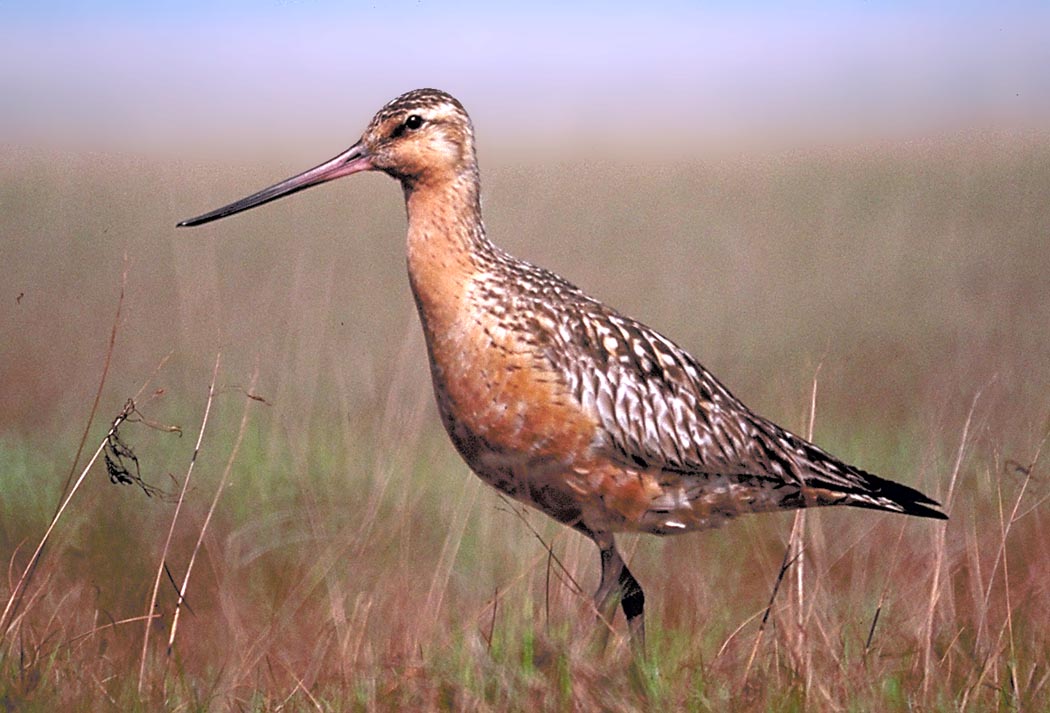
The Bartailed Godwit holds the record for the longest non-stop flight (photo: wikipedia)

Some birds only fly 20 or so miles a day, where others have been known to fly for around 600 miles in a day.  The Great Snipe is the fastest migrator, traveling at 60 miles per hour during its migration.  Most raptor species, like hawks, migrate during the day, whereas many songbirds will migrate at night, mostly to stay away from becoming hawk food. 

Speaking of food, many birds go through a stage of hyperphagia before their migration.  This is the technical term for eating A LOT of food.  Some birds, like the Blackpoll Warbler, will even double their body weight for the long trips. 

Flying birds aren’t the only ones that migrate.  Many penguins will swim for their migrations, and Emus will run for miles.  Migrating birds face a lot of threats though.  Weather, temperature, endurance, predators, but most migration deaths are because of people.  Billions of birds die every year due to collisions with windows, TV and radio towers, and power lines.  Even the bright lights of a city can alter a bird’s migration. 

A few things we as individuals can do to help these birds out include: keeping cats indoors all the time (cats are one of the leading causes of bird deaths), put up window stickers or tint your windows to prevent collisions, keep your bird feeders and birdbaths clean, and create a good pit stop for the birds in your backyard.  Keeping native grasses, plants, and trees will greatly help the birds and their environment as they migrate.

Submitted by Mike Cerutti, World Bird Sanctuary Naturalist/Trainer


Thursday, February 19, 2015

Sandhill Crane Migration-Nebraska


Do you want to see the greatest wildlife spectacle in the United States?  If so, you need to go to Kearney Nebraska in March.  The locals pronounce the city of Kearney (Car Knee).  

In March the Sandhill Cranes gather by the tens of thousands on the Platte River between Kearney and Grand Island, Nebraska.
The migration can be viewed along a forty mile stretch of the Platte River (photo: Outdoor Nebraska website)
There is a 40-mile stretch of the Platte River where the Sandhill Cranes come to roost every night during March.  The birds stand in the shallow river overnight.  Some stand on sand bars, but almost all of them stand in the cold water overnight.  They roost in mass numbers in close proximity to each other.  Presumably there is safety in numbers--safety from Coyotes.  The numbers of these majestic birds along this stretch of the river are estimated to be over 400,000 Cranes.

My favorite spot to observe the Cranes in the evening in the past has been the State Park south of Kearney on an old bridge.  It is called Fort Kearney Hike and Bike Trail.  It is an old railroad bridge and is a five minute walk from where you park your car.  You can watch there for a small fee (honor system when paying).  Unfortunately, this historic wooden bridge was destroyed by a wildfire in March 2009.  Construction is underway to rebuild the bridge and widen and pave the trail, but is not expected to be complete before this spring’s migration.  Target date for completion is sometime in late 2015.  Hopefully this viewing area will be reopened in time for the 2016 spring migration.  

Just before dusk the cranes begin to arrive on the Platte R. (photo: Mike Zieloski)
However, don't let the above information deter you from a trip to view the cranes, as there are many other areas that provide excellent views of this spectacle.  For a list of viewing  areas Click Here.  Once there, you will meet people from all over the world who also came to watch the spectacle--that is if you decide to converse with the Humans.  You may just want to soak up the sights and sounds of the birds.  The birds start arriving a couple of hours before dark.  They fly in …in flocks of 3 to 3,000, and they keep coming until dark.  The waves of birds keep arriving and arriving.

Among the din you can hear the voices of individual birds.  You can hear the higher pitched younger birds calling out to locate their family.  There will also be Green-winged Teal, Pintails, Mallards and other ducks flying in with the Cranes.
The din from thousands of birds is incredible (photo: Mike Zieloski)
No matter how hard I try to describe it, the noise of the Cranes is something you have to experience for yourself.   You can hear so many Crane voices.  Then after it gets dark, you can turn on your headlamp and hike off the bridge, back to your car. You will be amazed at what you just witnessed.

In the morning, you will want to head to Rowe Sanctuary to slip into your viewing blind before daybreak.  You will need a reservation for one of the precious spots in the viewing blind.  You will be in the dark, above the river, in very close proximity to the resting birds.  The Cranes will be fairly quiet.  But as Dawn approaches, the Cranes get more and more excited…and they get louder and louder.  Then a Bald Eagle may fly over…or a Coyote may be spotted, and thousands of Cranes get air born at once. The morning lift off is so much different from the evening’s staggered arrivals.

You can make reservations for the morning blind by calling 308-468-5282 or going to  rowe.audubon.org  online.
It was my pleasure to share this experience with my cousin Phil (photo: Mike Zieloski)
My last trip to Nebraska was with my cousin Phil Besendorf of Louisville, Kentucky. He was amazed at the spectacle.

Previously I had been to see the Cranes with my coworker Cathy Spahn. We were the naturalists on a bus tour to experience the Cranes. I have seen this wildlife spectacle four different years now and never tire of it.  I have no idea how many more times I will go.  You should experience this, too.
WBS's resident Sandhill Cranes (photo: Gay Schroer)
If you’re unable to make the trip to Nebraska, you can see these regal birds at the World Bird Sanctuary.  We have two Sandhill Cranes who sustained injuries that make it impossible for them to migrate. 
Meet Menomenee (photo: Gay Schroer)
So Shawnee and Menomenee, our resident Sandhill Cranes, will spend the rest of their days educating the public and being catered to by WBS staff, interns and volunteers.  You can even adopt one or both of these beautiful birds through the WBS Adopt A Bird program. 


Submitted by Michael Zeloski, World Bird Sanctuary Director of Education

Monday, January 12, 2015

Time to Leave Missouri


Sometimes animals migrate; it could be from the bottom of a mountain to higher pastures or it could be to another hemisphere. Sometimes animals just don’t know when to leave, or they may have an injury that prevents them from migrating.

The Broad-winged Hawk migrates through the Midwest on its way to and from central and South America each year.  There is a small window of time when these birds pass through the area. 

The World Bird Sanctuary’s Kathryn G. Favre Wildlife hospital admits a number of Broad-winged Hawks each year and most get released well before the migration south.  This year, however, there were two Broad-wings that each had broken wings.  It takes 6 weeks for a fracture to bond, and then another 5 to 6 weeks of physical therapy after the wing is unwrapped before a bird can be released. 

Even after a bird has recovered from its injuries, it does not mean it is ready to fly to South America.   Some years we have kept late migrants through the winter and released them in the early spring when the other birds return.  Since Broad-wings leave Missouri to escape the cold winters, and we didn’t have suitable indoor housing to keep them warm, we had to come up with an alternative plan.  This year we had the opportunity to send these birds to the Gladys Porter Zoo in south Texas.   This zoo has a small rehabilitation center for birds, and several of their staff released them shortly after they arrived.

A photo of the imped feathers from another hawk species which will  help our released bird in its flight.  

The birds were flying great after being in captivity for 4 months, but they had broken a few tail feathers.  After imping (super gluing) 5 new feathers onto each bird’s tail, then wrapping the tails in postal tape to protect them during shipping, the hawks were almost ready. 


An ingenious temporary hood created by Sanctuary Manager Joe Hoffman for shipping this Broad-winged Hawk to its release site

They only needed falconry hoods to calm them as they traveled.  Hoods are made by stitching leather and fashioning a pattern to fit over the head of a species.  No one makes hoods to fit a Broad-winged Hawk because they are not used in the sport of falconry, so we needed one-time use temporary hoods. I invented the duct tape hood.  None of the tape’s sticky part touches the bird of course. 

Then it was time to leave the sanctuary, Missouri, and soon maybe even the United States.  Being shipped by jet liner to a place so far south in Texas got the hawks closer to other Broad-wings staying the winter in central Mexico.  Even if the hawks stayed near the town of Brownsville, TX, until the spring migration, their winters are much warmer than here in Missouri.

Following are photos of the actual release:


Ready to fly (photo: Gwyn Carmean)
 Flying free at last (photo: Gwyn Carmean)
 Resting in a tree after the release (photo: Gwyn Carmean)

We would like to thank Dr. Tom Damaar and staff of the Gladys Porter Zoo for all their help in accepting, housing and releasing the hawks and Gwyn Carmean for allowing us to use her photos of the release. 

Submitted by Joe Hoffmann, World Bird Sanctuary’s Sanctuary Manager 

Monday, November 3, 2014

The Mystery of Migration


It’s officially autumn. Autumn means cool weather, hot cider, and many of us wishing we could make like geese and head south for the winter.

All we’d have to do is look at a road map, choose a destination and away we’d go. Geese, of course, not being able to read, don’t have the luxury of a map. So how do they know where to go? Furthermore, how do migratory birds know when to leave?

Sandhill Cranes in flight (photo: Wikipedia files)

The Cornell Lab of Ornithology estimates that there are over 650 species of birds in North America, and most of those are migratory, meaning that entire populations of birds are moving to a different place. Many of us assume that migration must mean long distances, crossing at least half of the country. The term migration, however, doesn’t only encompass such epic journeys; it also includes smaller ones. A species that simply moves from a higher elevation to a lower elevation is considered to have migrated. Birds that migrate such short distances might not have trouble finding their destination since it is relatively close to their starting point, but what about the birds that migrate medium to long distances?

It is not well known exactly how birds navigate from one location to another during migrations. Even first year birds which have never experienced migration can navigate following a precise pathway to the exact same location as other birds without the guidance of an older bird. Some birds appear to navigate by sensing the earth’s magnetic field, others seem to migrate using the stars for navigation, and some use a combination of techniques.
Wading birds in flight (photo: Wikipedia files)

Furthermore, the triggers for migration are not well known, and also likely vary from species to species. Some birds may begin migration as temperatures cool or as days shorten. Other species may only migrate when food sources become scarce. There may even be a genetic predisposition in some species, since certain species have a very precise window of migration, even as short as two weeks, while other species migrate over a period of a few months.

More is known about the reasons why birds migrate than how they migrate. While it’s certainly nice to escape cold weather, the primary reasons for migration are food and nesting locations. Northward migration in the spring brings the birds to rising populations of insects as well as new nesting locations, giving the earliest arrivals the pick of the best nesting spots. Southward migration in the fall brings the birds to fresher, larger food sources.

While the knowledge that birds migrate is common, surprisingly little is known about this phenomenon. The World Bird Sanctuary’s bird banding team does their part to better understand the mysteries of migration during their spring migration banding blitz, when they catch and release songbirds passing through the area.  The banding team also bands songbirds as they migrate south, and they have recently started banding Saw-whet Owls as they migrate south.

Submitted by JoHanna Burton, World Bird Sanctuary Naturalist

Wednesday, November 6, 2013

Fall Migration


The migration is underway for many species of birds in North America. The migration is a natural occurrence that happens every fall and spring. In our neck of the woods many migrant species have started to build in numbers for the migration south. The St. Louis area is located on the Mississippi Flyway, or bird highway, that lots of species use to fly to their overwintering grounds.


Migration is the seasonal movement between breeding and overwintering grounds for many North American birds. Migrating birds are primarily driven by the availability of food, temperature and the photoperiod. Most North American migrating birds will leave for their overwintering grounds in early fall and return as early as late winter to breed and raise their young.

The Mississippi flyway is one used by many species in North America. Almost half of the waterfowl and shorebirds found in North America use the Mississippi flyway as a migration route. The Mississippi flyway is highly productive because the Mississippi River has carved a path into the landscape for the birds to follow south and the river itself provides many types of food for the migrants.

As the days get shorter and the leaves begin to change many new bird species will be finding their way into our backyards. Some of the more noticeable species that will be migrating are the Hummingbirds, Starlings, and Robins. In the weeks to come keep an eye out for new winged visitors in the yard.

Submitted by Adam Triska, World Bird Sanctuary Naturalist

Saturday, February 18, 2012

White Pelican Migration

A short time ago, I had the opportunity to participate in the rescue of an injured White Pelican. 

The Pelican had become stranded on a small pond near the Portage de Sioux power plant.  It had broken its wing, and so could not fly to warmer waters if the small pond froze, although it had survived for a brief time on the fish living in the pond.  We successfully rescued the bird, but the event caused me to reflect on the amazing lives that Pelicans lead and the annual migration patterns that eventually brought this individual to its fate.
Rescuing an injured White Pelican earlier this year
American White Pelicans (Pelecanus erythrorhynchos) begin their lives near the shallow, glacial lakes found in the Upper Midwest Plains and Southern Canada.  Pelicans nest in large breeding colonies to help protect each other from predators.

When early Fall arrives, the Pelicans leave the northern breeding grounds and travel towards the Gulf Coast of the Southern United States.  Their routes take many of them along the Mississippi River and over the St. Louis region.  White Pelicans, along with many other migrating bird species, take advantage of the unfrozen water found near the large hydroelectric dams in our area. 
The Riverlands in Alton, IL is a great place to see migrating White Pelicans
A great place to spot White Pelicans this time of year is in the Riverlands Area in Alton.  The pond where we rescued the white pelican is located near a floodplain commonly used by migrating pelicans.  That individual likely became injured when its flock stopped to rest and feed.  When the rest of the flock moved on, this bird became stranded.
 
The pelicans spend the winter along the warmer waters of the Pacific and Gulf coasts.  They tend to avoid the open ocean, preferring instead inland lakes and estuaries. 

I always feel amazed when I consider the incredible journeys that birds regularly make to survive.  Traveling across a substantial section of the globe twice a year as a lifestyle is extremely perilous, as the injured pelican demonstrated. 

I felt privileged to participate in a small way in one of the most amazing rhythms of life on earth.

 Submitted by Leah Sainz, World Bird Sanctuary Naturalist/Trainer

Monday, July 25, 2011

Turkey Vulture Migration Study

LOOK!  Up in the sky—it’s a bird, it’s a plane….its definitely a Turkey Vulture!


After spending the winter months as far south as South America, those winged wonders, the Turkey Vultures, are once again circling overhead in Missouri skies with their amazing demonstrations of avian aerodynamics.
On March 22, 2009 we ran a blog post about a Turkey Vulture migration study being done by researchers at the Hawk Mountain Sanctuary in conjunction with other researchers in South America.  To review that post Click Here. 


If you’ve never paid particular attention to these birds in flight, stop for a few moments and really watch them.  You’ll be mesmerized!  Now that they’re back, this is your opportunity to be a part of an important ongoing study  about the migration habits of these fascinating birds.  To read more about the study's findings to date click here.  
There is a photo posted on the link of a bird wearing the tag so that you can see what it should look like.  So, the next time you see a turkey vulture soaring overhead, perched, or on the ground, stop what you're doing for a moment, and take a closer look.  That bird may be wearing some important jewelry!

Turkey vultures tagged for the tracking program may have blue, red or yellow wing tags. Anyone spotting a turkey vulture with a tag is asked to report it to the Hawk Mountain Sanctuary. Please note the location where you saw the bird, which wing the tag was on, the color, the number if possible, the bird’s behavior such as flying, perched or feeding, and whether it was with any other vultures.  Even if you’re not able to supply all the above information, contact them with whatever information you do have.
For more information on how, what and where to report Click Here.  
Once you’ve reported your sighting to the Hawk Mountain study, don’t forget to let us know about it by submitting a comment on our blog.
Submitted by Gay Schroer, World Bird Sanctuary Volunteer/Photographer

Tuesday, September 7, 2010

Going South

Don't forget your hummingbirds now that colder weather is approaching.


Many people stop feeding the hummingbirds and take in their feeders at this time of year.  They believe that if they continue to supply food into the cold weather it will keep the hummingbirds from migrating.  Nothing could be further from the truth.  In birds the instinct to migrate is usually fueled by shorter day lengths and cooler temperatures.  They will not stay around just because they are being fed.

Now is the time of year when they need your help the most.  For the most part, the males have already migrated to their southern wintering grounds.  However, the females are still here.  Since most of their preferred flowers are past their blooming peak, they are seeking alternative foods to fuel their long trip.  Actually, some of "the girls" that you've been feeding all summer have probably gone south, and their more northerly cousins are probably the birds in your backyard now.
The yellow at the center of the flowers attract bees
Bees at your feeder can be a problem at this time of year, because they, too, are finding that nectar is not as plentiful now.  Since bees are attracted to the color yellow it sometimes helps deter them if you make sure your feeder has no yellow on it, and the feeding port holes are small enough to deny the bees entry.
This feeder has no yellow, and the feeding ports sit above the nectar.  Holes are too small for the bees to enter.
The type of feeder that has a flat surface seems to work better for this purpose, since the bees cannot reach the nectar if the surface of the liquid sits far enough below the feeding port.  The hummers, with their long beaks and tongues can still get to it.

Your feeders will help these transient hummers fuel their trip to warmer climates.

Submitted by Gay Schroer, World Bird Sanctuary Volunteer

Sunday, April 26, 2009

THEY'RE BACK!! THEY'RE BACK!!!


This is the birding event we've been waiting for!

After a migration of thousands of miles (some individuals spend the winter as far south as Southern Panama), our favorite little Kamikazees, the Ruby Throated  Hummingbirds, are back in Missouri!!  

According to one of my favorite hummingbird blogs, http://www.hummingbirds.net/ they've probably been here for a while already, but  yesterday was the first time I actually saw one!  If you haven't already done it, put out your feeders.  They're here, and they're hungry after that long trip!  


Thursday, March 5, 2009

Camouflage

This is a special post for Mrs. Daniel's second grade class at St. Peters Elementary School, who are learning about animal camouflage, hibernation and migration.  

Here are two of the World Bird Sanctuary's resident owls, Ookpik and Tundra, our Snowy Owls.  However, since they usually live on the Arctic tundra they are only on display to the public during the cold months of the year here in Missouri.  In the summer they live in an air conditioned building elsewhere on our property.
This photo of Ookpik shows off his beautiful white plumage which, in the frozen arctic snow, would blend right in and make him nearly invisible.  Not only would this help make him invisible to predators, such as polar bears, but would also help to hide him from the lemmings (small rodents) which he hunts for his food.

In the photo of Tundra, our female Snowy 
Owl, you can see that she has more brown or tan areas in her feathers.  Since Snowy Owls nest on the ground, rather than in trees, this would help to camouflage her when she is sitting on her nest in May.  At that time of the year the snow may have melted in places, exposing the tundra for which she is named.  While she is sitting on her 5-14 eggs it would be the male's job to feed her.

Snowy Owls do not do what most people think of as migration--annual flights of extremely long distances triggered by day length or cold weather.  They are considered nomadic and travel according to the lemming population.  If the lemming population is very large, the owls might range within a fairly small area.  However, lemmings are subject to population "crashes".  In that instance the owls would travel a much greater distance in their search for food, at times appearing as far south as the northern U.S.

Here is a photo where I have placed Ookpik and Tundra's images in a snow scene.  Even though you can still see them, on a bright sunny day they would blend right in and be very difficult to see. Also, take a look at the gulls in the foreground and notice how well they blend into their surroundings.