Sunday, November 6, 2011

Got Biome?


Planet Earth – what an interesting and fascinating world. 

So, we live on the third rock from the Sun.  But how much do you know about the planet’s five major biomes: aquatic, deserts, forests, grasslands and tundra?

World Bird Sanctuary offers a Resource Nest Box called “Where We Live”.  This is an educational resource box loaded with books, DVD’s, videos, activities, games and more.  For a nominal fee of $25.00 you can rent this box for a two-week period through our Education Department.

This box contains a wealth of information and tools and hours of entertainment including twenty-two books on topics such as: arctic and desert wildlife, the tundra, desert, woods, rainforest, oceans, wetlands, grasslands, prairies and more, a tree ring counting guide, a food chain game, five VHS videos about animals and prairies, the Planet Earth and Blue Planet boxed DVD set containing ten DVD’s, a puppet show with seven puppets and a script, and more.

Resource Nest Boxes are a great addition to classroom teaching, for home schoolers, students working on research papers, day cares, scout leaders, or for kids that just want to have fun and learn more about our great planet and the creatures that we share it with. 

Other available Resource Nest Box topics are: Protect Our Planet; Rocks Rock and Talon Tote.

To reserve one of our educational and environmentally friendly Resource Nest Boxes, please call the Education Department at 636-225-4390 extension 0.

Submitted by Billie Baumann, World Bird Sanctuary Outreach Coordinator

Friday, November 4, 2011

Women in Conservation

Women have been pioneers in conservation for over 100 years.  Some of them were in our own backyard!

I recently saw a photo that a follower posted on our Facebook Page that piqued my interest.  It was a picture of a young woman banding birds in Missouri in the 1920's.  I emailed Lura and asked for more information, and uncovered a wonderful story about a wildlife conservation pioneer that, almost 100 years ago, was doing the same important work as our WBS Bird Banding Team.
 This newspaper article piqued my interest

This newspaper article, dated Monday 8th, 1929, shows Miss Cora Shoop banding birds, including cardinals and juncos.  Miss Shoop started the banding station after one of her students brought her a Blue Jay that he had killed earlier in the decade.  The Blue Jay had a numbered band on its leg, and together student and teacher set out to find out what it meant.  After tracing the band back to the biological survey unit of the United States Department of Agriculture, they learned that the Blue Jay had been banded in Wisconsin and made its way all the way down to Missouri.  The students were so interested in what they had learned that they applied to set up a bird banding station to contribute data to the survey.

When I saw the photo in this article I wanted to know more, and Lura Holt, Cora Shoop's niece, told me:

“I know Aunt Cora would be honored. I have attached the article that goes with the picture.  She was an amazing woman, and I have just recently started organizing her papers and photos.  She lived into her 90's, was a very prolific writer and saver.  She started banding birds in the early 20's in Steelville MO where she was born.  Family legend is that she was the first woman to receive a degree in biology at Mizzou.. Don't know if it is true or not.  Ornithology was her first love, botany her second (she was married to Julian Steyermark, renowned Missouri botanist who published the book, Flora of Missouri, among many others).
“This picture is Cora with my mother in 1931." 
“This last picture is one of my favorites. She has it labeled Blue Wing Teal at campsite Lacled Co. Niangua River 4 1/2 miles SW of Eldridge. 6/23/39."

It is pioneers like Cora Shoop that have inspired many of us at World Bird Sanctuary.  Today we'd like to acknowledge the contribution that they have made to the study of birds in our own backyards, and around the world.

Submitted by Catherine Redfern, Naturalist/Fundraiser, World Bird Sanctuary

Wednesday, November 2, 2011

A Day In The Life….


During the summer, the Educational Training Center (ETC) the World Bird Sanctuary’s behind the scenes bird housing facility, is a pretty quiet place.  

We take care of the few birds that do not end up out at a summer zoo show, and we take care of a lot of maintenance projects for WBS, such as filling potholes on the road to the ETC, or maintaining much of the behind the scenes bird housing.

However, when the first week of September rolls around, the ETC gets much noisier.  This year, WBS sent two groups of birds and trainers on the road—one group to the Milwaukee County Zoo in Wisconsin, and another to the Stone Zoo in Boston, Massachusetts.  Both birds and staff performed spectacularly at these zoos all summer.
 Grand finale of WBS Birds of Prey show at Boston's Stone Zoo
On September 7th, the Milwaukee zoo show returned to St. Louis, bringing with it about eighteen birds.  Then on September 10th, the Boston zoo show returned with another eighteen birds.  In the space of four days, the ETC went from being calm and quiet to a hub of activity.  We have a lot more birds to take care of down here now, and we love having them back!

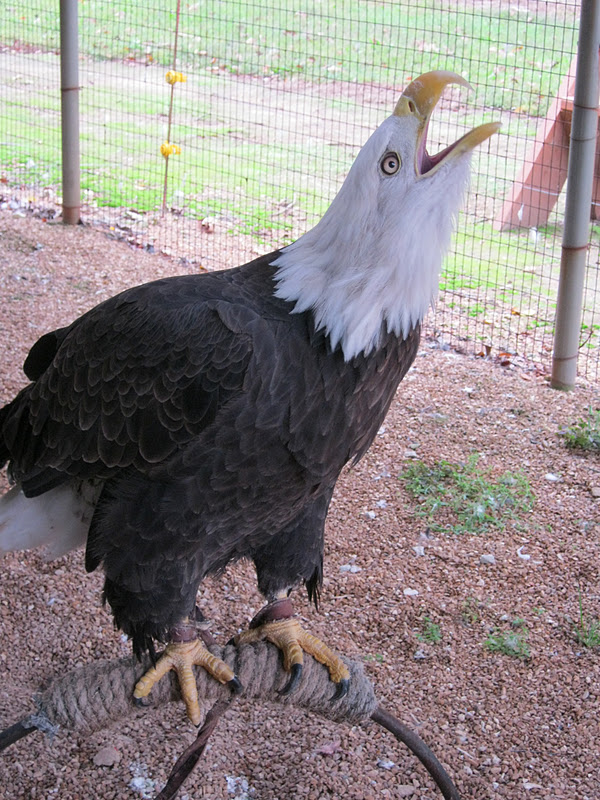
The daily routine starts by checking to make sure all of our birds are okay in the morning.  They usually greet us in their stalls with their signature noises—the peeping of our young Augur Buzzard, the grunting bark of a Tawny Eagle and the shrieking chirp of two Bald Eagles.  The Parrot Room, where all of our parrots are housed, is another level of noise entirely.  The parrots shriek loudly, and we even have to wear hearing protection.  They’re hungry, and they’re not going to let you forget it.  We feed the parrots first, then we take the raptors outside, so they can experience whatever weather happens to be going on that day.

The morning passes in a flurry of food prep.  On a typical day, we have to prepare at least thirty individual bird diets.  Some birds can only get specific types of food (for example, pelicans will only eat fish).  Some of our birds are weight managed, which means they are either performing in shows or learning a new behavior and need to maintain a specific weight: the weight at which they perform best (Goober the Black Vulture and Lenore the White-necked Raven are two such birds).  Other birds can eat whatever they want—we can feed our Bald Eagles rabbit, rat, fish or venison (although Patriot, one of our eagles, doesn’t like to eat fish, which is atypical of a Bald Eagle, really…) 

Here at the ETC we also prepare food for the Display line on the main site. This adds another thirty or so birds for which we must prepare the right diet.  We add a nutritional supplement to the food called Vitahawk.  This gives the birds extra vitamins and nutrients that are necessary for their health.  After the Vitahawk is added, the birds are ready to be fed.

When we walk out into the weathering area with the green tray, all of the birds get excited.  They know what that means: feeding time!  The bird that gets the most excited is Prius, our Gyrfalcon-Peregrine Falcon hybrid.  She chirps constantly, from the moment the weathering area is opened to the instant she gets her food.  Like most falcons, Prius’s favorite food is quail.  As soon as she has the food in her grip, she starts to chow down. 

Other birds are more reserved about eating.  Liberty the bald eagle will sometimes just stare at his fish or his rat, seemingly wondering what he is supposed to do with it.  More often than not, when we leave the weathering area, he has hopped down from his perch and started to eat.  By the time all the birds are fed, all the food is prepared and the kitchen is cleaned, it is time for the humans to have lunch.

After lunch, we have to make sure that all of the birds have a clean place to live and play and sit for the night.  Some of the birds stay in mews inside the ETC, especially those species that are not adapted to live in cold weather (Red-legged Seriema, African Pied Crow, etc.)  We spot clean these enclosures, taking out wet or dirty aspen shavings on a daily basis.  We also replace all of the aspen shavings in the mews regularly.  Sometimes the ravens and crows try to “help”—they attack the broom while we sweep.  Mostly, the birds sit on their perches and give us strange looks.  We also make sure to clean out the raptor room—the place where the raptors that are on anklets and jesses stay during the night.

After we clean up after the birds, we take care of any other maintenance that is needed behind the scenes.  We are a busy group of people down here at the ETC.

Here are just a few of the birds we take care of:
Baton Rouge, King Vulture
Osiris, Egyptian Vulture
Aesop, the baby American Crow, who was just recently christened
Patriot, Bald Eagle
Prius, Gyrfalcon-Peregrine Falcon hybrid

Some of these birds, like Patriot the Bald Eagle, will be rotated up to the Nature Center and Weathering areas from time to time, or will participate in educational programs over the winter.  Others, particularly those who are cold sensitive, will enjoy the heated quarters in the ETC building and will not be on public display until next summer when they will again be traveling to zoos and other entertainment venues.  For right now these birds are enjoying their winter vacation and the ETC staff is gearing up for a very busy winter.

Submitted by Emily Hall, World Bird Sanctuary Naturalist/Trainer

Monday, October 31, 2011

Happy Halloween!

HAPPY HALLOWEEN from our resident creepy crawlies and creatures of the night!

Coal, the Great Horned Owl hopes you have a "hoot" on Halloween

You might not want to wear a mouse costume if you're walking past Moonshine, the Barn Owl

...and, of course Lenore, the African Pied Crow, is here to remind you to keep those candy wrappers picked up

...and of course, what would Halloween be without a bat or two?  Scar, our Straw-colored Fruit Bat can't wait for night to fall...

To all those little goblins, have a Happy Halloween....and be careful out there!

Submitted by Gay Schroer, World Bird Sanctuary Volunteer/Photographer

Saturday, October 29, 2011

Meet Charlie, Our Thick-billed Parrot

Charlie, our Thick-billed Parrot, spends part of her time in our Nature Center greeting guests when they enter. 

Charlie came to World Bird Sanctuary in 2007 from Kaytee Products, Inc. in Chilton, WI.  She was originally rescued by the U.S. Fish and Wildlife Service from a facility where she and three other Thick-billed Parrots were being held illegally.  They were given to Kaytee for safekeeping. 

Charlie and her friends were transferred to World Bird Sanctuary to join the free flying flock of Thick-billed Parrots housed in the large enclosure on our display line.  We chose to keep Charlie for education since she was already trained to step to trainers and mimicked a few words.

Charlie greets the staff at the Nature Center with quite an adorable foot wave, and uses the wave “shamelessly” to get treats.  Thick-billed Parrots are not known as being great mimickers, but Charlie says “Hi” very clearly.  She also makes a kissing sound.
It's hard to resist Charlie's "wave" 
Charlie seems to enjoy hanging by her beak on the sides of the cage until she gets attention; which generally comes from the members of the public that come up to the staff to tell us we have a bird that is stuck.  She is not stuck--just trying to get more attention.  All of our Thick-billed Parrots do this behavior, even the breeding flock.  We do not know how or why this behavior originated, but it certainly works to Charlie’s advantage, since it gets her the attention she likes.  This is an excellent example of how an intelligent animal like a parrot can train its human caregivers.

The Thick-billed Parrot is the only remaining parrot native to the United States.  They weigh in at 11-13 ounces, are 15-17 inches long and can live 35-40 years.  They were once found in Arizona and New Mexico, but are now only found in a small part of Mexico.  The Thick-billed Parrot lives at high elevations in the pine forests year round.  They have been given the nickname of Snow Parrot because they tolerate cold temperatures and snow.  In the wild Thick-billed Parrots eat primarily pine seeds, acorns, juniper berries, conifer buds, agave nectar and insect larvae. 

The Thick-billed Parrot is an Endangered Species with only 500-2,000 individuals left in the wild.  The main threat to the Thick-billed Parrot is habitat loss.  With forests being destroyed Thick-bills have fewer nesting sites.  Biologists are trying to work with local landowners to protect these forests.  They are also trying to use nest boxes to provide nesting sites for these birds.  Currently these efforts are helping to keep the population stable but not increasing.  The second threat to the Thick-bill is just humans.  Thick-bills are very flock oriented and when one bird goes to the ground and gets  caught in a trap, they all go to the ground, putting the entire flock in danger.

Like most of the world’s parrots, the Thick-billed Parrot is a very social parrot living in flocks all the time.  Their call can be heard up to 2 miles away.  They also have a call that can sound like children laughing.  To read more about this rare species and the part it plays at the World Bird Sanctuary Click Here.

Charlie,,as well as all of our other birds, is available for adoption.  To adopt Charlie click here to go to the Parrots Adopt A Bird page on our website, click on Charlie’s photo, then click Add to Cart and follow the directions for payment.  Adoption donations are tax deductible to the full extent of the law.

Your adoption donation will help to feed, house and keep this adorable little character waving for her treats.

Adopt-a-Bird Parents receive:
·      A personal visit with the animal you adopt!!!! Call ahead to schedule a time for your personal visit.
·      Certificate of Adoption.
·      Color photo of the animals you’ve adopted.
·      Sponsorship card.
·      One year’s subscription to Mews News, WBS’s quarterly newsletter.
·      Life history and natural history of the animal.
·      10% discount off WBS merchandise.

Adoption Donation for Charlie - $100.00

Submitted by Cathy Spahn, World Bird Sanctuary Field Studies Coordinator

Thursday, October 27, 2011

Rocks Are Pretty Hard-core

Rocks rock!  But how much do you actually know about them? 

As old as the earth itself, there is much to learn about the many aspects of geology.  World Bird Sanctuary offers a great resource for studying rocks, fossils, gems and minerals all in a handy travel tote.  It’s called a Resource Nest Box and it’s loaded with educational books, games, videos, activities and more.  For a nominal fee of $25.00 you can rent a Resource Nest Box for a two week period through our Education Department.

This particular Resource Nest Box is called “Rocks Rock!”  In this box you will find Q & A cards about geology; guide books to rocks, gems, minerals and fossils; a book offering 50 hands-on activities to explore the earth; a video (VHS) about prehistoric life; over 100 rock and mineral specimens with ID guides; fossil replicas; rubbing plates and ID guides; and more.

WBS offers three additional Resource Nest Boxes, which are a great addition to classroom teachings, for home schoolers, day cares, scout leaders or for kids that just want to have fun and learn about our great planet and the creatures that we share it with.  Other topics include: Talon Tote; Protect Our Planet; and Where We Live.

If you’d like to reserve one of our educational and environmentally friendly Resource Nest Boxes, please call our Education Department at 636-225-4390 ext. 0.

Submitted by Billie Baumann, World Bird Sanctuary Outreach Coordinator

Tuesday, October 25, 2011

Free Birdfeeding Seminar

Attend a FREE Birdfeeding Seminar at WBS!

Winters can be long and hard for our feathered friends.  There are many ways that you can help to make it a little easier on them.

Join World Bird Sanctuary, Wild Delight® and Droll Yankees® to learn all you need to know about backyard birdfeeding at a free 1-hour long seminar on Sunday, November 6th, 2011. 


Expert tips on how to help birds through the winter
·      Learn which seed mixes to use to attract different bird species to your bird feeder.
·      Learn where to place your birdfeeder as well as other tips on how to make your yard attractive to birds.
·      Wild Delight® bird seed and Droll Yankees® birdfeeder giveaways at each of the 5 seminars!

Admission on a first-come, first-in basis, so get here early!
There will be five sessions, each 1 hour long.
Each session seats a maximum of 30 attendees.

Session times:
11 am
12 pm
1 pm
2 pm
3 pm

World Bird Sanctuary's birdfeeding seminars are sponsored by:


Sunday, October 23, 2011

Creatures of Halloween Filling Fast

Last chance to make your reservations for our Creatures of Halloween program!

We only do this program one time a year.   Reservations are filling fast—don’t miss out!

Don’t miss out on this once a year opportunity to have your spine tingled, your hair stood on end, your goosebumps raised!

Bring your little ghouls and goblins in costume to meet our resident ghoul and our creatures that are so much a part of the Halloween tradition. 

Come join us for a “spooktacular” good time.  The creepiness begins at 7 pm sharp on Friday, October 28, inside our Nature Center.

To make your reservations call 636-225-4390, Ext. 0.

Program Date:  Friday, 10/28
Program Fee:  $9.00 for adults, $7.00 for children
Program Time:  7 pm to 8 pm

Reservations required.  

For directions to our facility Click Here.

For the safety of our animals and our other guests, no pets please.

Friday, October 21, 2011

Tree Frogs

I was first introduced to the World Bird Sanctuary by a friend in 2009, and quickly decided that I wanted to volunteer at this amazing facility.  

After volunteering for over a year I was offered the opportunity to become a full time seasonal employee.  After working here as a full time seasonal employee I am often treated like an “old timer,” with the new volunteers coming to me with their questions. 
The Bird-voiced Tree Frog, Hyla_avivoca 
Very often when working outside we will come across small creatures like frogs and snakes. Recently an intern came to me for help identifying a very small frog he thought was a Bird-voiced Tree Frog (Hyla avivoca).  Its characteristics are smooth skin, large toe pads, light spots under the eyes and greenish to yellowish patches in groin and inner thigh. These characteristics are very similar to the Gray Tree Frog.  The Bird-voiced Tree Frog is considered threatened in Illinois (the northernmost portion of its range) due to the clearing and draining of bald cypress-tupelo swamps. The Bird-voiced Tree Frog’s main habitat is the bald cypress-tupelo swamps and nearby wet hardwood forests. This small frog can change color from dark gray to light green depending on background, temperature and moisture. The diet of an adult Bird-voiced Tree Frog includes small arboreal insects and spiders.
 The Gray Tree Frog, Hyla_versicolor
Unfortunately the intern’s find was not a Bird-voiced Tree Frog.  It would have been cool to know we have a threatened species on our property.  However, the species that he had found was the Gray Tree Frog (Hyla versicolor complex)—a common species.  The Gray Tree Frog also has large toe pads, but has a pale spot under the eye and orange or golden yellowish patches in the groin area and inner thigh. This frog is slightly larger then the Bird Voice Tree Frog. 

The habitat of a Gray Tree Frog is the trunks and branches of trees.  A recently transformed (from tadpole to frog) juvenile is bright green. The adults generally mate in woodland puddles, roadside ditches, or other temporary bodies of water. These frogs may change color from dark gray to light green depending on background and temperature. The diet consists of small spiders and insects. Feeding adults and juveniles are often found near house lights and windows where insects accumulate.
Photo showing the golden yellow patches in the groin area 
The IUCN status of the Gray Tree Frog is least concern. The International Union for Conservation of Nature and Natural Resources (IUCN) is an international organization dedicated to finding "pragmatic solutions to our most pressing environment and development challenges."   The organization publishes the IUCN Red List, compiling information from a network of conservation organizations to rate which species are most endangered

Although this intern was slightly upset to learn he had only found a common tree frog, he will most likely continue to look for creatures like this as he gets the outside chores of World Bird Sanctuary’s Education Training Center done, and further his knowledge (and mine) in the process.

Submitted by Jaimie Sansoucie, World Bird Sanctuary Seasonal Staff Member

Wednesday, October 19, 2011

Joplin Tornado


In mid-September WBS volunteer Linda Tossing and I were very excited to present  live bird programs to the school children and teachers of Joplin, Missouri.
All the schools in Joplin, Missouri, have the Bald Eagle as a mascot
The schools that were selected by Christie Barnhart of Missouri American Water, who sponsored the programs, were chosen because they were the schools that were destroyed by the tornado.  Some children were going to school in completely different buildings located in malls and industrial parks.  Some of the schools were renovated in record time. 

The F5 tornado that hit on Sunday, May 22, 2011, devastated a 2 mile wide by 12 mile wide swath of this Midwestern town.  We could see remnants of parking areas, driveways, rubble and debris.  No standing structures were visible in the center of where the town was previously located.

The School Superintendent decided within 2 days after the tornado that the kids would all have places to go to school by the start of the new school year.  People pulled out all the stops to repair salvageable schools, and find other places for the kids whose buildings had been damaged beyond repair to go to school .
 Michael Zieloski and Tobin, a European Barn Owl with a principal and children from one of the Joplin schools
The principal pictured in the above photo with some of her school children, showed me a video from her phone from the night of the tornado.  She stood at her school facing what used to be the front of the school and shot video of the devastating scene.  She then slowly scanned the video in a complete circle.  The damage was unbelievable!  The principals of the damaged schools knew that great challenges faced them.  These dedicated principals took virtually no time off all summer long to help get their schools reconstructed or completely moved to other buildings in Joplin.  Incredibly all was ready by this Fall.

Every school in Joplin has the Eagle as its Mascot.  I took pictures of the Logos/Mascots at two of the schools--Mckinley and Duchesne. 

We at WBS, in conjunction with Christie Barnhart of Missouri American Water, decided that all of the displaced elementary schools' children deserved to see a live Bald Eagle up close in their schools.  So we brought Liberty to each of the schools we visited.  We also brought a few other birds to share.  Newspaper reporters and TV reporters showed up at some of the schools to feature the birds and the school kids.

At night while we watched the news in Joplin, there were still stories every day about the tornado damage and recovery efforts.  Five families were still living in the Drury Inn. The families checked in on the night of the tornado or shortly thereafter. 

Many workers involved in the recovery and rebuilding effort were booking rooms at the Drury for two weeks at a time. There were bulldozer people, AT&T workers from Texas, Insurance Agents all still very active in rebuilding Joplin.

We brought an Eagle and other birds to the schools to help the kids have fun, learn, and take their minds off of some of their problems with the hope that we were helping rebuild peoples' spirits.

Submitted by Mike Zieloski, World Bird Sanctuary Naturalist

Monday, October 17, 2011

Camera Day - Just Around The Corner


Fall Camera Day is almost here!

You're invited to join us for our Fall Camera Day on Sunday, November 6th, where you can take photographs of our birds posed in natural settings and while they fly.


WHAT YOU NEED TO KNOW
Bring your family and cameras to see and photograph our magnificent birds in natural settings.

Image: Camera Day

Date: Sunday, November 6th
Time: 10am - 2pm
Admission: FREE for WBS Friends and Adopt a Bird Parents.  You can enroll as a WBS Friend from as little as $35 per year on the day.

Bring your family!  Bring your friends!  Bring your camera!  Bring your picnic!  And join us outside for a fun family day!

Saturday, October 15, 2011

2011: International Year of Forests Fun, Easy Outdoor Activities for Kids

Hurry!  Before winter arrives!  

Get your kids outside for some fun, easy activities that will get them better acquainted with the forest.   These would also be excellent activities for Boy Scouts and Girl Scouts—or for a teacher to do with his or her class.

Take them on a micro-hike!  They’ll discover the tiny world that lies just beneath their feet.  Be prepared for their hands and knees to get dirty!  This activity can be done in the forest or right in your backyard.  You’ll need: 20-30 feet of string for each child, magnifying glasses, pens, journal paper, plant and insect field guides (optional).  Have the kids each stretch their string across an area--it doesn’t have to be straight.  It can run along fallen logs, over stumps, around tree trunks or rocks, through a shallow creek, or along it.  Now they can get down on their hands and knees, starting at one end of the string, and slowly move along the string, examining everything in its path with a magnifying glass. Be careful with the magnifying glasses.  Especially on sunny days the magnifying glasses can intensify sun light to the point where fires can be started.

Have them look for different types of plants, including mosses and fallen leaves.  Look for fungi and lichens of different forms.  If they move any fallen leaves, rocks, logs, or fallen branches, be sure to tell them to do it gently and to return them where they found them.  They are sure to find insects and other invertebrates.  When they’re done, they can write down what they’ve seen, and compare with each other.  They can also take turns showing each other the things they found to be most interesting on their hike.

Smell some leaves!  On your next walk or hike through the forest, have the kids help you collect some leaves from trees (don’t forget evergreen trees!), shrubs, small plants and grasses.  When you arrive home, have them gather at the table and prepare for leaf sniffing time!  If you have a tree or plant field guide, see if they can identify some of them or at least separate them into different categories.  Then one at a time, rub a leaf in your hand and have them each smell it.  Let them each write down or say out loud what they think it smells like.  Some leaves smell musty, others smell sweet, spicy, fresh or sharp.  If the leaf is from a black birch tree, when crushed it will smell like root beer!  Sassafras crushed leaves are said to have a “pleasing medicinal scent,” whereas black walnut leaves have a spicy scent.

What Lives in a Tree?  To find out you’ll need: a tree with an easy to reach branch, a white bed sheet, and a magnifying glass.  Once you’ve found a tree, have two people stretch the white sheet under the tree branch, getting as close to the branch as possible.  Shake the branch vigorously for about one minute.  Lay the sheet on the ground and have the kids observe what has fallen.  Did the tree drop any seeds, nuts or fruits?  Help them to identify some of the insects using a field guide.  There may also be spiders and caterpillars! 

Next try this again with a different tree.  Are there differences in what is found among deciduous and coniferous trees?  Explain that to be deciduous, the tree or shrub has leaves that change color in the autumn and are dropped before the winter (depending on where you live).  Most coniferous trees and shrubs have long, thin, needle-like leaves.  Most keep these year round and are often called evergreen. 

The World Bird Sanctuary has several trails through our oak-hickory forest where we invite you to try these fun activities with your kids and their friends!

Submitted by Sara Oliver, World Bird Sanctuary Naturalist

Thursday, October 13, 2011

Open House...This Weekend!

Don't forget the World Bird Sanctuary Open House this weekend October 15 & 16!

FREE ADMISSION…FREE PARKING….FREE ENTERTAINMENT

One of our free flying Barn Owls swoop just over the heads of audience members
What better way to spend a beautiful Fall weekend than enjoying a day of fun and entertainment in the outdoors?

Activities include, but are not limited to:

•            Free flight performances by our stars, the birds throughout the day

•            Musical performances by our in house band, The Raptor Project at 3:30 pm each day

•            Opportunities to take close-up photos of our birds and other animals

*            Face Painting for a small fee

*            Meet our newest residents—Dorothy the Andean Condor and Thor the Stellar’s Sea     Eagle

•            See our “behind the scenes” areas – only open to the public during Open House

•            Opportunity for the kids to make a craft

•            Take part in a scavenger hunt

•            Sing-Alongs
Youngsters listen with bated breath to our storyteller, Shirley Ritsema
•            Story Telling sessions

•            For a nominal fee have your photo taken HOLDING a Eurasian Eagle Owl—the largest owl species in the world
Guests have the rare opportunity to have their photo taken holding Xena, the Eurasian Eagle Owl
•            Meet our Naturalists who will gladly answer any questions from guests

•            Refreshments and snacks available for purchase

•            Browse our gift shop

•             Our "Wishlist Donation Station" will be open for any guests who would like to support the World Bird Sanctuary by donating items from our wishlist

DATES:            SATURDAY, 10/15 & SUNDAY 10/16
TIME:               10 am – 4 pm
LOCATION:     125 Bald Eagle Ridge Road, Valley Park, MO

For directions to the World Bird Sanctuary Click Here 

For the safety of our animals and our other guests, no pets please.