Friday, July 5, 2013

Cousteau - The Regal Eagle


If you love eagles, then you are reading the right blog!  In this one I will discuss a very special eagle that I have come to know since I have been working at the World Bird Sanctuary.  His name is Cousteau and he is a White Tailed Sea Eagle (Haliaeetus albicilla).
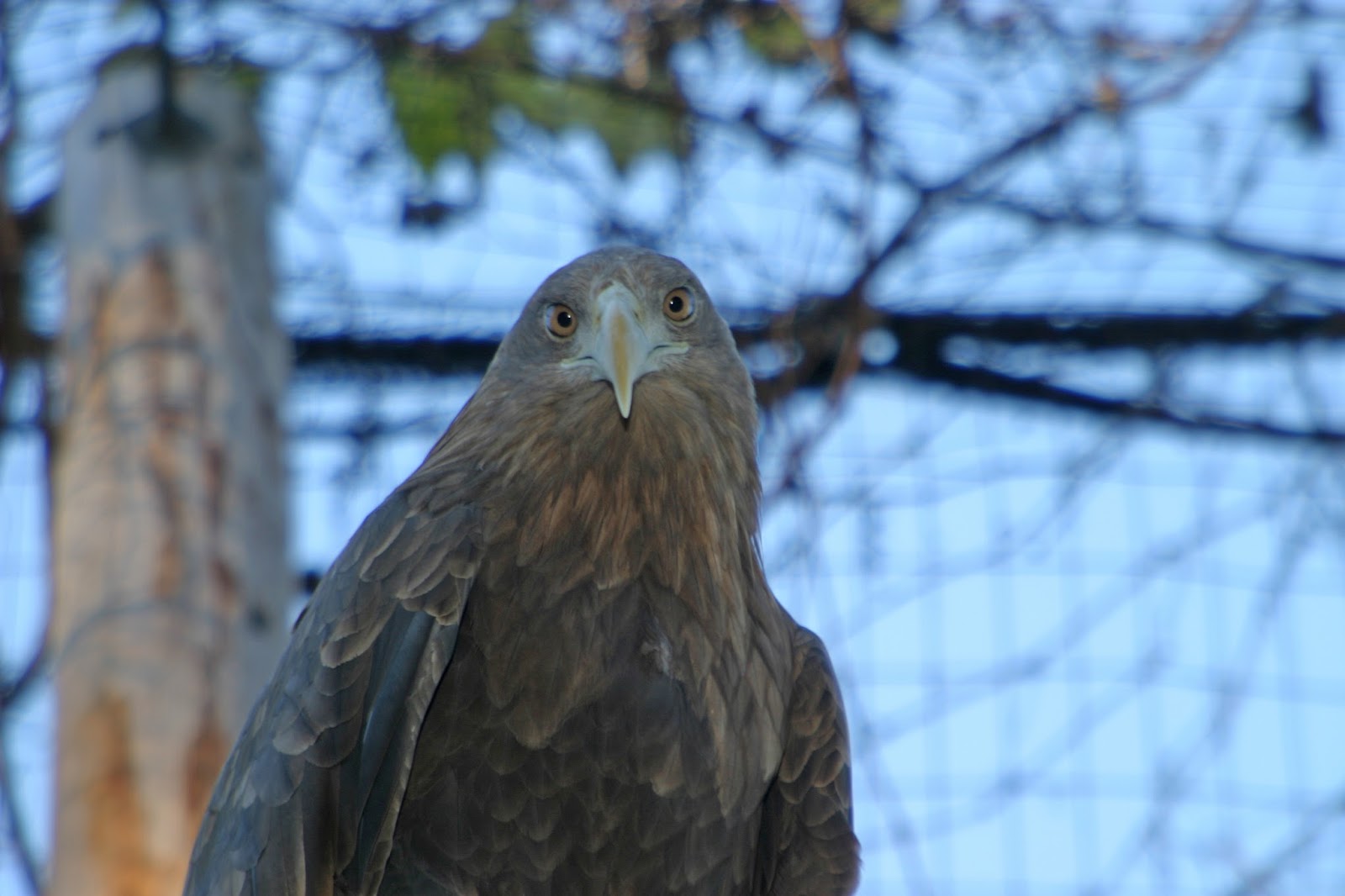
Meet Cousteau, a White-tailed Sea Eagle

These impressive eagles can be found in small areas of Europe and northern areas of Asia.  Even though they do not have any natural predators, human activity, such as poisoning, stealing eggs, loss of habitat, and decreased food sources has forced them to become protected by organizations such as the Mull Eagle Watch in Scotland and the International Migratory Bird Act.

Adult and juvenile White Tailed Sea Eagles are visually dimorphic.  This simply means that as the juvenile ages, its plumage (feather color) changes.  Juveniles have very dark brown plumage and adults have lighter brown plumage with a completely white tail.  This process takes from 5-6 years to complete. 

As with most birds of prey, the females are about a third larger than the males. White Tailed Sea Eagles weigh from 9-12 pounds and are 27-36 inches in length.  Their wingspan is the same as the Bald Eagle’s--6-8 feet wide.

After the White Tailed Sea Eagle has become an adult, it will search for a mate.  Females normally lay 1-2 eggs, sometimes 3 eggs per clutch (a group of eggs or chicks) in a nest in a tree.  The chicks will fledge (leave the nest) at 13-14 weeks of age, but still continue to stick around the parents begging for food even though they can manage on their own.  Their diet consists mainly of fish, but will also include mammals, reptiles, birds, and carrion (dead animals).

In this photo you can see the white tail from which this species takes its name 

Cousteau was hatched in captivity at the Kansas City Zoo on April 1st, 1997, making him 16 years old this year.  The lifespan for these eagles ranges from 20-25 years in the wild, but in captivity they can reach 40-50 years old.  There are a small handful of reasons why their lifespan is longer in captivity than in the wild.  These include protection from predators, available food on a daily basis, medical attention availability if necessary, and full or partial shelter from the elements.

Cousteau has lived at the Mesker Park Zoo in Evansville, IN and the Greater Baton Rouge Zoo in Louisiana before coming to the World Bird Sanctuary in 1998.  From the spring of 1999 to the end of the show season in 2001, he was part of WBS’s educational bird show at Busch Gardens in Williamsburg, VA.  Since then, he has been on display on our exhibit line.  When I or someone else he recognizes walks by his exhibit, he vocalizes and follows me/them down the exhibit line.  He is a very interesting bird with fascinating behavior!

Cousteau is available for adoption in our Adopt a Bird program.  To find out more information, call 636-861-3225.  All adoption donations are tax deductible. 

This summer Cousteau can be seen on the exhibit line at the World Bird Sanctuary, which is open daily from 8am-5pm.  Cousteau is definitely a regal eagle.  You should stop on by and visit him!

Submitted by Lisbeth Hodges, World Bird Sanctuary Naturalist 

Wednesday, July 3, 2013

Bagging More Birds At WBS


For 2013, a record number of migrating birds were banded at the World Bird Sanctuary from April 21 through May 14.  Fifty-eight different species were captured, and 675 birds were encountered in all.   This was up from an average of 300 in recent years.
This Tennessee Warbler is one of the more commonly caught birds.  Photo by team member Colleen Crank
The most commonly caught were Tennessee Warblers (117), Nashville Warblers (106), and White-Throated Sparrows (101).  
 Brewster's Warbler photographed by Banding Team member Valerie Geile

Special birds caught the spring of 2013 include Brewster’s, Golden-winged, Blue-winged, Myrtle, and Chestnut-sided Warblers. 
Kentucky Warbler photographed by WBS Banding Team member Linda Tossing
WBS Banders set up 23 difficult to see mist nets in a wooded ravine to catch the birds.  After being identified, measured, assessed, and banded the birds were released.  The statistics collected were submitted to a database under the auspices of the federal Bird Banding Laboratory, which is part of the United States Geological Survey.  The USGS issues permits to qualifying banding organizations that place uniquely numbered bands on captured birds.
Male Rose Breasted Grosbeak photographed by Linda Tossing
The number on its band indicated that one Nashville Warbler captured this year at the World Bird Sanctuary was previously banded last fall in New York State.  Generally birds follow one of four migration routes from their wintering grounds in South and Central America to their nesting territories in the northern United States and Canada.  The birds fly over the east coast, up the Mississippi, across the plains, or along the west coast.  At times weather conditions may cause birds to detour from their normal route.
Western Palm Warbler photographed by Becky Welter
 The data accumulated from this study is useful to monitor population growth or decline, life spans, migration paths, and survival rates.  Analysis of banding data can also play a major role in monitoring the status of species of concern and threatened or endangered species.  Changes in habitats for bird species may be reflected in capture numbers. Banding is thus an important tool to further the understanding of bird populations.   

Birds have been banded for centuries. The first record of a banded bird being recaptured was when one of Henry IV's banded Peregrine Falcons was lost in France about 1595. It showed up 24 hours later in Malta, about 1350 miles away, averaging 56 miles an hour!  Duke Ferdinand placed a band on a Grey Heron in 1669.  This bird was recovered by his grandson in 1728, indicating the heron lived at least 60 years. 

The first records of banding in North America are those of John James Audubon, the famous American naturalist and painter. In 1803 he tied silver cords to the legs of Eastern Phoebes near Philadelphia.  When they returned to the area the following year he was able to identify two of the of the previous year’s nestlings.
Yellow-breasted Chat photographed by Becky Welter
Bird banders at the World Bird Sanctuary are dedicated to monitoring bird numbers in the St. Louis area.  They not only band daily during spring migration, but they also band weekly throughout the summer and fall.  Saw Whet Owls are captured during special nightly sessions in October. 

If you are interested in observing the capture and banding process, public demonstrations are conducted every first and third Thursday of June, July, and August near the hospital at the World Bird Sanctuary, located off the intersection of highways 44 and 141, near Valley Park, MO.  For more information visit worldbirdsanctuary.org.

Submitted by Mary Elise Sampson, World Bird Sanctuary Bird Banding Team Member

Monday, July 1, 2013

Birds in Concert Coming Soon


Get ready to rock with the raptors and “The Raptor Project” every Thursday night in August at 7 pm.  Where else but WBS could you enjoy free family entertainment that includes not only a concert, but live birds of prey and other animals?

Every performance features WBS’ in house band “The Raptor Project” which is made up of staff members and faithful volunteers.  They will be playing songs from both of their popular children’s albums “Save the Future” and their latest release “All Along the Watershed”.  Sing along with us to favorites such as "Turkey Named Fred", "Roadkill Shiver," "What's the Matter," "The Greatest Possum," and "Animal Noises."

The band has already begun rehearsing, and is working on a couple of new songs!  Their environmentally friendly and educational tunes have been written primarily by our own staff members, Joe Hoffmann and Roger Holloway, both of whom run our Wildlife Hospital.

Most concerts will have special guest artists that you won’t want to miss.  Every concert will feature live birds of prey that will fly just inches over your head.  You may see a bird parade, a snake parade, a bald eagle or even a dancing Dodo bird.  During some of our songs kids will be invited on stage to shake a tail feather.

All performances begin at 7:00 pm.  The concert schedule is as follows:

August 1 – Babaloo followed by The Raptor Project
August 8 – The Raptor Project performs songs from their CD’s “All Along the Watershed” and “Save the Future”
August 15 – The Raptor Project followed by The Reserve, featuring Javier Mendoza & Jim Peters
August 22 – The Raptor Project followed by Fowl Play
August 29 – The Raptor Project followed by The Rebounds

If you have never heard “The Raptor Project’s” music before, or want to learn our songs so you can sing along, check out our new Artist page on ReverbNation and Become A Fan.
You can listen to several of our songs, see band photos and follow our concert schedule.

If you are on Facebook, be sure to Like our page and then check out our Band Page.

Visit our website for more information.

Birds in Concert is Sponsored by Ameren Missouri

Saturday, June 29, 2013

Thief In The Night


Thievery is not a behavior confined solely to the human race.

Thievery has existed for eons in the animal kingdom.  Take, for example, a Jackal slinking in to steal a morsel from a lion kill; one Bald Eagle attempting to snatch a Salmon from the talons of another of its own species; the packrat who steals into a campsite in the middle of the night to appropriate various items from unsuspecting campers; or a squirrel raiding a feeder clearly put out for the birds.
This Bluejay is one of the birds commonly accused of thievery, since they are known to raid the nests of other birds for eggs and young chicks.

For the past several years this last scenario is one that has baffled my husband and me at our Lake Cabin.  We have been plagued at various times by raids on the feeders, the culprits being Raccoons, Squirrels and Chipmunks. 

For the most part my husband has found various ways to thwart the thieves.  However, one feeder has continued to be a mystery.  At dusk there would still be about a fourth of a tube of seed left in the feeder, but in the morning it would be empty.

Originally this feeder was hung high off the ground in a tree about 8-10 feet from our deck, and we could only reach it to fill it by pulling it in with a small string too flimsy to support a squirrel.  We had had enough squirrel raids to know that any feeder needed to be in a squirrel-proof cage.  We finally found one that would keep most adult squirrels at bay--although very young, small squirrels could occasionally get into it.  This problem always solves itself, since they quickly grow to be too large to get through the bars.  Problem solved—we thought!
This thief, the common Grey Squirrel, will soon find that he can't squeeze between the wires of this feeder.

We soon found that we may have thwarted one thief, only to come up against another.  Apparently the local Raccoons had discovered this feeder.  Not to be thwarted by the cage enclosure they would simply jump onto it, dislodging it from the only available branch we could hang it from, and then ride it down the thirteen feet to the ground, spilling the seed everywhere.  Not to be defeated by the Raccoon version of a Six Flags Ride, my ever-resourceful husband went back to the drawing board!

Soon he came up with a Fisherman’s version of a feeder pole.  He made a fishing rod holder out of some PVC pipe fittings, and triumphantly installed a fishing rod out over the thirteen foot void off of our deck.  A fishing rod??  How did this solve the problem you might ask?  With a hot pepper suet feeder hanging from one ferrule and the much battered seed feeder hanging from another ferrule, we were now in business trolling for birds.  The squirrels couldn’t get into the feeder, no matter how many times they navigated the fishing rod, only to find to their chagrin that they could not fit between the cage bars surrounding the feeder; and the Raccoons couldn’t navigate the rod since it was too narrow and flimsy to support their weight.  Problem solved—right??
This Red Breasted Woodpecker doesn't care that the suet contains hot peppers, but the squirrels won't touch it once they've tried it one time

Well, problem solved for a while--at least until the birdseed again began to disappear between dusk and daybreak.  The finger of suspicion now began to point to the local Chipmunk population.  However, there was no evidence to confirm this “beyond a reasonable doubt.” 

Then one night it happened.  My husband had been sitting on the deck enjoying a beautiful Lake sunset, and had lingered a bit after dark, when he heard an unmistakable “clank” from the direction of the mystery feeder.   My husband grabbed a flashlight, sure that he was about to catch a Chipmunk in the act.  But, lo and behold, the critter in the spotlight was no thieving Chipmunk—it was a Flying Squirrel!

In all the years we’ve been going to the Lake of the Ozarks this was the first time encountering one of these nocturnal little creatures.  According to the Missouri Department of Conservation’s web page these small rodents, who really are in the squirrel family, are fairly common in a healthy ecosystem. 

Common or not—they are rarely seen by most people.  Last week we took our granddaughter with us to the Lake for a few days.  We were sitting on the deck after dark listening to the night sounds of the tree frogs, when our sharp eyed granddaughter excitedly exclaimed that something had scurried across the deck railing right under our noses, unseen by my husband and me.  Sure enough, it was the night thief--our resident Southern Flying Squirrel--sitting in the birdfeeder frantically stuffing itself with the remaining birdseed from the day. 

We were so taken by this stealthy little night creature that for now we have decided to share the day’s remaining birdseed with him and his brethren.  After all, how often do you get to share a true mystery with your grandchildren?

Submitted by Gay Schroer, World Bird Sanctuary Volunteer/Photographer  


Thursday, June 27, 2013

Amazing Animal Encounters


Visit World Bird Sanctuary this summer and experience Amazing Animal Encounters!

Ameren Missouri brings you free, family-friendly, fun and education Amazing Animal Encounters at World Bird Sanctuary, all summer long!
Meet Rustle the Armadillo
Free, fun, family-friendly environmental education programs are presented by our naturalists, using snakes, parrots, birds and mammals to teach you about the amazing creatures that share our planet, and what we can do to help them survive.

Dates: Every Saturday and Sunday from Memorial Day to Labor Day
Time: Saturdays at 11.30am and 2.00pm; Sundays 1.30pm. 
Admission: Admission and parking is FREE.  No reservations required.

Sponsored by Ameren Missouri 

Tuesday, June 25, 2013

Introduction to WBS


Growing up, I regrettably admit, I didn’t know much about birds. I knew the area’s common birds: Robins, Blue Jays, Cardinals, and Crows…or what I thought were Crows.  I later learned they were Grackles.  I must have assumed the big black birds, the actual crows, were Ravens.  It’s all so embarrassing now.
"I knew the most about Bluejays..."
I knew the most about Blue Jays, after having written an essay on Blue Jays in elementary school.  And though I was absolutely wowed with what I learned about Blue Jays, it didn’t register with me that there is a whole wide world of birds to learn about.
Most people don't realize that bats are mammals--not birds
Hawks, bats, owls, vultures…those were the creatures of countless Halloween stories.  The first time I had ever seen a real bat, I was probably close to 16 years old, and I was staying with relatives near Ste. Genevieve.  A small group of bats fluttered above my cousins and me as one night we laid ourselves out on their trampoline talking about whatever it is kids talk about.  I was captivated by these creatures as they swirled above us, and thought it to be the coolest thing ever.  But still, it didn’t register with me that there is a whole wide world of birds (and in this case, birdlike mammals) to learn about.

Around 2003, my husband became aware of the World Bird Sanctuary while attending a postal convention through his former employer.  WBS’ founder, Walter Crawford, Jr. and a volunteer were there with Tobin, a WBS Barn Owl.  They discussed WBS’ history and mission, and they flew Tobin, whose wing brushed my husband’s head as it flew by.
Upon meeting Tobin my husband was "hooked"
From the time my husband and I began dating in 1999 I have learned more and more about birds.  He grew up learning about them and is an official “bird nerd.”  Each time he sees a bird he’ll call it out, and finally, I began to fully realize there is a whole wide world filled with amazing and beautiful birds to learn about.  Since his passion for birds had quickly spread to me, when he came home from work the day Tobin’s wing brushed his head I was immediately…well…jealous…and I had to see this owl.  We made plans to visit WBS that weekend.

Upon arrival, I was in awe of the Sanctuary.  Tucked away in the middle of a hardwood forest, I could not envision a more perfect backdrop.  Oak and Hickory trees surround the sanctuary; an assortment of wild birds from Woodpeckers to Brown-headed Cowbirds to Nuthatches to Chickadees, Mourning Doves, and Titmice flitter about from feeder to feeder; in the distance, the Meramec river flows.
Who would guess that this little piece of wilderness is so close to St. Louis?
Further in is the raptor exhibit and just beyond that, the outdoor exhibit, where most of the birds are kept for viewing.  It is here where, for the very first time, I had seen, “in real life,” all the creatures of countless Halloween stories.  The feeling was almost indescribable.  To see these birds in pictures or on the TV screen is one thing, but to see them, to hear them, up close, to watch them move and take in all their fine details is, in the most literal sense, awesome.  It was here, that I truly and fully fell in love with not only birds of prey but also the World Bird Sanctuary.
To see the Bald Eagles up close is awesome
In the way the staff and volunteers interact with WBS’ animals it is clear to see that caring for these creatures is not just their job, but their passion--a passion that extends far beyond themselves and reaches out to each and every WBS visitor.
It’s in the way they interact with the animals, the way they so willingly share their knowledge and experience - it is born from a true desire to care for, protect, and preserve these vital birds.

I feel fortunate to live close to such a wonderful organization that not only focuses on the preservation and rehabilitation of birds of prey but also on educating the public on the importance of these birds and their ecological roles.  I am so grateful for the opportunity WBS provides my kids to learn about birds of prey, and learn what they can do to help make sure these animals thrive.

The amount of bird knowledge I have amassed in the years my husband, kids, and I have visited the World Bird Sanctuary, I guarantee, I would not have learned otherwise.  Through WBS’ programs - World Eagle Day, Baturday, International Migratory Bird Day, International Vulture Awareness Day, Fall Open House, Owl Prowls, and various concerts and trails days - the staff, and volunteers, I have learned enough (but there’s definitely more to learn!) to proudly, finally, call myself a true “bird nerd”.

Submitted by Sara Borgard, Guest Writer


Sunday, June 23, 2013

Rooftop Garden Oasis


World Bird Sanctuary visits St. Louis Children's Hospital a couple of times per year, thanks to Horticulturalist Gary Wangler.

Gary standing in his beautiful creation
Gary Wangler is the Staff Horticulturalist for Children's Hospital. He and his staff of gardeners have the most beautiful garden on the roof of part of the 8th floor at Children's Hospital. This garden is a magical place with growing trees, flowers and sculptures that will take your breath away. The garden, complete with a walking path and benches, has a view into Forest Park, St. Louis’s city park. This visual delight is just outside the kids’ playroom on the 8th floor.  Families can go out there to relax and look at the view, and admire the plants or the whimsical sculptures.

Colorful birdhouses adorn the fence surrounding the garden
Twice a year the World Bird Sanctuary is asked to bring animal biofacts like feathers, claws and eggs.  We share stories with the young patients.  Sometimes one of the parents just needs a break and pops in to ask questions about birds or tell us of one of the amazing animal encounters they have had.  Other times I have had a great conversation with a sibling who is not sick, but is interested in wildlife or birds.
I have been lucky enough to be the World Bird Sanctuary representative to go for these twice a year visits many times.  With every visit I feel better about sharing my knowledge or my passion for birds or compassion for fellow humans who need a change of pace.
 One of the whimsical sculptures that adorns the rooftop garden
Gary Wangler is a super guy, who enjoys making the hospital a bright place with wonderful plants and interactive sculptures.  He and Walter Crawford, our Executive Director at World Bird Sanctuary, have known each other for many years from working side by side at the St. Louis Zoo.  Gary always asks how Walt is doing and I always give him the latest update on Walt's travels or programs.

Gary's rooftop garden is a very special place for patients and families of St. Louis Children's Hospital.  World Bird Sanctuary is lucky to be able to go there a couple of times each year to share our passion about birds with these families.
Thank you Gary for inviting us to be part of something very special.

Story and photos submitted by Michael Zeloski
World Bird Sanctuary Director of Education

Friday, June 21, 2013

Duncan The Magnificent


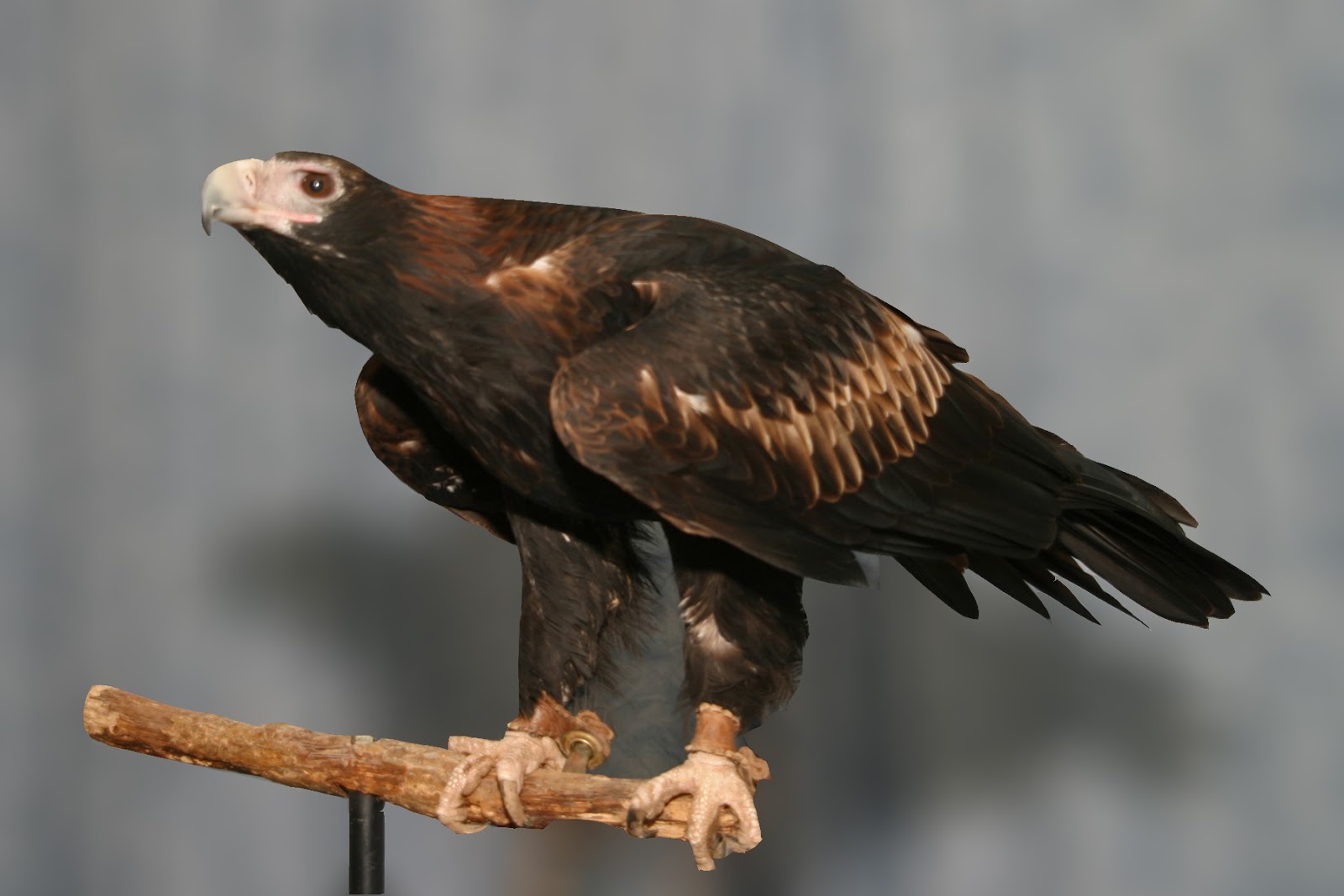
Duncan, our 26-year-old Wedge-tailed eagle, recently came out of retirement to wow audiences at WBS’s educational bird shows at Stone Zoo near Boston, MA.

Meet Duncan, WBS's Wedge-tailed Eagle
The last time this bird flew in our education programs was in 1994. This summer she is back and flying at our zoo program at Stone Zoo in Boston, MA, and doing quite well. At first I was unsure of how this would go, but I was very excited to have this opportunity to, basically, retrain this bird.

Training birds, and any animal I would assume, is very challenging. The first thing that we have to figure out is the “working weight” of the bird. The working weight is the weight we keep them at during their flying season (6 months of flying 6 months off), and this is a weight at which they’re food motivated (in other words, a weight at which they want food, but they’re not starving). The working weight is heavier than they would be naturally in the wild, but lighter than they would be if they were offered as much food as they wanted without working for it. In order to find that magic number it takes observation. Too light and your bird gets aggressive, too heavy and your bird won’t fly. Once you find this magic number you then have to do a lot of practicing and getting the bird back in shape because just like us, birds also get out of shape. We usually take about a month and a half to two months to get all the birds back in shape.

Photo courtesy of Alex Navarro, Educational Specialist, Stone Zoo
Once that training period has gone by its then time for shows to start.  This is when you learn even more about your bird. You have to get them used to seeing people in the theater, because during show practice time you practice in an empty theater. If the bird is new to flying for an audience you have to slowly build up from just a few people to more and larger crowds. You quickly learn all the strange things that individual birds may not like.  I’ve worked with birds that don’t like the strangest things, like big necklaces or strollers, or crutches. A very few don’t like sunglasses, perhaps because they can see themselves in them—or that’s what we think at least.

Photo courtesy of Alex Navarro, Educational Specialist, Stone Zoo
After learning the quirks of individual birds and doing our best to keep that object away from them, you then have to regularly deal with uncontrollable factors, like wind.  Very windy conditions may sometimes blow a free flying bird off course, but with the right flight muscle conditioning (in other words, lots of practice), our birds fly very well when the wind is blowing.

Photo courtesy of Alex Navarro, Educational Specialist, Stone Zoo
After taking all these factors into consideration, and even if you do everything right, sometimes the unexpected still happens--they are live animals after all.  Most times, though, things work out perfectly, and you get what I would imagine to be a “proud parent” moment the first time your bird does the exact behavior you’ve been training. Then, when the behavior you’re asking of your bird becomes consistent, that is one of the best feelings a trainer can have.

Photo courtesy of Alex Navarro, Educational Specialist, Stone Zoo
All of this is what my staff and I have dealt with while getting Duncan back into the swing of things.  And finally, after tons of practice and hard work, she is doing very well and flying for all our audiences at Stone Zoo. We are all very proud of this magnificent bird.

Submitted by Jaimie Sansoucie, World Bird Sanctuary Naturalist/Trainer

Wednesday, June 19, 2013

Don't Miss Your Chance


World Bird Sanctuary will be hosting its hugely popular Avian Training Workshop October 31-November 3, 2013.

If you've considered attending the World Bird Sanctuary Avian Training Workshop in the past but couldn’t work it into your schedule, now is your chance to plan ahead.   There's still plenty of time to arrange your schedule and take advantage of the early registration bonus!  Save $100 by registering before October 1st!

The classroom section covers a multitude of subjects

What is an Avian Training Workshop you may ask?  

The WBS Avian Training Workshop is an intensive 4-day workshop, which covers all aspects of housing, training, feeding and caring for raptors, parrots, corvids and many other species.  The workshop includes both classroom and hands-on training.

Subjects covered in the classroom section include:  
*  Establishing your own program--permits, insurance, facilities, staff & volunteers
*  Working with and training your bird--manning and positive reinforcement, desensitizing
*  Choosing the correct species to work with
*  Transportation--crates, permits, driving, flying, shipping
*  Housing--mews, jumpboxes, A-frames, flight cages, climate, hotwiring enclosures, substrates
*  Perch types--bow, platform, screen, etc.--which perch works best for which species
*  Diets--food types, frozen vs. live, storage, prep, raising food colonies, vitamins
*  Training your birds for flying--weight management, base weights, target weighs, flyer food
Learn how to weight manage your birds

Everybody's favorite--the hands-on section:
Our staff believes the only way to learn is through the hands-on experience of doing things yourself.  At our workshop you will have the opportunity to actually do the following:
*  Make jesses, anklets, leashes
*  Practice imping feathers
*  Experience coping and trimming of a raptor
*  Participate in simple public speaking games and learn how different elements make you a better public speaker
*  Fly a Harris' Hawk and/or Barn Owl with WBS staff
*  Help train a new behavior with a Raven or crow (continues throughout the workshop)
*  "Be the Bird" in our training game
*  Participate in emergency medical care and do a gross necropsy on a raptor
Help train a Raven or Crow to do a new behavior

The workshop also includes an extensive tour of WBS' facilities and opportunities to see birds and housing up close.

RESERVATIONS REQUIRED.  Workshop has a minimum of 10 participants and a maximum of 20.

WHEN:  Thursday, Oct. 31 through Sunday, Nov. 3

EARLY REGISTRATION:  Sign up by October 1st - Cost - $650/person
LATE REGISTRATION:  Sign up after October 1st - Cost - $750/person

$100 non-refundable deposit required by 10/01/13 for early registration, balance due by 10/15/13.

Registration fee includes lunch each day.

Transportation to and from St. Louis, hotel accommodations and breakfast & dinner are the responsibility of each participant.

To download a registration form CLICK HERE


Further questions?  Contact Teri Graves, 636-225-4390, ext. 0 or email workshop@worldbirdsanctuary.org