Tuesday, December 10, 2013

365 Photo Project - September


September was a fun and sometimes challenging month for photos. 

I began the month with a trip to the Missouri Botanical Gardens for the Japanese Festival.  Then I had two weekends at the Kansas City Renaissance Festival presenting programs for World Bird Sanctuary on the weekends.  Mixed in with all of the festivals I managed to do a little bird watching here and there.

The Missouri Botanical Gardens Japanese Festival is the largest festival of its kind in the United States.  I arrived about 9 am and left about 6pm, so needless to say I had a good time.  The weather was beautiful, so the photo opportunities were everywhere, including flowers, people, objects, and dragonflies.


Choosing photos from the Japanese Festival was a real challenge, but I finally narrowed it down to two.  The first is of some very pretty little parasols they had for sale.  These were sitting out on the lawn to advertise the designs they had available.  

The second photo from this day was of an orange dragonfly hovering over a pink lotus flower.  There were so many dragonflies and lotus flowers that it was hard to choose.

The next photo is from the Kansas City Renaissance Festival.  The World Bird Sanctuary  presents programs on weekends starting Labor Day week, and this year running through Columbus Day weekend.

Since we have limited time to do our presentations we usually have three people presenting these programs to make them move along.  That being the case, I would often use the backstage time while waiting to go on to attempt to take a photo or two through the crack in the divider between the audience and the backstage area. 
Intern Jess Hill and MacGyver the Harris' Hawk
Photographing a bird in full flight through a small crack can be very challenging.  I did however manage to get this photo of one of our interns Jess Hill releasing MacGyver, the Harris Hawk, for his flight up to the stage.   I love the intent stare in his eyes as he focuses on the speaker’s glove.  I also love how the one wing almost looks like you can see through it due to the movement of the wing.

The one thing I have learned with this project is that there are amazing photo opportunities all around you and you never know when they are going to appear. 

Submitted by Cathy Spahn, World Bird Sanctuary 

Sunday, December 8, 2013

More About Dorothy.....Condor Training


If you’re not already familiar with Dorothy she is our sub adult Andean Condor, and for the last two months I and a few others have been training her.

Dorothy, our young Andean Condor
We have been training Dorothy in a variety of different behaviors ranging from going to a particular location by verbal command to simpler behaviors like waiting patiently for her food reward.  There are various reasons why we are training with Dorothy but the primary reason is to provide her with an enriching and fun environment.

I have personally been around and known Dorothy for just 3 years now, but in that time she has come to be one of the most special animals I work with at World Bird Sanctuary.  Now if you have never seen Dorothy she is one of our largest birds at WBS, with a wing span of around 10 feet and weighing around 20 pounds. She definitely has a big character to match her massive size as well, and being a condor one of her strongest character traits is her intelligence.

The training has evolved greatly since September, through many training sessions and with instruction from my peers.  The goals have shifted and training style improved to efficiently get the most out of the time we spend with her.  The training technique that we are using is positively reinforcing behaviors with food and verbal praise. 

Dorothy about to receive a food reward 

Currently we are working on getting Dorothy to step to and stay on a scale so we can accurately weigh her. It would appear that this would be a simple goal, but I have learned that what would look to be a simple behavior is not always as simple as it appears.  This one seemingly simple behavior is actually broken down into many small steps and then these steps are combined to result in Dorothy stepping onto the scale and getting an accurate weight. 

We have started to train Dorothy to do this behavior by utilizing some of the behaviors she has already learned.  She will already go to her stump when called to it, so what we have done so far is to place another stump about 5 feet from the first one and placed the scale on it.   It has only been 5 days and we already have the two stumps next to each other and Dorothy is starting to put her toes on the scale to reach the food reward.  We are still far from getting the behavior down completely but every day she is getting closer to our goal of stepping to and staying on the scale.
                  
The last two months have been a learning experience—both for Dorothy and us (the trainers) as well.  At times it can be very frustrating, but as an animal trainer we must learn how to overcome the frustration, and keep looking at what we can do to promote a productive learning environment for Dorothy. 

Overall the time and effort that is exerted day in and day out is all worth it when you get to work with an amazing bird like Dorothy.     

Submitted by Adam Triska, World Bird Sanctuary Naturalist/Trainer

Friday, December 6, 2013

Survivors


Since the World Bird Sanctuary was founded in 1976 we have released four pelicans, one Trumpeter Swan, and six Great Blue Herons.  We have admitted twenty-three White Pelicans, about forty Great Blue Herons, and eleven Trumpeter Swans.  The swans are rare birds that are considered species of concern. 
Volunteer Bob Warbin hand feeding an injured White Pelican
You may ask why we have released so few of these birds.  The main reason is that they are survivors.  When they get injured they may live with that injury for a year or two until they are literally on their last leg.  They often arrive at the door of the World Bird Sanctuary wildlife hospital starving and emaciated, many times with a broken wing that has healed crooked and is not fixable.  We hand feed them and nurse them back to health and then we find them a home with us or another wildlife facility around the country. 

We are proud of the birds that recover to be released--even if those individuals are rare.  The others that remain with us or that are re-homed to other wildlife facilities may breed, and in return their babies will be released into the wild to increase their populations. 

Keep your eyes open for these birds near rivers, lakes, and ponds.  Several hundred Trumpeter Swans can be seen during winter months, near Alton, IL.

Submitted by Joe Hoffmann, Sanctuary Manager, World Bird Sanctuary

Wednesday, December 4, 2013

Acorn


Sadly, I must inform the followers of our blog that Acorn, our beloved eighteen-year-old red phase Eastern Screech Owl, passed away suddenly last week.


In the morning his caretakers noticed that he couldn’t stand and was breathing heavily.  After a few minutes he seemed to recover, but could not use his right leg very well.  He was immediately taken to our vet who found a large mass in his abdomen.  He had hardly any use of his right leg and had gone blind in one eye—we suspect from a blood clot.  As we considered the possibility of treatment he became so weak he could no longer stand.  In taking into consideration his quality of life we made the difficult decision to euthanize him.  Because of the “TLC” we gave him during his life, Acorn lived 6 times longer than a wild Screech Owl’s life span, which is about 3 years.

Acorn was one of our most popular birds—never failing to elicit a chorus of “Aaaaws!” when he would come onstage.  In addition to educating our audiences, he has helped to “train” hundreds of new staff, interns and volunteers, as he was one of the first birds these newbies would learn to handle.  His passing will leave a void in many lives here at WBS.

Acorn has educated millions of audience members in his eighteen year career with WBS and will be sorely missed by staff, volunteers and the thousands of visitors and audience members who looked forward to seeing him each year.

Submitted by Gay Schroer, World Bird Sanctuary Volunteer

Monday, December 2, 2013

It’s that time of year again! Owl Prowls are here!


If you’d like to participate in one of this season’s Owl Prowls, now is the time to make your reservations! 

Registration opened in August and some dates are already sold out. Don’t panic – we still have several dates available and have added a few more opportunities to join us, including a few evenings reserved just for those aged 16 and over.

Shakespeare, the Barred Owl, is likely to greet you as you walk down one of our paved paths
World Bird Sanctuary Owl Prowls have become quite well known and continue to gain popularity.  People of all ages have been fascinated with owls since the beginning of time.  This is your opportunity to see for yourself what makes these amazing birds so popular.

In the classroom you might meet Minerva, our beautiful Barn Owl
Not sure what an Owl Prowl is all about?  Your adventure will start inside our Nature Center, where one of our Naturalists will give an educational presentation about several different species of owls.  Not only will you have the opportunity to see multiple species of owls up close, but you will experience their silent flight demonstrations as they fly just inches over your head.

A Great Horned Owl is one of the native owls you may hear on your night hike
After the presentation you will be led on an easy night hike where you will have an opportunity to work on your owl calling skills.  Hopefully you’ll get to hear one of our resident wild owls hoot back. Many Missouri owls are very vocal throughout the fall and winter as they establish territory boundaries.  This makes for a great opportunity to try and hear a wild owl hooting, to learn different species’ calls and to try and call an owl yourself.

Dress for the weather, and bring your camera.  No flashlights please...the Naturalist leading the hike will provide any necessary lighting.  Seating is limited and advance reservations are required.

2013 dates remaining:
December 13, 20, 28

2014 dates:
January 3, 5 (for age 16 and over), 10, 11, 31
February 7, 15, 22
March 8, 14

Special dates for age 16 and over:
January 5
February 2 & 16

Owl Prowls start at 7:00 pm and will last 1.5 – 2 hours

Cost:  $9 for adults; $7 for children under 12
Group rates available for groups of 10 or more
WBS Friends and Adopt A Bird parents get a 10% discount!

Reservations required. 

Please call (636) 225-4390, ext. 1 to register with MC or VISA

Spaces are limited and sell out quickly.  Reserve your date today!

Submitted by Billie Baumann, World Bird Sanctuary Outreach Coordinator

Saturday, November 30, 2013

Holiday Lights Recycling


Don’t throw away your holiday lights!

It’s that time of year when we put up our holiday lights and decorate our trees.  But wait!  Don’t throw out those lights that aren’t working!  Recycle them!


This year, World Bird Sanctuary is partnering with St. Louis Green  to ensure that less lights end up in landfills.


You can drop off your holiday lights at any convenient location – a full list is available on the St. Louis Green website   World Bird Sanctuary is one such convenient location.

At World Bird Sanctuary we support small lifestyle changes that collectively make a big impact on preserving our environment.  Please drop off your non-working lights in the red recycling bin at the top of the stairs that lead to WBS’ nature center.  You can do your part for ensuring a more environmentally sustainable holiday season for St. Louis. 

Look for this red recycling bin at the top of the amphitheater stairs

St. Louis Green will ensure that they are recycled properly!  Our red recycle bin will remain in place until 1/12/14.

Submitted by Catherine Redfern, World Bird Sanctuary Development Director

Thursday, November 28, 2013

Lightning....Creature of Speed and Agility

My heart is sad tonight.  This lovely creature of speed and agility passed away November 20.
Photo published by permission of Sandra Lowe
Lightning, an extraordinary Peregrine Falcon, slipped quietly and peacefully away from us on 11/20, having lived a full 22 years.  A Peregrine Falcon's natural life span is only about 12-15 years in the wild, so we were honored to have this lovely gent with us for so long.

A veteran of the United Stated Air Force B.A.S.H. program, he came to live with us when it was time for him to retire.  His duty then became to delight and educate thousands of people in programs or as they visited him at World Bird Sanctuary.  Delight and educate he did.

On this Thanksgiving Day we are thankful to have been honored by this beautiful creature's presence for all these years. Rest in Peace sweet birdy.  We will miss you.

Photo and story submitted by Sandra Lowe, World Bird Sanctuary Volunteer

Tuesday, November 26, 2013

Shop Green This Year


Shop Green this holiday with World Bird Sanctuary's Gift Giving Guide!
PLUS: Scroll down for a coupon!

Make them smile this holiday season with a unique heartwarming gift that makes a difference!   Your choice to fulfill your holiday gift list from World Bird Sanctuary's selection of gifts will provide you with unique, one-of-a-kind gifts that will have your friends and family feeling special.  It will also help the World Bird Sanctuary to continue to fulfill our mission through wildlife rehabilitation and environmental education.


Return to the Wild!  Buy a gift certificate for the release of a rehabilitated bird back into the wild.

Treating a wild bird of prey admitted to our wildlife hospital can cost up to $1,000.  This special gift certificate entitles the recipient to take part in the release of a rehabilitated bird back into the wild.  Invite family and friends to release a bird of prey at your home or nearby park.  The World Bird Sanctuary Wildlife Hospital is a cornerstone of the World Bird Sanctuary, and is entirely funded by donations from the public. Help us give our patients a second chance to fly. Buy a Return to the Wild! Gift Certificate today!

$150.00.  Click here  to order your Return to the Wild! Gift Certificate, or email Catherine Redfern (link: credfern@worldbirdsanctuary.org), or call 636-225-4390 ext. 102.


Help us Pave the Way!   Buy-a-Brick and help us pave our amphitheater while leaving a lasting impression of your environmental values!
 The stairs are done!  Next area to be paved with inscribed bricks--the amphitheater.
Your brick will be laid in our amphitheater.  Each year our environmental education programs teach thousands of people how to make small everyday changes that will have a lasting environmentally sustainable impact for years to come.  Your purchase of one of our engraved bricks will allow us to achieve this goal, while providing you with a new and lasting way to recognize loved ones or commemorate special occasions.

Options range from $125 - $425  Click here to order your Engraved Brick.


Adopt-a-Bird! Make someone special the proud adoptive parent of one of over 200 animals at World Bird Sanctuary!
Acorn the Eastern Screech Owl is just one of the many animals available for adoption.
Your adoption fees help us to care for your animal for one year, as they live at the Sanctuary and travel around the country, teaching thousands of people about how to protect their friends in the wild and their habitats!  Your adoption packet includes a Certificate of Adoption, photographs and natural histories of your adopted animal and special visiting privileges.

Adoptions range from $25 - $150.  Click here to see our gallery of animals available for adoption. 


Give the Gift of Friendship!  A "Friend of World Bird Sanctuary" Gift Subscription is the gift that keeps giving all year!
Give the gift of friendship by giving your friends or family a gift subscription as a World Bird Sanctuary Friend.  WBS Friends receive invitations to "Friends only" events, and a membership card gives Friends a 10% discount on program fees at World Bird Sanctuary and on any item in our gift shop.

"Friends" subscriptions range from $35 - $100.  Click here to sign a friend or family member up for the "Friends" program.


Special gifts to Help our Wildlife Hospital!  All proceeds from the sale of these products go directly to treating and caring for animals in our wildlife hospital.

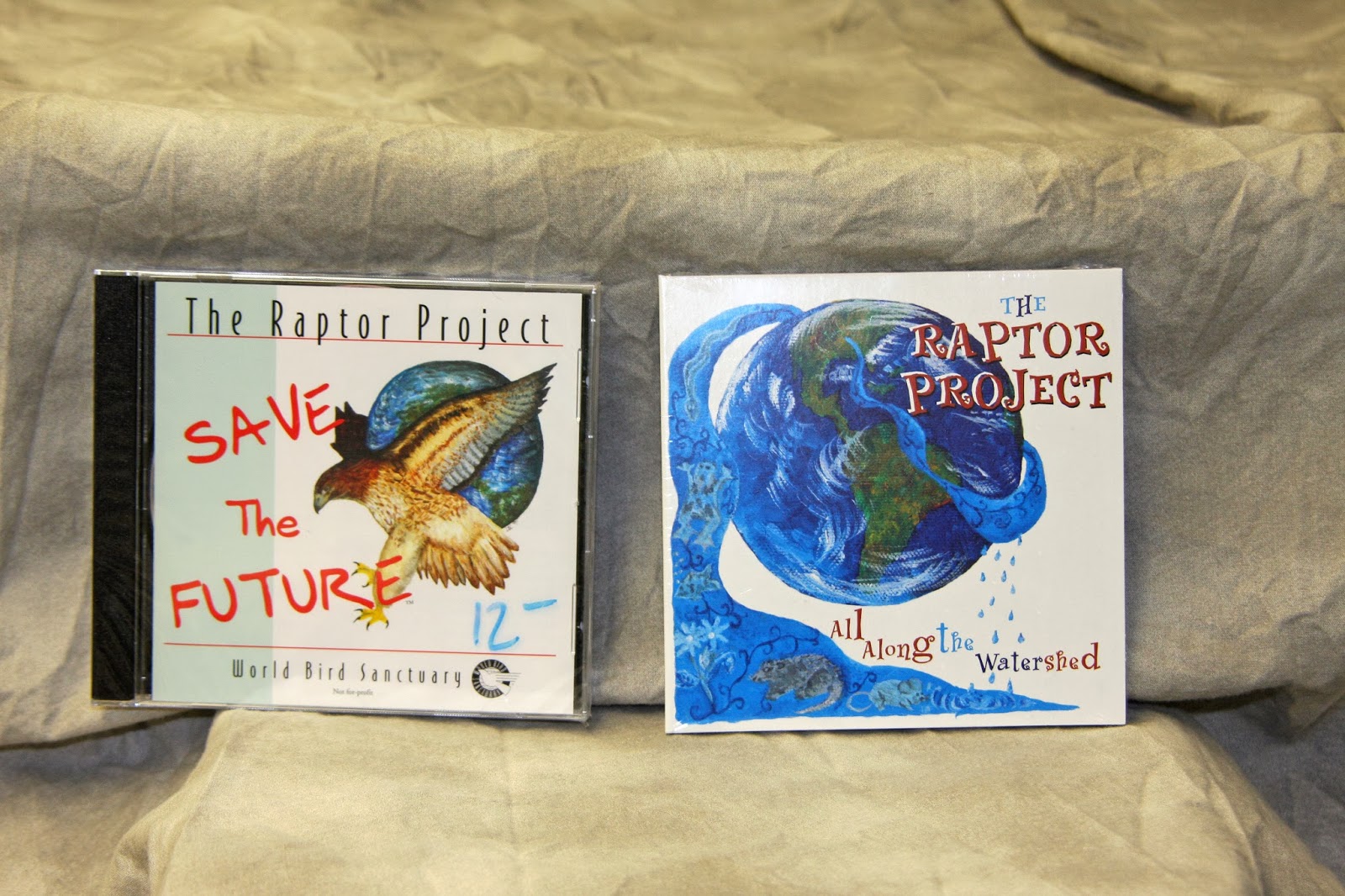
”Save the Future” CD and "All Across The Watershed" CD
World Bird Sanctuary's in-house band, The Raptor Project, has released two CDs, Save the Future and All Across The Watershed.  They consist of original songs about birds, the environment and taking care of our planet.  These fun and entertaining children's CDs comes with lyric sheets and education sheets embedded in the CD.

Save the Future CD or All Along The Watershed CD - $12 plus $3 shipping and handling for each.
Click here to order.

Valid from November 29th to December 24th, 2013, only – shop in our gift shop and get 10% of all purchases on gift shop items, Adopt a Bird packages and Friends Memberships.  Not valid on Return to the Wild.  Not valid for online purchases.
To print the coupon:
*   MAC users--click on the image, hold down the mouse and drag the image to your desktop.  Open the image and print as usual.
*  PC users--hover the mouse over the image, click "Open Image in a New Tab"--it will open a new tab with just the image.  Print as usual.  Or alternatively--print the whole blog page and bring it in.

Thank you for considering World Bird Sanctuary when you do your holiday gift shopping this year.  For even more 'green gifts' visit the World Bird Sanctuary gift shop,located in our Nature Center, where we have many seasonal items and apparel for sale.

Submitted by Catherine Redfern, Director of Development, World Bird Sanctuary.

Wednesday, November 20, 2013

Birdlore: The Mighty Thunderbird


 Legends are stories based on primitive human interpretation of witnessed events to explain the natural order of the world. 

Over time, these stories tend to change and become larger than life. A single legend will diverge into various versions as separate cultures will regard the focus of the said legend in a different light.  The legend of the thunderbird is a classic example.  In most Native American cultures, the thunderbird could create thunder and lightning with the beating of its wings.

Patriot the Bald Eagle
The thunderbird is likely inspired by Bald Eagles or Golden Eagles.  Even today, we are still in awe of these magnificent raptors.  It is easy to understand how earlier cultures would see eagles as a logical cause for storms when the science of water cycles was not yet known.

In the Americas references to the thunderbird can be found widespread among Pacific Northwestern, Northeastern, and Plains tribes.  Aside from being the originator of fierce storms, the thunderbird has been regarded as a protector to the Native Americans, a trickster, a challenger to other great powers in the natural world, or a malevolent being that would kill anyone that would trespass on his sacred mountain.

One tale of the Thunderbird comes from the Quileute tribe of the northern Pacific coast:

Legend has it that the Thunderbird was a great creature with feathers the size of a canoe paddle.  As he flew through the sky, he created thunder and wind with the flap of his mighty wings and flashed lightning from his eyes when he blinked.  Hunters were afraid of the Thunderbird, so they did not stay near his sacred mountain very long.

The Thunderbird lived off the meat of the whale and each day would go out to the ocean to catch the whale and fly it back to his mountain to eat. One time Thunderbird had a great battle with Killer Whale.  The Thunderbird would catch Killer Whale and fly back to his mountain, but Killer Whale would escape and return back to the ocean.  On and on the Thunderbird would capture the whale, only to have him get away every time.  During their long and hard struggle, Thunderbird would beat his wings with terrible force and breathe life into storms, which uprooted trees in the many places of their battle in the mountains.

A totem depicting the struggle between Thunderbird and Killer Whale.  

Finally, Killer Whale escaped to the middle of the ocean and Thunderbird gave up the battle. 

According to the legend the battle between Thunderbird and Killer Whale explains why Killer Whales inhabit the deep ocean, and how the storms from so many battles created prairies among the forests on the northern Pacific Coast.

Submitted by Jessica Bunke, World Bird Sanctuary Trainer

Monday, November 18, 2013

Chewk-Chewk-Chewk


Chewk- Chewk- Chewk is the alarm call of the Osprey.

The Osprey or sea hawk is one of the most common birds of prey and is found on every continent except Antarctica.  Locally in the U.S. the Osprey is found everywhere on or near water, and they are not shy about living amongst humans.  The diet of the Osprey is almost completely comprised of fish and they are completely specialized for a life style on the water.
An adult Osprey

Common on almost every continent, the Osprey is a master of its craft as a fisher.  With a worldwide population over half a million, the Osprey is one of the most widespread birds of prey.  The Osprey is found in most temperate regions throughout the world, from Canada to Argentina and Ireland to North Africa.  Temperate zone Ospreys do migrate, typically with the changing of the seasons in most regions.

The Osprey is specially designed to hunt on water in many very interesting ways. Sporting long slender wings and a short tail, the Osprey’s wingspan measures up to 6 feet in large females.  The Osprey is specially equipped with an outer toe that can rotate toward the back toe to help catch and hold on to slippery fish.  The scales on the feet and legs are fashioned in an upward position and is opposite of all the other birds of prey. These upside down scales make the legs more hydrodynamic when the bird plunges completely into the water to catch a fish (Bald Eagles catch fish near the water’s surface).  The pads on the bottom of the Osprey’s feet are made up of tiny barb like bumps.   Even the nose holes (nares) of the Osprey can be closed, which comes in handy when the Osprey hits its prey below the surface of the water and then has to fly out of the water with the fish.

The Osprey is among just a few of the legendary and mythical creatures that have been recorded in human culture from the beginning.  This is probably due to the common connection to water and fishing that humans and Ospreys share.  They are able to coexist in and amongst humans quite successfully as long as they are respected. 

The Osprey is truly one of the world’s most successful and magnificent animals.  If you would like to see an Osprey up close, stake a stroll down the WBS display line and visit our resident Osprey, Bennett (from late March through mid November).

Submitted by Adam Triska, World Bird Sanctuary Naturalist/Trainer

Saturday, November 16, 2013

Really Weird Birds - The Alpine Swift


The Alpine swift is an amazing migratory bird that spends its breeding season, which is the Northern Hemisphere summer months, in and around the Mediterranean and the northern Middle East, including the United Arab Emirates, through to western Asia and India. 

Before the arrival of winter, they migrate south to southern and eastern Africa, where there is a seasonal abundance of insects.  They have wide gaping mouths perfect for catching and swallowing insects while in flight.

Alpine swift in flight. 
Recently published in the journal Nature Communications, is a study that shows the first evidence that the Alpine swift can fly day and night for 200 days straight during their migration.  This is longer than any other recorded bird.  Six birds were affixed with a device that recorded acceleration and ambient light.  This determined when the birds flapped their wings, glided, and when they rested.  The results show that they didn’t fly during their breeding season, when they had to incubate their eggs and land on the nest to feed babies.  However, they glided and flapped during their entire southern migration (which included across the Sahara Desert!).  They also glided and flapped during their entire overwintering period in sub-Saharan West Africa! Then of course the return migration was non-stop also, meaning this little bird spends more than six and a half months of non-stop, day and night flight, which covers about 6,200 miles!

Flying and staying airborne uses up a lot of energy and Alpine swifts must be able to recover and rest while still aloft.  The results from the study are still inconclusive as to whether the birds actually sleep during their time above ground.  Perhaps these birds, like some other organisms, use unihemispheric sleep, where half the brain powers down into sleep mode while the other half remains alert; or perhaps they only sleep during their breeding season. 

They are of course very well adapted to eating in the air.  They will swallow small insects, but what also nourishes them is called aerial plankton.  It’s a mixture of fungus spores, bacteria, minute seeds, and those tiny insects.  Aerial plankton also contains enough water for Alpine swifts to last them indefinitely.

This research team next hopes to discover the evolutionary causes responsible for this extraordinary behavior.

Submitted by Sara Oliver, World Bird Sanctuary Naturalist

Thursday, November 14, 2013

Seeking Volunteer Pilots


World Bird Sanctuary has been doing aerial surveys of Bald Eagles along the Mississippi River for over 30 years.


Counters Emily Hall and Sara Carter, Recorder  Mike Zieloski,ready to do a census flight 
World Bird Sanctuary enlists volunteer pilots to fly from the Confluence of the Missouri and Mississippi Rivers north to 6 miles north of Quincy Illinois. We count the Bald Eagles along the river.
Pilot Joe St. Clair fills out paperwork while Emily Hall looks on 
The pilot for this flight was Joe St. Clair, who volunteers his services to an organization called Wings of Hope.  Wings of Hope flies out of Spirit Airport in Chesterfield Missouri. They fly medical missions to children’s hospitals and to 47 countries around the globe.

Our pilots, who share a Cessna 185 high winged plane were unable to help us last year due to issues with the plane.  Joe St.Clair shares the plane with Paul Knese and others. Paul has helped with Eagle Census Flights, too.

We are looking for additional pilots with Cessna high winged planes to help with the census this December, January and February.  We often see some amazing wildlife on these flights, and some years some interesting ice formations.

If you know of a pilot who could help us please contact Jeff Meshach, Director,  World Bird Sanctuary at 636-861-3225.


Emily Hall and Sara Carter  ready for take-off 
We would like to continue our multi year study of Bald Eagles along the Mississippi River.

Photos and Story submitted by Michael Zeloski, World Bird Sanctuary Director of Education 

Tuesday, November 12, 2013

Dorothy


Dorothy, our Andean Condor, or Vultur gryphus in Latin, is one of our largest birds at World Bird Sanctuary.  She has a wingspan of roughly 10 and a half feet, which happens to be almost exactly twice my height!  

Dorothy, WBS's young Andean Condor

Currently Dorothy is enjoying her days on the display line where you can come and see her between 8 am and 5 pm every day.  

Dorothy was hatched here at World Bird Sanctuary from a breeding pair of Andean Condors that we had on a breeding loan from the Cincinnati Zoo.  Andean Condors mate for life and during that pair’s 10 year tenure at WBS they raised 6 babies; a very successful rate considering that in the wild they usually lay only one egg every 2 years.  

Someday soon Dorothy will sport the beautiful plumage and ruff seen here on her mother, Laurel

Dorothy’s five brothers and sisters were then sent back to Cincinnati Zoo where they were eventually successfully released back into the wild in western South America, where you would naturally find them soaring through the air.   WBS chose to keep Dorothy so she could be one of our many ambassadors to educate our guests about problems birds are having worldwide.  

In South America, Andean Condors are classified as Near Threatened on the IUCN Red List.  In the wild they face threats from poisoning and human persecution by farmers, who believe that the condors are killing their livestock.  

Thankfully Dorothy is safe here at WBS where after hours she is being trained. Hopefully she will star one day in some of our educational programs.  Adam Triska, a staff member at WBS, and I  have recently started working with her to teach her to go easily into and out of a large crate in case she would ever need to be moved.  We are also working with her to go to specified targets, much like our White Pelicans do during some of our programs.  

Andean Condors are very social birds in the wild, where there have been reports of up to 40 condors feeding from a single carcass.  Dorothy looks as if she really enjoys the company of working with us and doing things correctly.  She is also a quick learner--a sign of high intelligence.  She picks up on cues and body language much faster than many of the other birds.  

Here I am teaching Dorothy to go into and out of her crate

Training is going very well and Dorothy always seems to get excited when she sees us walking towards her enclosure with our training equipment.  So far this is just the beginning of her training and I find that I look forward to working with her at the end of each day at WBS.  

When you visit the World Bird Sanctuary be sure to walk down the exhibit line to see Dorothy.  You can’t miss her—she’s the REALLY BIG bird.

Submitted by Mike Cerutti, World Bird Sanctuary Naturalist/Trainer

Sunday, November 10, 2013

Sleep, Nap or Siesta?


Have you ever wondered how many owl species there are in the world?  No one may ever know the exact number, but there are definitely over 200 species of owls in the world!  There is one owl in particular that I would like to introduce to you in this blog.  Her name is Siesta and she is a Mottled Owl (Strix virgata), formerly known as Ciccaba virgata.
The Mottled Owl is native to Mexico, Central America and South America.  The type of habitat where they are found varies from dry forest to humid lowland rainforests.  Their diet consists of small mammals, reptiles, amphibians, small birds, and insects.  From this list of the wide array of foods they eat, you can gather that they are opportunistic eaters.  Siesta’s favorite food here at WBS is mice!  She is also given rabbit, chicks (chicken), and venison (deer) on other occasions. 

Mottled Owls have a wingspan of about 3 feet and are 13-15 inches in height.  With most birds of prey the females are larger than the males.  These small owls range from 175-350g (.39 - .77 lbs.) in weight. 

Mid to late winter is breeding season for owls.  Mottled Owls choose a nest made by a larger bird in the past.  These nests can be found low near the ground or very high in the trees.  Once a year Mottled Owls will lay 2 round white eggs that hatch after about 23-28 days of incubation by the female.  After about 30 days of the chicks being in the nest they start to fledge (leave the nest). Siesta gets broody (in the mood to nest) during owl breeding season, so we give her a wooden egg to satisfy her needs during this time. 

Because of their size, Mottled Owls do not live a very long life in the wild.  They can reach 6 or 7 years in the wild, but in captivity that number can increase dramatically.  Siesta was hatched in April of 1995, so she is 18 years old this year.  We hope she will continue to age well with us at the World Bird Sanctuary. 

Siesta is such an adorable owl, that you wouldn’t think she could get any cuter!  But wait!  When you come to visit her, she will show off her beautiful long eyelashes!  When visitors approach her enclosure she will often seem to bat her lashes at them.  She is such a gorgeous little owl!

Siesta is available for adoption in our Adopt a Bird program.  To find out more information Click Here or call 636-861-3225, ext. 106.  All adoption donations are tax deductible. 

Throughout the year Siesta can be seen at the Environmental Education Center at the World Bird Sanctuary, which is open daily from 8am-5pm.  Siesta is a very interesting bird to view.  You should stop on by and visit her! 

Submitted by Lisbeth Hodges, World Bird Sanctuary Naturalist