Saturday, March 8, 2014

"Return to the Wild" program celebrates wildlife hospital successes!

Sick and injured birds of prey that enter our wildlife hospital at World Bird Sanctuary will often need an area to be released back to the wild, so we have designed a program to make this a unique experience for the general public to enjoy.  The “Return to the Wild” program gives World Bird Sanctuary supporters the opportunity to take part in the release of a bird of prey back to the wild!

Roger Holloway and Joe Hoffmann of World Bird Sanctuary, examine and treat a Bald Eagle with an injured wing.Photo: Sherry Seavers 

 The Kathryn G. Favre Wildlife Hospital at World Bird Sanctuary specializes in the rehabilitation of birds of prey, and also the reintroduction of these birds back to the wild, after their treatment is complete.  The actual return to the wild is where the public can be of great help to our organization and provide a memorable experience for those who witness and take part in the release. 

On the day of the release, a World Bird Sanctuary staff member will bring the bird to the release location, from where donors have the option to release the bird out of their own hands, or by simply opening the travel crate to let the bird fly away in its own time.


A Red-shouldered Hawk is returned to the wild after being successfullytreated in the wildlife hospital.  Photos: World Bird Sanctuary.

This is a memorable way to celebrate a special occasion – birthday, anniversary, wedding, tribute, graduation or memorial, or even just enjoying giving the special bird its second chance at life!


To find out more about our “Return to the Wild” program, you can contact our wildlife hospital staff at 636-861-1392, or click here for more information.

World Bird Sanctuary would like to the thank the skilled veterinarians of St. Louis Hills Veterinary Clinic for volunteering their time and resources to treat the sick and injured birds admitted to our wildlife hospital.

Thursday, March 6, 2014

Really Weird Animals: Tongue-eating Lice


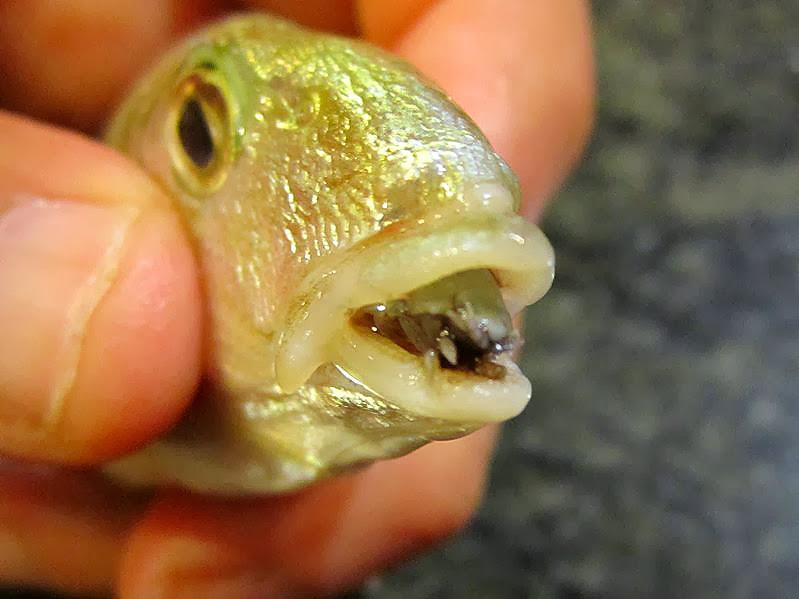
Tongue-eating and lice.  Those words by themselves do not bring pleasant thoughts.  This creature is a parasitic crustacean found off the coast of California and as far south as Ecuador, and has been sampled in water six to seven feet deep and down to 200 feet deep.

As juveniles, several tongue-eating lice will latch onto a fish and enter it through its gills.  The first crazy thing about these parasites is that they are “protandric hermaphrodites.”  Meaning: as the lice mature, they first become male (about 7.5-15 mm long).  Then usually one of them will turn into a female once it reaches 10 mm in length.  They can grow up to 29 mm in length


Tongue-eating louse (photo from the Wikimedia files) 
Females will crawl from the inside of the gills to the fish’s mouth and grab hold of the tongue.  They extract and consume the tongue’s blood through their front claws!  The tongue eventually dies and disintegrates from so much loss of blood and the louse becomes its new tongue, holding on to whatever nub is left.   So despite its name--the tongue-eating louse--it does not actually eat the tongue, but sucks its blood.  Although the process of losing its tongue is quite uncomfortable for the fish, the fish doesn’t die.  The parasite wants its host to live as long as possible, so it will then only occasionally consume its blood and mostly feed on the fish’s mucous.


Tongue-eating louse inside its host (photo from the Wikimedia files)
 Not much is known about this creature’s mating cycle.  They could possibly mate before the female ventures to become a fish’s tongue, or perhaps a male comes up to visit the female, or the female could just release her eggs in the direction of the males and they fertilize them.

Tongue-eating lice are not harmful to humans.  They are sometimes found in fish bought at supermarkets, but are usually dead along with the fish.

At the World Bird Sanctuary  you won’t find any tongue-eating lice, but we do have a healthy colony of Hissing Cockroaches.  When you visit be sure to check them out as they are very interesting.

Just as all creatures have a purpose in this world, even a tongue-eating louse can be food for other ocean dwelling life that finds these crustaceans floating around without a host!

Be sure to chew them well!

Submitted by Sara Oliver, World Bird Sanctuary Naturalist


Tuesday, March 4, 2014

Ameren Missouri Sponsors Fun In Flight 2014


Ameren Missouri continues sponsorship of World Bird Sanctuary’s “Fun in Flight Summer Series” Environmental Education Programs.

Ameren Missouri has once again committed to investing in environmental education by sponsoring World Bird Sanctuary’s summer public environmental education events in 2014.

2014 "Fun in Flight" Series will educate and delight visitors all summer long.
Ameren's Missouri continued commitment to fostering responsible earth stewardship will allow visitors from throughout Missouri  and Illinois to learn to protect the earth’s natural resources.  The sponsorship of these programs provides a fun, family-friendly and entertaining outing at no cost to visitors to the Sanctuary.

Mark your calendars for these free 2014 “Fun in Flight” Series events!
·      World Eagle Day – March 16th, 2014
·      Birds in Concert – every Thursday evening in August
·      Amazing Animal Encounters – every Saturday and Sunday between Memorial Day and Labor Day
·      International Vulture Awareness Day – September 6th, 2014
·      Annual Open House – October 18th and 19th, 2014

Go to www.worldbirdsanctuary.org and check our events calendar for more details!


The World Bird Sanctuary Events listed above are sponsored by Ameren Missouri

Sunday, March 2, 2014

A Day of Firsts


January 26, 2014:  This was going to be a day of firsts.

My first Eagle Days program in Clarksville, MO: Naturalist Trina Whitener and I, along with our awesome volunteer, Inga, left that morning with the Bald Eagle, Sanibel, and the Golden Eagle, Kili.  I was nervous.  I had worked with Sanibel on numerous occasions but Kili was another matter entirely. 

Working with Kili was an intimidating first 

Working with Kili, the fourteen pound behemoth, was going to be another first.  I only had to take her in and out of her crate for five different shows, in front of hundreds of people, and have her sit on my arm with talons that can exert about 450 pounds per square inch (psi) of pressure.  No big deal, right?!  And just to put that 450psi into perspective, the average human hand can only squeeze about 100psi of pressure. Yeah, I had nothing to worry about…

And I didn’t.  Kili was just as good as everyone told me she would be.  Every time I opened that crate door I was greeted with excited little chirps.  We had a towel in her crate that she could play with and when she would step up, she would hold onto that towel and look at me as if to say, “Hey, can I show everyone this fun toy I have?”  She seemed to love the attention she was getting, and the guests loved her.

The entire day went by smoothly.  In each show Trina discussed the enormous amounts of Bald Eagles that were flying around the area and encouraged guests to go and see the wild eagles along the river for themselves.  As of Saturday, Jan 25th, the conservationists had reported nearly 200 Bald Eagles.  So when our last show ended around 2:30pm we packed up quickly to go witness the wild, majestic birds ourselves.

There were nearly 200 Bald Eagles on the river (photo by Dawn Kernrich)

Majestic it was!  The event was another first for me as we witnessed several Bald Eagles flying around the river, swoop down to grab a fish, and then fly back to the trees to feast.  We even named one Pirate Bob.  Whenever he saw an eagle catch a fish, Pirate Bob would fly in and try to steal that fish.  I think he didn’t want to do the work of catching one himself.

On top of seeing all the eagles, there were nearly one hundred White Pelicans in the water and across the river hunting—another first!

There were easily a hundred White Pelicans on the river (photo by Dawn Kernrich)

If you haven’t had the chance to see the eagles during this time of the year, make time to do so.  It really is an awe-inspiring site that allows you to appreciate the wildlife that we have on this earth.

If you don’t have the opportunity to attend Eagle Days or see the wild ones on the river, you can always visit us at the World Bird Sanctuary to see our nation’s symbol (and many other species) up close.  The World Bird Sanctuary is open seven days a week from 8 to 5 except for Thanksgiving and Christmas. 

 Submitted by Dawn Kernrich, World Bird Sanctuary Naturalist

Friday, February 28, 2014

World Bird Sanctuary Board elects new President and Vice President

World Bird Sanctuary announced the election of JOHN KEMPER, former Vice President of the Board of Directors, as President of the Board, and SCOTT LIEBEL, former Treasurer, as Vice President, after a Board meeting held late last year.  Former President, JOHN RISBERG, ended his term as President in October 2013.  “I have served on the board of the World Bird Sanctuary for fifteen years, the last five as president, and I am proud of the progress the organization has made during that time, expanding the depth and breadth of its activities to include a unique and engaging nature center, open to the public year-round, and further increasing the scope of its educational outreach, rehabilitation, propagation and research services.  I am confident that our newly elected officers will continue to provide effective leadership support for the organization, building on its success and securing its place as a significant community resource.”

John Kemper, new Board President
Kemper, Vice President of PGAV Destinations, has served on the Board for World Bird Sanctuary since 2007.  As Vice President of the Board, John has been actively engaged in leading fundraising efforts and strategy development for the last 4 years, and will continue to drive the organization’s success during his tenure as Board President. 

“My goal is to continue raising awareness, providing quality educational experiences, and creating an engaging destination for wildlife supporters of all ages.  I am confident that we will maintain our position as a world leader in raptor rehabilitation, propagation, and research.”

John Kemper, WBS Board President

Scott Liebel, new Board Vice President
Liebel, Supervising Engineer, Engineering & Joint Use Services at Ameren Missouri, has served as a board member and Treasurer during his nine years on the Board of World Bird Sanctuary.  "I am excited about the positive direction that the World Bird Sanctuary is going.  I look forward to working with John and the rest of the Board to continue the WBS mission to preserve the earth′s biological diversity and to secure the future of threatened bird species in their natural environments.”

Scott Liebel, World Bird Sanctuary Board Vice-President

 In addition to these elections, Trent Tinsley, Business Process Manager – National Marketing at Enterprise, was elected as Treasurer, and Leon Ullensvang, retired, was reelected to the position of Secretary.

Wednesday, February 26, 2014

Sacred Heart School Program


Fred Abrolat began volunteering for the World Bird Sanctuary in March of 2010.  On January 31, 2012 Fred shared his love of Eagles with Sacred Heart School in Florissant, Missouri.

Fred, his sister Annamarie and Patriot the Bald Eagle (photo by Mike Zieloski)
Fred chose Sacred Heart because his sister Annamarie Sullivan works there.  Each volunteer is allowed a free World Bird Sanctuary bird program to be presented at the school or group of the volunteers choosing.

Fred's Mom, Mary Abrolat, went to school at Sacred Heart School, Fred's Grandpa and Grandma were married there, and Fred's Aunts and Uncles went to school there.  So you can see that Fred and his family have a long and special history with this school.  Fred wanted to honor his family by bringing a live Bald Eagle to the school.


Fred presenting the program to the kids (photo by Mike Zieloski)
Fred wanted to be the presenter for the program.  So we studied, made notes, and talked over the important points that he was going to cover with the students and teachers.  We all met in the gym.  You can see from the pictures that the children sat on the floor during Fred's presentations. We had 2 sessions for the school children--1st grade thru 8th grade.  Fred did a nice job working with the Bald Eagle and conversing with the
students.

The kids listened with rapt attention (photo by Mike Zieloski) 
As a special added bonus, one of Fred's nephews, Joe Sullivan, was able to attend.  Joe works as a Hockey referee and had the morning free.

Fred, his nephew Joe and Patriot the Bald Eagle
Fred was able to share his passion for Eagles with his family, the family church members, and the students.  It was a great day for Fred and his family.

We are fortunate to have Fred Abrolat helping as a World Bird Sanctuary volunteer.
This winter Fred has been helping us with our Eagle displays in the Alton, Illinois area.
We are grateful for Fred's passion for eagles and his eagerness to share his love and skills with the public and eagle watchers.

A big Thank you to Fred Abrolat.

If you would like to learn more about the World Bird Sanctuary’s volunteer program click here  to find out more or to fill out a volunteer application form.

Story and photos by Michael Zeloski,  Naturalist, World Bird Sanctuary

Monday, February 24, 2014

Coming Soon - World Eagle Day 2014!

Coming Soon –World Eagle Day 2014!

During the month of March the Bald Eagles wintering in our area start to fly back to the north, but that doesn’t mean you can’t see eagles until next winter.  Join us on Sunday, March 16th, 2014 as World Bird Sanctuary celebrates eagles from around the world!

You’ll meet eagles from North America, Africa, Australia and Europe.  Kids will enjoy fun, free crafts and activities.  Learn all about eagles through naturalist talks and free-flight shows featuring live flying eagles.  Get up close and personal and have your photo taken with a real Bald Eagle!

Bald Eagle in flight at World Bird Sanctuary.
Photo: (c) Sandra Lowe

New in 2014!  
We welcome special guests Bill Volker and Troy from Sia – The Comanche Nation Ethno-Ornotholigical Initiative.  They will be conducting presentations about the unique importance of eagles to Comanche culture.

Mariah, Golden Eagle at World Bird Sanctuary.
Learn about the importance of Golden Eagles in Comanche Culture at World Eagle Day 2014
Photo: Gay Schroer

All this, and more, is made possible by Ameren Missouri, who are sponsoring our “Fun in Flight” 2014 series.

  •      Meet vultures from North America, South America and Africa!
  •      Meet Dorothy, a live Andean Condor!
  •      Free-flight shows featuring live flying vultures!
  •      Free fun kids activity center.
  •      Gifts and souvenirs on sale.

 Date: Sunday, March 16th, 2013
Time: 10am – 4pm
Admission & Parking: FREE!

Sponsored by Ameren Missouri.


Join us as we wave winter goodbye, and welcome the Spring, at World Bird Sanctuary’s World Eagle Day 2014!

Submitted by:
Catherine Redfern, World Bird Sanctuary

Saturday, February 22, 2014

Look! Up in the Trees!


 One of my most fascinating wildlife encounters happened to me this past weekend.

I was picking up refuse on the World Bird Sanctuary exhibit line and I could see in the distance there was a large crowd forming in the middle of our paved trail.  Everyone had their cameras out and I figured they had spotted a Bald Eagle, but I never would have imagined what I encountered next.
McGwire, one of our resident Bald Eagles (photo by Adam Triska)

At the sanctuary we have many permanent Bald Eagle residents who have debilitating wing injuries that render them unable to fly.  Two of the enclosures that house Bald Eagles with wing injuries have open tops, and the wild population of Bald Eagles has become fully aware of this.  I looked up and not even 25 feet from the ground was a juvenile Bald Eagle perched on a branch!  I quickly recognized the individual as one of the local Bald Eagles who hangs out looking for an easy meal.  The bird was completely relaxed with probably 35 to 40 people standing underneath it.  The bird at one point locked eyes with me and you could see in its eyes that it didn't have any qualms with even the loudest child.

As I was taking questions and explaining the situation I noticed that the Bald Eagle was preparing to relieve itself and in the path of the “relief” was a young girl!  I quickly shouted to warn her of the danger soon headed her way.  She looked up and looked back at me before retreating to safety. 

Seconds after she had scampered away a huge line of poo painted the road where she was standing just seconds before!  Predictably the crowd was split with their reaction, a portion laughed while the rest were grossed out.

After lightening the load the bird had had enough glamour time and took to the air.  It launched itself from the tree and then dropped to about 10-15 feet from the ground, spread its wings, coasted for 50 feet or so and shot back up to a high branch in an old oak tree.

It’s memories and moments such as the one described above that remind me how lucky I am to work at the World Bird Sanctuary.

Submitted by Adam Triska, World Bird Sanctuary Naturalist/Trainer


Thursday, February 20, 2014

St. Louis - Home of the Birds


St. Louis is world renowned for being the home of the birds….the St. Louis Cardinals baseball team, that is.

In addition to being the home of the famed St. Louis Cardinals, however, Saint Louis is home to several species of birds of prey, and is also used as a stopping point for other species during the migration.
A Red-tailed Hawk fledgling recuperating in one of our Wildlife Hospital flight cages (photo by Adam Triska)
Birds of prey are all around us in St. Louis--from Great Horned Owls in Forest Park, to Peregrine Falcons on top of the AT&T building, to Bald Eagles riding the thermals over the arch grounds.  Spotting birds of prey is a great indication that the ecosystem in our neck of the woods is healthy and hearty.

This is a new thing for many people in St. Louis for the most part.  Being protected all across our country, birds of prey have flourished and reestablished in urban areas, therefore becoming much more visible to urban dwellers.  Just in my neighborhood, we have Great Horned Owls and Red-tailed Hawks.  At my aunt’s house in Maplewood, Missouri, there are Barred Owls just steps away in Deer Creek behind her house.
Coopers' Hawk fledglings cooling off in a backyard birdbath (photo by Gay Schroer)
All of the different birds of prey found in St. Louis each fill a significant role that urban environments naturally possess.  Being highly intelligent and having the ability to coexist in such close proximity to humans, is quite an impressive feat.  ….so hats off to the birds for adapting and soaring in such conditions.

If you would like to learn more about a bird of prey that you have spotted in your neighborhood, take a trip out to the World Bird Sanctuary where you will be able to view representatives of your new urban neighbors up close and learn all about their habits and needs.

Submited by Adam Triska, World Bird Sanctuary Naturalist/Trainer

Tuesday, February 18, 2014

Sunbathing -- Avian Style


My first blog entry as a relatively new employee for the World Bird Sanctuary gave me a bit of trouble. 

I was not sure what would be a great topic for my first entry. Obviously, it has to be interesting.  It has to be captivating and it has to make you want to read my entries.  I thought I could talk about my favorite bird; discuss fun facts and the importance of the species.  I could discuss my animal occupations and how I came to the Sanctuary or tell you about my first day on the job.  Maybe, in the future I will use those topics.  But for the first entry, I am currently being inspired by the snow falling down and how I wish I could be in the sun, soaking it in like so many of our birds do when the weather is warm.
Skinner, a Turkey Vulture, sunning (photo by Gay Schroer)
All birds adapt their own posture for sun bathing.  Some stand and open their wings while others may lay flat on the ground.  In both cases, body feathers are often fluffed up and the feathers along the wings are spread out.  Besides just soaking in the sun, these postures serve other important purposes.

For one, the preening oil along the feathers is allowed to spread.  This is the same oil that keeps the feather integrity, has a waterproofing effect, and an antiparasitic effect.
Dewey, a Bateleur Eagle enjoying the sun
Secondly, it also forces parasites out from within the plumage.  At the Sanctuary, we do routine checks on our birds to eliminate the possibility of parasites.  For birds in the wild, this is a helpful technique to help rid them of the nasty vermin.

Besides the healthy benefits that go with sunbathing, it is also hard not to admit that the behavior just looks awesome.  It is not everyday that you get to see these birds sitting still with wings stretched. 
Keeoo, an African Augur Buzzard (photo by Gay Schroer)
The snow may seem endless at times, but when the sun starts to peak through, make a visit out to the World Bird Sanctuary and you may get a glimpse of a sunbathing bird.

Submitted by Dawn Kernrich, World Bird Sanctuary Naturalist


Sunday, February 16, 2014

The Misunderstood Wolf


One of the most misunderstood animals in my opinion is the wolf. 
We met these amazing creatures at the Colorado Wolf & Wildlife Sanctuary
In North America there were 24 different species of wolves--the Alaskan Tundra Wolf, Alexander Archipelago Wolf, Arctic Wolf, Baffin Island Wolf, Bernard’s Wolf, British Columbia Wolf, Cascade Mountain Wolf, Eastern Timber Wolf, Great Plains Wolf, Greenland Wolf, Hudson Bay Wolf, Interior Alaskan Wolf, Kenai Peninsula Wolf, Labrador Wolf, Mackenzie Tundra Wolf, Mackenzie Valley Wolf, Manitoba Wolf, Mexican Wolf, Mogollon Mountain Wolf, Newfoundland Wolf, N. Rocky Mountain Wolf, S. Rocky Mountain Wolf, Texas Gray Wolf, and the Vancouver Island Wolf.  Sadly, the Texas Gray, S. Rocky Mountain, Newfoundland, Mogollon Mountain, Manitoba, Kenai Peninsula, Greenland, Cascade Mountain, British Columbian and the Bernard’s Wolf are all extinct, due mostly to indiscriminate hunting.

The Vancouver, N. Rocky Mountain, Mackenzie Valley, Labrador, Hudson Bay, Great Plains, and the Eastern Timber Wolf are all subspecies to the Gray Wolf.  The Interior Alaskan is the largest wolf species in North America at 5-7 feet from nose to tip of tail. 
Wolves can be very affectionate with those accepted into their pack
This past summer I went to Divide, Colorado where I came across an amazing sanctuary called Colorado Wolf and Wildlife Sanctuary.  The staff not only taught my husband and I all about wolves, but they showed us the animals’ great “personalities.”

One thing that made a big impression on me is that they mate for life, which a number of other animal species do also.  However, if a wolf loses its mate it mourns for life and very rarely finds another mate.  They will also mourn for other wolves that have died in the pack.  I am a huge family person, so this hit me hard. 
Wolves live in a family called a pack 
One of the wolves at CWWS lost her mate due to an illness.  It is believed she howled every night for six months for her lost mate.  It was noted that all the other wolves in the sanctuary never howled when she was howling.  In this six month period the sanctuary tried to put other wolves in her enclosure that she got along with previously to see if that would help her.   However, she would fight any other wolf that came near her.  This behavior continued until the day the sanctuary received an orphaned wolf pup.  They were looking for a wolf to foster the pup and to their surprise the lonely she wolf took him in instantly.  The people at the Colorado Wolf and Wildlife Sanctuary never thought their girl would ever accept another wolf, but this orphaned pup seemed to steal her heart.  To this day they are inseparable, and she is very protective of him.  

Wolves are a very important part of our environment and have a lot to teach us if we just observe.


Submitted by Christina McAlpin, World Bird Sanctuary Naturalist

Friday, February 14, 2014

Birdlore: The Piasa Bird


In my previous Birdlore blog I regaled readers with the legend of the Mighty Thunderbird of a Pacific Coast Tribe.  The image of the storm-creating eagle is perhaps the most well-known depiction of this creature; however, the word “thunderbird” may also be used as a general term to describe any great bird of the skies in Native American lore.  One of these great birds also happens to be a local legend:  The Piasa Bird of Alton, IL.

The Piasa (pie-a-saw) was a terrible creature that was said to have terrorized the Illini tribes, who lived along the Mississippi River long before the arrival of the white man.  The name translates as “the bird that devours men” because the Piasa was said to have preferred human flesh. 


A modern reproduction of the "Piasa Bird" on the bluffs of the Mississippi River in Alton, IL.  Wings were not described in Marquette's 1673 account.  The original petroglyph eroded away on the limestone bluffs. (photo from the Wikipedia files)
 The original petroglyph decorating the bluffs of Alton, depicted a mismatched creature that was part bird, reptile, mammal, and fish.  In 1673, Missionary Father Jacques Marquette wrote a detailed account of the Piasa Bird’s appearance in his diary, when he stumbled upon the original petroglyph on his journey down the Mississippi river.  He wrote, “…the Piasa was as large as a calf with horns like a deer, red eyes, a beard like a tiger’s, a face like a man, the body covered with green, red, and black scales and a tail so long it passed around the body, over the head and between the legs”.

The most common legend regarding the origins of the Piasa Bird goes:

Many moons ago, there existed a birdlike creature of such great size, he could easily carry off a full grown deer in his talons.  His taste, however, was for human flesh.  Hundreds of warriors attempted to destroy the Piasa, butt failed.  Whole villages were destroyed and fear spread throughout the Illini tribe.  Ouatoga, a chief whose fame extended even beyond the Great Lakes, separated himself from his tribe, fasted in solitude for the space of a whole moon, and prayed to the Great Spirit to protect his people from the Piasa.

On the last night of his fast, the Great Spirit appeared to Ouatoga in a dream and directed him to select 20 warriors, arm them each with a bow and poisoned arrow, and conceal them in a designated spot.  Another warrior was to stand in open view, as a victim for the Piasa.  When the chief awoke in the morning, he told the tribe of his dream.  The warriors were quickly selected and placed in ambush.  Ouatoga offered himself as the victim.  Placing himself in open view, he soon saw the Piasa perched on the bluff eyeing his prey.  Ouatoga began to chant the death song of a warrior.  The Piasa took to the air and swooped down upon the chief.  The Piasa had just reached his victim when every bow was sprung and every arrow sent sailing into the body of the beast.  The Piasa uttered a fearful scream that echoed down the river, and died.  Ouatoga was safe, and the tribe saved.

The most recent restoration of the Piasa Bird painting is located on the Mississippi bluffs just north of Alton along the Great River Road.

Even though the World Bird Sanctuary does not have a Piasa Bird, come visit us to see many other fascinating birds that may have been the inspiration for this ancient legend.

Submitted by Jessica Bunke, World Bird Sanctuary, Trainer

Wednesday, February 12, 2014

Really Weird Animals: The Aye Aye


A few times in 2014 I will expand my “Really Weird Birds” blog entries to include all weird and unusual animals!  The World Bird Sanctuary even has some strange non-bird animals in its nature center and visitor center. 

There are so many bizarre and unique creatures in the world that people don’t know about, and they may be a threatened or endangered species!  There may be one day when humans will never see that animal again.  I can only hope to help raise awareness about some of these creatures.  But endangered or not, I will be researching and presenting to you some of the most wacky animals you have never seen!


One of my favorite mammals that I have done research on in the past is called the Aye-aye (pronounced just like you would say, “aye aye Captain!”).   They are native only to the island of Madagascar and are in the same suborder as lemurs.  Much like the pug, the Aye-aye walks the delicate tightrope of being either considerably ugly or kind of cute!


To me, the Aye-aye looks like a cross between a cat, an opossum, and a raccoon with rodent-like teeth and large bat-like ears.  Scientists once thought the Aye-aye was a rodent because its incisors keep growing and must constantly be worn down.  Currently, they are considered to be in the order of primates.  They are nocturnal and spend their nights foraging in the rain forest trees.  They have very slender fingers and sharp claws to help them dangle from branches.

An Aye Aye hand

The Aye-aye’s most unusual adaptation is its middle finger.  It is extra long and has a ball and socket joint much like the human shoulder.  They use it to tap on branches and then listen with their large sensitive ears to the noises or echoes produced to find chambers with grubs inside.  The aye-aye can detect grubs that are two centimeters below the surface of the branch.  It uses its teeth to tear away some of the wood.  Then its long middle fingers come in handy again and are used as picks to stab the grubs.  Aye-ayes also eat fruits, adult insects, and other small invertebrates.

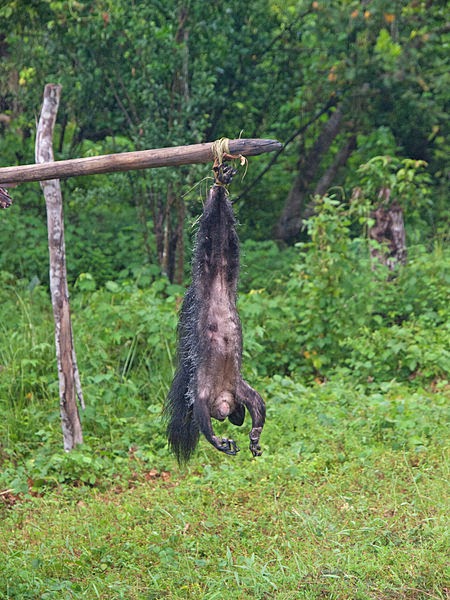
The aye-aye is classified as near threatened on the IUCN list, mainly because of destruction of its habitat.  However, also contributing to its decline is the superstition of the local people.  Some view the aye-aye as a bad omen and it is killed on sight.  Others believe that if the Aye-aye points its middle finger at you then you are doomed to die early.  Some even say if an Aye-aye ventures into a village then a villager will die.  They believe the only way to prevent this is to kill the Aye-aye.


Locals will kill the aye-aye and hang it up so its evil spirit can be carried away by travelers.
Captive breeding of Aye-ayes has aided in the conservation of this species, primarily at the Duke Lemur Center in Durham, North Carolina.  They were responsible for the first Aye-aye born into captivity and studied how he and the other Aye-aye infants born at the center develop through infancy.

Watch this interesting video of an Aye Aye procuring a meal.

Submitted by Sara Oliver, World Bird Sanctuary Naturalist