Saturday, June 7, 2014

Spring Migration Blitz Nets Record Numbers


How do they do it?  Millions of tiny songbirds migrate thousands of miles from their wintering grounds in Central and South America to their nesting grounds in North America each spring.  Studies show that they often take longer routes to take advantage of jet-stream patterns to save energy.

Blackburnian Warbler (photo:  Valerie Geile)

This spring brought many, many birds along the Mississippi River flyway to the mist nets at the World Bird Sanctuary (WBS).   A record number of migrating birds were banded at WBS from April 21 through May 12 this year.  Sixty different species were captured, and a total of 853 birds were encountered in all!  Last year’s total was 675 birds which was significantly more than the average of 300 birds per previous season.

Cerulean Warbler (photo: Linda Tossing)

Of the 60 different species banded, there were 23 different warbler species.   The most commonly caught were Tennessee Warblers (183) and Nashville Warblers (120), both numbers up from last year.  Special birds caught in the spring of 2014 include a Cerulean Warbler (the first ever caught at WBS), a Blackburnian Warbler, and a Wilson’s Warbler.

Wilson's Warbler (photo: Laura Bailey)

In a wooded ravine at WBS, banders opened 24 mist nets before sunrise daily for three weeks to see what birds might drop by.  These 10-foot high nets look like a combination of a badminton net and a Roman shade.  Since the nets are hard to see, birds fly into a net and drop into a pocket.  They are then carefully extracted, identified, measured, assessed, banded, and released.

The statistics collected were submitted to a database under the auspices of the Bird Banding Laboratory, part of the United States Geological Survey (USGS).  The USGS issues permits to qualifying banding organizations that place uniquely numbered bands on captured birds.  If a banded bird is recaptured, it is interesting to find out where it has been or how long it has been in our area.  The data accumulated from this study could be useful to monitor population growth or decline for various species, their life spans, migration paths, and survival rates. Changes in habitats for bird species may be reflected in capture numbers as well.  Banding is thus an important tool to further the understanding of bird populations.

Chestnut-sided Warbler (photo: Susan Eatoon)

Why would a bird leave comfortable territory to travel to parts unknown?  There is a greater chance of survival and success in finding food and shelter when there are separate breeding and wintering grounds.  In the spring a different food source becomes available in the new location and there is less competition for nesting sites.  With colder temperatures a return to warmer climes is necessary.  Change in day length, temperature, amount of food available, and genetic predispositions trigger migration.

Bird banders at WBS are dedicated to monitoring bird numbers in the St. Louis area.  They not only band daily during spring migration but they also band weekly throughout the summer and fall.  Northern Saw-whet Owls are captured during special nightly sessions in October.

If you are interested in observing or helping with the capture and banding process, public demonstrations are conducted every first and third Thursday of June, July, and August near the wildlife hospital at WBS.  The World Bird Sanctuary is located off the Highway 44 North Outer Road, accessed at the intersection of Highways 44 and 141 near Valley Park.

For more information click here

Submitted by Mary Elise Okenfuss
             

Thursday, June 5, 2014

Why Birds? Why NOT Birds?


I am sure none of my old classmates would be surprised to see me working with animals today. I was the kid who volunteered to hold snakes and parrots during presentations even in elementary school.

Norbert the Bald Eagle gliding into the theater (photo: Carmen Volante)

Still, I get asked “Why birds?” often enough, and frankly struggle to come up with a short reply. Three general things do come to mind when I think about why I love birds and enjoy working with them, and I can conveniently use some of the birds gearing up for the World Bird Sanctuary’s Birds of Prey show at Boston’s Stone Zoo as examples!

The first reason I always give for my fascination with these winged creatures is simply the pure variety of birds in the world. It's thought that there are just under ten thousand living species of birds today. That's a number only surpassed by fish, insects, and spiders in the animal world.

Scarlett the Red-shouldered Hawk showing off her beautiful coloring (photo: Carmen Volante)

From Red-shouldered Hawks having slimmer, longer legs to better catch snakes and amphibians to Harris's Hawks hunting in groups to catch the elusive desert hare, bird adaptability has allowed them to occupy every environment and niche.

You may be thinking you see the same sparrows, robins, or finches in your backyard all the time, but take a walk to a nearby park or field and the occupants can change dramatically, no matter what time of year it is! This doesn't just apply to what the bird is eating either. Color, song, flight pattern, what a nest is made of – and keep your eyes and ears open and you may find those sparrows in your backyard are actually three different species.

Rio flying across stage (photo: Flannery O'Brien)

Of course, bright colors and flight are usually what people think of when picturing birds. Whether it's one of our raptors gliding over the seats or Rio the Red & Green Macaw flashing her colorful wings across stage, the beauty of birds easily grabs attention. Feathers have been a part of fashion for centuries, and I doubt I need to go into how our admiration of flying has played a role in human history.

I also can't help but throw the word cute in here. Has anyone else noticed owls taking over the fashion world lately? Even if someone is nervous around our larger birds, most cannot seem to resist an owl's fluffy appearance and huge eyes.

My final point is brains! I dare say that birds are greatly underrated when it comes to their intelligence. When flying in free-flight shows we rely on the birds to recognize their flying pattern well enough to not be looking to every perch or platform before finding the trainer, but also to wait for said trainer to call them to the spot before taking off.

Nemo the African Grey parrot responding to a cue word (photo: Flannery O'Brien)

It’s mostly common knowledge that parrots are smart enough to mimic human speech, but did you know there are crows in Japan that drop nuts in the road at red lights and wait for cars to crack them open when it turns green? Some wild Corvids (the family of birds that includes crows, ravens, jays, etc.) use twigs just like chimpanzees do to find insects! I am fascinated by how resourceful and quick birds can be. I could go on and on with particular species and examples.

Being a part of the summer live bird show is my way of hopefully rubbing some of my love for birds off on others, and maybe even inspiring a future wildlife rehabilitator or biologist. I don't expect everyone to run home and watch an avian documentary, but next time you hear a birdsong you don't recognize or glimpse a hawk flying overhead take a moment to enjoy the feathered part of our world.

Submitted by Carmen Volante, World Bird Sanctuary Boston Zoo Show Trainer


Tuesday, June 3, 2014

Amazing Opportunities


Working at World Bird Sanctuary has given me so many memorable experiences.
    
I’ve had the chance to dress up at a renaissance fair.  Doing shows in a dress was interesting and fun.  I also got to visit many of the other booths at the fair, and each had a lot to teach and show just as our World Bird Sanctuary displays and presentations did.

A Harris' Hawk landing on my glove during an education program 

I had the opportunity to go to Keokuk, Iowa for the Iowa Department of Natural Resources Eagle Days.  Here we did shows in a movie theater and made the front page of the local magazine.  We also got to see dances the Native Americans did to show their respect for the Bald Eagle.  At the Eagle Days there was also a group from an insect zoo.  We learned about different spiders, scorpions, and other sorts of bugs and creepy crawlies.

Educating an audience about Tawny Owls

My most recent trip was to Minnesota.  Here we did programs for Carpenter Nature Center.  Carpenter Nature Center has a lot of the same goals as WBS.  They are not as big as we are, so they asked us to come out and help spread the word.  Here I got to see how another nature center works.  I had the opportunity to go snowshoeing, see a wild Snowy Owl, and we got to eat in Wisconsin, so I can now say I have been to both states.  My favorite part of this trip was seeing the wild Snowy Owl.  Thanks to WBS I got to see an owl I would not have normally seen in Missouri.  When I went snowshoeing we were looking for other owls that had been seen in the area, such as Short- eared, Saw-whet and Long-eared Owls.
Tundra, WBS's female Snowy Owl--I actually got to see one in the wild!  (photo: Gay Schroer)

One thing that I’ve learned from all this is that everyone has something to teach and there is always something new to learn.  Though I went to these programs to teach the public about birds of prey and how they can help our environment, I came home having learned so much about so many other things. 

It makes me happy and excited that there are other people out there who work hard to teach others what they have learned.  If nobody stood up for what they believed then we would lose a lot of what we have in this world.

To see many of the birds mentioned in this article come visit WBS the next time you are looking for free outdoor entertainment.  We have many of these birds on display and easily visible to the public.

Submitted by Christina Rankin, World Bird Sanctuary Naturalist


Sunday, June 1, 2014

Eagles of the World: The White-tailed Sea Eagle


 The White-Tailed Sea Eagle, “Haliaeetus albicillo,” is a very large bird that is considered closely related to the Bald Eagle. 

Head shot - White-tailed Sea Eagle (photo: wikipedia)

Its wingspan can measure anywhere between five and eight feet in length.  This Eagle is known to be one of the largest Eagles in the world averaging slightly larger than the Bald Eagle.  Moreover, the White-Tailed Sea Eagle is ranked on average the fourth largest and fourth heaviest bird in the world.  The largest recorded weighed in at 17lbs.

Full body photo - White-tailed Sea Eagle (photo: wikipedia)

This Eagle is characterized by thick yellow beak and feet, broad wingspan, and large head.  The White-Tailed Sea Eagle has mostly brownish-gray plumage with the exception of a slightly lighter head and neck, dark, nearly black flight feathers, and its distinctive white tail feathers.  The average lifespan of a White-Tailed Sea Eagle is 21 years, although some have lived upwards of 25 years.

White-tailed Sea Eagle fishing (photo: wikipedia)

Like most birds of prey the diet of a White-Tailed Sea Eagle varies due to season and opportunity.  Because these birds inhabit mostly coastal areas, the majority of their diet is in the form of scavenged mammals, birds, or fish.  Any fish that is near the surface of the water is likely to fall victim to this large predator.  Their main source of food during the winter months consists primarily of carrion, although it seems they prefer fish and ungulates.  They have sometimes been known to target water-based birds as well as land birds.  They will repeatedly fly towards a water bird causing it to dive again and again until the bird has become exhausted and is no longer hard to catch.  Once the water bird has been killed the White-Tailed Sea Eagle will fly the prey across the top of the water to the shore where it will then be consumed.
 
These Eagles reach sexual maturity around 4 or 5 years of age whereupon they will then find a mate and pair for life.  If one eagle dies they are usually comfortable finding a replacement fairly quickly. 

Pairs usually produce between one and three eggs a year, which are laid about 2 to 3 days apart.  Once the eggs have been laid they are then incubated for another 35-40 days by both the male and female.  At 11-12 weeks the nestlings are now mature enough to feed themselves and promptly fledge.  The youngsters remain close to their nest for another 6-10 weeks, then leave their parents’ care completely.  Juveniles tend to disperse from breeding areas and become more migratory than the mature Eagles. 

Range of the White-tailed Sea Eagle (photo: wikipedia)

For the most part, these apex predators can be found mainly around Europe.  However, they have been known to range anywhere from Greenland to Southern China and often inhabit areas close to water. 

Cousteau, WBS's resident White-tailed Sea Eagle (photo: Gay Schroer)

The World Bird Sanctuary is fortunate to have one of these magnificent birds on our display line.  The next time you visit WBS be sure to stroll down the line to see Cousteau, our resident White-tailed Sea Eagle.

 
Submitted by Callie Plakovic, World Bird Sanctuary Outreach Coordinator

Friday, May 30, 2014

Memorable Moments


Working at World Bird Sanctuary has given me so many memorable experiences!

    
I’ve had the chance to dress up at a renaissance fair.  Doing shows in a dress was interesting and fun.  I also got to visit many of the other booths at the fair, and each had a lot to teach and show just as our World Bird Sanctuary displays and presentations did.

I had the opportunity to go to Keokuk, Iowa for the Iowa Department of Natural Resources Eagle Days.  Here we did shows in a movie theater and made the front page of the local magazine.  We also got to see dances the Native Americans did to show their respect for the Bald Eagle.  At the Eagle Days there was also a group from an insect zoo.  We learned about different spiders, scorpions, and other sorts of bugs and creepy crawlies.


My most recent trip was to Minnesota.  Here we did programs for Carpenter Nature Center.  Carpenter Nature Center has a lot of the same goals as WBS.  They are not as big as we are, so they asked us to come out and help spread the word.  Here I got to see how another nature center works.  I had the opportunity to go snowshoeing, see a wild Snowy Owl, and we got to eat in Wisconsin, so I can now say I have been to both states.  My favorite part of this trip was seeing the wild Snowy Owl.  Thanks to WBS I got to see an owl I would not have normally seen in Missouri.  When I went snowshoeing we were looking for other owls that had been seen in the area, such as Short- eared, Saw-whet and Long-eared Owls.

One thing that I’ve learned from all this is that everyone has something to teach and there is always something new to learn.  Though I went to these programs to teach the public about birds of prey and how they can help our environment, I came home having learned so much about so many other things. 

It makes me happy and excited that there are other people out there who work hard to teach others what they have learned.  If nobody stood up for what they believed then we would lose a lot of what we have in this world.

Submitted by Christina Rankin, World Bird Sanctuary Naturalist


Wednesday, May 28, 2014

Really Weird Birds: The Bee Hummingbird


Hummingbirds are not considered rare in the United States, but whenever I see one I get very excited!  They are just the type of bird that is so amazing, strange, and tiny, you just have to stop whatever you were doing, freeze and watch the beautiful creature until it buzzes away.

The Bee Hummingbird, native to the dense forests and woodlands of Cuba, is the smallest bird in the world.  It is also the world’s smallest warm-blooded vertebrate.  They are only two inches long and weigh 1.6 to 1.9 grams, lighter than a penny!  All hummingbirds can beat their wings so fast that to the human eye it is just a blur.  The bee hummingbird can flap its wings an estimated 80 times per second when flying and 200 times per second when mating.

Males are slightly smaller than females and can be easily mistaken for a bee as it buzzes quickly by.  During breeding season, males have a fiery red head and throat with elongated lateral feathers growing from their neck.  The remainder of his upper body is iridescent blue and the underside is gray white.  Females have iridescent green upperparts and whitish undersides.
Bee Hummingbird (photo: Wikipedia)
Bee hummingbirds have the highest body temperature of all birds at 104°F.  At night, in order to save energy, their temperature drops to about 66°F.  They mainly consume nectar and insects.  They can eat enough small insects to equal half their total body mass and drink eight times their total body mass in water each day.

Females alone build a tiny cup-shaped nest about one inch in diameter, 3 to 5 meters above the ground.  She uses bits of lichen, cobwebs, bark and soft plant fibers.  She usually lays two pea-sized eggs, which she solely incubates.  Chicks hatch after around three weeks and they have a full set of feathers within two weeks.

Bee Hummingbirds are considered “near threatened” by the IUCN Red List of Endangered Species.  Populations have clearly declined, caused by loss of habitat due to crop and livestock farming and timber harvesting.

The next time you visit the World Bird Sanctuary take a short break or have your lunch on one of the benches near one of our bird feeder areas.  If you watch closely you are likely to see a Ruby Throated Hummingbird—the only hummingbird native to the St. Louis, Missouri area.

Submitted by Sara Oliver, World Bird Sanctuary Naturalist


Monday, May 26, 2014

Chique, a Special Parrot

Chique is a Blue-fronted Amazon, and was given to World Bird Sanctuary by an owner that didn’t have the time for Chique anymore.  This species is also called the Turquoise-fronted Amazon.  

Blue-fronted Amazons are found in northern and eastern Bolivia, northern Argentina, Paraguay and eastern Brazil. They are one the best mimickers, next to the African Gray parrot.  They will live 40-80 years with proper care and diet.  They are the most common parrot kept in captivity.
A wild Blue-fronted Amazon in Brazil.  Photo: wikiepedia.org
Parrots need exercise, just like humans.  Providing them with chew toys and keeping them challenged by making them think about how to get to their food, instead of just putting their food in a bowl and giving it to them, is a good enrichment.  Creating fun puzzles for them to solve, and rewarding them for it, is great enrichment, too.   As long as you have the time to spend with them, they do make good pets.  Although they are great tempered, having a parrot is a lot of work.  They need lots of attention and care.  It’s a lot like having a child that never grows up, but you can also gain an unbreakable bond.  Parrots are very long lived, and may live longer than you, so you always want to have someone dependable to take care of your parrot in cases like that.
Blue-fronted Amazons are a common sight in Brazil, even in the cities in South America.  Photo: wikipedia.org
Blue-fronted Amazons are typically a very well mannered parrot.  Chique is very sweet, but is shy when it comes to new people.  She can say “How are you,” “What are you doing,” “Polly want a cracker,” and my favorite; ”What.”  Chique will say this when you are walking out of the room or when she can hear you, but you’re not paying attention to her.  She loves sunflower seeds and grapes as rewards. She is a quick learner and is very gentle.  She also has been trained to give kisses.
With almost any pet, you may think the animal will be awesome to have, but they take a lot of responsibility.  As you have read, it takes more than just feeding and watering to have any pet.  The next time you think you want a pet, do the proper research to make sure you are capable of meeting all their needs.
A pet Blue-fronted Amazon.  Photo: wikipedia.org
Submitted by Christina Rankin, World Bird Sanctuary Naturalist

Saturday, May 24, 2014

Special Delivery


Throughout my time at World Bird Sanctuary I have helped to transport many birds.  Every so often new birds arrive that are coming from someplace far away, so we receive them by plane.  If you think it is a hassle to pick up people from the airport, just wait until you are waiting for a bird to arrive!

Scarlett the Red-Shouldered Hawk (photo:  Gay Schroer)
I have picked up three different birds for World Bird Sanctuary during my time, and each one has been a different experience.  Scarlett, our Red-shouldered Hawk, was the first bird I was ever charged with getting from the airport, and I was very excited.  Of course since it was the first time that meant I had to first find the Air Cargo depot, which took me a lot of trial and error and some help from a (friendly) airport security guard.  Once I finally found my way to “Cargo City” it was a piece of cake.   I just gave them my confirmation number and they gave me my hawk.

Reese the Great Horned Owl (photo:  Leah Tyndall)
Simple and quick!  “Well, that was easy and totally repeatable,” I foolishly thought to myself.  Since things went swimmingly for my first go round (minus getting lost) I was eager to pick up the next bird (Reese, the Great Horned Owl) a month later.  As an added bonus I got to stretch my naturalist skills and tell everyone in the Air Cargo office all about Great Horned Owls.  He was a quiet little passenger on the ride back, except for the occasional hoot every time that I coughed.  Once again, I thought to myself that that was easy and if it needed to happen again, I was totally game!

Azizi, our young Abdim's Stork (photo:  Leah Tyndall)
Finally, on March 6 I had another chance!  We were getting a new, young Abdim’s Stork (native to Africa, but this one was hatched in Delaware) and he needed to be picked up from the airport.  His flight was supposed to get in at 6:30.   I would have to wait about an hour for him to go through security and then back to WBS.  I may have been so excited I jumped the gun and got there at 6:45, but I didn’t mind.  I figured I would just wait in the office and play on my phone…you can see where this is going, right? 

I sat down for a bit since I knew the stork wouldn’t be ready until later and watched people pick up their dogs.  At around 7 they asked for my confirmation number and told me that the plane had been delayed in taking off due to mechanical issues, so the bird arrival would be closer to nine.  An hour later I found out the stork was not due until 11!  The plane had taken off, returned to Dulles airport and was waiting to take off again!  At this point my phone decided it was a great time to flash low battery, so I pulled out my pocket logic puzzles, bought a soda and settled into my surprisingly comfortable chair.  The plane was delayed twice more. 

The office closed, although the wonderful people at United Cargo let me stay, and finally the plane arrived at midnight, and then I waited an hour for the stork to go through security.  Finally at 1:02 AM I glimpsed the little bundle of joy. 

We drove back in silence and bright and early in the morning I let him out of his crate.  As he chittered happily and flapped his wings to beg for food I realized all of the trouble was worth it.  He was precious, and so we named him Azizi, which means precious in Arabic.

Azizi, bravely checking out his new quarters (Photo:  Leah Tyndall)
Life with birds is never boring and not just training them. Each airport visit will always stick with me, whether it was the terror of being followed by Airport security, the quiet hoots from my back seat or the first time I laid eyes on a precious stork.  Despite my last trip, I’m psyched about the opportunity to pick up the next bird.

Submitted by Leah Tyndall, World Bird Sanctuary Naturalist/Trainer


Thursday, May 22, 2014

Spring Cleaning and the WBS Wishlist


It’s that time of the year when spring cleaning begins.

You may be downsizing, throwing away extra non-necessities or you are stumped as to where to take your extra or unwanted items.  Before you throw away anything check out the World Bird Sanctuary’s wish list.
Just a few of the many items on our wishlist (photo: Alisha Cole)

WBS is always in need of many items varying from toilet paper, spray bottles, paper shredders, vehicles, lawn mowers and distilled water to name just a few.  Our wish list is long and you may be surprised to find an item on the list that you happen to have extra of or no need for anymore.  For a full listing please click here to visit the World Bird Sanctuary website wishlist. 

If you don’t have any items for donation but still wish to help out the World Bird Sanctuary’s wish list, you can shop on Amazon and visit the World Bird Sanctuary’s Amazon wish list.  Here you can purchase any item(s) off the wish list to help the World Bird Sanctuary. Here is a quick link to the WBS Amazon wish list 

Your donations help make a difference for bird species worldwide and we are truly grateful for any donation of items/purchases online. 

Submitted by Alisha Cole, World Bird Sanctuary Social Media Intern

Tuesday, May 20, 2014

North by Northeast


World Bird Sanctuary is 1,207 miles from Stone Zoo.  Every year we have to drive that far because we have our awesome bird show there during the summer.

WBS Director Jeff Meshach loading the truck for the long haul (photo: Mike Cerutti)

For the past 3 years I have driven this with Jeff Meshach, our director.  It is a long drive that takes us over twenty hours to complete.  This year it took us 22 hours and nine minutes, our fastest time yet.  We drive straight through, only stopping for food and gasoline.  We take turns driving to make sure that whoever is driving is awake and alert.

This sounds like a long and rough drive, but it’s actually a lot of fun.  It’s a time I get to talk to my boss about everything non-work related.  During the winter I try to keep small talk with Jeff to a minimum, just so we have more to talk about during that drive.  We get to discuss movies, sports, music and just about any little thing that crosses our minds.
We saw a Rough-legged Hawk like our beautiful Bella (above) (photo: Gay Schroer)

We also get to see a lot of different bird species during this trip.  We see countless birds, but I pay close attention to the raptors that we see.  There are always Red-tailed Hawks, Turkey Vultures and Bald Eagles.  However, this year we got to see a Rough-legged Hawk fly over the highway right in front of us!  At first glance we thought it was just another Red-tailed Hawk, but after seeing its dark bellyband we were sure it was a Rough-legged Hawk.  It was the first time I have ever seen one in the wild, so that was special for me.
In Indiana we spotted an American Kestrel like our own Detour (above) (photo: Gay Schroer)

I was keeping an eye out for American Kestrels all the way into Indiana before we actually saw one.  There were also a few Red-shouldered Hawks, which happen to be one of my favorite hawk species, and my favorite native to Missouri.
We also saw Red-shouldered Hawks like our own Flip (above) (photo: Gay Schroer)

My favorite state to drive through on this trip has to be PA.  It has smooth highways and fantastic views as you drive through the Appalachian Mountains.  As you come over the top of a mountain and see the beautiful view into a valley, it almost takes your breath away.  But as beautiful as it is, it can be terrifying.  This year a deer decided to meander onto the highway, and stopping a truck full of birds hauling a car on a trailer isn’t a simple task.

This year Jeff and I were both hoping to see a Black Bear while on the long haul, but no dice.  I’ve only ever seen a Black Bear once in the wild in my life, and they will always be my favorite animal in the world.
We pulled into Stone Zoo in the early morning hours (photo: Mike Cerutti)

Near the end of our journey we always have energy drinks to make sure we “hit our second wind”.  As we are coming East on I-90 we watch the sun rise over Boston in the distance, a pretty cool sight.  Finally, as we pull into the zoo, I feel a sense of accomplishment.  I also start to feel a little nervous, for while I’m happy to be back doing zoo shows, this will be my first year supervising one.  But that’s a story for another blog.

So, if you’re in the Boston area this summer be sure to take a day to see the Stone Zoo, and in particular the Birds of Prey Show presented by the World Bird Sanctuary.


Submitted by Mike Cerutti, World Bird Sanctuary Stone Zoo Show
 

Sunday, May 18, 2014

Baby Season


With the passing of a long winter, spring has finally sprung.  We are now entering the season that most of us at WBS have nicknamed “The Baby Season.”

With birds of prey, which species will arrive when at WBS’s Rehabilitation department is pretty predictable.  First will be the native owl species, then around mid-May the native hawk, falcon, and eagle species will start showing up.  There are some simple yet very important steps to take if a baby bird of prey were to show up in your neck of the woods.

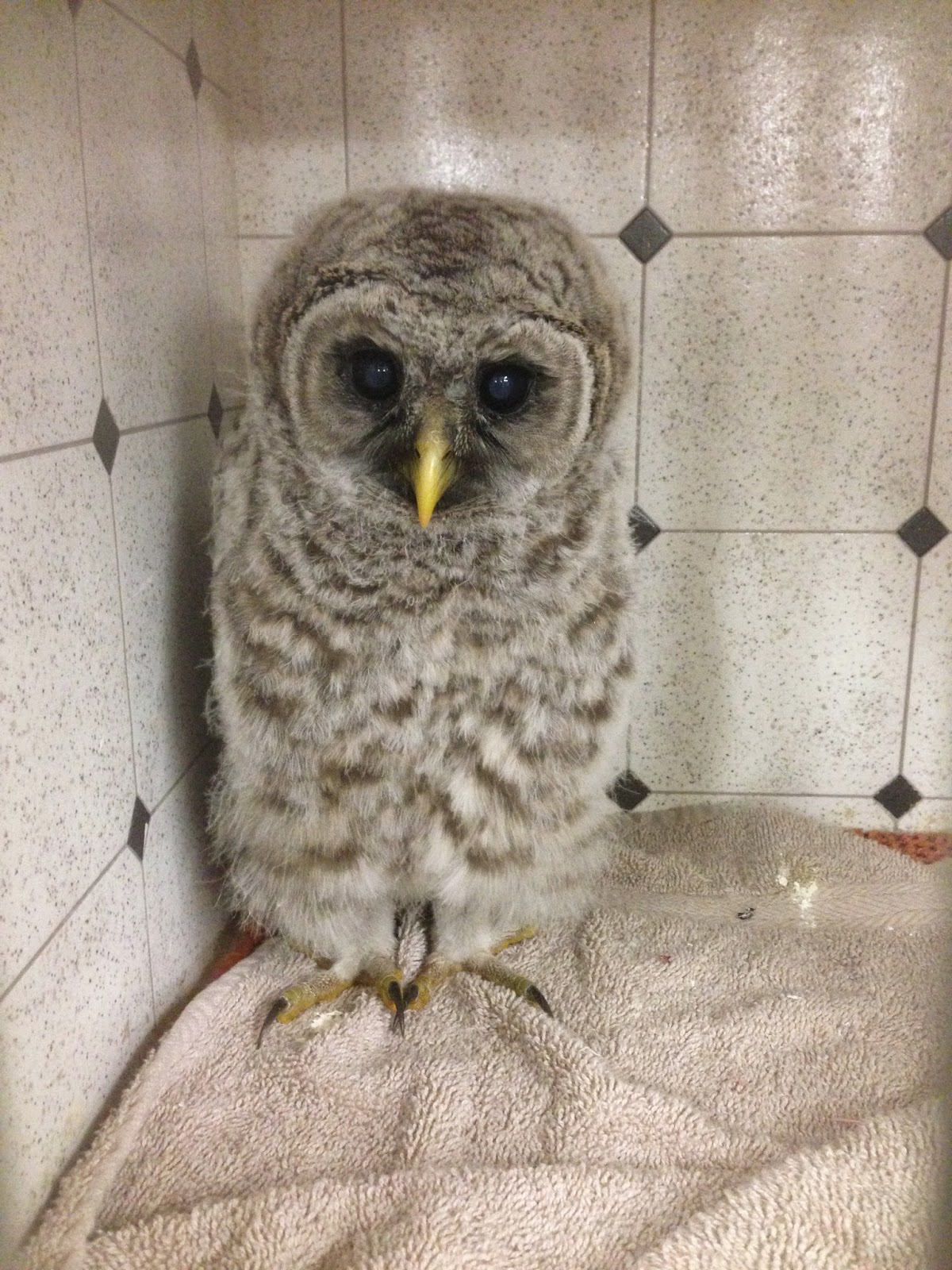
Baby Barred Owl (photo:  Adam Triska)

The World Bird Sanctuary is home to the Catherine G. Favre Wildlife Hospital, where we specialize in the rehabilitation of sick and injured birds of prey.  Around this time of year we experience a particularly high influx of birds to treat in the hospital.  Because of limited funds and manpower, we cannot go out on individual calls to bring back birds ourselves.  We must rely almost exclusively on the individuals who discover these birds.  We examine the birds to look for any ailments or injuries here in the Wildlife Hospital.  After the initial examination, we go on to determine what should be done in the best interest of each individual bird.

While instinct may lead you to want to pick up a cute, fluffy, lonely baby birdie, it may not be a smart idea.  The parents are usually in the area, and unlike smaller songbirds, bird of prey parents may be aggressive and quite dangerous.  I caution you to only intervene if the baby bird appears sick or injured.

Unlike the parents of these baby Bluebirds, bird of prey parents may attack would-be rescuers (photo: Adam Triska)

The most beneficial action to take if you were to stumble across this situation would be to call us here at the World Bird Sanctuary, while keeping your eyes on the bird.  One of our representatives at the Wildlife Hospital can walk you through what to do next.

If that isn’t possible, try to answer these three very important questions:
1. Are the parents nearby? 
2. Is it safe and necessary to remove the baby from its natural habitat?
3. Is the bird able to fly?

If the parents are in the area actively feeding and guarding the baby, it would be best not to disturb the family and to let nature take its course.  For the first several days after leaving the nest, baby birds aren’t usually very skilled at flying.  In this case we would instruct you to return the baby to a safe place near or at the location where it was found.  If the bird can stand well, put it on a low branch, top of a fence or the top of a shed, so it isn’t as vulnerable to ground predators.  Be careful if you have to leave the ground to place the baby.

If it is indeed necessary to rescue the baby bird, there are again precautions to consider.  The equipment needed to capture a baby bird includes:
°  A good pair of leather gloves (welding gloves or garden gloves)
°  A towel, sheet or jacket of some sort
°  A box with a closeable top for transportation that is large enough to hold the bird

Once you have contacted the World Bird Sanctuary and explained the situation, if the suggestion is to bring the bird to the Wildlife Hospital you need to gather your supplies and do the following:

°  Put the gloves on and slowly approach the bird with the sheet/towel/blanket/jacket spread between your hands.
°  Then simply drape the sheet over the baby and grab for the feet.
°  Once you have a good hold of the feet you can place the bird and the sheet into the box. Make sure that you always have someone else with you when handling a wild animal.
°  Once the box is sealed, as soon as possible make arrangements to get the bird to WBS or another Wildlife Hospital that accepts birds of prey.
 
In closing, I’d like to remind everyone that it is unlawful and morally incorrect to keep a baby bird as a pet. Birds of prey are protected under federal and state law, and require specific diets so they grow correctly.

Submitted by Adam Triska, World Bird Sanctuary ETC Supervisor