Monday, April 6, 2015

World Eagle Day A Huge Success


World Eagle Day a Huge Success

This year’s World Eagle Day event on March 29 at the World Bird Sanctuary was a resounding success!  We had record attendance.

This could have been you feeling the rush of air created by a free flying Bald Eagle (photo: Gay Schroer)

Young and old alike took advantage of the ideal weather and joined us for a day of outdoor fun.  Eagles from around the world were on display—some at a mere arm’s length, and our free flying Bald Eagle, Clark, amazed the crowds by swooping just over their heads.

In case you were unable to attend or live too far away, Click Here to see the Show Me St. Louis segment, which aired on KSDK Channel 5 on March 27.   You’ll see what World Eagle Day is all about.  

We would like to take this opportunity to thank all who attended, the staff and volunteers who made this event possible, and the local television stations that helped us to get the word out.  We would also like to thank Ameren Missouri for sponsoring the event.

Be sure to check out the World Bird Sanctuary Calendar for other exciting events coming soon. 


Submitted by Gay Schroer, World Bird Sanctuary Volunteer/Photographer


Saturday, April 4, 2015

Meet Kahn


Basking comfortably in the warmth of his large cage in the Nature Center at World Bird Sanctuary, you will find Kahn, the albino Burmese python.  Kahn has been a resident of the sanctuary since about 1998, when he flew to St. Louis from Rapid City, South Dakota in the coat pocket of Walter C. Crawford Jr.

Kahn, World Bird Sanctuary’s Albino Burmese Python (photo: Dawn Griffard)

Kahn is an albino Burmese Python (Python bivittatus).  The term albino refers to the fact that this particular animal lacks pigment in his skin.  In animals, albinism is a hereditary condition characterized by the absence of pigment in the eyes, skin, hair, scales, feathers or cuticles.  It is a recessive gene (meaning the gene’s traits are rare to see) passed down by one of the parent animals.
 
Unfortunately, albino animals do not fare well in the wild.  They fall easy prey to predators since they have much difficulty camouflaging their bright body color. 
Normal color Burmese Pythons may be pale tan, yellowish-brown or gray.  On top of this base color are large reddish blotches outlined in cream or gold.  Kahn does have the Burmese Python blotches, but they are the same yellow as the rest of his body and are outlined in white.  His eyes are pale red instead of gold.

Burmese Pythons are one of the largest snakes on Earth, averaging 16-23 feet in length and up to 200 pounds.  Their girth can be as big as a telephone pole.  Female Burmese Pythons are the larger of the two sexes and usually have a different coloration and a smaller head relative to the body.
If you are considering a Burmese Python, remember that they can reach 23 feet long, weigh up to 200 lbs., and live as long as 30 years--are you ready for that responsibility?

Our Kahn weighs about 70 pounds and is 12 feet long.  He was the runt of his litter and was not doing well when he was hatched at Black Hills Reptile Gardens, so Executive Director Walter Crawford, offered to bring him back to WBS for some focused attention.  He arrived at the sanctuary when he was only 12 inches long.

The life span of these snakes is 20-30 years.  Since our Kahn is only about 16 years old, he has a long life ahead of him!

Burmese pythons are indigenous to southern China, Burma, Indochina, Thailand, and the Malay Archipelago. These snakes generally live in rainforests near streams, although they survive in a variety of habitats, such as grasslands, swamps, marshes, and rocky foothills.   Populations are dependent upon a permanent source of water.  Interestingly, Burmese pythons are excellent swimmers and can stay underwater for up to 30 minutes before surfacing for air.  They use their powerful body muscles to flow gracefully in the water.


Kahn in his swimming pool (photo: JoHanna Burton)

They have very poor eyesight, but can use the special chemical receptors on their tongue and the super-sensitive heat-sensing pits around their mouth to find food.  Pythons are constrictors, which means they grab their prey with their teeth and coil their muscular bodies around it and squeeze until the prey is suffocated.  Because they don’t use venom, they do not have fangs.  However, they do have many rows of backward curving teeth that allow them to grab prey and not allow it to escape.

In the wild, Burmese pythons will eat small mammals, reptiles and birds.  They swallow their prey whole and spend the next several days to weeks keeping warm enough to digest their meal.  Like most snakes, Burmese pythons can unhinge their jaws and have special ligaments that allow them to swallow an animal four to five times as wide as their heads.

Our Kahn eats pre-killed food items, which are much safer than live prey.  Snakes that are born into and live in captivity generally lose some of their wild inborn ability to catch and kill prey items quickly and efficiently.  Because of this, they can often be bitten by that prey animal.  In turn, that bite may turn into a dangerous infected wound.  The snake may also react to such an attack by learning that the smell of that prey animal means “fear and injury” instead of “food”; subsequently becoming a problem eater.


Closeup of Kahn (photo: Dawn Trainor Griffard)

The plight of the Burmese python in the wild is extreme.  Native populations are considered to be threatened and are listed on CITES (Convention on International Trade of Endangered Species) Appendix II.  Although the snake is widespread throughout their range, they are diminishing in numbers.

Hundreds of thousands of these snakes are killed for their skins – which are made into accessory items such as shoes, boots, belts and other items.  Their blood and gall is used in folk medicine, and for “snake wine” in Viet Nam.  Young snakes are captured and sold in the pet trade.  Some snakes are commercially bred for these purposes, but too many are still removed from the wild.

Conversely, non-native populations of Burmese pythons are booming as an introduced species in southern Florida.  Populations begun by overwhelmed and irresponsible pet owners, who thought it was a good idea to release their pet snakes when they got too big to handle, have flourished in the warm and humid Florida climate.  These unnatural introductions are having devastating consequences on the Florida ecosystem.  Preying on many different native species and therefore competing with the native natural predators, these Burmese Pythons are seriously impacting the natural order of the ecological community.  Over 2,000 Burmese pythons have been removed from Everglades National Park.   Although the Burmese Python will likely never be eradicated from south Florida, the National Park Service has been taking great strides to manage the existing population.

If you are considering a snake as a pet please remember that this species grows too large for most home environments (Photo: Gay Schroer)

Considering these grim facts about our wild Burmese pythons, it seems they will never be seen in a good, respectful light.  Snakes are often not seen as desirable, important creatures overall, but they serve a great purpose to their native environments, as rodent control for one example.

Our Kahn is an important symbol for the exploited native wild animal populations that are disappearing quickly on our planet, and as one who has unwittingly become a “nuisance animal” as an introduced species by the irresponsible human hand.

Please consider showing your support of this troubled species by adopting Kahn into your family today.  Your $50.00 adoption fee will help feed, house and care for Kahn in the coming year.  Your donation will make a great difference.   Kahn does not yet have a family of his own, and it would be wonderful to have his nobility recognized!

Submitted by Dawn Griffard, World Bird Sanctuary Naturalist

Thursday, April 2, 2015

Birds on the Line: Thick-billed Parrots


This year I will be talking about some of the many birds you will encounter as you walk down the World Bird Sanctuary’s exhibit line just beyond the Wildlife Hospital.  The first bird I have chosen to talk about is not an individual, but an entire flock.  They are the Thick-billed Parrots that live on the exhibit line in a large flight cage.

Closeup of one member of our Thick-bill flock (photo: Cathy Spahn)

The Thick-billed Parrot, Rhynchopsitta pachyrhyncha, is a highly endangered species.  They are the only remaining parrot that is Native to the United States.  They were originally found in Arizona and Mexico.  Today they are only found in Mexico. 

Our free flying flock of Thick-billed Parrots (photo: Gay Schroer)

The wild population of this amazing bird number only 500 to 2,000.  The Thick-billed Parrots that we have at the World Bird Sanctuary are mostly from confiscated birds that were brought into the United States illegally.  Some individuals are from other collections of single birds, and a few in the flock have hatched at World Bird Sanctuary. 

In the United States, the Thick-billed Parrot was hunted to extinction.  In Mexico, the biggest threats to the existing Thick-bill populations are logging and trapping for the pet trade.  Logging has changed the composition of the forests and decreased the Juniper forest, which provides food and nesting cavities for these parrots.  Insects have increased due to climate change created by the logging, which in turn changes the habitat.  The climate change and damage to the forest from both insects and logging have then resulted in an increase in the number of forest fires.  The increase of fires to the forests and the increase in insect populations may cause the biggest threat to the Thick-bills. 
A pair of Thick-bill sitting on a branch in their flight cage (photo: Cathy Spahn)
 Thick-billed Parrots may be identified by their bright green color, large black bill, the distinctive red crown, shoulders and thighs, and the yellow patch under the wings.  They live at high elevations (6,000 feet and higher) in the pine forests in the mountains of Mexico.  They are also known as the Christmas Parrot, because of their colors and the fact that they will often play in the snow.

Efforts are under way in Mexico to try to save this species, and groups here in the United States are again working to try to figure out a way to reintroduce birds into their former habitat in Arizona.  In the late 1980’s World Bird Sanctuary helped the Arizona Fish and Game Department, the U. S. Fish and Wildlife Service and the U.S. Forest Service with efforts to reintroduce Thick-billed Parrots back into the mountains of Arizona.  Several youngsters produced from WBS’s flock were released to the wild.  However, for various reasons, the reintroduction did not work.  Hopefully this time, having learned from the former attempt, we will have more success.

A pair of Thick-bills peeking out from their nest box at WBS (photo: Cathy Spahn)
 Here at the World Bird Sanctuary we have a large enclosure with a free flying flock of Thick-billed Parrots.  It’s always a treat to watch them flying and interacting with each other as they would in the wild.  During the winter you may see them early in the morning as they leave their night roosts looking for breakfast.  They are often heard more than seen.  They love their nest boxes and can often be heard “laughing” (yes, their voice sometimes sounds like a human laughing) inside the boxes.  They also like to sit in pairs high in the cage, so be sure to look up. 


Arizona, WBS’s Education Ambassador (photo: Gay Schroer)
 During the summer you can also meet Arizona, a Thick-billed Parrot that is one of our Education Department birds.  He lives in the Nature Center and likes to greet our visitors when he is not traveling to one of our outreach programs.  Arizona, as well as all of our other resident animals, is available for adoption as part of our Adopt A Bird program.  If you choose to adopt Arizona your adoption donation will help to feed, house, and care for him throughout the coming year.  Of course, if you are so inclined, there is always the option to adopt the whole flock!

Submitted by Cathy Spahn, World Bird Sanctuary Naturalist

Tuesday, March 31, 2015

Why is that bird Tethered?


One of the most common questions we receive at World Bird Sanctuary is, “Why is that bird tethered to its perch?” 

Solo, a juvenile Peregrine Falcon on his perch (photo: JoHanna Burton) 
Birds of prey differ from other types of birds such as waterfowl and songbirds.  You can look out your window and see songbirds flying around and very active.  Raptors actually spend most of their day perched in trees, conserving energy, and waiting for food to enter their hunting field of view.  In fact, birds of prey spend about 80-95% of their day perched.  They only fly when necessary such as to avoid a predator or catch a meal.

Many birds of prey are sit-and-wait type predators, including species such as the Red-tailed Hawk.  This means that the bird will sit perched to watch for potential food sources, waiting to fly until there is a chance at a meal.

A Cooper’s Hawk scanning the area for prey (photo: Gay Schroer)
When you do see most birds of prey flying, often you will notice that they are not flapping their wings extremely often.  To save energy, raptors will ride thermals (warm currents of air rising from the ground) that enable them to soar and glide effortlessly and cover great distances.  The Turkey Vulture is a prime example of this behavior.  The less a bird has to flap its wings, the more energy it saves.

A Turkey Vulture riding the air currents (photo: Gay Schroer) 
Tethering birds of prey is a practice that has been used by falconers for about 4,000 years.  Each bird has its own specially crafted equipment made from soft leather, sized specifically for that species.  The health of each bird is priority, and tethering is one method that is used to keep healthy birds.  Our birds are constantly monitored throughout the day for any sign of mental or physical stress.  By placing a raptor on a perch, we are able to mimic their natural perching behavior.  At World Bird Sanctuary, our birds tend to double or even triple the lifespan of a wild bird.  This can only be accomplished in healthy, stress-free animals.

Data the Eastern Screech Owl (photo: JoHanna Burton) 
Although we do have our birds tethered out in the open for visiting hours, the birds do not stay out continuously, and they do come in before closing.  We also take outdoor temperature into consideration as to when we put our birds outside on the perches.  On extremely cold days, you may find that we only put out certain birds such as our Snowy Owl, Tundra, which is perfectly adapted for the cold weather.  We also free fly many of our birds on a daily basis to help maintain good physical and mental condition.  You can often see this taking place at the Nature Center in the afternoons.  As mentioned before, raptors only fly when they need to, and our birds fly for tasty treats of meat.

Oracle, a dark phase Augur Buzzard (photo: JoHanna Burton)

The next time you visit World Bird Sanctuary, be sure to check out our weathering areas containing our tethered birds of prey.  If you have any questions, feel free to ask our knowledgeable staff and volunteers.  We would be happy to talk to you!

Submitted by Paige Davis, World Bird Sanctuary Naturalist

Sunday, March 29, 2015

Can You Hear Me Now?


In the course of a year the World Bird Sanctuary presents upwards of 600 outreach programs—a large majority of them presented in school gymnasiums.  We generally talk with groups of school children or scouts, with a group size of up to 250 people.

It is very important for our Naturalists to be able to use hands-free belt pack amplifiers so we’re heard by the children and teachers, especially once one of our trained flying birds glides over the top of the school children and the children get excited.  It is important to be able to use both of our hands to fly the birds.

When handling free-flying birds it is imperative to have your hands free—note the amplifier belt pack worn by the trainer (photo: Gay Schroer) 
Unfortunately, we have literally worn out our last 3 sound systems.  We are in dire need of 3 brand new Waist Band amplifiers—the kind that have the belt to clip to our waists.  If you would like to help World Bird Sanctuary with our Mission of Conservation Education, these amplifies are some of our most immediate needs.

Our worn out microphone systems (photo: Michael Zeloski) 
New sound systems may be obtained for prices ranging from $110 to $250.  Various companies manufacture these amplifiers.  Some of the companies in business now are Chattervox, or Sonivox or Amplivox.  You can peek at the systems on the web to see which sound system you could help us fund.

Please hear my plea.

If you would be willing to help us fund the purchase of new amplifiers for our hands-free audio system please call us at 636-225-4390, X 104 or send your check to World Bird Sanctuary, 125 Bald Eagle Ridge Road, Valley Park, MO 63088.  If you would prefer to donate by credit card or check you can make those arrangements by calling the above number.

Thank you for helping us to fulfill our mission.


Submitted by Michael Zieloski, Director of Education

Friday, March 27, 2015

World Eagle Day 2015


It’s finally here!

Are you tired of winter?  Ready to get outdoors?  Suffering from LDS (Light deficiency syndrome)? Cabin fever?  Well the World Bird Sanctuary has just what the doctor ordered—a chance to get out of the house into the fresh air and enjoy one of the area’s most popular Spring events—WORLD EAGLE DAY!!
See Clark, one of our team of free flying eagles, soar right over your head (photo: Gay Schroer)
COME CELEBRATE SPRING WITH US WHILE THE WORLD BIRD SANCTUARY’S FREE FLYING EAGLES SOAR OVER YOUR HEADS!

On Sunday, March 29, The World Bird Sanctuary will celebrate World Eagle Day.  In addition to our national symbol, the Bald Eagle, this is your opportunity to see a number of other species of Eagles from around the world!  

Mark your calendars—World Eagle Day is March 29, 10:00 to 4:00!!
Our naturalists will be glad to answer questions or give you an up close photo opportunity (photo: Sandra Lowe)
World Eagle Day is one of our most popular events.  It’s a chance for everyone to get out of the house after a long cold winter and enjoy the outdoors with us.  Be prepared to celebrate everything Eagle—from close-up encounters with eagles from around the world to having an eagle soar overhead--close enough to feel the draft from its wing beats.
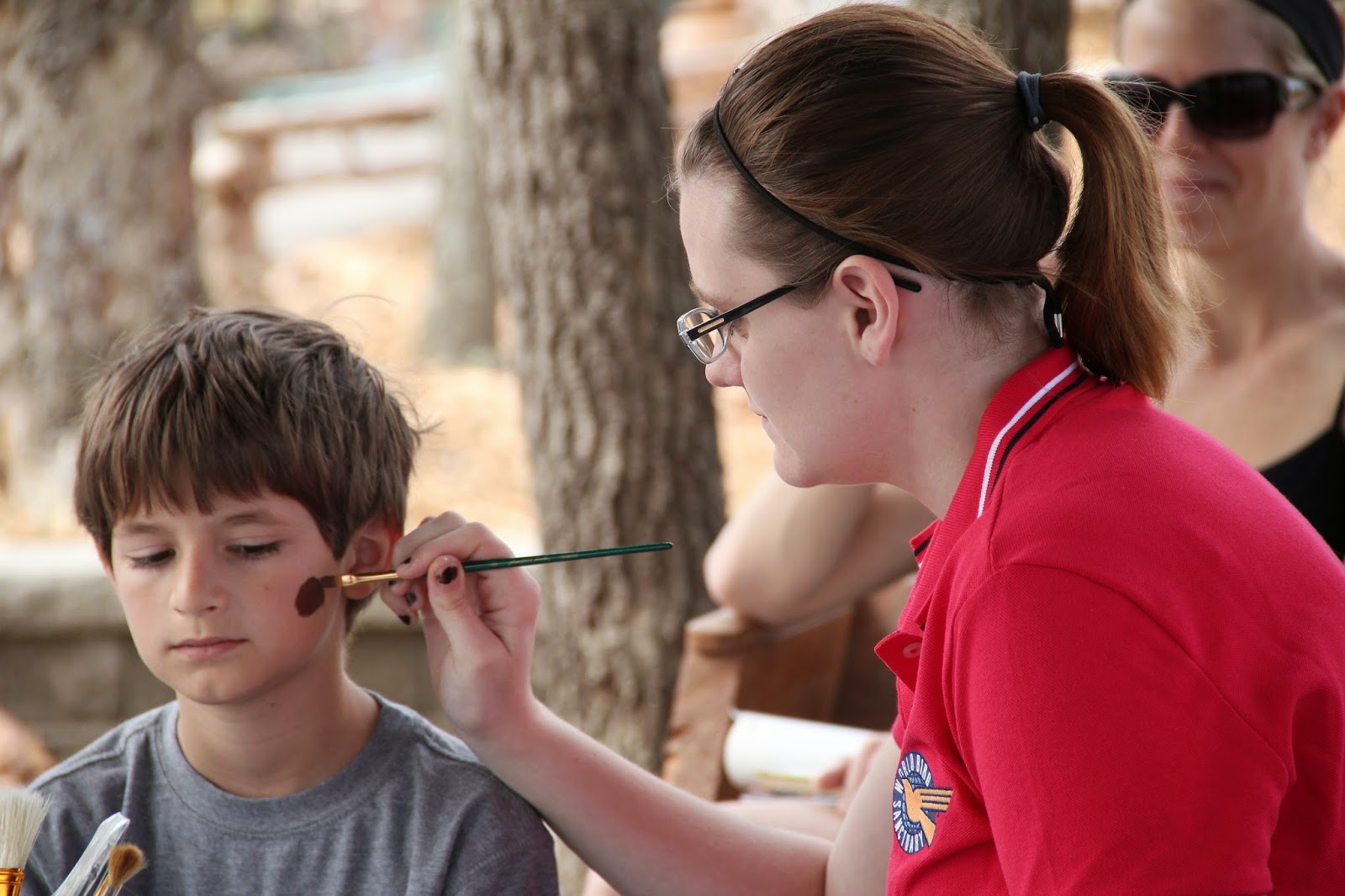
Kids of all ages can have their faces painted (photo: Sandra Lowe)
There will be face painting, crafts for the kids, flight demonstrations by our free flying eagles, the opportunity to have your photo taken with a Bald Eagle, and much more.  Our gift shop will have special eagle-related merchandise for those wanting souvenirs.
Have your photo taken with a live eagle for a small fee (photo: Gay Schroer)
As a special treat this year members of SIA: The Comanche Nation Ethno-Ornithological Institute, will discuss the unique importance of eagles to Comanche culture.

So, mark your calendars. 

WHEN?   March 29
TIME?      10 AM to 4 PM
NEED DIRECTIONS?  Click Here  
Be sure to bring your camera (photo: Sandra Lowe)
Be prepared to spend the day with us learning about these magnificent creatures.  Bring a picnic lunch, or take advantage of food and beverages from our food truck.  Bring your cameras and take photos of the kids in our simulated eagle’s nest.
You may be lucky enough to see one of our birds take a refreshing bath (photo: Sandra Lowe)
Dress for the weather and be sure to wear comfortable walking shoes as there is much to see, and most of the events will be outdoors.

As always, admission and parking are FREE!

For the safety of our birds and our other guests, please no pets.

Submitted by Gay Schroer, World Bird Sanctuary Volunteer/Photographer

Wednesday, March 25, 2015

Bird Nests


Birds are amazing and versatile creatures.  One versatile thing about birds is the differences in the nesting requirements of the various species. 


Bald Eagle at a nest in Kodiak, Alaska (photo: Gay Schroer)
Birds build all kinds of nests.  For example, Bald Eagles build the largest nests of any bird of prey in the world.  Constructed primarily of large sticks and branches, these nests may be used and added on to for many years.  The largest one ever found was about ten feet across, twenty feet deep, and weighed almost three tons!  The nest can become so heavy that it may eventually topple the tree in which is it built.

Conversely, the smallest bird nest is built by the Cuban Bee Hummingbird.  On average they are less than one inch wide and less than 2 inches deep...quite the difference. 

In my opinion one of the most interesting and unusual nests is built by the Sociable Weavers.  The entire bird colony builds the nest, and it can house up to one hundred birds.  Not only are these nesting colonies very large, but some have been observed to be occupied for over one hundred years!
This colony of swallows have built their nests under a highway overpass (photo: Gay Schroer)
However, not all birds build nests in trees.  Many birds, like Gyrfalcons for example, build their nests on the sides of cliffs and have eggs that are less round so they won't easily roll off the cliff.  Snowy Owls, along with many other birds, will make a “nest” on the ground by digging a small scrape in the ground.

This Great Horned Owl commandeered a nest built by hawks the prior year (photo: Gay Schroer)
Not all birds build their own nests either.  Great-Horned Owls will use the nests of Red-tailed Hawks, and Burrowing Owls will use the burrows of small mammals.  Unfortunately, a large number of bird nests are destroyed each year by humans. 

One way to help out birds during nesting season is by building or buying a nest box--a small wooden box designed to fit the requirements of certain species of birds.  You can stop by World Bird Sanctuary to buy a nest box for your feathered friends, or if you're more into Do It Yourself, WBS has pamphlets that show you how to properly build a nest box yourself.

Submitted by Mike Cerutti, World Bird Sanctuary Naturalist/Trainer


Monday, March 23, 2015

Avian Diseases: Psittacosis


Our staff, interns and volunteers here at the World Bird Sanctuary go to great lengths to make sure all of our birds are happy and healthy.  We are lucky to have veterinarians who assist us in learning about potential diseases and in keeping a close eye on our birds.


Psitticosis is most commonly associated with Parrots, thus the name Parrot Fever (photo: Gay Schroer)
One disease that may be of particular interest to our readers who are bird owners is known as Psittacosis, or “Parrot Fever.”  Contrary to the way it sounds, “Parrot Fever” is not the overwhelming desire to purchase or own many pet birds!  It is a disease that was discovered in 1879 by Robert Koch, and is caused by a bacteria known as Clamydia psittaci.  The name, Psittacosis, is derived from the Greek word for parrot, psittakos.

Although named for the parrot family (and sometimes identified in parrots, especially those that have been imported), many species of birds can contract this disease, including even chickens and pigeons.  Symptoms in birds may include respiratory signs like nasal discharge, sneezing, or wheezing; there may also be gastrointestinal signs like loss of interest in food and discolored droppings.  Birds with Psittacosis may have other signs and symptoms as well, like lethargy (acting sluggish) and weight loss, and sometimes birds may have very little in the way of symptoms, but still have the disease within them.

Other species that can contract this disease, including pigeons, chickens and even humans (photo: Melissa Moore)

The good news is that Psittacosis can be diagnosed with tests administered by your avian veterinarian, and it is treatable with a course of antibiotics.  I am not aware of any vaccine for Psittacosis at this time, but the disease is considered fairly rare.  It is important to be aware of this disease, since it is considered a zoonotic disease, meaning that it can be transmitted to humans.  If you have any questions about Psittacosis in humans, please talk with your family doctor.

Like most other avian diseases, “Parrot Fever” is generally not something most of us at World Bird Sanctuary or most of our readers may ever encounter.  However, it is good to be informed, especially about those animals that are near and dear to our hearts, and often live with us in our homes.

Here are some online references to check out about Psittacosis:

Submitted by Melissa Moore, World Bird Sanctuary Chief of Operations in Education


Saturday, March 21, 2015

Watching Birds Grow


Watching Birds Grow


One of the coolest things about being involved with the World Bird Sanctuary for a number of years is being able to watch birds grow and change. 

In addition to watching Goblin grow into an awesome flyer and show-bird, I was also able to watch Mortimer the Turkey Vulture and Wyatt the Harris Hawk grow up and end up being really fun to work with.  I also got to experience the differences in their “personalities.”
Naturalist Cathy Spahn & baby Mortimer just beginning to get his adult plumage (photo: Gay Schroer)
With Mortimer, I was around when he first began roaming the Nature Center with downy feathers, with some of his black feathers growing in, and a blackish face, nibbling at anything within reach.  He then progressed to being used in education programs as a bird which was walked around on a trainer’s glove, so he could get used to people.  During this progression, I was in college, which meant that I was unable to watch the changes like I could with Goblin.  Instead, I got to see the beginning bird and the end results for that time (which ended up being Mortimer making an appearance during the Open House program of 2012).  Then I went back to college for two years, but started working at the Nature Center during the summer of 2014.  I was re-introduced to Mortimer — this time with him flying perch to perch in programs, such as International Vulture Awareness Day. Of course he had grown up, and had that red face and white beak. 

Mortimer beginning to do education programs as a walk-on bird (photo: Sandra Lowe)

As I've had the chance to experience, his looks weren't the only thing that changed.  His “personality” has changed from a bird which was not totally used to being around people to one which was much more at ease with people.  In Mortimer's case, this means testing the people who are new to him by trying to see what he can get away with.  I found this out very quickly and learned not to let my guard down when working with him.  Somehow he seems to know when you're thinking about doing just that.

Watching Wyatt grow up was a lot different because I wasn't around nearly as much, so the progression I was able to watch was his transition between juvenile and adult plumage.  In the summer of 2012 he was given many opportunities to show off the beautiful markings of a juvenile Harris Hawk during Amazing Animal Encounters (free weekend summer shows sponsored by Ameren Missouri).

Naturalist Neal Cowan & Wyatt at a Birds in Concert show  (photo: Gay Schroer)

Then, during the same Open House program where Mortimer appeared, I got to see Wyatt flying again, this time over crowds at least four times as large as the Animal Encounters.  This didn't seem to bother him in the slightest, and he's proven to be a wonderfully reliable flyer throughout the entirety of his flying career.

Wyatt easily became my favorite Harris Hawk to work with.  This happened not only because of his cool iris color (tan, instead of the more common brown found in adult Harris Hawks), but also his “personality.”  Even during vertical flight practice when I wasn't ready for him to fly to me, he proved to be remarkably patient — seeing that I wasn't ready, he would circle back down to his perch, and wait for me to be ready before flying to me.  He kept this patience and added quick learning and adaptability to his list of good qualities.  He quickly adapts to different flights his trainers ask of him, showcased in a video you can see here, where he demonstrates how Harris Hawks adjust to flying over terrains that vary in heights. 

If you visit the World Bird Sanctuary when these two remarkable birds are not traveling to programs with their trainers you may be able to see both of these interesting birds, as well as numerous others which call the Sanctuary their home.

Hope to see you there!

Matt Levin, World Bird Sanctuary Naturalist