Showing posts with label Babies. Show all posts

Sunday, May 17, 2015

Babies Are Here!


If you’ve been watching our Falcon Cam, you know that the Peregrine Falcon pair at the Ameren MO Sioux Energy Center have been sitting on four eggs.

As of Saturday the babies had begun to pip their eggshells, and by Sunday morning there were four babies.  If you watch the Falcon Cam you may see momma sitting over her clutch to keep them warm, and occasionally you will see one or more babies peek out from beneath her feathers only to be tucked back in by mom.


2014 Photo of parent bird feeding babies (photo: WBS website)

If you’re really lucky you may just catch them when one of the parents returns to the nest with a pigeon or starling and feeds them.  At this time you will see a big ball of fuzz with anywhere from one to four heads ready and waiting for a meal. 

Once the babies have been fed the parent will fly off with the remaining carcass, either to finish off any remaining morsels or to dispose of the carcass somewhere other than the nest.  Shortly after that the parent will return to the nest and gather the babies to be tucked safely under the parent’s warm body.

The Falcon Cam is a cooperative effort between The World Bird Sanctuary, Ameren Missouri, and the Missouri Department of Conservation.

WARNING!!  FALCON WATCHING CAN BE ADDICTIVE!

 
Submitted by Gay Schroer, World Bird Sanctuary Volunteer/Photographer

Tuesday, May 6, 2014

GoFundMe: New Washer & Dryer Needed for Hospital


The World Bird Sanctuary is sorely in need of a heavy duty washer & dryer for the Wildlife Hospital.  It will cost $1,500.

Our old washer has died due to constant use and WBS staff members are having to drive off-site to keep up with the laundry.  The dryer also is on its last legs, barely hanging on by a string.
Baby Red-shouldered Hawk (photo: Catherine Redfern)

It’s now baby season and it is of vast importance to keep their areas clean in order to keep them healthy. Because these babies cannot yet stand, they spend a great deal of time lying down and need soft, clean towels and blankets to keep them warm.  Because this requires daily loads of laundry, a new heavy duty washer & dryer is a very important necessity for the WBS Wildlife Hospital.

Making a donation through GoFundMe is a safe and easy way to support World Bird Sanctuary.  GoFundMe guarantees a secure payment through encryption technology.  The site only allows Certified Charities like WBS to utilize its site.  GoFundMe has been recognized in Forbes, CNN, NPR, Time and many more.  Can you help us reach our goal?  Making a donation is not only safe, but quick and easy.
Baby Barred Owl with broken leg (photo: Catherine Redfern)

Please help us reach our goal to provide the World Bird Sanctuary Wildlife Hospital with a new washer & dryer for our new babies by clicking on the link!


Be sure to share the World Bird Sanctuary GoFundMe link with your friends and family. We appreciate your support!

Submitted by Alisha Cole, World Bird Sanctuary  Social Media and 

Sunday, July 17, 2011

Tales From The Nest - Part 10

4/24 – Today is Easter Sunday and it’s been raining off and on for most of the day.  No point in even trying for photos

4/25 – Today there is no activity in or around the nest—are they still there?  I wlll try again tomorrow.

4/26 – It rained most of the night last night, but this morning there is a narrow window of opportunity with no rain.  I hurry to make it to the nest before it starts to rain again. 

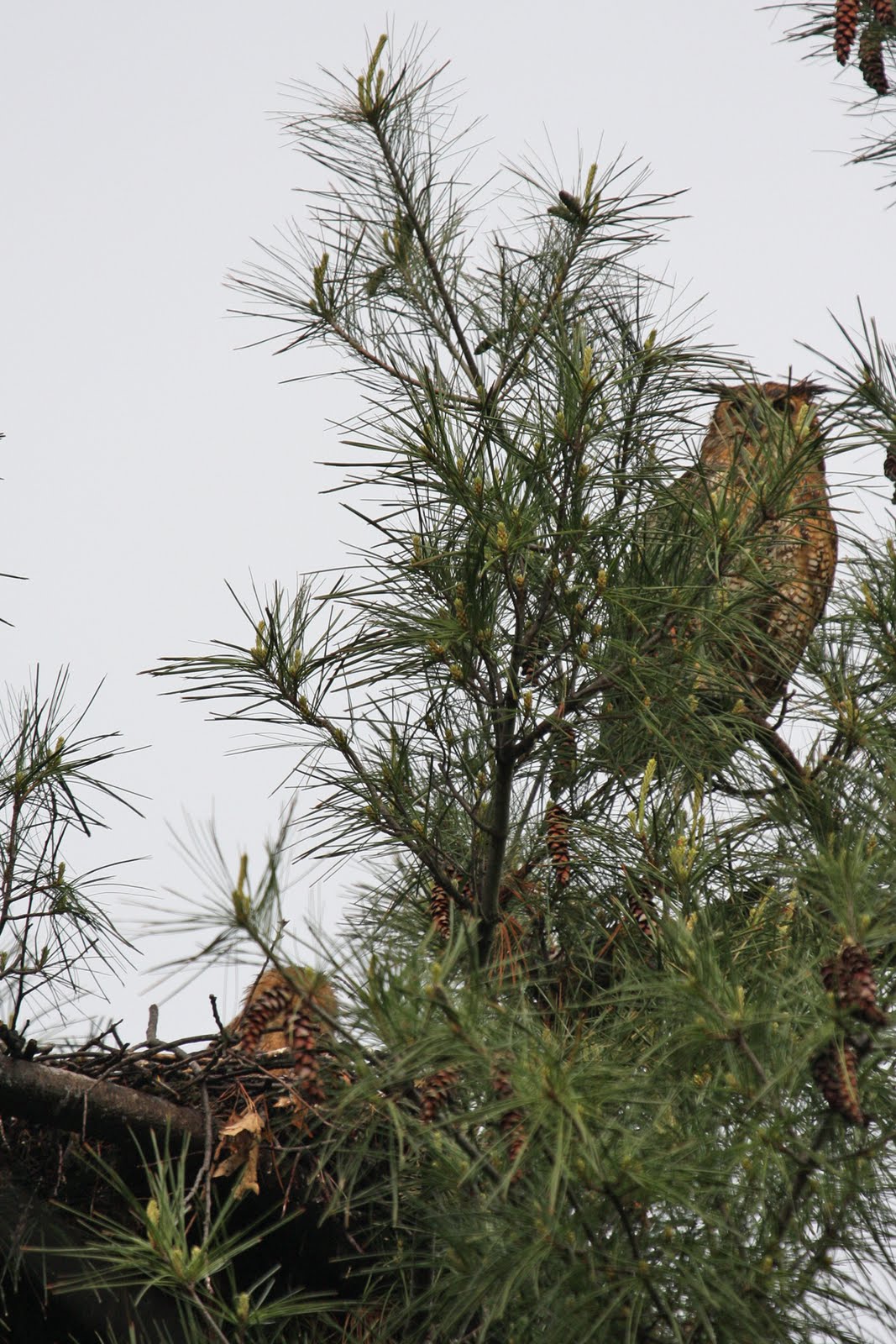
When I arrive there is no activity at the nest or in the old pine tree.  I begin scanning the nearby trees—the Sweetgum tree, being the closest to the Pine, is the most likely candidate.  I scan the Sweetgum for several minutes and see nothing.  Then I begin searching the other trees (which I think are too far away, but you never know).  Nothing!  I check the nest and Pine tree one more time, and just as I am ready to give up I see an upright silhouette on one of the branches of the Sweetgum. 


I know that I’ve already scanned that entire tree—could I have missed it?  Sure enough, there is one of the babies sitting about halfway up the tree.  He’s behind a clump of leaves so photographing him is tough, but I am relieved to know that at least one of them has made it.  I sit and photograph for a while, trying to get a clear photo whenever the wind blows the leaves to the side.  


A car pulls up and two of the neighbors want to know if I’ve seen the babies.  They tell me that the owls had stopped hooting for quite some time, but for the last couple of days they’ve been hearing them again.  (Owls hoot when they are setting up territories and finding mates, but the female becomes silent once she is on the nest, and while babies are in the nest.  This is a defense mechanism to keep predators from finding the nest.)  The hooting resumes from both parents because they are still alerting other owls that this territory is taken. The babies hunger scream, and this helps the parents locate the kids.  Mom and Dad will have their hands full feeding these two babies who can now wander rather than being confined to one tree.

I show the neighbors where the one baby is sitting, but even with someone pointing it out they have a difficult time spotting him.  (Mother Nature’s camouflage is very good.)  


The homeowner comes out to see what we are looking at, and tells us that the other day his wife heard a thump on their front door.  Thinking that her husband had gone out to his car to get something and then couldn’t open the door because his arms were full, she opened the door and found one of the baby owls sitting on her doorstep.  Baby Owls at this stage do not truly fly.  They hop and glide for short distances.  This one apparently missed his target branch and landed on her doorstep.  When she opened the door he assumed a defensive posture.  He stood up tall, spread out his wings to make himself look big and scary, and started clacking his beak.  He then fly-hopped his way across the street to another neighbor’s yard and sat at the base of a tree pretending to be part of the tree trunk.  The homeowners went into the house to get their camera and when they returned the owl was gone. 

Hopefully this little guy will be able to hide out in the dense neighborhood shrubbery and bushes until he is able to fly well enough to get airborne and into the large old trees that abound in this area.  Major threats to young owls at this stage will be the dogs, cats, coyotes and other owls that inhabit the area.  Perhaps their greatest danger will be a vehicle collision if they wander onto one of the busy roads in the area.

For now one of the owls appears to be safely ensconced in the large old Sweetgum tree.  Hopefully he will stay in the high branches until he is able to fly well enough to navigate the large trees in the neighborhood.  Mom and Dad will continue to feed these babies (possibly most of the summer) until they are able to hunt for themselves.  


I leave knowing that this will probably be my last sighting of the owl family of whom I’ve become so fond.  Now that they are mobile and out of the nest any sightings will be strictly by happenstance.


I hope our readers have enjoyed this rare opportunity to follow the development of this little owl family.  


If you've never seen a Great Horned Owl up close, please consider visiting the World Bird Sanctuary where you can see this and many other species of raptors up close and personal.  The World Bird Sanctuary is open every day of the year except Thanksgiving and Christmas. For more information about special events click here to go to our website.


Submitted by Gay Schroer, World Bird Sanctuary Volunteer/Photographer

Friday, July 1, 2011

Tales From The Nest - Part 9

4/23 – Last night tornadoes ripped through the St. Louis area, demolishing homes and damaging the airport badly enough to shut down Lambert St. Louis Airport for an undetermined length of time. 

The storm roared out of the west bringing with it golf ball size hail, 70 mph winds, and a lightening display St. Louisans will remember for years to come.  On its way to Northwest St. Louis County it roared right over our Great Horned Owl nest, and I wonder—“Will our owl family still be there this morning, or have they been swept away by the storm?” 

Even though it’s still raining I have to find out if our little family is still there.  I hold my breath as I approach my viewing station.  Yes!...there are three distinct shadows at the nest.  


Mamma sits up high on her favorite perching branch, and the two babies are perched on the edge of the nest right below her.  They are drenched, but appear to be no worse for wear.  


The nest itself seems to have weathered the storm—the hawks who built the original structure last year get an “A” for their construction skills and choice of a good site.  This nest has been through more than it’s fair share of bad weather and still seems to be rock solid. 

Since it’s still raining I take only a few photos before I leave, all the while saying a silent “thank you” to a higher power that the nest was kept safe through last night’s terrible storm.

Check back soon for more "Tales From The Nest".

Submitted by Gay Schroer, World Bird Sanctuary Volunteer/Photographer

Monday, June 27, 2011

Tales From The Nest - Part 8

4/22 – It’s raining this A.M., but it’s only drizzling, so I decided to check out the nest, as I know they will soon be leaving it.  When I arrived there was no visible activity, but Mamma was at her post on the large branch just above and to the right of the nest. 

As I watched, Mamma jumped down into the nest and began doing some housekeeping chores.  It was then that I realized that the two clumps of “pine cones” on Mamma’s branch were, in fact, the two babies!  

I have mixed emotions about their graduation to the status of “branchers”.  I am excited that they have passed this first big hurdle, but I know that now it will be more difficult, if not impossible, to get clear photos of our two babies. 

Between  the dense tree growth, the wind, and the fact that they are about 80 feet in the air, the problem of getting a clear shot has just grown exponentially.  By moving from my usual vantage point and doing my version of a circus contortionist I was able to get a photo with only a minimum of pine boughs screening our little graduates. 

I am loath to leave the cover of my van since I believe they are accustomed to vehicles and do not perceive them as a threat.  Hopefully they will start moving about more as they gain confidence in their ability to navigate the tree branches and will be more visible—at least for a couple of weeks.


Check back again soon for more "Tales From The Nest"


Submitted by Gay Schroer, World Bird Sanctuary Volunteer/Photographer

Sunday, June 19, 2011

Tales From the Nest - Part 7


4/21 – I Arrived this morning to find no activity in the nest and no sign of mom.  Have they left the nest?  They should be getting close. 

The books say that owls venture out onto nearby branches and fly-hop from branch to branch for a couple of weeks before they really fly, but I don’t see any of that kind of activity.  However, I’m not sure our owls have read the books.  If they have left the nest I’m sure they will be much more difficult to photograph. 

It’s been over an hour now and no sign of activity.  If they’ve left the nest and ended up on the ground they could have fallen prey to a predator.  Just as I am about to give up for the day I see the tip of a wing being stretched in the nest.  They’re still there! 

All of a sudden there is a flurry of activity from the babies.  There’s much fly-hopping up onto the side of the nest, and then back down.  Then there’s some hopping from one side of the nest to the other (this nest is at least four feet across).  Then there is much stretching and flapping of wings.  They are beginning to look more and more like the adults. 

I now know that it won’t be long before they venture out onto the branches of this big pine tree and become what is called “branchers”.  I still don’t see mom, but I am sure she is close by, keeping an eye on the nest.


Check back again soon for more "Tales From The Nest".


Submitted by Gay Schroer, World Bird Sanctuary Volunteer/Photographer

Saturday, June 11, 2011

Tales From the Nest - Part 6

4/19 – Last night we had bad Thunderstorms with rain and winds gusting to 49 mph.  It’s still raining this morning and I will probably not get any photos, but I’ve decided to check out the nest anyway to make sure it hasn’t been blown away or sustained damage.

At first I see no activity from the nest and am fearful that the storm last night has caused havoc with our owl family.  Then  I spot Mamma who is sitting on her favorite branch above the nest, but is so well camouflaged that I could not see her with the naked eye.  
 Can you see Mamma?  This photo is greatly magnified.  With the naked eye she was all but invisible.
Something is different this morning.  While I am fiddling with my binoculars my peripheral vision catches an adult flying in from another tree and landing on Mom’s favorite perch.  

Had Mom flown off while my attention was elsewhere?  Was this dad and had this been a changing of the guard while I was otherwise occupied—or is this Mom encouraging the babies to venture out of the nest?  The adult sat there perched over the nest, for a while, then flew off into a neighboring tree. 

There is much wing flapping going on in the nest this morning, and I am not sure if they are trying out their wing coordination, or just attempting to dry off their feathers after last night’s drenching. 

Before leaving today I look for pellets under the tree, but find none.  Possibly they are getting caught on the dense tree growth between the ground and the nest.  I estimate the nest is 60-80 feet high.  So far I have only found one pellet.  
Owl pellets are the indigestible parts of an owl's mean--such as fur, bones, feathers, etc., which are coughed up similar to a hairball
Unfortunately for me the homeowners are excellent groundskeepers and are conscientious about keeping the Sweetgum balls picked up.

4/20 – Last night we again had rain, hail, and high winds with severe thunderstorm and tornado warnings all around the area – didn’t get to the nest until the afternoon – will it still be there after last night?  The babies appear to be none the worse for wear.  Mom is watching from a nearby tree.  I now believe she’s encouraging them to venture from the nest onto the branches of the pine tree.

Check back again soon for more Tales From the Nest

Submitted by Gay Schroer, World Bird Sanctuary Volunteer/Photographer

Sunday, June 5, 2011

Part 5 – Tales From the Nest

4/14 – 4/16 – The last three days have been unproductive for photographing our owl family.  It has been rainy and windy, with winds gusting up to 44 mph, and temperatures fluctuating from 43° to 73°.  Our normally unpredictable St. Louis weather has been doing it’s utmost to live up to it’s reputation, and the birds have been laying low in the nest.
 They are learning to use those things connected to their shoulders
4/17 – The weather has finally abated and the babies are moving around in the nest this morning.  As I watch their antics (much preening, wing stretching) they demonstrate a newfound skill (a form of owl etiquette)--hopping up onto the side of the nest to defecate over the edge.  
 Humans aren't the only ones who follow the rules of etiquette
There is also much hopping from one side of the nest to the other as these little balls of down work to perfect their pouncing skills.  Suddenly, a mob of Crows flies in from the North, screaming and cawing loudly.  
Trying to figure out what those big black birds are all about
The bolder of the two babies sits up tall in the nest to see what these intruders are all about.  As they land in the trees surrounding the nest even this bold youngster disappears into the safety of the nest, but with Mamma ever watchful the babies are safe.  These visitors, however, do put an end to playtime.
 Now what's that two-legged creature with the three legged gizmo doing in the street?
4/18 – This morning I discover that another photographer has found the nest.  She was there when I arrived, with her tripod set up in the street. The babies are curious and are cautiously peering over the edge of the nest, but Mamma was not visible.  The photographer was clapping loudly to try to get the mom to sit up in the nest.  The babies were watching her, but mom was sitting tight. Little did this photographer realize that the more she clapped the tighter mom would sit.
 Is she gone yet?
Once the other photographer left, the babies started moving around in the nest.  They are getting more and more of their adult plumage.  Soon they will be nearly indistinguishable from their mom.  
Looking more and more like mom every day
I watch and photograph for a while until they retire into the nest for their nap.  They are, after all, still babies and take frequent long naps.  It’s probably a good thing for me, since I would get nothing else done if it were not for their naps.  Hmmm.....I believe I remember saying that when my children were toddlers!

Check back again soon for more Tales From The Nest.

Submitted by Gay Schroer, World Bird Sanctuary Volunteer/Photographer

Saturday, May 28, 2011

Spring = A Fuzziness of Babies

Spring = A Fuzziness of Babies admitted to the Wildlife Hospital!

It's the time of year when hawks and owls start raising their young and we get an influx of little ones to the Kathryn G. Favre wildlife hospital.
  This young Barred Owl broke his leg when a storm broke the branch his nest was on.

They are admitted to the hospital for a variety of reasons – they have been orphaned; their nest has fallen out of the tree; they have fallen out of the nest; or a well-meaning passerby assumes that the youngster, who has jumped from the nest while learning to fly, needs help.
 There are currently 10 baby Barred Owls of varying ages being looked after by our Propagation Department.

Fortunately, there is nothing physically wrong with these birds – so they will be raised and released as soon as they are old enough.  These youngsters will be ready to embark on their journey as a wild bird of prey within the next 6-8 weeks. 
 These week-old Red-shouldered Hawks were admitted to the wildlife hospital after the tree their nest was in was blown down in a storm.

This is a rare opportunity for you to be a part of the positive journey for these babies by participating in the Return to the Wild Program.  For just $150 you can sponsor and take part in the release of one of these youngsters at your home, a nearby park, or school.  You may do it to celebrate a special event – birthday, anniversary, wedding, or graduation.  Do it as a celebration of a loved one’s life.  Do it because there is nothing like the feeling of being a hands-on contributor to the success of this species in the wild.  It costs us approximately $300 per baby to look after them and ready them for the next stage of their bright young lives.
 You can have your own hands-on Return to the Wild experience!

If you would like to participate in one of our mission-critical activities and sponsor a Return to the Wild for one of these 12 youngsters, you may purchase your release online or call 636-225-4390 ext. 102 to speak to Catherine.

The mission of the World Bird Sanctuary is to preserve the earth's biological diversity and to secure the future of threatened bird species in their natural environments.  We work to fulfill this mission through education, propagation, field studies and rehabilitation.

Submited by Catherine Redfern, World Bird Sanctuary Staff Member

Monday, June 29, 2009

It's Hot, Hot, Hot!!


Now that the hot summer weather is here in full force, don't forget your feathered friends.  Late spring and summer means babies, babies, babies!

Your backyard birds need you just as much now as they do in the winter months.  Even though food is plentiful now in the form of insects, seeds, and nectar, your backyard birds will still come to the feeders for the seeds, nuts, and suet you've been feeding them during the cold weather--if you continue to provide them.  At this time of year they are feeding babies, and the feeders are a wonderful source of "fast" food for their demanding young ones.

Possibly the most important thing you can do for your feathered friends at this time of year is to provide them with a source of fresh water for drinking and bathing.  Birdbaths, plant saucers, or even a shallow bowl will work.  Please remember to change the water at least every other day to prevent mosquitos from hatching.  Lawn sprinklers are also a delight, both for the birds, and the humans that watch them.

Tuesday, February 3, 2009

How They Grow - Tawny Owls

This little owl is so popular in Great Britain that it makes an appearance in many pieces of English literature--the most well known being "Winnie the Pooh" and the "Harry Potter" books.

Above you see our Tawny Owl baby at 7 days old.


This photo, taken at 30 days, shows a remarkable change in appearance.  He (she) is already showing characteristics of the beautiful little bird he will become


At 43 days our little baby is assuming the rounded, blocky shape, by which his species is generally described.  I personally think he looks  like a kid who's been caught in the act, and is saying "Who me?"  

In the wild he would now be scrambling around on branches near the nest, beginning to explore his world, although his parents would still be feeding him.


At 58 days you can see that our little character is beginning to get some of his adult plumage, even though he is still quite fuzzy.


As you can see, at 64 days he now has most of his adult feathers, even though there is still some down left.  In the wild he would be flying and beginning to hunt for himself.


At three months (about 90 days), he would be independent and he and his siblings would be starting to disperse.  

This photo is Tigger, our resident adult Tawny Owl.

Isn't it an incredible transformation from photo #1 to this beautiful, amazing creature in such a short time?


TO SEE TIGGER AND SOME OF HIS FRIENDS IN PERSON, JOIN US FOR ONE OF OUR SEVEN REMAINING OWL PROWLS!

Owl Prowls begin at 7 p.m. and last approximately 1-1/2 hour.  The first half hour is held inside our Nature Center where you will meet several of our owls close up and our Naturalists will teach participants how to  "hoot".  We will then proceed outside and walk the trails of our grounds, while attempting to coax our local owls to return our "hoots".

For more Owl Prowl information, or to Make a Reservation, call 636-225-4390, Ext. 0.

Cost for this entertaining and informative program is:  $9.00 for adults and $7.00 for children.

Saturday, January 31, 2009

Barn Owls & How They Grow

Do you remember the story of Jack in the Beanstalk?  This old fairy tale is brought to mind every time I witness the incredible growth rate of birds, as witnessed by these photos of some of our baby barn owls.

Our first photo shows two of our hatchlings at the age of 14 days.  At this stage they don't much resemble the beautiful creature they will eventually become.


This next photo is our pair at 21 days old.  They are just beginning to learn to balance, and their faces are beginning to show the characteristic heart shape for which their species is known.


At 29 days of age this basketful of babies is beginning to show more awareness of their surroundings, and is beginning to move about a bit.


At 33 days they are definitely more aware of their surroundings, especially if they spot their caretaker--who they perceive as a source of food!


At 42 days they are beginning to sprout their "big boy (or girl)" feathers, and are beginning to take on more of the appearance of a "real" barn owl.


At 49 days they are more fully feathered, but still have quite a bit of their baby down feathers.  They are now able to perch on branches and stumps (if a bit precariously), and are beginning to show quite a bit of curiosity about their surroundings.


At 63 days our young barn owl is almost indistinguishable from the adults of it's species, although he still has quite a lot to learn.


To learn more about these fascinating creatures and to experience a firsthand demonstration of their soundless flight, join us for one of our Owl Prowls.

For more information and to make reservations for an Owl Prowl, call 636-225-4390, Ext. 0.


IT'S AN EXPERIENCE YOU WON'T FORGET!!