Showing posts with label training. Show all posts

Saturday, January 10, 2015

ETC Experiences: Stork Training


One of the most interesting experiences working at World Bird Sanctuary’s ETC (Education and Training Center) over the summer was participating in the initial training of a couple of different birds, which I never really got to do before. 

Azizi the young Abdim's Stork (photo: Gay Schroer)

The bird I had the most interactions with was a young Abdim's, or White-Bellied Stork, named Azizi.  I'm not sure if it's because he's still young or if it's just the way he is, but he's a skittish bird, so the first part of his training was one that I didn't realize I was doing — just being around.  Any bird or animal that is in training needs to first get used to people in general, and then the specific people who will be doing said training.  Even though I wasn't one of the initial people training him, just walking past Azizi every now and then on my way to do something else, he slowly got used to seeing me around.

If you do an internship with the World Bird Sanctuary, one of the things you get is an intern project, which could entail just about anything.  For a couple of the interns this summer it happened to be beginning Azizi's training; but once their internships were done, the training still needed to continue.  My supervisor suggested that since I'd been around all summer, I should give it a shot and see how Azizi responded to me. 

To my surprise, he responded relatively well, eating out of my hand with no aggression, and going to his stump when cued.  After debating what the next step should be, my supervisor decided crate training should be the next step.  Getting birds accustomed to being in crates is very important, because that's how we transport them, so the more comfortable the birds are inside the crates, the better.

Azizi took quite well to initial training--now for the next step (photo: Gay Schroer)

For Azizi, crate training meant first getting him accustomed to a carpet square that eventually ended up being put inside the crate.  Once he became accustomed to the carpet I began throwing food onto the carpet for him to eat.  Once he became accustomed to eating his treats on the carpet I began slowly moving the carpet farther and farther back inside the crate to try and convince Azizi to go farther and farther into the crate.  Since he's skittish and fearful of strange things this part took time.  For a while, he'd stretch his long, skinny neck as far inside the crate as it would go, so he could avoid stepping inside the crate.  Eventually he became more accustomed to the crate and started stepping inside to get the food that was thrown inside.  After a good deal more time, he finally started going fully inside the crate, which meant it was time for the next couple of steps.

At first Azizi would stretch his long skinny neck as far as it would go to get his treat (photo: Gay Schroer)

The next step was putting a feeding hole in the back of the crate and putting the crate door back on.  This way, food could be slipped in through the back of the crate to keep Azizi inside for longer periods of time (we’re talking seconds here).  The food also provided positive reinforcement for the fact that the door was being closed, and all other parts of the training.  After leaving it closed for around 10 seconds, I would open the door, Azizi would leave the crate, and then a couple seconds later I would throw food in the crate to get him to go back inside, close the door, wait a few seconds longer, and then repeat.

So far, he's taking well to the training, which hopefully means that in a couple years, if you happen to be at a zoo where the World Bird Sanctuary presents shows over the summer, you just might see an Abdim's Stork named Azizi running across the stage while you learn all about his kind!

Submitted by Matt Levin, World Bird Sanctuary Naturalist/Trainer  

Sunday, December 22, 2013

The Rookie Files: Vader Vulture


When I first started as an intern at World Bird Sanctuary in 2008 I imagined I would enjoy all of the birds that I was going to be working with.  What I never expected is that over time all the birds would grow on me, even the seemingly disgusting ones.  I am of course referring to nature’s recycler: the vulture.

Gator, a Black Vulture who was with us for many years.

It did not take me long to learn to love and appreciate the vulture.  I am especially intrigued by animals that have fascinating adaptations, and you do not get more unique than vultures--especially the New World vultures (those from North and South America).

More closely related to storks than other birds of prey, New World vultures do not have strong grasping feet and talons.  They have weak, chicken-like feet.  Since they cannot defend themselves with their feet, they projectile vomit at any predators that dare approach after they have gorged themselves.

The white film is a result of urohydrosis

They also cannot sweat, so not only will they pant to cool off (like other birds), but they will go to the bathroom down the backs of their own legs, and the evaporation cools them off by about ten to twelve degrees almost instantly.  This delightful adaptation is known as urohydrosis.  With crazy adaptations like these, how could I not become fascinated by vultures?  Luckily for me there are plenty of New World vultures at World Bird Sanctuary.

The first vulture I worked with was a turkey vulture.  After dealing with an enclosure holding six Turkey Vultures I determined humanity to be very lucky that they do not hunt live prey. 

Baton Rouge, our big beautiful King Vulture, was next, but I don’t think I ever really appreciated a vulture until I had to train one. 
Here you see Trina, one of our naturalists, flying a Black Vulture

Every vulture I had worked with up until last year was already trained; I just got to reap the benefits.  Vader, our 3-year-old Black Vulture, was not.  Well, that is not entirely true. He knew how to go into a crate (after a refresher course) and go to a perch, but he had never been in a WBS zoo show program before.  He proved to be a delightful challenge (and I do not mean that sarcastically).
Vader's natural curiosity makes him difficult to photograph

Vader, due to his young age, is incredibly curious (making it very difficult to photograph him!).  He is also easily startled and frightened.  Being a black vulture, he is also highly social, something we use to our advantage. 

If Vader were afraid of something, say a new toy or location, we could often get him over that fear simply by showing him that whatever was scaring him was not dangerous.  There is a gate on the stage at the Milwaukee County Zoo that leads into our backstage area.  Vader needed to pass through this gate in order to get onstage.  At first he was afraid to go through the narrow opening, even with tasty food on the other side!  We opened the other half of the gate so that his passageway would be wider, but still he hesitated.  Then one day I walked through it with him--success!  He followed at my side like a puppy, and after that he had no trouble with the gate, even when he had to pass through it alone.  Once through the gate he galloped across the stage to the sheer delight of the audience.  Nothing brings a smile to the audience’s faces quite like a Black Vulture galloping.

The “vulture see/vulture do” method does not always work, however.  Vader is still afraid of stumps, and despite my climbing up on top of the fence so he would hop up to me atop the fencepost, we could not get him over this fear.  He did seem very confused and upset that he could not reach me.  This is still a work in progress.
As he matures Vader will lose this ruff of black feathers

Luckily Vader is still young and so he is still learning.  He is very affectionate for a vulture, bobbing his head madly and “shnuring” (one of the sounds pertinent to a vulture) every time we come into the building. In fact his hissing/grunting, stalking walk, in combination with the hood of feathers on his neck, is what earned him the name Vader.  Over time he will lose the small black feathers on his head and his hood will recede, giving him a bald head so that it can stay nice and clean once he sticks it inside a carcass. 

With the right training and patience, eventually he will also become braver and may one day follow in the footsteps of our other great black vultures. He is off to an excellent start!

Submitted by Leah Tyndall, World Bird Sanctuary Naturalist/Trainer

Sunday, December 8, 2013

More About Dorothy.....Condor Training


If you’re not already familiar with Dorothy she is our sub adult Andean Condor, and for the last two months I and a few others have been training her.

Dorothy, our young Andean Condor
We have been training Dorothy in a variety of different behaviors ranging from going to a particular location by verbal command to simpler behaviors like waiting patiently for her food reward.  There are various reasons why we are training with Dorothy but the primary reason is to provide her with an enriching and fun environment.

I have personally been around and known Dorothy for just 3 years now, but in that time she has come to be one of the most special animals I work with at World Bird Sanctuary.  Now if you have never seen Dorothy she is one of our largest birds at WBS, with a wing span of around 10 feet and weighing around 20 pounds. She definitely has a big character to match her massive size as well, and being a condor one of her strongest character traits is her intelligence.

The training has evolved greatly since September, through many training sessions and with instruction from my peers.  The goals have shifted and training style improved to efficiently get the most out of the time we spend with her.  The training technique that we are using is positively reinforcing behaviors with food and verbal praise. 

Dorothy about to receive a food reward 

Currently we are working on getting Dorothy to step to and stay on a scale so we can accurately weigh her. It would appear that this would be a simple goal, but I have learned that what would look to be a simple behavior is not always as simple as it appears.  This one seemingly simple behavior is actually broken down into many small steps and then these steps are combined to result in Dorothy stepping onto the scale and getting an accurate weight. 

We have started to train Dorothy to do this behavior by utilizing some of the behaviors she has already learned.  She will already go to her stump when called to it, so what we have done so far is to place another stump about 5 feet from the first one and placed the scale on it.   It has only been 5 days and we already have the two stumps next to each other and Dorothy is starting to put her toes on the scale to reach the food reward.  We are still far from getting the behavior down completely but every day she is getting closer to our goal of stepping to and staying on the scale.
                  
The last two months have been a learning experienceboth for Dorothy and us (the trainers) as well.  At times it can be very frustrating, but as an animal trainer we must learn how to overcome the frustration, and keep looking at what we can do to promote a productive learning environment for Dorothy. 

Overall the time and effort that is exerted day in and day out is all worth it when you get to work with an amazing bird like Dorothy.     

Submitted by Adam Triska, World Bird Sanctuary Naturalist/Trainer

Friday, June 21, 2013

Duncan The Magnificent


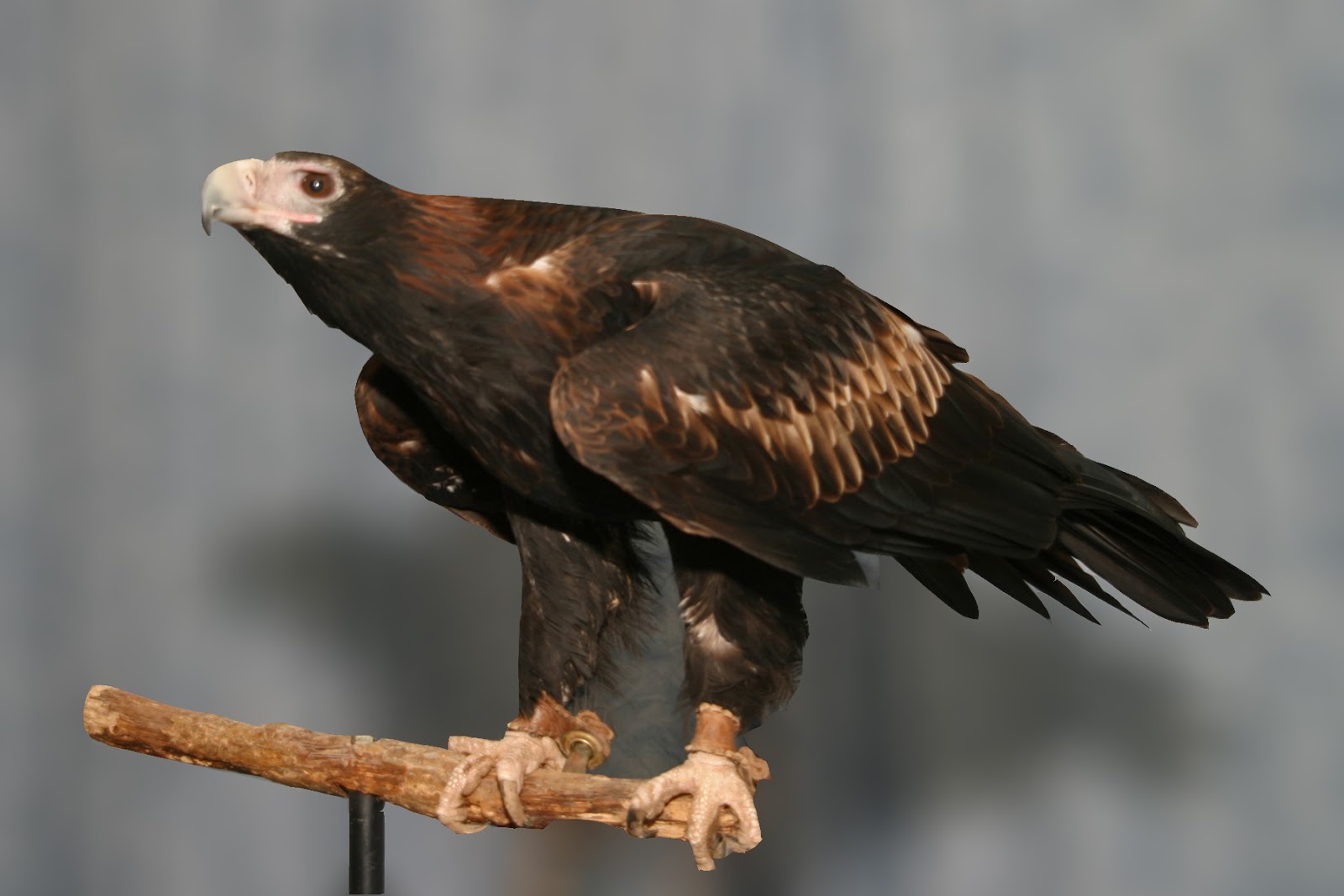
Duncan, our 26-year-old Wedge-tailed eagle, recently came out of retirement to wow audiences at WBS’s educational bird shows at Stone Zoo near Boston, MA.

Meet Duncan, WBS's Wedge-tailed Eagle
The last time this bird flew in our education programs was in 1994. This summer she is back and flying at our zoo program at Stone Zoo in Boston, MA, and doing quite well. At first I was unsure of how this would go, but I was very excited to have this opportunity to, basically, retrain this bird.

Training birds, and any animal I would assume, is very challenging. The first thing that we have to figure out is the “working weight” of the bird. The working weight is the weight we keep them at during their flying season (6 months of flying 6 months off), and this is a weight at which they’re food motivated (in other words, a weight at which they want food, but they’re not starving). The working weight is heavier than they would be naturally in the wild, but lighter than they would be if they were offered as much food as they wanted without working for it. In order to find that magic number it takes observation. Too light and your bird gets aggressive, too heavy and your bird won’t fly. Once you find this magic number you then have to do a lot of practicing and getting the bird back in shape because just like us, birds also get out of shape. We usually take about a month and a half to two months to get all the birds back in shape.

Photo courtesy of Alex Navarro, Educational Specialist, Stone Zoo
Once that training period has gone by its then time for shows to start.  This is when you learn even more about your bird. You have to get them used to seeing people in the theater, because during show practice time you practice in an empty theater. If the bird is new to flying for an audience you have to slowly build up from just a few people to more and larger crowds. You quickly learn all the strange things that individual birds may not like.  I’ve worked with birds that don’t like the strangest things, like big necklaces or strollers, or crutches. A very few don’t like sunglasses, perhaps because they can see themselves in them—or that’s what we think at least.

Photo courtesy of Alex Navarro, Educational Specialist, Stone Zoo
After learning the quirks of individual birds and doing our best to keep that object away from them, you then have to regularly deal with uncontrollable factors, like wind.  Very windy conditions may sometimes blow a free flying bird off course, but with the right flight muscle conditioning (in other words, lots of practice), our birds fly very well when the wind is blowing.

Photo courtesy of Alex Navarro, Educational Specialist, Stone Zoo
After taking all these factors into consideration, and even if you do everything right, sometimes the unexpected still happens--they are live animals after all.  Most times, though, things work out perfectly, and you get what I would imagine to be a “proud parent” moment the first time your bird does the exact behavior you’ve been training. Then, when the behavior you’re asking of your bird becomes consistent, that is one of the best feelings a trainer can have.

Photo courtesy of Alex Navarro, Educational Specialist, Stone Zoo
All of this is what my staff and I have dealt with while getting Duncan back into the swing of things.  And finally, after tons of practice and hard work, she is doing very well and flying for all our audiences at Stone Zoo. We are all very proud of this magnificent bird.

Submitted by Jaimie Sansoucie, World Bird Sanctuary Naturalist/Trainer

Tuesday, May 14, 2013

Whoo’s that? Reese!


It’s true dear readers, there is a new man in my life.  He’s handsome, talkative, about a foot tall and nocturnal.
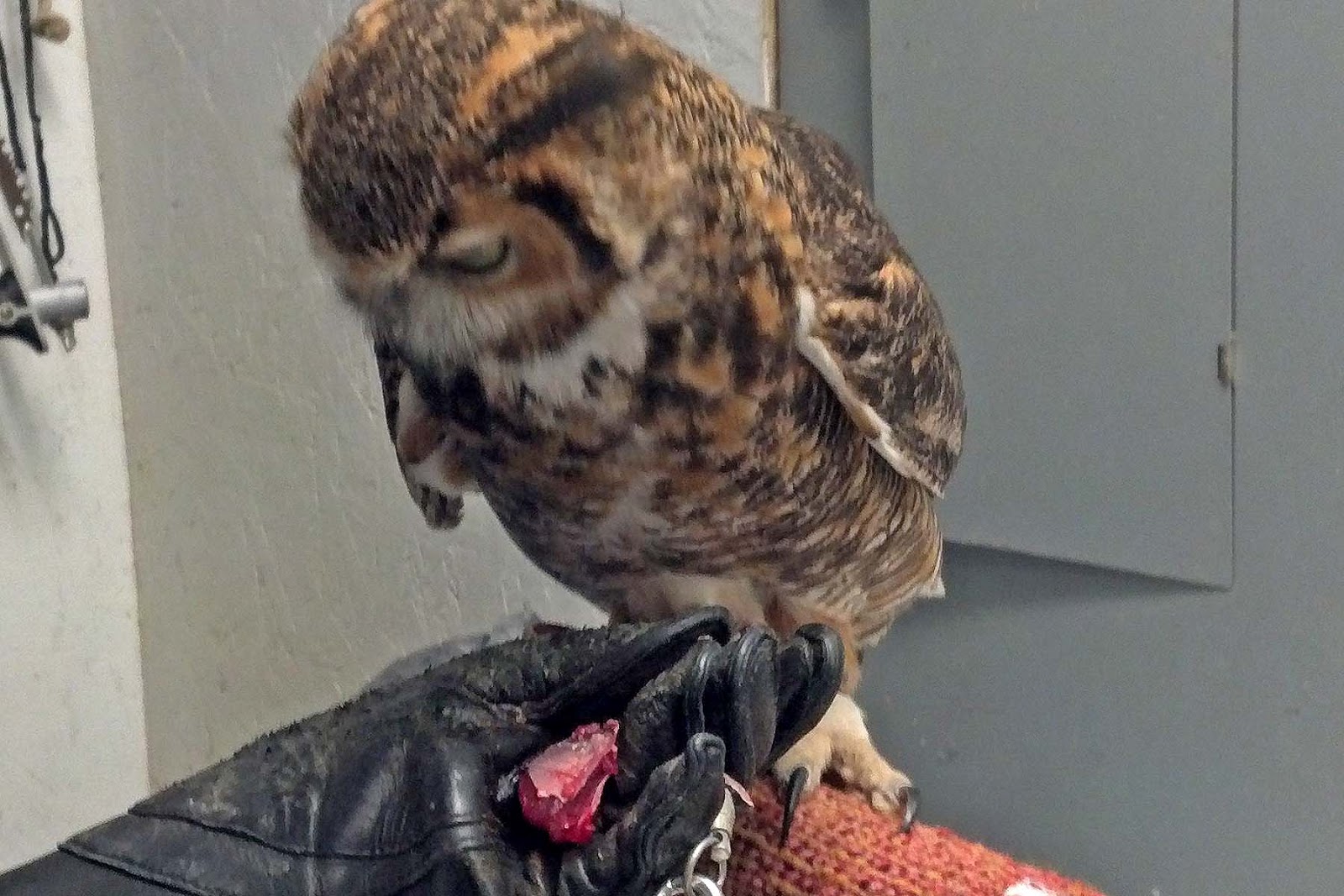
Reese learning to stand on the glove
Okay, so he’s not a man, he’s a Great Horned Owl.  Yes, this girl, who arrived at World Bird Sanctuary with an odd fear of Great Horned Owls from the movie Rock-a-Doodle is thrilled to be working with one.

I overcame my bizarre issues with Great Horned Owls with the help of Carmelita, a beautiful female Great Horned Owl I worked with when I started as a staff member.  My issues with Great Horned Owls aside, I still had issues. 

Then I met Reese, a young male Great Horned Owl that came to us from another facility.  When I picked him up from the airport he was very quiet, sitting a little warily in his crate.  Then on the ride back to the Sanctuary I coughed.  Suddenly there was an explosion of hooting from the back of my car!  I coughed again, and more hoots burst forth.  We hooted back and forth the whole ride back, and as he came out of the crate he sat on a perch and hooted right in front of me.  Clearly the fear of people was not going to be an issue for this bird.

Although Reese was very comfortable around people, he was not a glove bird.  He was never on equipment (the anklets and jesses we use to secure our birds), and had never sat on the glove.  The first time we put him on the glove he did well, sitting for stretches of time even transferring from one glove to another.  Imagine that you are standing on the glove of a giant, which despite the best efforts of the giant may move like a fun house floor.  Sounds a little scary, but Reese was a champ! 
Reese in his training stall
Next we tethered him in a training stall where the perch parallels and is close to the wall, rather than perpendicular it.  This allows him to make the decision whether or not to come to, or at least toward us for food.  When we first put him in the stall, he was great about eating in front of us when we were in the room and right in front of him.  What he wasn’t good about was the glove; he was wary of it at first.  To help him we put a spare glove in his stall, out of the way so that he couldn’t get tangled or hit it if he got scared.  This way he could see the glove in a non-threatening way.  We also made sure to put his food on the glove so he would associate the glove with food.  Over time he began to take food from our glove.

Getting him to step up onto the glove was a little tricky.  In most cases a piece of food is held firmly on top of the glove and a bird will put its foot up to get the leverage to tear or pull food from the glove.  Reese however grabbed the piece in his beak, planted his feet firmly on the ground and pulled as hard as he could, which usually resulted in him scooting backwards and ripping his treat into pieces (Reese’s pieces!).  After some careful maneuvering of the glove and his food we finally got Reese to step up and not over.  Now Reese goes on walks on the glove. 
Reese learning to step to the scale
He is now learning to step up onto the scale and soon he will go outside on a perch.
 Several years ago I never would have dreamed I would be so excited to be training a Great Horned Owl (seriously, watch the movie, that owl is disturbing).  Since that first moment in my car to his patented butt scooting to snag food, everything Reese does reminds me how every training experience is different.  No matter how many birds you have helped to train, there is always something new to learn and see.

Submitted by Leah Tyndall, World Bird Sanctuary Naturalist/Trainer

Friday, December 28, 2012

The Rookie Files: Training Clark


I’m sure I’ve mentioned Clark the Bald Eagle in previous blogs, but he is one of my favorites.
 Clark, one of our magnificent flying Bald Eagles
I know, I know, parents aren’t supposed to have favorite kids, and trainers are not supposed to have favorite birds--but we often do, and Clark is one of mine.

My Clark fan club membership was recently renewed because I got to work one on one with him for the first time in years.  The first year I worked with Clark I was but a young rookie myself.  Fresh off my second internship and summer at Grant’s Farm I was told we were going to fly Clark at Silver Dollar City, Branson, Missouri, in the fall of 2009.

When he first arrived for preliminary training at WBS’s Milwaukee County Zoo bird show (where many of the staff who would eventually work at WBS’s Silver Dollar City bird show were stationed) I was a little on the nervous side.  A Bald EAGLE was going to be flying towards me!  It was a little unnerving to say the least.
 A Bald Eagle in full flight heading straight toward you can be a little unnerving!
Luckily for me at that point in my career, Clark was first trained by our excellent Bald Eagle trainer, Roger Wallace, and then continued his education with our amazing ETC supervisor; so no Bald Eagle landing on MY head!  …well, there was that one time when he didn’t really understand that we were calling him to a stump rather than the glove, but that was a fluke.  He was amazing to fly at Silver Dollar City, never missed a beat, and had the most incredible flights!

I was able to work with Clark a few more times over the next couple winters.  I only heard about his great double flights with Lewis the Bald eagle, but overall I did not work with Clark in a show capacity again until the summer of 2012.  We flew Clark at WBS’s Stone Zoo bird show in Stoneham, Massachusetts, near Boston.

This time I was the one in charge of Clark for the summer--his training, his pattern, his health and wellness.  To be honest, I was a little apprehensive, but felt confident that I was up to the challenge.  And then I remembered all of Clark’s delightful little quirks that I had completely forgotten about during the winter!  Clark loves to rip, tear and shred—it doesn’t matter what, just as long as he can turn it into a chew toy.

As I mentioned in my earlier Enrichment blog we had to provide Clark with a variety of different things to distract him at night so that he would not destroy his anklets or jesses.  Due to his “chewtastic” nature, Clark has to have special woven, nylon jesses instead of the usual leather ones.
 The goal was to get Clark to cue to the word "feathers"--and only to "feathers"
Clark is also very smart and very good at picking up on patterns.  At the beginning of the show we would ask the audience a question, the answer to which was the word “feathers!”. Once this guess was confirmed by the speaker, Clark would be cued for his exit.  Clark first picked up on the connection between the audience speaking and his cue for food.  When the audience would guess incorrectly, Clark would still try to leave.  Clark then learned that his food cue was connected to the word “feathers” itself.  By the end of the season, Clark would be ready to exit if the audience yelled “feathers”, but only “feathers”.  If, for instance, they yelled “wings” Clark would sit patiently until they guessed correctly; only then would he be primed to leave!
 Clark launching himself from the second story window of our Nature Center
Clark also started to anticipate his end pattern and became bored with it, forcing us to come up with new and exciting patterns to keep him engaged.  Birds of prey may not be as intelligent as some parrots or corvids (crows, ravens, jays), but don’t ever let anyone tell you that Bald eagles are dumb.  Fortunately it was this pattern recognition and intelligence that allowed us to be able to do an incredible release for WBS’s Open House this year--flying Clark out of our Nature Center’s second story window and out over the audience in our amphitheater!
 Our Open House audience experiencing a Bald Eagle flying just a few feet overhead
Clark and I have both come so far since we first met.  I became a supervisor and trainer in my own right; he flew in tandem with another Bald eagle and before a Saint Louis Blues hockey match.  He is a challenging bird who keeps me on my toes, and for enrichment purposes, I keep him guessing as well.  We may not always be working together due to scheduling conflicts, but when we do I think Clark and I bring out the best in each other.

Submitted by Leah Tyndall, World Bird Sanctuary 

Wednesday, December 26, 2012

A Trainer Always In Training


In order for anyone to run a successful business it is very important to first show all the employees exactly what needs to be done for the business.
 Scoop the Pelican knows that by hitting his mark he will receive a reward
When the employees fully understand what needs to be done, or are fully trained, the business will usually compensate the employee for their time spent training and working for the company.  At WBS this concept is used not only for the staff, interns, and volunteers but also for the birds themselves.

Positive reinforcement is something that is utilized in day-to day life, many times unknowingly, and is a part of behavioral training in almost any possible situation.  It is also the most used method of the World Bird Sanctuary. 

When first becoming an intern, I was trained to clean and feed the correct way and was positively reinforced by being allowed more and more privileges with the birds as I understood more procedures.  Then, once I was a trainer in Boston, in order to train the stars of the show, I first needed to be coached on how to properly guide them to the correct behaviors, with everything revolving around positive reinforcement.
 How do you teach a Seriema to "slam" a rubber snake?....baby steps!
Unfortunately, birds do not understand English so what speaks louder than words?  Food, of course!  Normally people would say, “Actions speak louder than words,” but when it comes to birds of prey (and many people) a sure way to the heart is through the stomach.  So for every behavior that needs to be achieved, a step-by-step (most of the time baby steps) process needs to slowly take place in order for the bird to catch on, or achieve the goal behavior.  Every time the bird completes one of the small steps, it should be immediately positively reinforced with food so that the bird understands that that exact action will get them food.
 This Barn Owl knows there is a tasty morsel waiting on this perch
The immediate and consistent reward is crucial for proper training to make sure that the correct behavior is reinforced.  While training one of the sanctuary’s newer Bald Eagles, Lina, to step to the leather glove that we wear, there is a fine line between stepping to the glove and footing the glove, or grabbing aggressively for food.  So, instead of rewarding her immediately for putting her foot on the glove (whether it be aggressive or not), she must be rewarded for stepping and only stepping on the glove, and not for footing the glove.  By doing this, we can minimize any confusion she might have about what gets her food, and will also help to keep her from accidentally learning that footing the glove is the behavior the trainer wants. 
 This American Kestrel knows there is a tasty morsel waiting for him in the other trainer's glove
Taking small steps to eventually accomplish the goal behavior and being careful to reinforce only the exact action desired are the two main pieces to the puzzle of training.

Submitted by Teresa Aldrich, World Bird Sanctuary Naturalist/Trainer ETC

Sunday, October 21, 2012

Frequently Asked Questions: Part 1


So this month I opted for something a little different.  I am going to answer a few of the most frequently asked questions from the simple to the odd question. 
This Barn Owl knows there is a treat hidden in the glove 
How do you train your birds?  All of our birds are trained with positive reinforcement.  This means every time they perform a behavior correctly they get a reward.  For most of the birds it is a piece of food in the glove.  We also use variable rewards, so every now and then they get 2 or 3 pieces of food, instead of just 1.  By keeping the birds guessing this can help reinforce the behaviors the birds are doing.  Along with the rewards we will also use vocal reinforcement words like “Good” with birds like crows, ravens and parrots.  This is a somewhat simplified answer to this question.
 Scoop's beak has razor sharp edges--notice the glove on my right hand 
How much does the pelican weigh and does it hurt when a pelican bites you?  Scoop, our male White Pelican, weighs about 14 lbs., while Mudflap, our female, weighs about 10 lbs.  The pelicans look heavier than they really are, but remember they have hollow bones, lots of feathers, and air sacs within their bodies that make them lighter than they look.  The pelican beak is very interesting.  The White Pelican beak is designed for scooping up fish.  There is not a lot of strength behind the beak like a bird of prey, but the sides of the beak are almost like razors that help the pelican to hold onto the fish.  They also have a hook at the end of the beak that is kind of sharp, so it does hurt some when they bite at the right angle.  The Brown Pelican beak is much stronger since they dive into the water after their food and their beak hurts more if they bite.

Where is the other rabbit—it says you have two on the sign?  In the Nature Center, we have two rabbits, Hazel and Patches.  They are two female Mini Rex Rabbits.  They were housed together for a few years, but then one day they just did not get along.  They are now separated-- while one is housed on exhibit the other is housed behind the scenes.  We just switch them on a regular basis.

While Hazel greets visitors in the Nature Center, Patches waits her turn behind the scenes 
I hope you have enjoyed the answers to a few frequently asked questions.  If you have any questions you would like answered please post in the comments and I will answer them in a future blog.  If you would like your questions answered in person, join us today for the last day of Open House.  Any staff member will be happy to answer your questions.

Submitted by Cathy Spahn, World Bird Sanctuary Naturalist

Tuesday, March 15, 2011

The Rookie Files: Corvid Training

When I first arrived at the World Bird Sanctuary I was prepared to work with birds of prey, and even the parrots that I had viewed during my tour. 

After all, who doesn’t want a chance to interact with intelligent and mimicking birds? What I did not count on was meeting the crows and ravens who take bird intelligence to a whole new level.
 Lenore, a White Necked Raven--when no toys are available a twig will do
One of the upsides to working with Corvids?--their intelligence.  Crows, ravens, jays and magpies are all members of the family Corvidae and are some of the most intelligent birds in the world. They are able to learn numbers, colors, shapes and sizes, as well as mimic sounds. This includes everything from human voices to the calls of other wild birds.  Blue jays have been heard screaming like red-tailed hawks at crowded bird feeders. These creative Corvids then enjoy all of the tasty seed left by the other songbirds, which vacated when they heard “the Red-tail.”

This characteristic intelligence makes them a great joy to work with and train. They are able to understand a variety of different behaviors including stacking rings, puzzle balls, recycling, toy pick up and painting. We also use them to collect donations after programs by harnessing their natural behavior of caching. Corvids will set aside and hide food to eat later.  By giving our birds a food reward we can encourage them to stash money instead--turning caching into cashing.
Mischief, a White Necked Raven, demonstrates caching behavior 
One of the downsides to working with Corvids?--their intelligence.  Being such clever birds also makes them excellent problem solvers and sometimes they problem solve against us.

Our crows and ravens are not so thrilled when we go to collect their leftovers, including anything they may have cached, so they will occasionally fake us out. Instead of standing protectively by their real cache, they will guard an empty pile of shavings in a corner of their enclosure. By the time they have moved and we discover the deception they are sitting on their perch enjoying some leftover tidbits from the still undiscovered cache.

During show season they become escape artists, undoing show clips and untying knots. They also have excellent memories so if they happen to find food that someone has dropped they will head back to that same location, show after show, in search of more.
 Corvid toys look suspiciously like what you might use to entertain your 2-year-old  (except for the soda can)
 This creativity means we need to keep our birds entertained with a variety of activities and toys. If we don’t, they invent their own ways to keep entertained. Lenore, one of our White-necked Ravens is a big fan of “help I’m stuck”. She will sit on her perch in the Nature Center weathering area, wait for a large group of people and then hop to the ground. She will then hop pathetically towards her perch, giving the appearance that her jesses are caught and she is stuck. Once a staff member has been alerted by a concerned guest, Lenore will hop up to her perch without any problem. This is one of her favorite games, and since our birds’ safety is such a priority we always check on her.
Little Guy carrying one of her rings
Little Guy, another White-necked Raven, enjoys seeing how often she can be rewarded during a behavior. When stacking rings, she will look up at unsuspecting humans between rings hoping to prod them into giving her a treat for every individual ring rather than stacking the whole tower.

Cherry an African Pied Crow is excellent at tricking people into doing most of the behavior for her. She sits and stares and will on occasion nudge the items, causing many people to think she needs help…clever crow.
Cherry, an African Pied Crow, trying to train the trainer 
Corvids have a bad rap, often being connected through myth and legend with death and murder. What many people do not realize is that they are incredibly intelligent and social creatures. Working with them is a true delight although it does often pose the question: who exactly is being trained?
 Mischief, a White Necked Raven, accepting donations from an audience member
If you would like to interact with one of these incredibly intelligent creatures, join us for World Eagle Day on March 20 when one of these remarkable birds will do it’s donation collection routine. 

Submitted by Leah Tyndall, World Bird Sanctuary Naturalist/Trainer