Showing posts with label Milwaukee County Zoo. Show all posts

Friday, August 21, 2015

A Busman's Holiday


In late June I traveled to the Milwaukee County Zoo for a quick trip to see the World Bird Sanctuary’s Bird Show and to see Zeus, our Golden Eagle, fly for the first time. 

This was the first time I have been back to the Milwaukee County Zoo in over 9 years.  My first 5 years with World Bird Sanctuary were spent there because the zoo sponsored WBS to present a summer and winter show back then, so in some way it was like going home after being away for a long time. 

I went to the zoo with a few friends and volunteers for a nice full day’s trip.  We arrived nice and early.  We walked around for a little while before the first show.  Right before the show we stopped by the WBS weathering area (a falconer’s term for exposing captive birds of prey to weather) to see some of the stars before the show.  At that time we learned Zeus was not yet flying in front of big groups, so we would have to wait until the end of the day to see him.

 The show started and birds started flying--Harris Hawk, Tawny Owl, Barn Owl, a chicken, Augur Buzzard, a skipping Black Vulture, Parrots, a snake slamming Red-legged Seriema and 3 flying eagles make for more pictures than you know what to do with.  My personal favorites were the skipping Black Vulture, snake slamming Seriema, Wedge-tailed Eagle, Bald Eagle and Zeus. 
There's just something about a skipping Black Vulture that brings a smile to your face (photo: Cathy Spahn)

All of the birds are fun to see fly, but when a Black Vulture starts to skip across the stage you cannot help but smile. 
The snake slamming Seriema was a crowd favorite (photo: Cathy Spahn)
Then, seeing Evita the Red-legged Seriema run out, pick up her fake snake, and start slamming away was just incredible.  The real “ooh” moment was when Duncan the Wedge-tailed Eagle was seemingly launched over the perimeter fence, and you see this bird with a 7- 8 ft wingspan coming right at you.  The last bird of the show was Clark the Bald Eagle flying strong--glove to glove--over the audience!
Of course, Clark our free flying Bald Eagle, is always a favorite (photo: Cathy Spahn)
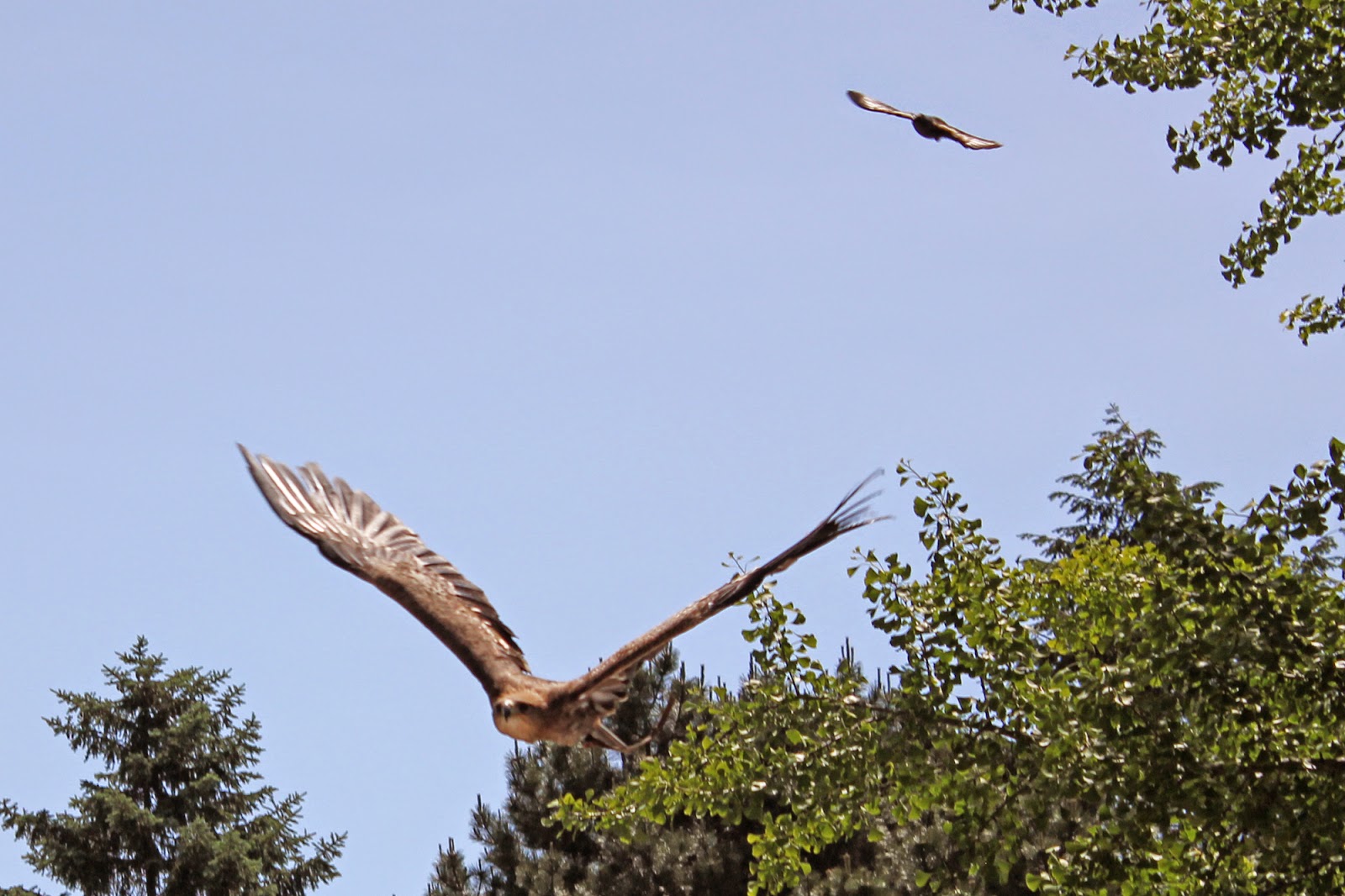
After the last show we returned to see Zeus fly.  We (all 3 of us) were the largest audience Zeus, the Golden Eagle, had ever seen while flying to that point in his training.  Zeus is a good-sized eagle and to see him come over the fence, open his wings and fly to his stump, back and forth, and then offstage, was fantastic.  It is not a difficult flight pattern, but with young birds you sometimes start with simple and always positive.  For me it was so exciting to see this bird fly, since a few summers ago I worked very hard on training him.
Zeus the young Golden Eagle flew for his first audience--the three of us  (photo: Cathy Spahn)
After the shows I also stopped behind the scenes to visit Trinidad, the Military Macaw.  He was not in the shows due to the construction in the area, which he does not like.  Trinidad’s facial skin immediately turned bright red upon seeing me and he started his excited dance.  I love that he goes to zoo shows to fly, but he is the one bird I miss when he is gone.  Trinidad was the first parrot I ever flew with WBS and we have always had a special relationship.

The Milwaukee County Zoo Bird Show runs only through Labor Day and is free with admission to the zoo, but you'll have to hurry--only 18 days left to see these amazing flying raptors.  It is a great weekend trip from the St. Louis area.  

Submitted by Cathy Spahn, World Bird Sanctuary Naturalist

Thursday, July 16, 2015

The Rookie Class of 2015


The arrival of summer at the World Bird Sanctuary can mean only one thing--zoo shows are here!  And by Zoo Shows I of course mean those educational and entertaining programs WBS staff and birds present at zoos around the nation.

With every new zoo show season we have a new class of rookies ready to make their mark.  This year is an especially large graduating class so to speak, because not only do we have brand new birds, but an old pro that has come out of retirement.

Zeus, a young Golden Eagle is one of our new fliers (photo: Gay Schroer)

This year we have one rookie flyer at our Stone Zoo show and five at the Milwaukee County Zoo, plus one returning flyer after a six year vacation.  It is always exciting teaching new birds to fly.  Most new flyers do what I like to call “prong horning,” where they hop straight up into the air and then make a horizontal flight.  This is very common the first several times they take off until they learn how to better control their flights.  Many new fliers also overshoot their landing spots, since they have not yet learned how to apply their brakes or to properly calculate distance.  Discerning the distance to and from a perch and other objects is a skill that birds obtain through practice.

When we first started practicing Zeus our Golden Eagle he would fly away from his stumps if they appeared to be too close to the bleachers.  We moved the stumps and over several days and flying sessions we gradually pushed them back to their original positions.  Now Zeus loves his stumps wherever we place them on stage.

 Technically this is Evita's debut year (photo: Flannery O'brien)

 Even birds that don’t do a whole lot of flying, like Evita the Red-legged Seriema, have to start out slow so that they can get used to new situations.  Technically Evita was in two shows at the very end of the season last year, but this year is her big debut season.  We started out slowly, gradually leading her closer and closer to the stage.  Her first time on the stage she wandered around for five minutes exploring everything the theater had to offer.  After carefully checking out all three sets of bleachers she was ready to exit and hasn’t really wandered since.

The key with rookies is to start small, get the birds used to the behavior or pattern first and then transition it to the theater.  The audience must be built up gradually until they are used to people.  They often need time to check out their new surroundings, either by wandering or sitting on a high perch and just scoping out the area.  Giving a bird time to do this is very important because it makes them feel safe.  They learn the surrounding area, determine that there are no predators and make a mental map so they can get back in case they ever leave the theater.

Chique the Blue-fronted Amazon parrot (photo: Leah Tyndall)

Sherlock an African Pied Crow is currently practicing his recycling routine in his enclosure, but soon we will be able to practice him in the theater.  Chique (a Blue-fronted Amazon parrot) is just starting to do her vocal cues on the hand rather than in her cage.  Once she is comfortable on the hand, she will also move to the stage. 

Azizi the White-bellied Stork rounds out our rookie line-up (photo: Flannery O'Brien)

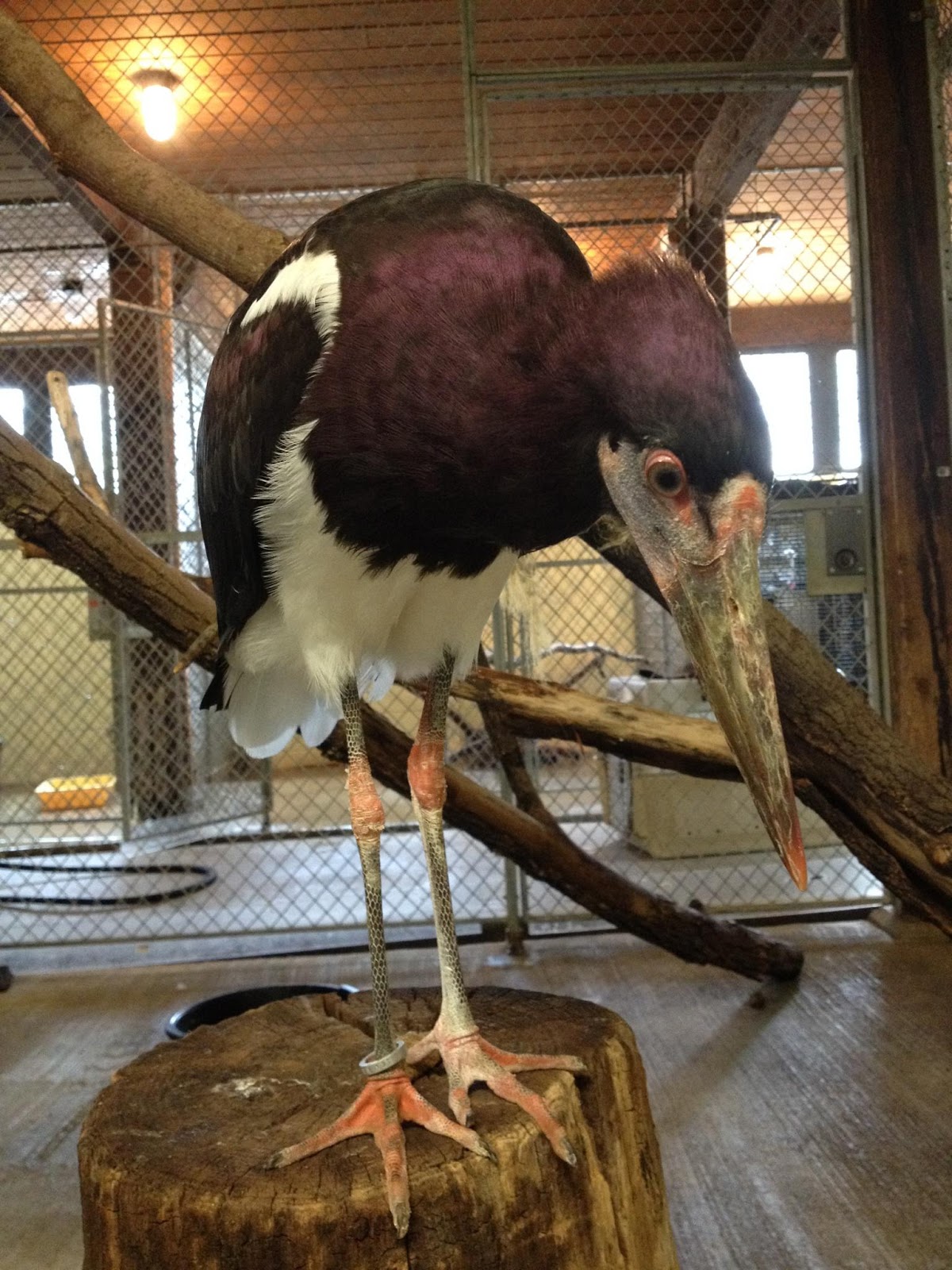
Our last MCZ rookie is Azizi the White-bellied Stork.  He is learning to follow us, and our trail of meat, wherever we go.  This includes short walks outside of both his indoor and outdoor enclosures.

Skinner the Turkey Vulture is our returning veteran (photo: Flannery O'Brien)

The returning champion is Skinner the Turkey Vulture, who has already proved he is an excellent homing vulture.

Every new zoo show season means a new crop of rookies. Be sure to visit the Milwaukee County Zoo this summer and see Zeus, Azizi, Evita, Sherlock, Chique and Skinner. Also be sure to pay a visit to Roderigo the Common Buzzard up in Boston. Come see all of their hard work pay off.

Submitted by Leah Tyndall, World Bird Sanctuary Naturalist/Trainer


Tuesday, July 14, 2015

Flying Gunk


They say time flies when you are having fun.  This year, I am having more fun than ever working at the World Bird Sanctuary’s Milwaukee County Zoo Bird Show.

Duncan, the Wedge-tailed Eagle executes a beautiful flight (photo: Flannery O'Brien)
However, the birds and time are not the only things that are flying at the bird show.  Blood.  Guts.  Poo.  Slobber.  All of these things are constantly soaring around those of us who work these amazing programs.  Unfortunately, sometimes these soaring pieces of “gunk” find their way onto our arms, face, and even into our mouths.

I like to talk--a lot! (photo: Ian Wright)

I like to talk; a lot.  It’s kind of my thing.  My job sort of requires that I talk constantly and nine times out of ten my sentences seem perfectly timed for my mouth to be open just as the bird is sending a slobber, blood, or meat filled shower my way.  I can talk my way through a lot of unexpected situations, such as a bird deciding it wants to take the scenic route to its perch.  However, when an unwanted bird shower ends up in my mouth, it’s impossible to not be taken aback for a few seconds.

Whiskey Sam Adams, our African Augur Buzzard (photo: Flannery O'Brien)
Earlier this year, our African Augur Buzzard, Whiskey Sam, decided to become a part of the Africa section of the zoo by hanging out in a tree within the Bongo exhibit.  After running out of my long list of “Fun Fowl Facts with Flannery,” I decided to ask the audience for questions.  Of course, the first hand into the air was a little girl in the front row.   She obviously had been itching to ask me the question for a while.  I called on her and she eagerly opened her mouth and asked, “What would happen if a baby was crying and a bird flew over and pooped in that baby’s mouth?”

I love kid questions.  They are so creative.  However this was by far the most creative and unexpected question I have ever been asked.  After hesitating for a moment and rewording the question so everyone could hear, I came up with the only answer I could think of, “Well, the mom would probably run to the bathroom and rinse that baby’s mouth out.”


At the time, that was probably the worst scenario I could have imagined happening with flying bird “gunk.”  Until, that is, a couple of weeks later.  At the end of the show, as I am delivering a particularly delightful conclusion, Clark, our Bald Eagle, decided that the piece of meat he was in the middle of consuming, needed to be shared.  He shook his head and sent a shower of slobbery, disgusting, gooey meat directly towards my face and into my mouth!

All was going well until Clark decided to "share" (photo: Ian Wright)

As mentioned earlier, I can usually pretend the situation never happened and keep talking--but a piece of meat flying into my mouth was not a situation I can handle with much grace.  Instantly, I started sputtering, trying to get the gunk out, but to no avail.  The only thing that resulted was that the speakers were echoing my sputtering into the stands, and that was not professional.  My left hand was in a glove that Clark was seated on top of, and my right was covered in blood and gore from handling food for the rest of the birds.  So I did the only thing I could do.  I took a deep breathe, thought, “Yep, I’m doing this,” swallowed as best I could, and continued with the rest of the conclusion.  The second that show was over, and I had joked with several people about being more patriotic now that the Bald Eagle had given me that deliciously disgusting piece of food, I gracefully put Clark down, and did exactly what I had told the little girl.  I ran to the sink and rinsed my mouth profusely with water.

When you work with animals, you sign up for the fun things like speaking shows and watching a bird problem-solve on its own.  You also sign up for the not so fun stuff, like scrubbing poo and apparently sometimes sharing their dinners.  It was easily the most disgusting experience of my life, but that was the moment I knew that I was hooked on this career and that I found where I belong.  Because if I can suck it up, eat a ball of slobber and gore, and still keep a smile on my face, I can do anything that this job throws at me.  Literally.

Submitted by Flannery O’Brien, World Bird Sanctuary Milwaukee County Zoo Show Naturalist/Trainer

Friday, June 26, 2015

Zoo Show “Radar”


When sitting in the audience of a World Bird Sanctuary bird show at a zoo, the setup may appear simple enough; one person is talking (the Speaker) while two others are mostly backstage (the Trainers) cueing perches for birds to fly to or walking birds offstage.

While memorizing a roughly twelve page long script and fifteen or so different bird flight patterns (the places on stage a particular bird flies to) may not seem too bad, we have a lot more than just script and patterns on our radar!  Like the birds we work with, we must be acutely aware of anything and everything going on around the theater, and react to those things at a second’s notice.

Locust, the Red-legged Seriema, pausing to watch a plane

The main things that we are watching are the behaviors of the avian members of the team.  On the occasion a bird goes to an incorrect perch or is not flying to the next one, it is our job to determine why.  It’s often as simple as trying to look at whatever the bird is looking at!  A plane flying overhead may have caught their attention for a moment, or an audience member sifting through a purse across stage.  Usually re-pointing to a location is all we have to do to re-catch a bird’s attention, and as the Speaker we always have extra facts ready to share to fill in the time.

Riley taking off to fly to his next cue in the bleachers

The second thing everyone has an eye on is the audience.  One of my favorite parts of our show is getting into the bleacher seats and flying Riley, an American Barn Owl, right above and very close to the audience.  As you are walking to the set of bleachers in Riley’s pattern, you have a few sentences to decide where exactly you should go.  A giant snake stuffed animal resting in the back row?  To Riley that looks like a Godzilla-sized predator…not a good spot!  Everyone must keep an eye on the extra-antsy young members in attendance as well.  Emergency bathroom trips are quite common.  Trainers know when the Speaker delays saying a release cue (a point in the script that signals the next bird to appear), it’s a signal that audience members are making their way out of the theater.  Norbert the Bald Eagle should definitely not fly through the entryway at that moment.

Our radar expands to outside the theater too.  Sometimes wild raptors make an appearance in the sky above us.  While a wild Red-tailed Hawk gliding by is no threat to the eagles in the show, stalling is sometimes required if the next bird just so happens to be a smaller species.  It’s almost a guarantee the wild raptor won’t attack any of our birds, but the smaller birds could still react like the wild bird would attack.

The classic “All’s Clear!” sign

This leads to another thing all the human members of the show team are watching--each other!  A Trainer arm appearing above the fence could signal several things to the Speaker.  Pointing skyward, for example, means a wild predator is overhead.  The ever-changing and always-different environment of zoo shows is one of the things I love about them.

Now, after reading this you may be thinking that an awful lot of things can cause a Speaker to stall for time during a show.  However, if you watch a World Bird Sanctuary zoo show at Stone Zoo or Milwaukee County Zoo this summer, you probably won’t be able to tell if anything out of the ordinary is happening!  Our goal during zoo shows is to educate and entertain the audience about the amazing birds of our world.  After all, “stalling” really just means sharing more cool facts!

Submitted by Carmen Volante, World Bird Sanctuary Naturalist/Trainer

Sunday, May 31, 2015

Pack it on up. Move it on out.


As show supervisor for World Bird Sanctuary’s zoo shows I enjoy a transient lifestyle.  I’ve mentioned before how the ever-changing scenery and people keep me on my toes and free of boredom.  This is true but there is one thing I don’t enjoy about constantly being on the move—Packing!

Time to pack the car (photo: Neal Cowan)
 I hate packing.  I loathe packing.  It doesn’t help that I’m not particularly good at it.  I’m great at gathering things, checking and double checking a list, and sorting.  I’m not so good at the actual packing…or moving. Putting things in boxes, carrying them around, making them fit in a car.  All of it is not fun. 

Not only do I have to pack all of my own things, but I also have to pack for the birds and the show.  Both zoos we frequent allow us to leave items in storage, but we still cart the majority of our supplies back and forth.  It is important to make sure we have everything we need, as there are very few opportunities to bring the missing items to us from St. Louis.  That is a lot of pressure when packing, which makes it even less fun.

So much “stuff” and I’ve only just begun (photo: Leah Tyndall)
 I will admit there have been occasions, when I am very tired, that I’ve pondered the possibility of training birds to pack for themselves--not that they have a whole lot of experience when it comes to packing.  Well Sherlock the African Pied Crow will pile his toys in his crate, but that’s about it.

Hmmm…do you think?  Uh….no, I guess not! (photo: Mike Cerutti) 
In the wild, birds don’t have to pack up and move their things from one nest to another.  In most cases they build their nest from scratch.  In some cases they don’t even build the nest.  Owls for instance build a scrape.  This is a depression either in the ground or in a tree cavity.  They usually line these with feathers before laying their eggs.  Abandoned nests will often be used by different birds, even different species.  It is not uncommon for Great Horned Owls to take over abandoned Red-tailed Hawk nests.  On occasion they don’t even wait for the nests to be abandoned.

Brood parasites are a group of birds including European cuckoos and cowbirds.  These birds will lay their eggs in another bird’s nest.  Not only do they not have to raise their own young, but they also do not have to expend the energy to build a nest in the first place.  Bald Eagles are the closest to being movers, although they don’t move between nests as much as they build onto their existing nest.  Bald Eagles will return to the same nest year after year, adding more and more sticks.  The largest Bald Eagle nest ever recorded was nine and a half feet wide, twenty feet deep, and weighed over three tons before it broke the tree in which it was built. That weighs more than my car--my car being a RAV 4, so I can pack all of my stuff or fit an eagle size crate in it!

Zoo show life is fantastic, except for moving myself, and 15-20 birds and all of their items, across the country.  In the wild birds do not need to move anything but themselves from one place to another.  In some cases they do not even need to build a nest in the first place. If only moving zoo shows were that simple…and don’t even get me started on unpacking!

And just about the time I have reached the point of exhaustion and am throwing myself a real pity party, I am reminded why we at zoo shows do all this packing, unpacking and moving of personal items, equipment and birds.  The first time a bird swoops over the heads of audience members and we hear the gasps of amazement from a theater full of adults and children we know that “OH YEAH…that’s why we do it!”

So, if you happen to be in the Milwaukee area this summer, be sure to make the Milwaukee County Zoo one of your stops.  Our amazing birds will demonstrate for you why all that furious packing and transporting was well worth the effort.

Submitted by Leah Tyndall, World Bird Sanctuary Naturalist/Trainer and Zoo Show Supervisor.


Thursday, December 11, 2014

Tawny Eagles


Tawny Eagles derive their name from the color of their feathers, a subtle rusty brown. 
Juvenile Tawny Eagle (photo: the wikipedia files)

They can be found in eastern and southern Africa but also in southern Asia.  They are scavengers, mostly eating things that are already dead.  However, they have been seen catching prey up to the size of large rabbits.  They also often steal food from other birds, such as storks and hornbills. 
Tawny Eagle feeding on roadkill (photo: the wikipedia files)

Tawny Eagles are smaller than most old-world vulture species, and eat the same food.  Often times the vultures will find carrion first.  Tawny Eagles will wait for the vultures to eat, and then drive them away by repeatedly flying and “barking” at them (their call does sound like a dog barking).  Once the vultures are scared, they will vomit to be light enough to fly away.  Tawny Eagles then use this opportunity to devour the vomit as a warm “fresh” meal. 

During the dry season in Africa they build very large flat nests for raising their young.  This nest will be used for many years.  They usually lay two eggs, which take a little over a month to hatch.  Usually only one of the chicks survives. 

In the wild, a Tawny Eagle will live for upwards of sixteen years.  In captivity we can usually about double their lifespan. 
Diablo - Watch for him in Milwaukee next summer (photo: Gay Schroer)

Max and Diablo, the two Tawny Eagles here at the World Bird Sanctuary, were raised in captivity for educational purposes.  You can usually find Max in the weathering area behind the visitors’ center if he is not traveling to one of out outreach programs in the area.  Diablo can be seen at the Milwaukee County Zoo during the summers flying in our Bird of Prey shows.

In the wild Tawny Eagles are a common sight, and are listed as a species of Least Concern on the IUCN (International Union for Conservation of Nature) Red List. At this time the species seems to be doing well and there are no specific conservation efforts for them.
Max is one of the most photogenic birds at WBS (photo: Gay Schroer)

The next time you visit the World Bird Sanctuary look for Max in the weathering area.  You may get lucky enough to see him playing with his tennis balls or hear him barking at someone or something he perceives to be a threat within his territorial boundaries. 

And don’t let the plain brown feathers fool you…Tawny Eagles are one of the most photogenic birds at WBS.  Be sure to bring your cameras. 

As with all our animals, Max and Diablo are available for adoption as part of our Adopt A Bird Program.

Submitted by Mike Cerutti, World Bird Sanctuary Naturalist/Trainer

Tuesday, September 30, 2014

Meet the Neighbors


There are many challenges when doing a zoo show program.  Weather has to be taken into account, wind speeds compensated for, and the crowd carefully monitored to make sure no one tries to stand up during the show.  These challenges I was always prepared for; one thing I never took into account was the neighbors.

By neighbors I mean the wild (or semi-wild) birds that call the zoo home.  When our birds first move into the neighborhood in the spring they are generally ignored by the wild birds unless they end up in a tree while learning their new patterns.
Many zoos and theme parks release peafowl such as this albino Peacock  (photo by Gay Schroer at Magnolia Plantation)
The biggest problem we have when we first arrive is the peafowl.  Peafowl are not native, and are intentionally released by zoos and theme parks for their guest’s enjoyment.  The fowl quickly call wherever they are released home, and rarely wander off grounds.  Both Milwaukee County Zoo and Grant’s Farm have free ranging Peacocks and Peahens that consider the entire zoo their territory.  In the winter months they have free range of the exhibits where we keep our birds, so they are often surprised and upset when they suddenly cannot cross into “their” territory.  They wander into the theaters during practices and we have to stand guard in the weathering area (the outdoor area where we keep our birds on display) to prevent Peahens from charging our poor birds.  Peafowl may look ridiculous, but they have strong kicks and they could do a fair amount of damage to our birds, especially the Peacocks, which have spurs on their legs.  After a while the peafowl start to realize they cannot enter certain areas, but we still have to stay on guard because peafowl are not the only birds that are not pleased with our birds’ presence.
A Peahen wandering under our bleacher seating 
Songbirds, understandably, are not thrilled when a group of predators move into their territory--especially during breeding season.  Once songbirds have eggs in their nests they begin to display a behavior called mobbing.  They will gather in groups and dive bomb large birds of prey to “encourage” them to leave the area.  Unfortunately, these birds do not realize that our birds have little interest in them or their young—our birds get three free meals a day.

The worst offenders are the Common Grackles, black songbirds that leave nothing to chance.  I am especially bitter about them because they chased a kestrel I worked with into the woods.  Every time he tried to fly back into the theater they chased him further into the woods (don’t worry we got him back…it just took a while).

The grackles this year were especially numerous.  Diablo (a Tawny Eagle), Reese (Great Horned Owl) and Clark (Bald Eagle) got the worst of it.  Both Reese and Diablo had clouds of five to seven grackles following them throughout their patterns.  We used the grackles’ natural fear of humans to our advantage, strategically placing ourselves between them and our birds or flying our birds into the crowd.  Robins, especially juveniles, will also harass our birds--often lurking in the trees above the weathering area in wait.
 The scariest scenario is wild raptors who chase our birds (photo: Laura Bailey)
The scariest case of wild bird interaction however did not involve songbirds, but a wild juvenile Cooper’s Hawk who wanted to chase our Military Macaws my first year doing shows.  Suddenly instead of two birds doing loops around the theater there were three!  Luckily we were able to call our birds down to safety and we never saw the young hawk again.

Despite all of the trouble wild birds cause, I will admit there is no better way of finding a bird that has flown off or been blown out of the theater by wind.  Just follow the sound of angry songbirds and nine times out of ten we find our bird.  Although sometimes we find wild birds of prey!

There are many challenges to face during zoo show programs, but none quite as unpredictable as the local bird population.  They can be an annoyance, an amusement and even aid you, assuming they did not cause the bird to seek shelter in a tree in the first place.  Regardless, they certainly keep us on our toes!

If you live in or are visiting the Milwaukee, Wisconsin area this summer be sure to visit the Milwaukee County Zoo, and in particular the bird show presented by the World Bird Sanctuary.

Submitted by Leah Tyndall, World Bird Sanctuary’s 2014 Milwaukee Zoo Show Supervisor

Friday, September 26, 2014

Height: Help or Hindrance


I'm easy to pick out of a crowd, and I've heard the question, "How tall are you," too many times to count.  My height (I'm 6'6") has been helpful for most of my life, but when I started working for World Bird Sanctuary’s bird show at the Milwaukee County Zoo, I considered it more of a hindrance at times.

I started volunteering at WBS’s nature center in February 2014 because I could work with both the birds and reptiles there, and at the same time interact with the public.  I found my niche in the daily chores, but I wanted to help more with the animals, especially the birds.  Once I started handling the birds, I wanted to participate more in their flying exercises.  When Jeff noticed my thirst for knowledge and drive to help out more, he recommended I try the bird show.  That is how I ended up becoming a trainer in Milwaukee for the summer.

Being tall has many perks when it comes to bird shows.  During the initial setup, it helped in the construction of the outdoor bird enclosures, since I could reach on top of them without any problems.

When it came time to shape birds’ flying patterns, I got designated the "official creance tester" (creance being a long line used in initial raptor free flight training), since during later training I could place birds on high perches others couldn't reach.  The main advantage I utilize every day is that I don't have to use a step stool to reach into the raptor's night stalls (picture below).  This helps me get them out of their stalls faster and easier during the morning weigh/change and later during shows for faster transitions.

Cleaning the stalls (photo by Erika Fenske) 
While being tall has some advantages when working with the birds, it also has some  disadvantages when it comes to training and doing shows with them.  My size tended to intimidate/scare a lot of the birds at first (and still does for some), so I have to limit my interactions with them during the initial stages of training.  When it comes to shows I have learned to adjust my height a lot, because the fence covering the behind the scenes area is only 6' in most places.  So, I have to crouch a lot to hide my movements from both the audience and the birds on stage. 

"Hidey ho neighbor"–A Wilson quote from the Tim Allen Show, Home Improvement (photo: Erica Fenske)
I have accepted the fact that I'm tall and I can't do anything about it.  That just means I have to devise new techniques to work with the World Bird Sanctuary’s amazing birds while doing bird shows.

Submitted by William Oberbeck III, World Bird Sanctuary’s Milwaukee Zoo Bird Show Trainer/Naturalist

Tuesday, August 26, 2014

My Preparation for Zoo Shows


I first started volunteering (as a part of the World Bird Sanctuary Junior Volunteer Program) in 2007 when I was 13 years old.

I spent my first seven years volunteering at the World Bird Sanctuary’s ETC (Educational Training Center) doing pretty much anything I was told. Whether it was cleaning mews, prepping food, or doing whatever projects we had that day, I was always on it.

For the first 3 years I was always at the ETC, but when I turned 16 I was brought into a whole new world. Now able to handle birds, I was getting more into my work as a whole. Since I was able to do more with bird handling I would tag along with staff members on trips to feed and care for some of the birds on the exhibit “line” at the upper site (This is the area that is always open to the public.)

While I was there I was finally able to interact with the public.  It was something new and amazing to be able to talk to people who thought what I did was incredible. I now had a whole new appreciation for what I do. But I wanted to get out more without leaving the ETC, so I volunteered to work at any special events that appeared on the calendar.

There is World Eagle Day that I always enjoyed being apart of. It gave me a chance to help out on the upper site. I got the chance to walk the “line” and answer people’s questions, and I found that to be one of my favorite things to do. It always made me feel good to help anyone out or help clarify an “old wives tale” about birds.

Whenever a new event would come along I would do anything to try and be able to lend a helping hand to the public. But there was no event quite like Open House.  It gave me a chance to be at the ETC and also interact with the public--working displays, answering questions, and most of all giving tours. This gave me the chance to share the store of information that I had learned over the past seven years with guests, and they truly appreciate it.


After seven years of hard work I now know what it was all for—WBS Bird Shows that we present at zoos! That is what I have been training for most of my life--flying birds every day, hearing the “ooos” and “aaahs” from the crowd as our birds fly over their heads, and being front and center to bring the public a show like they have never seen before.  Every day I get to meet hundreds of new people and a few old familiar acquaintances.

I truly feel like the bird show is where I am meant to be.  I feel it’s what I am meant to do.  Now I know the energy I get from performing a show will never leave me.

Submitted by Ian Wright, World Bird Sanctuary Milwaukee County Zoo Show Trainer