Showing posts with label ETC. Show all posts

Saturday, December 10, 2011

The Rookie Files: And we’re back!


Hello again dear reader! After a long, wonderful show season, I, Leah Tyndall, zoo show supervisor for World Bird Sanctuary, have returned to WBS headquarters.
The WBS Educational Training Center (ETC) 
It was an exciting and at times exhausting season in which I both taught and learned.  The time has come however to hang up the microphone, unclip the show pouch, and settle in for the winter.

Winter, or the “off season”, is drastically different than show season (April through September).  Not just because we are no longer doing shows every day, but because our jobs shift from educator to keeper.  The Education Training Center (ETC) is where show birds vacation during the winter. 
Outdoor mews where native and cold hardy species are housed in winter
Native or cold hardier species are put into free loft, or large outdoor enclosures, that allow space to fly if the birds wish.  The cold sensitive species spend the off-season free lofted in large, indoor pens.  There are a few birds that remain on equipment (anklets and jesses) for health or training reasons, but even those birds are on vacation.

It falls to us to act as the resort staff and make sure that all of the birds remain happy and healthy during their stay.  This is more than just feeding and enriching the birds with toys.  It also means upgrades in housekeeping chores and tasks that we do not have to worry about quite as much during show season.  These include changing shavings on indoor enclosure floors, keeping water bowls and outdoor pools clean, maintaining and raking the outdoor mews, as well as switching out old with new perches to make sure that their feet stay in good condition.
The heated indoor enclosures where more cold sensitive species are housed in winter
This period of time is also key in shaping and maintaining behaviors that will be useful during the show season.  Things like perching on command, waiting until a piece of food is thrown, crating, and response to verbal commands are all very important come show season. 

These actions are also helpful for husbandry reasons.  A vulture that knows how to wait in a particular spot when cued to do so, will do so on the scale instead of rushing its trainer in search of food (which is greatly preferable).  A territorial bird that crates makes changing shavings and cleaning pens much safer. 

In order to maintain these behaviors, all of the birds inside of the ETC work for their food.  This not only helps us, but it also keeps the birds entertained throughout the winter.  This is especially important for the more intelligent birds such as corvids, parrots and vultures.  If these species become bored they may resort to other means to amuse themselves--methods that could be destructive to themselves, their caretakers or their housing.

The Education and Training Center is also just that, a training center.  Since we are behind the scenes we can afford to spend more of our time training new birds--be they juveniles that have just been put on equipment, adult birds pulled from free loft or birds new to the sanctuary.  All of them need to be trained before they can be used for education or in shows.  This also helps to keep our bird training and observation skills sharp for the coming show season.

Even though there is nothing quite like show season, the slower more easygoing pace of the off-season has its charms as well.  It gives us a chance to maintain behaviors, entertain the birds and improve on our own training skills. All of which are incredibly important….not to mention, “concierge to a Bald Eagle,” looks great on a résumé. 

Submitted by Leah Tyndall, World Bird Sanctuary Naturalist/Trainer

Wednesday, November 2, 2011

A Day In The Life….


During the summer, the Educational Training Center (ETC) the World Bird Sanctuary’s behind the scenes bird housing facility, is a pretty quiet place.  

We take care of the few birds that do not end up out at a summer zoo show, and we take care of a lot of maintenance projects for WBS, such as filling potholes on the road to the ETC, or maintaining much of the behind the scenes bird housing.

However, when the first week of September rolls around, the ETC gets much noisier.  This year, WBS sent two groups of birds and trainers on the road—one group to the Milwaukee County Zoo in Wisconsin, and another to the Stone Zoo in Boston, Massachusetts.  Both birds and staff performed spectacularly at these zoos all summer.
 Grand finale of WBS Birds of Prey show at Boston's Stone Zoo
On September 7th, the Milwaukee zoo show returned to St. Louis, bringing with it about eighteen birds.  Then on September 10th, the Boston zoo show returned with another eighteen birds.  In the space of four days, the ETC went from being calm and quiet to a hub of activity.  We have a lot more birds to take care of down here now, and we love having them back!

The daily routine starts by checking to make sure all of our birds are okay in the morning.  They usually greet us in their stalls with their signature noises—the peeping of our young Augur Buzzard, the grunting bark of a Tawny Eagle and the shrieking chirp of two Bald Eagles.  The Parrot Room, where all of our parrots are housed, is another level of noise entirely.  The parrots shriek loudly, and we even have to wear hearing protection.  They’re hungry, and they’re not going to let you forget it.  We feed the parrots first, then we take the raptors outside, so they can experience whatever weather happens to be going on that day.

The morning passes in a flurry of food prep.  On a typical day, we have to prepare at least thirty individual bird diets.  Some birds can only get specific types of food (for example, pelicans will only eat fish).  Some of our birds are weight managed, which means they are either performing in shows or learning a new behavior and need to maintain a specific weight: the weight at which they perform best (Goober the Black Vulture and Lenore the White-necked Raven are two such birds).  Other birds can eat whatever they want—we can feed our Bald Eagles rabbit, rat, fish or venison (although Patriot, one of our eagles, doesn’t like to eat fish, which is atypical of a Bald Eagle, really…) 

Here at the ETC we also prepare food for the Display line on the main site. This adds another thirty or so birds for which we must prepare the right diet.  We add a nutritional supplement to the food called Vitahawk.  This gives the birds extra vitamins and nutrients that are necessary for their health.  After the Vitahawk is added, the birds are ready to be fed.

When we walk out into the weathering area with the green tray, all of the birds get excited.  They know what that means: feeding time!  The bird that gets the most excited is Prius, our Gyrfalcon-Peregrine Falcon hybrid.  She chirps constantly, from the moment the weathering area is opened to the instant she gets her food.  Like most falcons, Prius’s favorite food is quail.  As soon as she has the food in her grip, she starts to chow down. 

Other birds are more reserved about eating.  Liberty the bald eagle will sometimes just stare at his fish or his rat, seemingly wondering what he is supposed to do with it.  More often than not, when we leave the weathering area, he has hopped down from his perch and started to eat.  By the time all the birds are fed, all the food is prepared and the kitchen is cleaned, it is time for the humans to have lunch.

After lunch, we have to make sure that all of the birds have a clean place to live and play and sit for the night.  Some of the birds stay in mews inside the ETC, especially those species that are not adapted to live in cold weather (Red-legged Seriema, African Pied Crow, etc.)  We spot clean these enclosures, taking out wet or dirty aspen shavings on a daily basis.  We also replace all of the aspen shavings in the mews regularly.  Sometimes the ravens and crows try to “help”—they attack the broom while we sweep.  Mostly, the birds sit on their perches and give us strange looks.  We also make sure to clean out the raptor room—the place where the raptors that are on anklets and jesses stay during the night.

After we clean up after the birds, we take care of any other maintenance that is needed behind the scenes.  We are a busy group of people down here at the ETC.

Here are just a few of the birds we take care of:
Baton Rouge, King Vulture
Osiris, Egyptian Vulture
Aesop, the baby American Crow, who was just recently christened
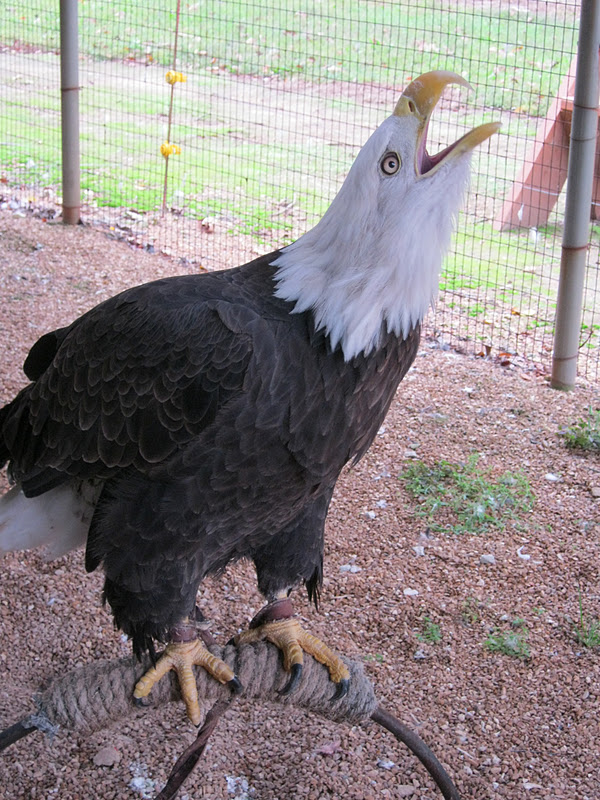
Patriot, Bald Eagle
Prius, Gyrfalcon-Peregrine Falcon hybrid

Some of these birds, like Patriot the Bald Eagle, will be rotated up to the Nature Center and Weathering areas from time to time, or will participate in educational programs over the winter.  Others, particularly those who are cold sensitive, will enjoy the heated quarters in the ETC building and will not be on public display until next summer when they will again be traveling to zoos and other entertainment venues.  For right now these birds are enjoying their winter vacation and the ETC staff is gearing up for a very busy winter.

Submitted by Emily Hall, World Bird Sanctuary Naturalist/Trainer

Monday, October 11, 2010

Greetings from Down Under!

No, not Australia--the Education Training Center (ETC). 

The ETC is the behind the scenes valley area of the World Bird Sanctuary where many of our birds spend the winter months between show seasons.  It is also where our cold sensitive birds spend the winter months in heated quarters.
 ETC interior enclosures where cold sensitive birds spend the winter months

The past month of September has been very busy with the comings and goings  of our birds and staff. To begin, since the visitor information center (VIC) and the area it is in was under construction for most of the summer, all birds that were normally housed there were kept at WBS’s Education Training Center (ETC).  On Saturday, 4 September, those birds were finally moved back to the VIC.  But the ‘calm’ and ‘quiet’ that this provided didn’t last long because within 4 days the summer bird show from Milwaukee returned with all the supplies, birds, and 2 staff members.

The show staff had left in early May with 23 birds to prepare for the show at the Milwaukee County Zoo. The summer was busy with 23 birds, 4 staff, a script to memorize and a lot of new behaviors to train before shows started on Memorial Day Weekend.
 Riley has perfected the art of looking cute--so on to bigger and better things

Some of the biggest challenges for the staff included many rookie birds.  Riley (American Barn Owl) spent the previous summer getting socialized to the crowds as a beginner and just being cute. This year he was required to be cute as he flew over the audience. 
 Hoss trying to match Riley's cutness factor

Hoss (Eurasian Eagle Owl) assumed Riley’s role from the previous year, learning how to stand on the glove and getting socialized in front of our audiences.  Mesquite (Harris Hawk) was going through accelerated learning.  He spent a couple of weeks in the spring being trained to sit comfortably on the glove.  For the show in Milwaukee he was flying to perches, and even some without a trainer to cue him there! 
 With Tsavo, our Bateleur Eagle, it's not all about being cute--his role is about being impressive!

Tsavo (Bateleur Eagle) spent the previous summer as a glove or display bird at Grant’s Farm.   According to his file before he migrated to the Sanctuary, he had flown at shows but this was his first time flying at a sanctuary show. Now was the time to see what he could do. After passing all tests, he cruised into the theater and into the bleachers and right over the crowd awing them with his bright red face and feet.

Many birds have gone to shows before, but they still had to learn their patterns for this show (and we did too!)  Some behaviors were tweaked or added to. 
Black - Our little chicken hawk impersonator 
 Our chickens have always been the ‘fowl’ part of the show, but Black showed a lot of promise in an interactive part of the show with a young victim… I mean volunteer.  Guests had the opportunity to be a perch for Black, our “chicken hawk” impersonator.
Rio, part of our triple Macaw Madness, wowing an audience 
Our flocking Military Macaws (Carmen and Trinidad) found themselves with an additional macaw flying in the theater.  While the green blurs passed outside the theater, buzzing by bystanders on the paths, Rio (Green Winged Macaw) flew a couple of loops right over audience heads, providing many with new hair dos! This part of the show was lovingly referred to as Triple Macaw Madness.
Millwaukee pre show talk at the weathering area

So, in the end, we presented more than 325 shows, performing seven days a week from Memorial weekend to Labor Day, and educated more than 31,000 guests!!  I mention “more than” because before shows even started for the day, we spoke to zoo guests about the raptors that were in our weathering area in the morning.
Milwaukee Zoo Show guests taking photos and having questions answered before the show
At the end of the show we asked guests to fill out a survey.  A quarter of the guests surveyed enjoyed the bald eagle the best, followed closely by the Triple Macaw Madness and the parrots that sounded like people.   Guests gave many accolades including a few of my favorites.  “Very informative and entertaining.  Nicely Done.” Another guest said “We are the best part of the zoo!” Another visitor remarked “Fun and entertaining for both children and adults.”  And my favorite one of all “The best show in 20 years!”
Outside Weathering Area at lower site where our zoo show birds spend their winter vacation
All the birds have since settled in from the summer and are ready for the ‘relaxing’ winter to come, where they get breakfast in bed, sight- seeing opportunities, views of the local wildlife, and room service to their mews (winter hotel room.)

Also, Grants Farm has slowed down but you may still see several of our raptors in the show Fridays thru Sundays.  Hunter (Eurasian Eagle Owl) and Richie (Harris Hawk extraordinaire) fly in the Animal encounter programs that occur 3-4 times a day.  Several other birds might also be spotted, including Carmelita (Great Horned Owl veteran), Shadow (Bateleur Eagle) and Sanibel (Bald Eagle).

If this was September, lets hope October slows down a little and cools off.

Submitted by World Bird Sanctuary Trainer/Naturalist Christina Lavallee