Showing posts with label Duncan. Show all posts

Tuesday, July 14, 2015

Flying Gunk


They say time flies when you are having fun.  This year, I am having more fun than ever working at the World Bird Sanctuary’s Milwaukee County Zoo Bird Show.

Duncan, the Wedge-tailed Eagle executes a beautiful flight (photo: Flannery O'Brien)
However, the birds and time are not the only things that are flying at the bird show.  Blood.  Guts.  Poo.  Slobber.  All of these things are constantly soaring around those of us who work these amazing programs.  Unfortunately, sometimes these soaring pieces of “gunk” find their way onto our arms, face, and even into our mouths.

I like to talk--a lot! (photo: Ian Wright)

I like to talk; a lot.  It’s kind of my thing.  My job sort of requires that I talk constantly and nine times out of ten my sentences seem perfectly timed for my mouth to be open just as the bird is sending a slobber, blood, or meat filled shower my way.  I can talk my way through a lot of unexpected situations, such as a bird deciding it wants to take the scenic route to its perch.  However, when an unwanted bird shower ends up in my mouth, it’s impossible to not be taken aback for a few seconds.

Whiskey Sam Adams, our African Augur Buzzard (photo: Flannery O'Brien)
Earlier this year, our African Augur Buzzard, Whiskey Sam, decided to become a part of the Africa section of the zoo by hanging out in a tree within the Bongo exhibit.  After running out of my long list of “Fun Fowl Facts with Flannery,” I decided to ask the audience for questions.  Of course, the first hand into the air was a little girl in the front row.   She obviously had been itching to ask me the question for a while.  I called on her and she eagerly opened her mouth and asked, “What would happen if a baby was crying and a bird flew over and pooped in that baby’s mouth?”

I love kid questions.  They are so creative.  However this was by far the most creative and unexpected question I have ever been asked.  After hesitating for a moment and rewording the question so everyone could hear, I came up with the only answer I could think of, “Well, the mom would probably run to the bathroom and rinse that baby’s mouth out.”


At the time, that was probably the worst scenario I could have imagined happening with flying bird “gunk.”  Until, that is, a couple of weeks later.  At the end of the show, as I am delivering a particularly delightful conclusion, Clark, our Bald Eagle, decided that the piece of meat he was in the middle of consuming, needed to be shared.  He shook his head and sent a shower of slobbery, disgusting, gooey meat directly towards my face and into my mouth!

All was going well until Clark decided to "share" (photo: Ian Wright)

As mentioned earlier, I can usually pretend the situation never happened and keep talking--but a piece of meat flying into my mouth was not a situation I can handle with much grace.  Instantly, I started sputtering, trying to get the gunk out, but to no avail.  The only thing that resulted was that the speakers were echoing my sputtering into the stands, and that was not professional.  My left hand was in a glove that Clark was seated on top of, and my right was covered in blood and gore from handling food for the rest of the birds.  So I did the only thing I could do.  I took a deep breathe, thought, “Yep, I’m doing this,” swallowed as best I could, and continued with the rest of the conclusion.  The second that show was over, and I had joked with several people about being more patriotic now that the Bald Eagle had given me that deliciously disgusting piece of food, I gracefully put Clark down, and did exactly what I had told the little girl.  I ran to the sink and rinsed my mouth profusely with water.

When you work with animals, you sign up for the fun things like speaking shows and watching a bird problem-solve on its own.  You also sign up for the not so fun stuff, like scrubbing poo and apparently sometimes sharing their dinners.  It was easily the most disgusting experience of my life, but that was the moment I knew that I was hooked on this career and that I found where I belong.  Because if I can suck it up, eat a ball of slobber and gore, and still keep a smile on my face, I can do anything that this job throws at me.  Literally.

Submitted by Flannery O’Brien, World Bird Sanctuary Milwaukee County Zoo Show Naturalist/Trainer

Monday, September 8, 2014

Birdlore: The Wedged-tailed Eagle: Bunjil


On the continent of Australia, the land down under, lives a unique raptor known as the Wedge-tailed Eagle (Aquila audax).

The name of this bird of prey comes from its characteristic diamond-shaped tail. The Wedge-tailed Eagle can be seen widespread throughout the continent, as well as Tasmania, and parts of southern New Guinea.

A wedge-tailed eagle in flight with broad wings stretched out and its diamond-shape tail easily seen (photo: the Wikipedia files)
The Wedge-tailed Eagle is the largest raptor found in Australia and fills in the niche as nature’s scavenger, as there are no native vultures.  Despite past persecution due to accusations of predation on cattle and sheep herds, the Wedge-tailed Eagle population has thrived well from the introduction of rabbits, a pest species introduced in the early 1800’s, as well as the usual sources of carrion.

In many early cultures, apex predators were regarded as gods or spirits, responsible for the elements or even the creation of the world, the Wedge-tailed Eagle being no exception to this.

One creation story belonging to the Kulin, an aboriginal people of Australia’s Victoria state, tells the story of Bunjil, in the form of a
Wedge-tailed Eagle, and his creation of the world and humanity.

Bunjil, the Great Spirit and All-father, created the entire earth with the plants and animals to inhabit it.  He also made the form of man, which proved a greater undertaking than the rest of his creation, for man would require the complex power of thought and reasoning to separate him from simple animals. 

After much consideration, Bunjil selected two slabs of bark and crafted them into shapes suitable for his greatest creation, being sure to incorporate the necessary traits of mobility and dexterity into his design.  Next, he took soft clay from the earth and molded it around the bark sheets, smoothing it.  Completing this task, he danced around the still figures, implanting the seeds of knowledge, thought, and reason.

Granting them the names, Berrook-boorn and Kookin-berrook, Bunjil knew this was necessary so that they could retain individual personalities and spirit.  His creations ready to be filled with life force, Bunjil danced around them once again and proceeded to fill their mouths, nostrils, and navels with breath and life.

Dancing around them a third time, Bunjil weaved complex patterns in the dust.  As he did so, Berrook-boorn and Kookin-berrok rose from their place on the ground and linked hands with Bunjil.  They joined their All-Father in celebration of the dance of life, singing with Bunjil with the first song from the lips of man.

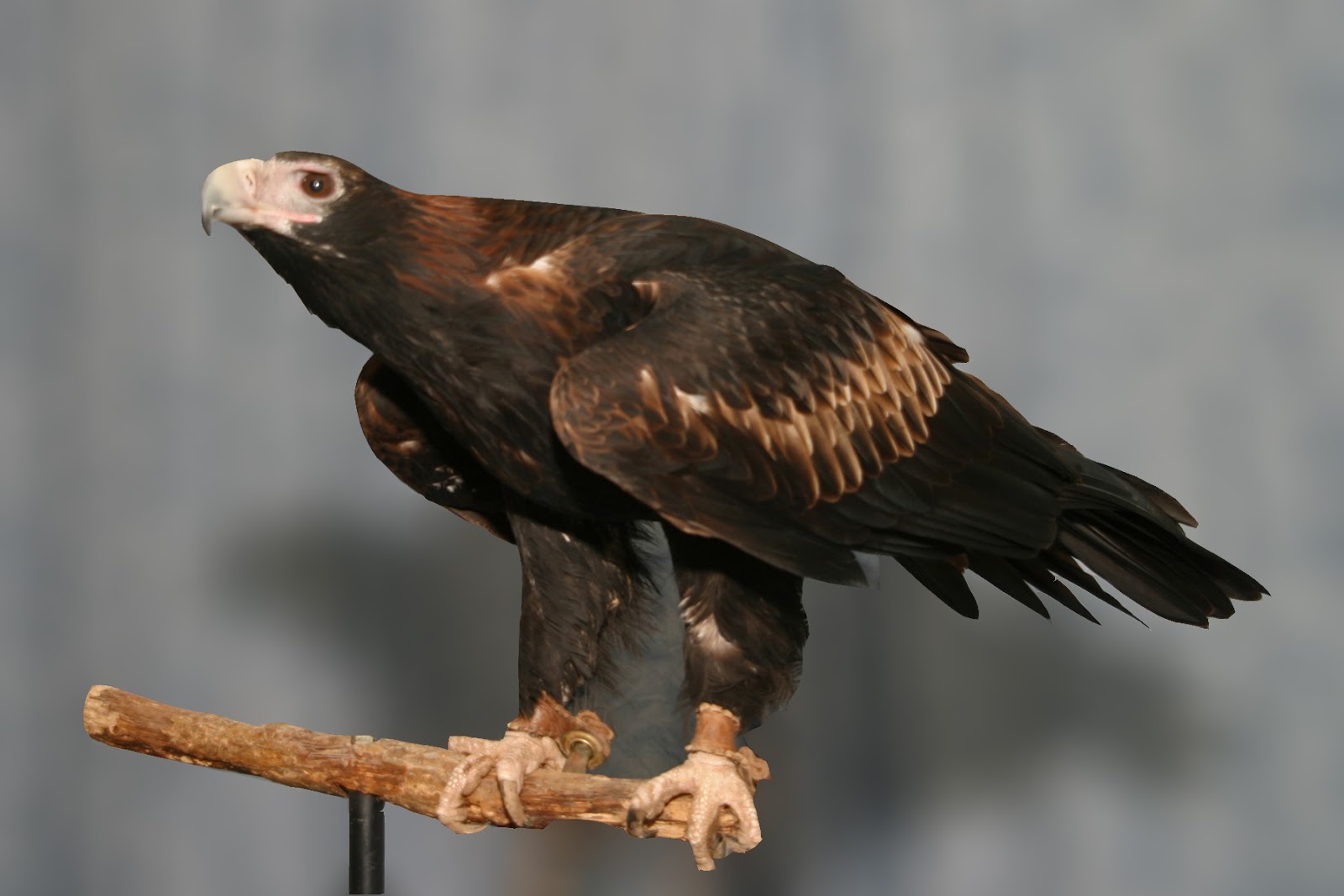
Duncan, WBS's resident Wedge-tailed Eagle (photo: Gay Schroer)

To see a flesh and blood example of Bunjil come visit us at the World Bird Sanctuary where you can meet Duncan our resident Wedge-tailed Eagle who usually resides in one of our exhibit enclosures on the path just past the Wildlife Hopital.

Submitted by Jessica Bunke, World Bird Sanctuary ETC Trainer

Friday, June 21, 2013

Duncan The Magnificent


Duncan, our 26-year-old Wedge-tailed eagle, recently came out of retirement to wow audiences at WBS’s educational bird shows at Stone Zoo near Boston, MA.

Meet Duncan, WBS's Wedge-tailed Eagle
The last time this bird flew in our education programs was in 1994. This summer she is back and flying at our zoo program at Stone Zoo in Boston, MA, and doing quite well. At first I was unsure of how this would go, but I was very excited to have this opportunity to, basically, retrain this bird.

Training birds, and any animal I would assume, is very challenging. The first thing that we have to figure out is the “working weight” of the bird. The working weight is the weight we keep them at during their flying season (6 months of flying 6 months off), and this is a weight at which they’re food motivated (in other words, a weight at which they want food, but they’re not starving). The working weight is heavier than they would be naturally in the wild, but lighter than they would be if they were offered as much food as they wanted without working for it. In order to find that magic number it takes observation. Too light and your bird gets aggressive, too heavy and your bird won’t fly. Once you find this magic number you then have to do a lot of practicing and getting the bird back in shape because just like us, birds also get out of shape. We usually take about a month and a half to two months to get all the birds back in shape.

Photo courtesy of Alex Navarro, Educational Specialist, Stone Zoo
Once that training period has gone by its then time for shows to start.  This is when you learn even more about your bird. You have to get them used to seeing people in the theater, because during show practice time you practice in an empty theater. If the bird is new to flying for an audience you have to slowly build up from just a few people to more and larger crowds. You quickly learn all the strange things that individual birds may not like.  I’ve worked with birds that don’t like the strangest things, like big necklaces or strollers, or crutches. A very few don’t like sunglasses, perhaps because they can see themselves in them—or that’s what we think at least.

Photo courtesy of Alex Navarro, Educational Specialist, Stone Zoo
After learning the quirks of individual birds and doing our best to keep that object away from them, you then have to regularly deal with uncontrollable factors, like wind.  Very windy conditions may sometimes blow a free flying bird off course, but with the right flight muscle conditioning (in other words, lots of practice), our birds fly very well when the wind is blowing.

Photo courtesy of Alex Navarro, Educational Specialist, Stone Zoo
After taking all these factors into consideration, and even if you do everything right, sometimes the unexpected still happens--they are live animals after all.  Most times, though, things work out perfectly, and you get what I would imagine to be a “proud parent” moment the first time your bird does the exact behavior you’ve been training. Then, when the behavior you’re asking of your bird becomes consistent, that is one of the best feelings a trainer can have.

Photo courtesy of Alex Navarro, Educational Specialist, Stone Zoo
All of this is what my staff and I have dealt with while getting Duncan back into the swing of things.  And finally, after tons of practice and hard work, she is doing very well and flying for all our audiences at Stone Zoo. We are all very proud of this magnificent bird.

Submitted by Jaimie Sansoucie, World Bird Sanctuary Naturalist/Trainer

Friday, January 14, 2011

Handling Duncan


A few weeks ago I handled our Wedge-Tailed Eagle, Duncan, for the first time.  I don’t normally work in the department where this bird is housed, so the opportunity hadn’t really presented itself before.  We do not know if Duncan is a male or female, as the plumage is the same for both sexes.  I will refer to Duncan as a “he” for writing purposes, unless he proves us otherwise, by laying an egg.
Duncan, our Wedge-Tailed Eagle 
I admit I was a little apprehensive about handling him.  He is a rather large bird and has shown a dislike for certain people that have had to assist during routine beak and talon trims.  When birds are in captivity, their beaks and talons do not wear down as they would in the wild, so they require a little upkeep on our part.

I knew ahead of time that I would be handling Duncan soon, because all of our birds that are on equipment (jessed birds) are weighed every two weeks, and their equipment is thoroughly checked and treated, in addition to inspecting the bird’s feet.  I decided I wanted a preview of what Duncan’s behavior might be like, so I tagged along with staff members Laura and Sara, for a dry run.  I was pretty surprised at how calm he was for them, and after seeing their interaction, I felt pretty confident that I wouldn’t have any problems.

My first time handlng a Wedge-Tailed Eagle 
Two weeks later, it was my turn to work with him, and I was pretty jazzed about it.  He stepped up onto my glove like a pro and we walked for a bit down to the building where the scale was set up.  As soon as we stepped outside, he spread his wings and stretched out for a few moments.  Then he made a lot of cute little “squeaky” sounding noises as we walked.  Sara and I weighed him, checked his equipment and his feet, and then I proudly put him on his perch so he could enjoy some outdoor time.  I had finally handled a Wedge-Tailed Eagle, and it was a pretty awesome feeling.
 What an awesome feeling!
Duncan was the first Wedge-Tailed Eagle hatched by WBS, back in 1988.  He has been a part of our zoo programs in several states.  Wedge-Tailed Eagles are native to Australia’s mainland, and their largest bird of prey.  They have a 7’ – 8’ wingspan and weigh 8 – 12 pounds.  Their prey of choice is rabbits or hares, but they will also feed on carrion, smaller birds and other small mammals.  Several Wedge-Tailed Eagles may be seen at a time feeding on a carcass – as many as 30 – 40.

The next time you visit World Bird Sanctuary, be sure to look for Duncan on the exhibit line, past the Wildlife Hospital.

Submitted by Billie Bauman, World Bird Sanctuary Outreach Coordinator