Tuesday, September 21, 2010

Meet Rustle, our Armadillo

Meet Rustle, one of the newest members of our staff!
Rustle is a nine-banded armadillo, the only one out of the twenty worldwide recognized species of armadillo found in the United States.  It is also the most abundant.  The other species can be found in Central and South America.  We obtained Rustle on July 5, 2010; he was about 6 months old and weighed 2 pounds, 6 ounces.  Male armadillos can reach up to 17 pounds, while females can reach up to 13 pounds.  Rustle is growing quite quickly; as of August 23rd, he weighed 4 pounds 9 ounces!  We are feeding him canned cat food, hard-boiled eggs, earthworms, and cooked yams.  In the wild these armadillos would forage for a variety of insects, insect larvae and other invertebrates like millipedes, centipedes, snails and earthworms.  They have also been observed eating some fruit, seeds and other vegetable matter in the wild as well as a few frogs, toads, salamanders, lizards, skinks, small snakes, and reptile and bird eggs.
  Rustle enjoying his gourmet meal of canned cat food, hard-boiled eggs, earthworms, and cooked yams--yumm!

Rustle’s armor, called a carapace, consists of scutes or bony plates connected by tough bands of skin.  Each scute overlaps slightly with the one before it and the entire shell appears to move like an accordion as Rustle walks.  This armor covers the back, sides, head, tail, and outer part of the legs.  The ears, belly and inner part of the limbs are not covered by the armor, but have tough skin and some coarse hair.  Despite their name, nine-banded armadillos can have between 7 and 10 bands on their carapace.
  Close up of Rustle’s scutes

Nine-banded armadillos are generally nocturnal and spend most of their time foraging for food.  They have long, sharp claws which make them excellent diggers.  They also have been seen tearing bark off trees in search of insects.  Their tongues are sticky and rough to aid with their main diet of insects.  If alarmed, they often will leap vertically first and then run away with surprising speed to a nearby burrow they have dug.  Contrary to popular belief, this species of armadillo cannot roll up in a ball to protect itself.  They have very poor eyesight but an excellent sense of smell and hearing.
 Close-up of Rustle’s powerful claws
 Here you can see Rustle's small eyes, long snout, large ears

These animals have been quickly expanding their range more north and east in the U.S.  They are becoming more established in Missouri and Kansas and are being seen in southern Nebraska, southern Illinois and southern Indiana and as far east as South Carolina.  Their western range seems to end in central New Mexico.  They range southward through Central and South America into Argentina and Uruguay.  They avoid extremes of wet and dry habitats.  They prefer sandy or clay soils for burrowing.  They can be found in a variety of habitats like pine forests, hardwood woodlands, grass prairies, salt marshes and coastal dunes.
  Sara holding Rustle, he was being quite squirmy!*

Rustle made his debut appearance at Birds in Concert.  Very soon Rustle will be brought to education programs at schools, libraries and at events where he will assist the World Bird Sanctuary in teaching children and adults about the animals that make up our earth!  If you can't wait until then, you can visit him at our Nature Center.  We are open from 8am – 5pm every day except Christmas and Thanksgiving.

Submitted by Sara Oliver, World Bird Sanctuary Naturalist

Sunday, September 19, 2010

Training Lewis and Clark to Fly at the Stadium


Today I helped Roger Wallace train Lewis and Clark, two of WBS’s education Bald Eagles, to fly at Busch Stadium.   
Volunteer Daniel Cone, releasing Clark during an early Spring training session
We positioned Lewis and Clark’s crates above the grassy area directly behind center field.  Roger climbed down a ladder onto the field and walked over to the pitcher’s mound.  Daniel Cone opened Lewis’s crate, but Lewis did not fly out of it.  Sometimes they fly from their crates and sometimes they don’t.  So, Daniel had Lewis step onto his glove, and then Lewis flew right away.  Lewis made a couple of spectacular loops around the stadium before flying down to Roger’s glove. 
Clark, making a spot-on landing on Trainer Roger Wallace's glove
Next, I had a chance to release Lewis.  When Roger was ready, I opened the box to allow Lewis a chance to fly out, but as before, Lewis waited until he was on my glove to leave the release point.  Roger would like Lewis and Clark to fly at the same time on game day sometime in the future, so for training purposes Daniel held Clark on his glove as Lewis made another impressive flight.  Afterwards, I held Lewis on my glove so he could watch Clark make his breathtaking, no-nonsense flight.
 Lewis on creance line during one of our early Spring training sessions.  Later the line is removed so that they are free flying.
When we fly the eagles in tandem, there will obviously need to be two trainers on the field to receive them.  So, the next round of flights allowed the birds to get used to that.  As Daniel and Roger made their way back to the pitcher’s mound, I got Clark out of the crate and prepared to release him from my glove.  I tried to turn Clark away from the field, so he wouldn’t bate (try to fly too soon) before Roger and Daniel were in position, but Clark knew exactly what was going on.  He didn’t bate, but he turned his head almost all the way around and watched Roger walk.  When Roger stopped walking, Clark was more than ready to fly.  He flew like an arrow directly to Roger’s glove.
Clark, at an early training session, demonstrating the intensity with which an eagle zeroes in on a target.  
Finally, Roger let me go onto the field with him as Daniel released Lewis.  Roger told me not to give the cue, but to get ready in case Lewis decides to fly to me.  And sure enough, he did!  Lewis made a couple of loops, and then trained his eagle eyes directly on me and made his way over.  I got my glove under his talons, locked his jesses, and tossed him a mouse.  I tried to play it cool, but the whole experience was pretty overwhelming and I could not stop smiling!

Because of Roger’s expert and insightful training, Lewis and Clark rocked the stadium.

Submitted by Leah Sainz, World Bird Sanctuary Naturalist

Friday, September 17, 2010

Beating The Heat

While there are many things these days for people to disagree about, most of us can agree on one thing: it’s been ridiculously hot this summer.  

This weather has caused families across the region to come up with new and exciting ways to stay cool.  We naturalists at the Sanctuary have also had to keep a close watch on our birds, as well as ourselves, during our programs and displays.  How do birds stay cool, you might ask?  They use a variety of methods.
All of our birds have free access to water at all times--weather for drinking or bathing
One way is quite similar to humans—drink lots of water.  All of our birds have water bowls in their indoor and outdoor enclosures that they can drink from, as well as bathe in.  Birds of prey normally get the majority of the water they need from the blood in the meat they eat.   Like humans, though, more water is needed in hot weather.  
Chrys, our Long Crested Eagle, after a refreshing bath
Another familiar cooling method is to get in the pool!  Many of our birds love to be in the bath.  Water is very important for healthy feather condition at all times of year, but it becomes even more important in the hot summer months.  Birds lose heat through bare, unfeathered skin, especially the cere, (skin around the beak), legs, and feet.  When the wind blows on the bare wet skin, the bird’s temperature drops.  This is called evaporative cooling, and it’s the same reason we feel cooler after we get out of a pool. 

There is a group of birds that use evaporative cooling in a different (and ickier) way than others.  These are the New World vultures, or the species of vultures living in North, Central, and South America.  These guys have bare legs and feet, unlike their relatives living in Europe, Asia, and Africa who have feathered legs.  New World vultures will go to the bathroom down their legs.  What comes out is mostly liquid, so as the wind dries the waste, the vulture can cool off 10-12 degrees almost instantly.  Personally, I’m glad we have swimming pools instead, but to each their own!

One thing we humans have working to our advantage is the ability to sweat.  We may feel gross and sticky after being out in the heat, but we’d be in bad shape without sweating.  Birds can’t sweat because of their feathers.  Instead they have to pant, much like a dog would.  This action is usually the first sign of a bird cooling off. 

Lastly, many of our birds enjoy the bright sunshine and can be seen sunning on even the hottest days for a little while.  Birds get vitamin D from the sun just like us, and it is also very important for healthy feathers. 
Dewey, a Bateleur Eagle, demonstrating the amazing feather control that allows them to dissipate their body heat
Vultures and Eagles are most often seen sunning with their wings out to the sides like solar panels.  Some will even fluff their chest and belly feathers to catch the sun, but also release heat from in between them.  They can control movement of different groups of feathers, which is helpful for a variety of reasons. 
Skinner, one of our Turkey Vultures, demonstrating his sunbathing technique
Hawks often lay flat on the ground like a pancake, wings stretched as far as possible out to the sides.  This can freak people out before they know what the bird is doing; it looks a lot like something is wrong with the bird.  The winner of this contest, by far, is the Red-legged Seriema, a South American ground bird with long, orange legs.  When they sun, they roll on their sides, wings askew, and legs in the air.  Quite honestly, they look very dead and startle visitors all the time…especially when the “dead bird” pops up and looks curiously at them as they walk by!  If your timing is good, you might observe our Seriemas, Sara and Gomez, doing this behavior on our Display Line past the Wildlife Hospital.

Here at the Sanctuary, we have both indoor and outdoor exhibits, so when you visit, you can look for some of these “cool” behaviors by our birds, then come inside to chill out yourselves.  In the meantime, we’ll be here looking forward to Fall! 

Submitted by Dana Lambert, World Bird Sanctuary Naturalist

Wednesday, September 15, 2010

Wing Shape

As you observe the birds around you when you walk through the forest, sit in your yard, or visit the World Bird Sanctuary, you will notice that bird wings come in many shapes and sizes.
 Red-tailed Hawk in flight (photo by Gay Schroer)
You can tell a great deal about a bird’s lifestyle just by looking at the shape of its wings.  The variation in wing form is due to the different uses each bird species has for its wings.  Some birds need to soar for long periods of time.  Others need to use their wings for very rapid flight.  Still others need wings that allow for agility so they can evade predators or avoid running into trees.
  Turkey Vulture in flight (photo by Gay Schtoer)
The next time you are outside, see if you can spot one of the many turkey vultures found in our area.  You will notice that they flap their wings very rarely. Using very broad wings with long, slotted primaries, they can ride on the rising thermals.  That way, they will expend as little energy as possible as they search for carrion below.

Millenium, a Peregrin Falcon in her juvenile plumage - note how long and pointed her wings are (photo by Gay Schroer) 
In contrast, falcons can’t just cruise the region in search of ready-to-eat meat.  If a falcon had broad wings like a vulture, it would fly too slowly to catch its prey.  If a falcon wants to catch, for example, a pigeon, it needs long, narrow, pointed wings capable of high speed flight.  The peregrine falcon’s wing shape allows it to reach record dive speeds of 175 mph! 
  A wild Cooper's Hawk-note it's shorter rounded wing shape in contrast to the falcon's (photo by Cathy Spahn)
Raptors in the accipiter family, such as the sharp-shinned hawk and the Cooper’s hawk have short, rounded wings. Their wing shape gives them the agility they need to maneuver through their forest homes without flying into trees

http://www.stanford.edu/group/stanfordbirds/text/essays/Soaring.html

Submitted by Leah Sainz, World Bird Sanctuary Naturalist

Monday, September 13, 2010

Bat Bombers

A while ago, I wrote a story about “Project Pigeon”, a top-secret aviation project to teach pigeons to be suicide bombers during WWII.  While I was researching it, I discovered another project that was just as fascinating.  This one involved bats.

In December of 1941, Dr. Lytle Adams was visiting Carlsbad Caverns, NM, when he heard about the bombing of Pearl Harbor.  He cut short his vacation to head home, but couldn’t stop thinking about the impressive bat colonies he had just seen.  As he was getting ready to leave, he suddenly thought that if each of the millions of bats flying around had a tiny incendiary device attached to its body and then they were dropped from a plane… well, they could cause an awful lot of destruction.  Adams stopped at the caverns before he left and captured some of the Mexican free-tail bats that lived there.  He took them home and started to study them.  He was convinced that they could be used as bombers.

In January of 1942, he sent a proposal to the government for his project.  His letter was one of a very few that actually made it to President Roosevelt’s desk.  Roosevelt sent a memo to Colonel Donovan, the coordinator of information, with the note, ‘This man is not a nut.  It sounds like a perfectly wild idea but is worth looking into.’

In April of 1942, the work began.  It was decided that the free-tail bats were the best ones to work with, as they were very common, hardy and could carry a payload significantly higher than its own body weight.  Thousands of bats were captured for the project.  They were put into refrigerated trucks to force them into hibernation and taken back to study and be fit with their devices. 

The first bombs they tried were tiny – only 18 grams (.63 oz.), but they packed a punch.  They were called ‘baby incendiaries’ and had a time-delay igniter fuse.  This way, the bats could be released over the target area at night and the bombs wouldn’t go off until they had roosted for the day in buildings.  The bombs were attached to the bats by clipping them to the loose skin on the bat’s chest with a surgical clip and a piece of string.

The first tests in May of 1943 were unsuccessful.  The bats had been placed into refrigerators to force them to hibernate then placed in boxes and flown to their target area.  The boxes were dropped from 5,000 feet, but the bats hadn’t warmed up enough from their hibernation and they weren’t able to fly.            More test releases were done, but the bats either wouldn’t warm up fast enough to fly, or they would warm up too quickly and escape from the boxes.

In June of 1943, a report was written that requested more research into better release methods, a better bomb and better way to attach the bomb to the bats.  There was also a note that said their testing had stopped because of a fire that had destroyed most of the testing material.  The letter neglected to mention that a barracks, a control tower and other buildings had been set afire by their own bats that had escaped.

The project was dumped by the Army in August of 1943 and handed to the Navy.  The Navy gave it to the Marines and testing continued until August 1944 (during which time 30 more fires were started by the bats).  That August, the government refused to continue funding the 27-month, $2 million project – it was all over.

In those years, over 6,000 bats gave their lives for this country.  If you want to learn more, check out a great site www.historynet.com.
Visitors at the WBS Nature Center watching Batty & Scar
While we may not have trained our Straw-colored Fruit Bats, Batty and Scar, to be bat bombers, they do ‘hang around’ at our Nature Center, where you can visit them from 8am to 5pm daily.

Submitted by Laura MacLeod, World Bird Sanctuary Education Coordinator

Saturday, September 11, 2010

Our Birds Meet the Klingons

What do owls, ravens, falcons, eagles, and hawks have to do with Klingons, Dungeons and Dragons, and Star Wars?  Clearly nothing.  Except that earlier this summer, our birds’ paths crossed with such other-worldly fare in Chicago, as they have once a year for the last five.

Confused yet?  Okay, enough being cryptic.  Duckon, an annual science fiction convention, blew through the Chicago suburbs June 17th-19th and we made our way north with A LOT of birds in tow.  Over the course of the weekend, our birds entertained several hundred people (and aliens?) in free-flight shows and rare up-close photo opportunities.

 Birds of prey and corvids (the family including crows and ravens and jays) figure prominently into many science fiction and fantasy stories, so we help lovers of this genre meet the actual creatures behind the stories, and they’re never disappointed with the real thing!.

This is where the science meets the fiction in a fantastic way.  Themes of conservation and cautionary tales are common in science fiction.  How many of these stories start with people having to move to space because we wrecked the planet we have?  It makes for good fiction, but who really wants to move to a new planet…really?  Teaching about the responsible care of our planet’s resources and wildlife will keep those stories as fiction, not reality.
  
Duckon is one of my favorite events to go to each year because of the wonderful people we meet and their outpouring of support for the World Bird Sanctuary.  We naturalists that go every year are frequently recognized, even when we’re not in uniform or with a bird.  We are greeted with such joy and enthusiasm!  It’s the closest I’ll ever get to being a rock star…even if it’s really the birds that are the stars! 

There are familiar faces who we see annually, some of whom come specifically to see our feathered comrades. Of course they immediately want to know who we’ve brought and if their favorites are among them.  Oh yes, they’re happy to see us too, but some of our birds, like Twig the Eastern Screech Owl and Xena the Eurasian Eagle Owl, have quite the Chicago fan base!  Every time we go, though, we also reach out to new folks who aren’t familiar with our mission, and I think it’s safe to say that after seeing our show, everyone is on board to help in any way they can.  They are a powerful force.  After all, what group doesn’t benefit from having Klingons in their corner?! 

In all seriousness, though, I’d like to thank all our loyal supporters on the Duckon planning committees and fans who fill out surveys listing the World Bird Sanctuary shows as their favorite part of the convention.  It is because of your input and enthusiasm that we get to keep coming back for more fun year after year.  Thanks for helping us to have another great one!

Submitted by Dana Lambert, World Bird Sanctuary Naturalist

Thursday, September 9, 2010

Yoga comes to World Bird Sanctuary on Sunday!

Do you want to practice yoga surrounded by the raptors of World Bird Sanctuary?  


There's still time to register for Yoga and Wings of Love taking place at WBS this Sunday.

Linda Jones, Instructor/Owner of Yoga to Go Studio, is volunteering her time to lead a yoga class at World Bird Sanctuary.


If you'd like to join us for Yoga with the birds, click here to find out more!

Tuesday, September 7, 2010

Going South

Don't forget your hummingbirds now that colder weather is approaching.


Many people stop feeding the hummingbirds and take in their feeders at this time of year.  They believe that if they continue to supply food into the cold weather it will keep the hummingbirds from migrating.  Nothing could be further from the truth.  In birds the instinct to migrate is usually fueled by shorter day lengths and cooler temperatures.  They will not stay around just because they are being fed.

Now is the time of year when they need your help the most.  For the most part, the males have already migrated to their southern wintering grounds.  However, the females are still here.  Since most of their preferred flowers are past their blooming peak, they are seeking alternative foods to fuel their long trip.  Actually, some of "the girls" that you've been feeding all summer have probably gone south, and their more northerly cousins are probably the birds in your backyard now.
The yellow at the center of the flowers attract bees
Bees at your feeder can be a problem at this time of year, because they, too, are finding that nectar is not as plentiful now.  Since bees are attracted to the color yellow it sometimes helps deter them if you make sure your feeder has no yellow on it, and the feeding port holes are small enough to deny the bees entry.
This feeder has no yellow, and the feeding ports sit above the nectar.  Holes are too small for the bees to enter.
The type of feeder that has a flat surface seems to work better for this purpose, since the bees cannot reach the nectar if the surface of the liquid sits far enough below the feeding port.  The hummers, with their long beaks and tongues can still get to it.

Your feeders will help these transient hummers fuel their trip to warmer climates.

Submitted by Gay Schroer, World Bird Sanctuary Volunteer

Sunday, September 5, 2010

We Take All Questions Seriously

Close-up of an Ostrich seen on our Ostrich farm tour
Last November I took a cruise to the Caribbean, Panama, and Costa Rica.  This trip was truly an amazing experience.  Since this cruise was on a large cruise ship it was not very environmentally oriented, so when looking at side trips I took trips that would get me outside, and might have the highest probability of seeing birds
Another of the Ostriches seen on our tour
One of the most interesting trips was to an Ostrich Farm in Curacao.  The area was beautiful!  When we arrived, they had an open-air truck with shaded benches for us to ride on for the tour. 

The information they gave us about the ostriches was very interesting.  At the ostrich farm these birds are being raised for food – the part I found the most interesting was that they find ways to use every part of the bird, and nothing goes to waste.
Ostrich chicks hatched at the farm
I found that the most entertaining part of this whole trip was listening to the questions the adults presented – in particular there were two questions that made me sit up straight in my seat.  The first was, “Do you clip the birds’ wings to keep them from flying away?”  The second was, “Do ostriches nest in trees?”
 
After a quick review of these questions I realized that not everyone grows up being exposed to the natural world around them as I was, and these are the people we most need to reach.
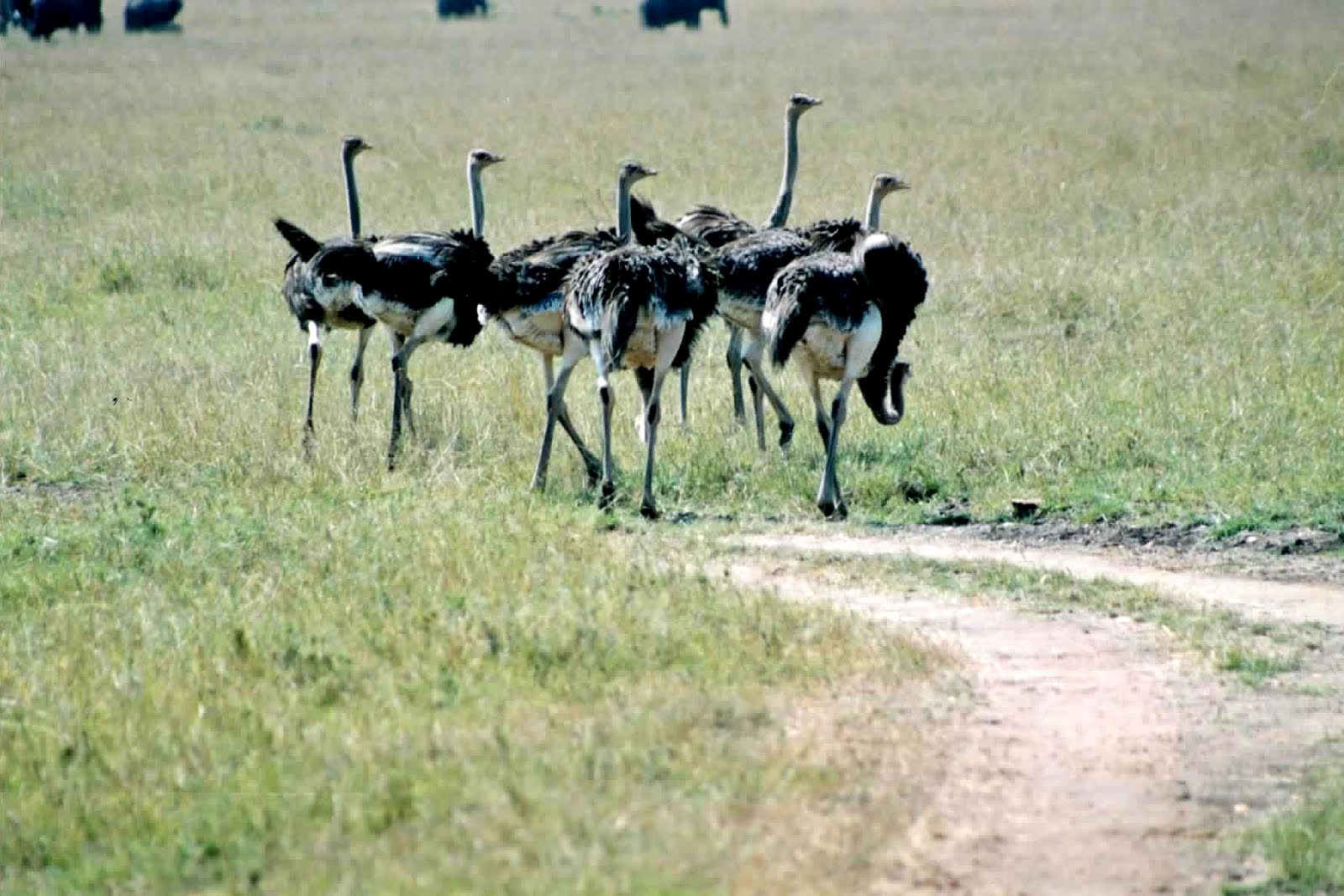
Juveniles in their natural environment in the Masai Mara
At World Bird Sanctuary we take every question asked of us very seriously.  It may be obvious to most that Ostriches are flightless and therefore don’t need their wings clipped.  It also may be obvious to most that Ostriches nest on the ground.  However, if you don’t take all questions seriously, and someone gets hurt because you think they should already know something, then the person asking may shy away from asking other questions and lose future opportunities to learn.  If all are informed properly about birds, their newly acquired knowledge can only help WBS toward its mission to preserve all the world’s birds in their natural environments.

Submitted by Cathy Spahn, World Bird Sanctuary Field Studies Coordinator

Friday, September 3, 2010

International Vulture Awareness Day

We love vultures!  Do you?
Join us on Saturday, September 4th, as we celebrate International Vulture Awareness Day 2010!
Dorothy, an Andean Condor that will be on display, has a wingspan of 10ft and a beak strong enough to rip through seal and whale hide.

Ewwww, Vultures are Gross!  But we need them the most!  Find out more at World Bird Sanctuary as we take part in the international celebration of all things vulture. 

·      Kids will love the Vulture Knowledge Test Table and the scavenger hunt, with prizes.
·      Shows featuring vultures and other animals, as well as music from the Raptor Project.
·      Special vulture exhibits, including Turkey Vultures and an Andean Condor (on public display for the first time at World Bird Sanctuary).
Turkey Vultures are native to Missouri.

Date: September 4th, 2010
Time: 10am – 3pm
Vulture shows: 11.30am and 2pm
Activities: Scavenger Hunt, Activities Table, Prizes!

Admission and parking is free!

Sponsored by AmerenUE.


Wednesday, September 1, 2010

Good day, Lords and Ladies!

  It’s that time of year again…
…beautiful fall weather, funny costumes, and a World Bird Sanctuary van driving back and forth repeatedly to Kansas City for the K.C. Renaissance Faire.  We are known as the “King’s Falconers,” and visitors often tell us that we are their favorite reason to come back to the Faire year after year.  The World Bird Sanctuary has been doing raptor shows at this Faire for over 20 years and I think it is one our most enjoyable traditions.

Me (Dana Lambert) with our young Peregrine Falcon Millenium, volunter Jennifer Jones with our grey phase Screech Owl Twig, and longtime beloved volunteer John Kinsey who passed away suddenly in December with Dewey the Bateleur Eagle, who also passed away earlier this year
Now, this is not to say that it’s all fun and games to do shows in this setting.  You have to learn how to get up and down from benches and fly birds in your crazy outfit, which for most of us involves big sleeves and long skirts, without falling over.  People are always standing all around your stage, which is something we can discourage at most of our flying programs.  At Faire, however, that is simply impossible.  Pets and other animals are not allowed at our programs under normal circumstances.  This too is a special Faire circumstance that a naturalist must learn to safely deal with, as dogs, chickens, parrots, and ferrets are just a few of the creatures who have tried to visit our shows with their owners!  Oh, and like any time of year in the Midwest….the “beautiful” fall weather isn’t really always beautiful!

All these things aside, I love my time at the Renaissance Faire.  In fact, these challenges are how many new staff, interns, volunteers, and even new birds, have learned to be adaptable and think on their feet.  These kinds of scenarios teach us how to do better, more entertaining shows and be better at our jobs in general.  Because of that, Ren Faire is something I feel as many of our staff and volunteers as possible should experience at least once.

Whether you’ve never seen a presentation by our naturalists or you’re a frequent visitor to our site and events, I encourage you to come out to Kansas City and see what Renaissance Faire is all about.  The shows out there are unlike any others we do, you won’t be disappointed!

Renfaire begins Labor Day weekend and runs through October 17th.  For more information click here.

If you can’t make it out to K.C. this season, you can catch the “King’s Falconers” at the Wentzville Renaissance Faire in May, as well as back in Kansas City starting Labor Day weekend 2011. 

Huzzah and Godspeed to ye all!

Submitted by Dana Lambert, World Bird Sanctuary Naturalist


Monday, August 30, 2010

Meet the Vultures

In the United States, turkey vultures are often seen along the side of the road eating roadkill or soaring high in the sky looking for carrion.  The only other vulture you may see in the U.S. is the black vulture.  These are two of the seven species of New World vultures (family Cathartidae) that inhabit North and South America.  California Condors and Andean Condors are also of the seven in this grouping.  At the World Bird Sanctuary, turkey vultures can be seen on our display line and you may also see our newest education turkey vulture, Kinsey, at our Nature Center.
Me (Sara Oliver) with our young Turkey Vulture, Kinsey
Dorothy our Andean Condor will make her debut appearance on International Vulture Awareness Day on Saturday September 4th at the sanctuary!
Dorothy, our young Andean Condor
There are sixteen species of Old World vultures (family Accipitridae) that inhabit Africa, Europe, and Asia.  This family also includes eagles, kites, and hawks.  Old World vultures find carrion exclusively by sight, whereas several species of New World vultures, especially turkey vultures, are able to find the dead with a sense of smell, which is unusual for birds of prey. 

Vultures are scavengers.  They are Mother Nature’s garbage crew.  They consume dead, rotting animals which are often infected with bacteria that could kill most other animals.   Thus, vultures prevent disease from spreading to other animals.  They do not become sick from the carrion they consume because vultures have a very acidic stomach, with a pH of around 1.  (On the pH scale 7 is considered neutral – 0 to 1 is the range for battery acid).  This allows them to safely digest putrid meat infected with botulism, hog cholera, and anthrax bacteria.  Vultures keep our forests, grass plains, and savannas healthy.  Without them we could be deep in an accumulation of rancid carcasses.
Fred, our Hooded Vulture
Unfortunately, vulture populations have been dwindling, to the extent that some are termed nearly extinct, endangered or vulnerable.  For example, the Cape Griffon Vulture is listed as a species vulnerable to extinction.  Native to a small range in south and southwest Africa, these vultures face dangers such as electrocution on power lines.  Of more concern, mass amounts of vultures are killed at one time through accidental poisonings.  It is common for farmers and ranchers in parts of Africa to poison the bodies of dead livestock in order to kill predators like leopards and jackals which also prey on their live animals.  The vultures gather in large groups to feast on this free banquet.  One carcass can attract 50 to 500 birds leading to high death toll all at once.  Researchers have begun applying satellite telemetry collars to these birds to track their movements and give information on the sources of contaminants in their range.

In India, Pakistan and Nepal, vultures are dying when they consume dead livestock that had been treated with a pain relieving drug called diclofenac.  The drug is harmless to humans, but it causes kidney failure in vultures.  They are in steep decline in south Asia, and as a result more carcasses are piling up and feral dogs and rats are increasing in numbers, feeding on the waste the vultures would have eaten.  As the number of feral dogs increase, so do rabies and the number of people bitten by a rabid dog.  The only thing that can stop this slippery slope is the ban of diclofenac.

The California condor is labeled as critically endangered.  The threats they face include lead poisoning from eating animals containing lead bullets, collisions with electric power lines, habitat destruction, and poaching.  In some parts of the western United States, this species was driven to the brink of extinction by cattle ranchers who observed condors feeding on dead calves and assumed the birds had killed them.  Conservation efforts for this species include a captive breeding program and release of captive-reared adolescents.

Another conservation effort being done to help these birds is “vulture restaurants” where fresh and poison-free carcasses of livestock or wild mammals are put out for vultures to enjoy. 

Efforts to protect vultures require cooperation and support at international, national, regional and individual levels.  You can help in this cause.  Support conservation organizations and breeding programs for endangered vulture species.  Do not use poison to kill wildlife.  Eliminate pesticide use.  Do not use lead bullets when hunting.  Recycle forest products to decrease the need to cut down trees in which vultures roost.  And, lastly, report roadkill so it can be removed to protect vultures from being hit by cars. 

Join us for International Vulture Awareness Day at the World Bird Sanctuary on Saturday, September 4th from 10 am to 3 pm!  As always, admission and parking are free.  International Vulture Awareness Day is sponsored by AmerenUE.

Submitted by Sara Oliver, World Bird Sanctuary Naturalist