Thursday, July 21, 2011

AVIAN TRAINING WORKSHOP


It’s not too late to sign up for our Avian Training Workshop.
 Classes include lectures and hands-on work learning
If you are a novice or are already experienced with birds of prey and training, but want to learn more, you should attend our “Avian Training Workshop” this November.  The workshop is an intensive 4-day long experience where you will learn from the senior staff at World Bird Sanctuary.  
Learning to tube feed a sick or injured bird
Part of the workshop is classroom lecture style, and part of it will be hands-on working with equipment and the birds themselves.  Some of the topics we will cover include:

·      Different species of birds utilized for education programs, which ones work best, and comparing hawks, falcons, owls, eagles, pelicans, horn bills, crows, ravens, parrots and other bird species.

·      Information about how to develop your own raptor center, the permits and necessary experience needed, insurance, etc.

·      How to best house raptors and other birds– perches, mews, jump boxes and other caging.  How best to protect weathering and exhibited raptors and other birds from potential predators, weather, etc.

·      How to present education programs – dress code, scripts, voice protection exercises, audience participation and much more.

·      Transportation of birds – driving, flying, shipping – how best to keep them safe and comfortable.

·      Bird diets – what to feed, how to get and store the food, vitamins, etc.

·      How to train your birds– what is a base weight, what is a target weight, creance line, flyer food, positive and negative reinforcement, and we train a White-necked Raven to perform a new behavior throughout the workshop!

·      Hands-on making of jesses, anklets and leashes.  Learning how to imp feathers on a bird.
 Learning to fly a Harris' Hawk
·      Flying a bird!  A chance to fly a Harris’ Hawk or a Barn Owl and learn the correct techniques for free flying.

The registration fee includes your workshop guide. This guide contains a wealth of information, most of which is covered during the workshop, as well as additional information.  The class is small; we take a minimum of 10 people and a maximum of 20 people.  But that also means that if you don’t act, the spaces could be filled.  Enroll today to insure your place in this unique and highly informative class, now in its 15th year!!
 
The workshop runs from Thursday, Nov. 3rd through Sunday, Nov. 6th and the cost for the 4-day event is $650 per person (this includes lunch each day).  In order to register, we require a $100 non-refundable deposit by October 1st, after that date the price will increase to $750 per person.

If you would like to learn more, or register for the workshop, please contact Teri Schroer at tschroer@worldbirdsanctuary.org or call 636-225-4390 ext. 3.


Tuesday, July 19, 2011

Geocaching at the World Bird Sanctuary

Did you know you can go geocaching at World Bird Sanctuary?  

We didn't.  But you can.  So we decided to find out more about it!
Young guests learning about geocaching at a recent WBS National Trails Day event
Tom Wolpert from the St. Louis Area Geogachers Association tells us what it's all about.
"Geocaching is a high-tech treasure or scavenger hunt which uses the Global Positioning System (GPS) to locate hidden containers.  Geocachers like to joke that we use billion dollar defense satellite systems to hunt Tupperware® in the woods.

At midnight on May 2, the government did away with Selective Availability, which limited the accuracy of the civilian GPS signal to about 200 feet.  Without Selective Availability, accuracy improved to about 20 feet.  The next day, geocaching started.  Dave Ulmer, a GPS enthusiast, decided to see just how well the system worked.  He stocked a plastic bucket with trade items and a notebook, hid it in the woods, posted the coordinates – the latitude and longitude – on the Internet, and invited fellow enthusiasts to use their GPS receivers to find the bucket.  The rules were simple:  “Take some stuff, leave some stuff!  Record it all in the logbook.  Have fun!”  Although there have been a lot of embellishments over the years, that’s still the way the basic game is played today.

Virtually anyone can go geocaching, although very small children may need some help from mom and dad.  Geocaches (and geocachers) are everywhere.  There are over 1.4 million caches – and over 5 million geocachers – worldwide.  There are caches on every continent, including Antarctica.  In fact, there are about 480 geocaches within a 10 mile radius of the World Bird Sanctuary!  There are caches which require long hikes, caches within a few steps of parking, and caches which are wheelchair-accessible.  There are caches which are very easy to find and others which might require an extensive search.  Each cache has difficulty and terrain ratings on a scale of one to five.  This makes it easy to choose caches that fit your abilities and the circumstances.

In order to go geocaching, you need an inexpensive handheld GPS receiver. Low-end models, such as the Garmin eTrex H, sell for $85 to $100.  They are available online, at sporting goods stores such as REI, Bass Pro Shops, Cabela’s, and big-box retailers such as Walmart. In areas with good celphone coverage, you can also use a GPS-enabled smartphone with an inexpensive geocaching application.  You also need occasional access to the Internet and a free membership at the central geocaching web site, www.geocaching.com.  Other than that, it’s just a matter of batteries for the GPS receiver and gas for the “cachemobile.” 

Once you have your free membership at geocaching.com, you can get started.  From the web site you can search for geocaches by, among other things, zip code or street address.  This shows you a list of geocaches in order of increasing distance from that location.  For each cache, you can see the distance, cache name, and the difficulty and terrain ratings.  You can also see the date that the cache was last found and the number of geocachers who named the cache as one of their favorites.   If you’re a visual kind of person, you can also view the list in Google Maps.  Either way, when you see a cache that looks interesting, you can click on it to see the cache page, which contains all the details.

On the cache page, you’ll find the coordinates – the latitude and longitude – of the cache.  You’ll also get other information, such as the story behind the cache, the container size and type, and perhaps a hint to help you find it.  You can also see log entries from all the geocachers who have hunted this cache in the past.  There might even be pictures to go along with the logs!  You can even get driving directions.

If you decide to hunt the cache, you must put the coordinates into your GPS.  (If you are using a smartphone, you use the geocaching application to look up the cache right on your phone.)  If the cache is complicated, you may also want to print out the cache page – or at least jot down relevant information, including the hint.  As you get more involved with the game, you will learn to send coordinates directly to your GPS receiver through a connection to your computer.  More expensive handheld GPS receivers can do paperless caching.  That is, you can load all the cache information – description, difficulty/terrain, size, hints, and even logs – right onto the GPS unit.  Such units can hold information for thousands of caches at the same time.

Geocaches come in all shapes and sizes.  Each cache has a listed size ranging from large (a five gallon bucket, a pickup truck toolbox, or even a car) to micro (a 35mm film canister, a waterproof matchbox, or a magnetic container the size of your pinky fingernail).  Regular-sized caches are usually about the size of a one- or two-quart food storage container.  Small caches are about the size of a sandwich storage container.  In most cases, the cache page will tell you about the container.

There are several different types of caches.  For a traditional cache, the container is located at the listed coordinates.  A multi-cache involves multiple stages, each of which has information which leads you to the next stage and ultimately to the final, where you will find the container.  There are also puzzle caches which require you to solve a creative puzzle in order to get the final coordinates.  To start with, you’ll probably want to stick to traditional caches, regular or larger containers, and low difficulty and terrain ratings.
Stealth and nonchalance are often required while geocaching in public places
Many caches are located in crowded public places.  Stealth is required while you’re hunting the cache!  We’ve all pretended that our GPS receiver is a cell phone or camera…  And we spend a lot of time pretending to tie our shoes while we’re looking under things!  Part of the fun is keeping the game a secret from the muggles – those who don’t play the game.  There’s a practical aspect to that as well – it keeps the caches themselves safe.

Once you find the container, you should always sign the log.  If the log is large enough, you might also want to leave a comment about your experience finding the cache.  If the cache is large enough to contain trade items, you’re free to take something and leave something of equal or greater value.  Geocaching is family-friendly.  Most trade items are small toys or trinkets which appeal to children.  Think cereal box toys, happy meal toys, or party favors here.  When you get back to your computer, log your find on the central web site.  The cache owner likes to hear about your experience!

Speaking of cache owners, where do all these caches come from?  Other geocachers hide them.  Once you get the hang of the game, you’ll likely get the urge to hide some of your own.  SLAGA recommends that you find at least 50 before you hide one.  That way, you’ll have a feel for what makes a good cache.  There are a few rules for hiding caches.  You can find them on geocaching.com. One of the most important is to follow land manager guidelines for placing caches and obtain permission if required.  In addition, a volunteer reviewer looks over each new cache before it is published.  The reviewer will help you follow the rules and may even give you feedback for improving your cache.

Cache ownership is a long-term relationship.  Once you hide a cache, you’re responsible for checking on it periodically.  You have to make sure the container is in good shape, keep it stocked with trade items, replace the log if it gets full, and so forth.  If something happens to the cache, it’s your responsibility to pick up the container and archive the cache so that it’s no longer available to be hunted.

Like all social pursuits, geocaching has its share of informal rules and etiquette.  Do not trespass.  Observe all local regulations, such as park operating hours.  Geocachers respect the environment in which they play. Do your best to “leave no trace” when you go geocaching.   If the area requires stealth, do your best to keep the hunt and the container location secret from muggles in the area.  Always leave the container and the surrounding area as you found it.  Make sure the container is tightly closed.  If you trade, trade even or up.   Geocaching is family-friendly, so don’t leave anything which is not child-friendly (or which would be dangerous in the hands of a child) in a cache.  If you find something like that, remove it (no trade required).  Always sign the log.  Always log your find (or your “did not find”) on the geocaching.com web site.  And say something about your experience in the hunt.  The owner gets an e-mail when you log the cache online – and he or she wants to know that people are having fun hunting the cache.  If there’s something wrong (container is broken, contents are wet, or whatever), the owner wants to hear about that as well.  Don’t include anything in your log that would spoil the hunt for others.

For someone who’s new to the game, there’s a lot of introductory information – including videos – on the geocaching.com web site.  There is also a local geocaching club, the St. Louis Area Geocachers Association (SLAGA).  SLAGA does periodic introductions to geocaching in a number of venues.  Twice a year, they offer a formal Geocaching 101 class in conjunction with St. Louis County Parks.  They also do introductory activities at public events such as Park Palooza, Get Out and Play Days at Missouri State Parks, and Outdoor Expo events sponsored by the Missouri Department of Conservation.  SLAGA also holds social events such as picnics and informal “meet and greets” which are open to the public.  To find out what’s coming up, see the calendar on the SLAGA web site at www.slaga.org."

Submitted by Catherine Redfern, World Bird Sanctuary Naturalist/Fundraiser

Sunday, July 17, 2011

Tales From The Nest - Part 10

4/24 – Today is Easter Sunday and it’s been raining off and on for most of the day.  No point in even trying for photos

4/25 – Today there is no activity in or around the nest—are they still there?  I wlll try again tomorrow.

4/26 – It rained most of the night last night, but this morning there is a narrow window of opportunity with no rain.  I hurry to make it to the nest before it starts to rain again. 

When I arrive there is no activity at the nest or in the old pine tree.  I begin scanning the nearby trees—the Sweetgum tree, being the closest to the Pine, is the most likely candidate.  I scan the Sweetgum for several minutes and see nothing.  Then I begin searching the other trees (which I think are too far away, but you never know).  Nothing!  I check the nest and Pine tree one more time, and just as I am ready to give up I see an upright silhouette on one of the branches of the Sweetgum. 


I know that I’ve already scanned that entire tree—could I have missed it?  Sure enough, there is one of the babies sitting about halfway up the tree.  He’s behind a clump of leaves so photographing him is tough, but I am relieved to know that at least one of them has made it.  I sit and photograph for a while, trying to get a clear photo whenever the wind blows the leaves to the side.  


A car pulls up and two of the neighbors want to know if I’ve seen the babies.  They tell me that the owls had stopped hooting for quite some time, but for the last couple of days they’ve been hearing them again.  (Owls hoot when they are setting up territories and finding mates, but the female becomes silent once she is on the nest, and while babies are in the nest.  This is a defense mechanism to keep predators from finding the nest.)  The hooting resumes from both parents because they are still alerting other owls that this territory is taken. The babies hunger scream, and this helps the parents locate the kids.  Mom and Dad will have their hands full feeding these two babies who can now wander rather than being confined to one tree.

I show the neighbors where the one baby is sitting, but even with someone pointing it out they have a difficult time spotting him.  (Mother Nature’s camouflage is very good.)  


The homeowner comes out to see what we are looking at, and tells us that the other day his wife heard a thump on their front door.  Thinking that her husband had gone out to his car to get something and then couldn’t open the door because his arms were full, she opened the door and found one of the baby owls sitting on her doorstep.  Baby Owls at this stage do not truly fly.  They hop and glide for short distances.  This one apparently missed his target branch and landed on her doorstep.  When she opened the door he assumed a defensive posture.  He stood up tall, spread out his wings to make himself look big and scary, and started clacking his beak.  He then fly-hopped his way across the street to another neighbor’s yard and sat at the base of a tree pretending to be part of the tree trunk.  The homeowners went into the house to get their camera and when they returned the owl was gone. 

Hopefully this little guy will be able to hide out in the dense neighborhood shrubbery and bushes until he is able to fly well enough to get airborne and into the large old trees that abound in this area.  Major threats to young owls at this stage will be the dogs, cats, coyotes and other owls that inhabit the area.  Perhaps their greatest danger will be a vehicle collision if they wander onto one of the busy roads in the area.

For now one of the owls appears to be safely ensconced in the large old Sweetgum tree.  Hopefully he will stay in the high branches until he is able to fly well enough to navigate the large trees in the neighborhood.  Mom and Dad will continue to feed these babies (possibly most of the summer) until they are able to hunt for themselves.  


I leave knowing that this will probably be my last sighting of the owl family of whom I’ve become so fond.  Now that they are mobile and out of the nest any sightings will be strictly by happenstance.


I hope our readers have enjoyed this rare opportunity to follow the development of this little owl family.  


If you've never seen a Great Horned Owl up close, please consider visiting the World Bird Sanctuary where you can see this and many other species of raptors up close and personal.  The World Bird Sanctuary is open every day of the year except Thanksgiving and Christmas. For more information about special events click here to go to our website.


Submitted by Gay Schroer, World Bird Sanctuary Volunteer/Photographer

Friday, July 15, 2011

Birds in Concert 2011

Birds in Concert is back!  Meet the new bands!
  Our own Raptor Project
It's almost time for Birds in Concert 2011!  World Bird Sanctuary’s in-house band, “The Raptor Project” performs songs from their popular children’s environmental education CDs "Save the Future" and "All Along the Watershed" while birds fly just inches over your heads.  Fun songs include “Turkey Named Fred”, “Roadkill Shiver”, “What’s the Matter”, “Animal Noises” and others.
The phenomenal Javier Mendoza will be returning to our stage
“Raptor Project” performances are followed by performances by local artists, including Javier Mendoza and two new artists this year.

Join us from 7.00 – 8.30pm, every Thursday evening in August
August 4th The Raptor Project
August 11th The Raptor Project, followed by Javier Mendoza
August 18th – The Raptor Project, followed by new Nashville country artist Shelly Rann.
August 25th The Raptor Project, followed by folk rock band, Chudan.
New Nashville country artist, Shelly Rann
Admission and parking is FREE.  No reservations required.  Just bring yourself and your picnic.  Concessions will be on sale.


Sponsored by Ameren Missouri

Wednesday, July 13, 2011

Books for Birds

World Bird Sanctuary needs gently used or new books relating to animals, nature, the planet, going green, and/or conservation. 

Fiction, non-fiction, magazines, and field guides are all welcome. Books can be for any age, but children’s books are especially needed. For your convenience, a donation box is located on the porch of our Wildlife Hospital.

World Bird Sanctuary is developing a children’s reading and activity room in the Olga Reye’s Building. Once opened, this room will be free to the public to use. To get things started, a collection of environmental books is essential. If you are like most of us at WBS, you probably have quite a collection of such volumes on your book shelves at home. So if you have a few that seem to be collecting dust, please consider donating them for use in our aspiring library.

If you do donate, your information will be entered into a drawing for a chance to win an ‘Adopt a Bird’ package of your choice – up to a $150 value! The drawing will be held on July 31st.
Acorn the Screech Owl is a popular bird adoptee


Donated books can be dropped off or mailed to us:
 Drop off point: Wildlife Hospital porch
Mail to: World Bird Sanctuary – Reading Room Project
125 Bald Eagle Ridge Rd, Valley Park, MO 63088

So come on down to see our amazing birds and bring the kids, bring a picnic lunch, and bring a book to donate.  As always, admission is free!  What better way to spend an afternoon than to visit the World Bird Sanctuary!

Submitted by KK Pattitucci, WBS Summer 2011 Intern

Monday, July 11, 2011

Water Conservation – Why we need it. What you can do

Recently I attended a presentation by Missouri American Water Company's Environmental Manager, Tim Ganz.  Some of the things he told us about were really interesting, and I thought they would be interesting to our blog readers too.  I interviewed Tim about Water Conservation – you can read all about it here.
Catherine Redfern, World Bird Sanctuary.

Catherine:  I wanted to find out more about water consumption and the factors that affect our decisions about how much water we consume.  What can you tell us about that?

Tim:  The average household consumes about 7,500 gallons of water per month.  Missouri American Water has noticed a trend of per capita water consumption decreasing.

In the St. Louis area we are fortunate that we have an abundant supply of water.  We are seeing declines in residential water usage primarily due to factors that are more global, than local, in nature.  These include:

·      New appliances, fixtures, and toilets are much more efficient in their water usage than older models.  For example, most toilets today use between 1–2 gallons of water per flush, compared to 3-5 gallons for older models.  “Low flow” showerheads and faucets (which use less than 2.5 gallons per minute) are being installed on newer homes and as retrofits to existing home.  Front loading washers are now commonplace in many homes and use half as much water as existing washers. High efficiency dishwashers also use less water than older models.

·      Lawn irrigation creates the largest water demand during the warm weather months and irrigation techniques and equipment have become more efficient.  For example, most irrigation is done during the early morning hours to avoid water losses through evaporation. Also, some new systems have the ability to detect rain and will automatically shut the system off during wet weather.  Beyond this, many people have taken to using native plants for their landscaping which require less water than non-native species.
 
·      People’s attitudes about water use are also changing. This is especially apparent in the younger generation, who no longer view water as an inexhaustible resource.  Many are willingly conserving water and using less in their daily activities, such as shorter showers and turning the water off while brushing their teeth.

·      Weather.  The last three summers in the St. Louis region, along with the start of this summer, have been wet compared to historical records.  This has had an impact on water usage due to less watering for lawn and landscape needs.

·      Water rates. Water utilities are facing massive investment costs primarily due to aging infrastructure as many urban water systems are well over one hundred years old.  Continually tighter regulations also require upgrades to treatment systems to meet the stricter limits imposed by the U.S. EPA and the Missouri Department of Natural Resources.

o      The U.S. EPA says the nation’s water utilities will need to make an additional $335 billion in infrastructure investments – more than $7 billion in Missouri – over the next 20 years to replace thousands of miles of pipe and for upgrades to treatment plants, storage tanks and other assets.

o      In St. Louis County alone, Missouri American Water’s system includes about 4,200 miles of water mains, about 30,000 hydrants, more than 30 water storage tanks and four water treatment plants that deliver an average of 180 million gallons of water per day.  Much of this system is more than fifty years old and continual upgrades are needed to help ensure the continued public health, safety and economic benefits that these systems provide

o      Water rates are increasing to help utilities meet these challenges however water continues to be very affordable as most public systems charge less than a penny per gallon.  Higher rates will cause some people to do more to conserve water.

Catherine:  All these questions about water consumption made me consider where our water comes from.  We all know that the amount of water on the planet right now is the same amount of water that we will have on the planet at any point in the future.  What will change is the quality of that water.  So I asked Tim to tell us a bit more about where our water comes from, what threats our water resources face, and what we can do to protect our water sources.

Tim:  We draw the water we use from watersheds.  According to the U.S. EPA a watershed is the area of land where all of the water that is under it or drains off of it goes into the same place.  For example, parts of south and western St. Louis County are in the lower Meramec River watershed.  The precipitation that falls on the ground drains (eventually) into the Meramec River.
The Mississippi River is part of the Mississippi Watershed

Watersheds come in all shapes and sizes.  They cross county, state, and national boundaries.  In the continental U.S., there are 2,110 watersheds.  Watersheds are classified according to size, and large watersheds like the Meramec River may have several smaller watersheds within them, such as the Big River and Bourbeuse River watersheds.  It is important to note that everyone lives in a watershed.

It is important to protect watersheds.  Clean water is essential to life, and healthy watersheds help produce clean water.  Watersheds that are in their natural state with no development have a high capacity to retain and filter water.  This leads to lower volumes of water in creeks and rivers during storm events, resulting in reduced erosion and deposits of silt (dirt) in our waterways.  The plants in the watershed slow, filter, and retain the water that travels through the watershed.  The undisturbed soil and pervious geology within the watershed acts as a filter to help remove contaminants and nutrients from the water. 

Commercial development of a watershed area impairs these capacities as it leads to impervious surfaces and the introduction of excess nutrients and contaminants into the watershed.  Impervious surfaces, i.e. concrete/asphalt, lead to higher volumes of stormwater runoff during rain events which causes erosion and siltation issues in creeks.  Stormwater also carries contaminants from yards, parking lots, and streets into waterways, which degrades the water quality of the creeks and streams within the watershed.  Many of the urban streams within the St. Louis region, such as Dardenne Creek, Coldwater Creek, and Bonhomme Creek, have severe erosion and siltation issues for these reasons.

The birds at the World Bird Sanctuary illustrate the importance of these efforts.  Clean watersheds and rivers provide them with habitat, food, water – all the things that are essential to their survival. 

Catherine:  Can you tell us more about what Missouri American Water Company is doing to protect our watersheds.

Tim:  Missouri American Water partners with environmental organizations, such as the World Bird Sanctuary, the Open Space Council, Missouri River Relief, the Confluence Partnership, Wildcat Glades & Audubon Center, Missouri Stream Team, The Nature Conservancy, The Trust for Public Land, and others to help organize and conduct clean-ups, provide input on the development of watershed protection plans, and to participate in educational events about the importance of watershed protection efforts.  For example, the company has assumed a lead role in the annual Operation Clean Stream event on the Meramec River watershed.  We also participate in the Lower Meramec River Tributary Alliance project and the development of the Meramec River Basin Conservation Plan.  Both projects focus on implementing watershed protection tools to improve and restore water quality and biological integrity within the Meramec River watershed. 
 Missouri American Water has partnered with World Bird Sanctuary to install and monitor nest boxes at several Missouri American Water plants in Missouri.  Roger Holloway (WBS) and Tim Ganz (MOAW) installing a nest box at a St. Louis MOAW plant.
 Tree Swallow recorded and banded at a nestbox placed at a Missouri American Water Plant.
 Eastern Bluebird eggs recorded at a nestbox placed at a Missouri American Water Plant.
 Baby Eastern Bluebirds recorded and banded at a nestbox placed at a Missouri American Water Plant.

Missouri American Water teams have joined St. Louis Earth Day events, Science Center’s SciFest, the Little Creek Watershed Festival and other environmental education events.   These events provide a forum to discuss the importance of watershed protection as it relates to the water quality of our drinking water sources. 

The company also sponsors an environmental grant program that provides funding to environmental organizations for watershed related projects, such as installing rain gardens, household hazardous waste collections, and funding unused pharmaceutical collections.  Over the past five years the grant program has funded dozens of watershed related projects across Missouri. 

Beyond this, our teams conduct volunteer water quality monitoring on several creeks and streams, such as Watkins Creek, the Meramec River, Shoal Creek, and Otoe Creek, as part of monitoring the water quality of the streams to identify potential impairments.

Finally, we have implemented Source Water Protection Plans (SWPPS) for five of our drinking water systems in Missouri. The SWPPs focus on taking pro-active measures to ensure the watersheds and areas around our drinking water sources are protected from contamination.  The SWPPs follow a five-step development and implementation process and have been endorsed by the Missouri Department of Natural Resources as meeting their criteria for an approved SWPP.

Catherine:  What tips do you have for those of us who want to make changes in our daily habits to help protect watersheds?

Tim:
·      Keep litter, pet wastes, leaves, and debris out of street gutters and storm drains
·      Apply lawn and garden chemicals sparingly and according to directions
·      Dispose of used oil, antifreeze, paints and other household chemicals properly—not in storm sewers or drains
·      Control soil erosion on your property by planting ground cover and stabilizing erosion-prone areas  - install rain gardens and utilize native plantings
·      Support local government’s construction erosion and sediment control ordinances in your community
·      Maintain your septic tank
·      Purchase household detergents and cleaners that are low in phosphorous to reduce the nutrients discharged into our streams
·      Dispose of pills/medicines properly – DO NOT FLUSH THEM
·      Do not store chemicals or other contaminants near drinking water wells
·      Plug your abandoned wells

I would like to thank Tim Ganz for taking the time to answer my questions.  I hope you have learned something valuable about our important water resources and what you can to help conserve them.

Saturday, July 9, 2011

St. Louis Sprout and About

It's a party!  And you're invited!

 St. Louis Sprout and About is a great resource for local St. Louis parents looking for things to do as a family.  Next weekend, St. Louis Sprout and About is celebrating its first birthday with a party at Purina Farms, and World Bird Sanctuary will be there. 

 World Bird Sanctuary's Catherine Redfern and Liberty, the Bald Eagle, meet some St. Louis youngsters at last year's Sprout and About celebration
Meet some interesting creatures from WBS at the STL Sprout & About Celebration next weekend.

Date: Saturday, July 16th, 2011
Time: 10am – 2pm
Place: Purina Farms

There is limited space for this FREE, fun, family-orientated and entertainment-packed party.  To learn more and RSVP  click here 

We hope to see you there.

Thursday, July 7, 2011

Have You Seen Our New Amphitheater?

Wednesday, June 29, marked the Grand Opening ceremony for our new renovated amphitheater.
WBS Director, Walter Crawford, and Board President, John Risberg, cut the ribbon
We marked this important event with performances by our in house band The Raptor Project and flight demonstrations by our stars, the birds.
Employees and guests enjoy the more comfortable seating while our birds perform for the audience
A crowd of longtime supporters was present, as well as a number of supporters who had purchased or received inscribed bricks.  Our thanks to the Ludwick Foundation which generously funded the beautiful improvements to this important component of our Education Department. 

This project was begun in the summer of 2009 with the announcement of our Buy A Brick campaign. The proceeds from brick sales were earmarked to replace the original steps and amphitheater seating which had begun deteriorating.  The original plan was to replace the steps and amphitheater in sections as the bricks were sold to fund the reconstruction.  However, the deterioration of the original materials soon outpaced brick sales, and the Ludwick Foundation generously stepped forward with funds to complete the project.

Now that the main thrust of our Buy A Brick campaign has been completed we will still be taking orders for the inscribed bricks, with proceeds now going toward helping the Education Department to achieve its mission – to give the members of our community the tools that they need to make responsible decisions about sustainable resource management. 
A view of the new improved seating area
So, if you haven’t seen our new amphitheater yet, be sure to pay us a visit and take part in some of our expanded programs such as our Amazing Animal Encounters which take place every Saturday and Sunday in our beautiful newly remodeled amphitheater.  These programs are free to the public.

While you’re there be sure to check out the many different types of brick inscriptions possible—memorials for a loved one, birthday wishes, anniversary wishes, Girl Scout Troop mementos, pet memorials, expressions of friendship, etc.  The bricks make a great gift and are always much appreciated by the recipient.

Submitted by Gay Schroer, World Bird Sanctuary Volunteer/Photographer

Tuesday, July 5, 2011

Join Us For a Nature Walk

Hey!  There's Nature in My Woods!  Time to go find it!

Have you booked your family onto World Bird Sanctuary's family-friendly guided nature hikes yet?

Join us for a leisurely 2-hour hike through our oak hickory forest to see what kind of nature is in our woods.
 Turtles are frequently seen on our nature hikes.

An expert naturalist will lead you on your hike – where you may see birds, reptiles, amphibians and mammals.  Learn about trees, rocks and who knows what else!

Each hike will be a new experience depending on the season and creatures we encounter.

Time: Hike starts at 9am.  Check-in at 8.30am in the Nature Center
Dates: Every fourth Saturday of the month from July until October, except August.
July 23rd
Sept 24th
Oct 22nd
 Enjoy a walk through our oak hickory forest.

Cost: $9 for adults; $7 for children under 12.  Groups of 10 or more - $7 per person regardless of age.

Reservations Required: Call 636-225-4390 ext. 0 to make your reservation and find out what nature is in your woods!

Dress for the weather and don't forget your binoculars and cameras!

Sunday, July 3, 2011

Miracle Bird

In our wildlife hospital the fight for survival can produce some amazing stories.

We receive many common species of birds of prey in the Kathryn G. Favre Wildlife Hospital at World Bird Sanctuary--Red-tailed Hawks, Barred Owls, Great Horned Owls, etc.  These may be common species, but many of them have very individual spirits and some have an uncommon, almost miraculous story.

When you think about a 2 lb. bird being plowed over and dragged under a large truck, or in some cases even a train, you might wonder how any of them survive.  But here at the
World Bird Sanctuary we are always amazed at the fighting spirit exhibited by some of these pint sized survivors.  I would like to share a recent miracle story with you.

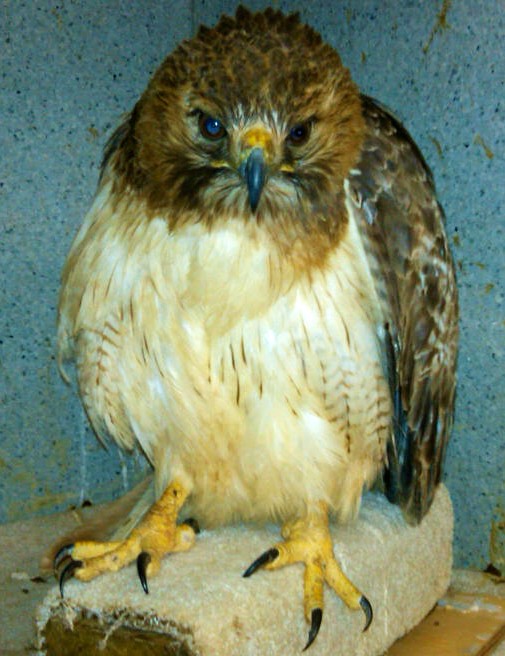
As I am writing I can hear patient # 050811 flapping around in her hospital stall.  She is a Red-tailed Hawk that was admitted over four weeks ago.  For these last four weeks our volunteers and staff have hand fed this bird and washed her tail each day.  She could not stand – she was paralyzed.  She could not move to eat her food on her own or get her tail out of the way when she went to the bathroom.  But she could always move her feet a little, and seemed to have an unending will to live.  Somehow it seemed she knew we were trying to help.

All of the staff and volunteers at the hospital have fallen in love with her; some volunteers have offered to work late and come in more often if it might help this bird, but we always do the best we can – the rest is up to the bird.  We wondered when, if ever, would she be ready to stand?

Most likely, she was hit by a car and had spinal bruising.  We believed that inflammation in the area exerted pressure on the spine which resulted in paralysis.  The x-rays taken of her legs and hip area showed no signs of fractures.
 Patient #050811 standing for the first time after 4 weeks of care for paralysis.
 On June 14th she stood for the first time in four weeks, and since then has been making remarkable progress.  We hope to move her outside next week and release this miracle bird by August.  I hope some of this bird's "can-do" attitude has rubbed off on me.

Success stories such as this one are what keep all of us here at the Kathryn G. Favre Hospital motivated.

The costs of caring for this bird, and the many other patients who enter our hospital each year, are totally funded by private and corporate donations.  The average cost to care for a bird is in excess of $1,000.  You can be a part of one of these miracles by opting to be a Return To The Wild sponsor.  Just click here for the details.

Submitted by Joe Hoffmann, Sanctuary Manager.

Friday, July 1, 2011

Tales From The Nest - Part 9

4/23 – Last night tornadoes ripped through the St. Louis area, demolishing homes and damaging the airport badly enough to shut down Lambert St. Louis Airport for an undetermined length of time. 

The storm roared out of the west bringing with it golf ball size hail, 70 mph winds, and a lightening display St. Louisans will remember for years to come.  On its way to Northwest St. Louis County it roared right over our Great Horned Owl nest, and I wonder—“Will our owl family still be there this morning, or have they been swept away by the storm?” 

Even though it’s still raining I have to find out if our little family is still there.  I hold my breath as I approach my viewing station.  Yes!...there are three distinct shadows at the nest.  


Mamma sits up high on her favorite perching branch, and the two babies are perched on the edge of the nest right below her.  They are drenched, but appear to be no worse for wear.  


The nest itself seems to have weathered the storm—the hawks who built the original structure last year get an “A” for their construction skills and choice of a good site.  This nest has been through more than it’s fair share of bad weather and still seems to be rock solid. 

Since it’s still raining I take only a few photos before I leave, all the while saying a silent “thank you” to a higher power that the nest was kept safe through last night’s terrible storm.

Check back soon for more "Tales From The Nest".

Submitted by Gay Schroer, World Bird Sanctuary Volunteer/Photographer