Tuesday, November 22, 2011

JUST ANNOUNCED: WORLD BIRD SANCTUARY ALASKA CRUISE 2012

Join WBS Founder & Executive Director, Walter Crawford, on a week-long cruise with Holland America to explore the natural wonders of Alaska, from September 9 – 16 2012.  
Your Holland America ship at anchor in the quaint town of Sitka
ALASKAN EXPLORER CRUISE
·      Escorted by Walt Crawford, Executive Director, World Bird Sanctuary
·      Aboard Holland America MS Oosterdam
·      Sailing Roundtrip from Seattle to Ketchikan, Juneau, Sitka, Tracy Arm/Sawyer Glacier, Victoria, BC and return to Seattle
·      Prices Start At Only $1,168 (inside cabin); $1,488 (ocean view); $1,888 (verandah)

Price Includes:
·      7-Day Cruise Accommodations
·      Onboard Meals & Entertainment
·      Special Lectures by Walter Crawford
·      Visit to the Raptor Center in Sitka
·      Private Cocktail Party Onboard
·      $25.00 per person Shipboard Credit
·      All Taxes and Government Fees
·      Also Included is a $50 Donation to World Bird Sanctuary

For Reservations or Information
Contact Cathy Robinson at ext. 114 (314) 439-5700 or (800) 527-1059

Enjoy a vacation with a group of like-minded people interested in natural history, and especially Birds of Prey.

Sunday, November 20, 2011

A Turkey Named Fred survives another Thanksgiving!


“Turkey Named Fred” is without a doubt THE fan favorite for audiences of our in-house band, The Raptor Project.  Now Fred has his own animated music video for you to enjoy!

The Turkey Named Fred – video star!
Joe Hoffmann, signer/songwriter for The Raptor Project, wrote the song “Turkey Named Fred” in honor of Fred, the Royal Palm Turkey that calls World Bird Sanctuary home.  The song inspired the animated music video.

Watch the video and share it with your friends!
You can meet Fred’s animated alter ego by visiting our YouTube Channel and watching the Turkey Named Fred music video here for free!

Visit Fred soon at World Bird Sanctuary – he loves visitors!  And share his video with your friends on Facebook, YouTube, Twitter and email.

We would like to thank Jeremy Lueders and The Vision Factory for making this animated video possible.

Friday, November 18, 2011

Christmas Shopping

Have you started your Christmas shopping yet?

Believe it or not, there are only five more weeks (37 days to be specific) left until Christmas.  Black Friday, the quintessential Christmas bargain shopping day, will be here in one week.  But do you really want to fight all the Black Friday crowds? 
The WBS gift shop offers a wide selection of merchandise
You can avoid the crowds and mass hysteria by doing some, or all, of your shopping at the World Bird Sanctuary.  For those adults and children on your list who love the outdoors and wildlife we have a well-stocked gift shop in our Nature Center.  Here you can find gifts ranging from stocking stuffers to great t-shirts and outdoor wear—all with a nature related theme.  All of these items may be purchased in person while enjoying all that the Sanctuary has to offer.

Don’t have time to visit in person?  Other gift options that may be purchased on-line include:

BUY A BRICK
A WBS brick is a personalized, lasting gift 
For those on your list that fall into the “hard to buy for” category consider giving them a lasting gift – a brick to be installed in our amphitheater with your holiday wishes or other sentiment inscribed on it.  Two brick sizes are available with the option of including a presentation gift certificate for gift giving.  To purchase a brick click here. 


ADOPT A BIRD
Acorn, the Eastern Screech Owl is just one of the many animals available for adoption
All of the birds and other animals that call World Bird Sanctuary home are available for adoption. Your adoption helps to care for your animal for a year, and adoption fees include:
•            Certificate of Adoption with a full color photograph of your special animal
•            World Bird Sanctuary sponsorship for one year
•            One year’s subscription to our newsletter – the Mews News – printed three times per year
•            Natural history and life history of your special adopted animal
•            10% discount on all World Bird Sanctuary merchandise in our gift shop
•            10% discount on all public programs offered at World Bird Sanctuary, such as Owl Prowls, Nature Hikes etc.
•            Visiting privileges and photo opportunities with the special new member of your family  (just call ahead first to make sure your adopted animal will be here on the day of your visit).

To adopt your bird select the category of bird that you want to adopt, and then click on the individual bird within that gallery and complete the adoption form.

RETURN TO THE WILD

Take part in the release of a rehabilitated bird!
Returning a bird of prey back to the wild can cost up to $1,000 in care and rehabilitation. Your contribution of only $150 helps our patients and gives you the opportunity to participate in the release of a wild bird of prey.
Give someone on your list the opportunity to actually return a creature to the wild
Invite family and friends to release a bird of prey at your home or nearby park. Celebrate a wedding, birthday, anniversary, family reunion, school or corporate function with this special gift.
The World Bird Sanctuary Wildlife Hospital is a cornerstone of the World Bird Sanctuary, and is entirely funded by donations from the public. Help us give our patients a second chance to fly Sponsor a release today!


Questions about Return To The Wild?  Call (636) 861-1392 or email: credfern@worldbirdsanctuary.org

A WBS Friend Membership

Your WBS Friend Membership includes:
•            One year’s subscription to our newsletter – the Mews News – printed three times per year
•            Reusable WBS shopping bag
•            10% discount on all World Bird Sanctuary merchandise in our gift shop
•            Invitation to Friends-only events like Camera Day offering unique photographic opportunities featuring live birds of prey. Bring your cameras for rare shots of raptors in natural settings
•            10% discount on all public programs offered at World Bird Sanctuary, such as Owl Prowls, Nature Hikes etc.
•            Invitations to members-only events held at World Bird Sanctuary

To purchase a WBS Friend membership click here.

RAPTOR PROJECT CD

For the youngsters on your list there is a selection of two audio CDs by our in-house band, The Raptor Project.  These CDs also contain encoded lyrics and teacher activity pages.  Enjoy songs such as “Mr. Frog Blues”, “Those Wonderful Birds”, “The Food Chain Blues” and many more.  All proceeds from sale of CDs supports the Wildlife Hospital.  To purchase a CD click here.

BEAK TO BEAK

For the book lover on your list purchase “Beak To Beak”, a book by our Director, Walter C. Crawford, Jr.  This book is filled with Walter's musings on wildlife, conservation and life in general told through a collection of short, true-life stories.

The book is available for purchase for $10.

Any of the above items may also be purchased in person at the World Bird Sanctuary’s Nature Center, or call 636-225-4390 Ext. 0 for further information.

Wednesday, November 16, 2011

Our popular Owl Prowls are back!


Owl Prowls were awarded the Midwest Traveler's Travel Treasure for the Midwest last year - and sold out quickly.


Most November dates are already sold out, but we've added dates to ensure that those of you who missed out last winter will get seats this season, so book now!

Come over to the Dark Side and meet the amazing birds that exist by moonlight.  Owl Prowls offer an exciting opportunity to learn more about the fascinating lives of owls.

Join one of our Naturalists at our evening programs - a 30 minute presentation featuring live flying owls, followed by an easy night hike around our grounds as we try to  find wild Barred Owls and Great-horned Owls who are busy setting up territories and finding mates for the winter owl-breeding season!


Owl Programs offered on selected evenings from November '11 to March '12
Book today to ensure your place on our popular Owl Prowls.

All Owl Prowls start at 7pm.

January 2012
Friday 1/13
Friday 1/27

February 2012
Friday 2/10
Saturday 2/18
Friday 2/24
Saturday 2/25

March 2012
Friday 3/2
Saturday 3/10

To book, call our Education Center at 636-225-4390 ext. 0.
$9 per adult; $7 per child under 12.
Friends of World Bird Sanctuary receive a 10% discount.
Groups of 10 or more pay $7 per adult and $7 per child.

Monday, November 14, 2011

WBS Assists Wisconsin Organization

In late August our Director, Walter Crawford, received a call from a raptor rehabilitation organization in Wisconsin asking for our help.
 A mixture of species shares quarters around this facility's pond
Because of the many severe storms and tornadoes in their area this past spring the Wisconsin facility had been inundated with injured and orphaned birds.  Some birds came in with the usual injuries and problems, but many were youngsters who had been swept from their nests by the severe storms.  Many of these were otherwise healthy, but needed time in the large flight cages to perfect their flying and hunting skills.  This large influx of birds had taxed their facility’s holding capacity to the maximum.
This enclosure and the many others at the facility can now be used to their best advantage by shuffling housing arrangements
Because the director of this organization had a longstanding acquaintance with Walter Crawford, our Director, and knew of the World Bird Sanctuary’s excellent reputation as rehabbers and educators, she turned to us for assistance.
REGI staff member Katie Farvour and my husband, Art Schroer, with what looks like a mountain of crates--how will they all fit in the van?
On Labor Day weekend my husband and I headed north to pick up sixteen birds from this organization.  The quarters vacated by these sixteen birds would make room for significantly more than sixteen injured and orphaned birds—housing arrangements can sometimes get complicated with animals. Once all the birds were loaded into the van we made a beeline for St. Louis.
The birds begin their journey on a foggy Wisconsin morning 
Transporting birds can sometimes be tricky—especially if they are birds that have never been crated before.  Some of these birds fell into that category.  Our main concern on the drive home was keeping the van cool so that the birds would not overheat.  Lunch was definitely a drive through affair, and potty stops were taken in shifts while one person stayed with the birds to keep the air conditioner running.  However, all was quiet in the back of the van during the eleven-hour drive and all sixteen of our charges weathered the drive well. 
 Great care was taken with the birds who were unaccustomed to being crated
As the St. Louis Arch came into view we called ahead to let WBS personnel know that we would be there shortly.  To our amazement, when we pulled into the parking area at  WBS’s behind the scenes facility we were met by a small army of WBS staff members, including our wonderful volunteer veterinarian Dr. Stacey Schaeffer.
 WBS personnel help unload the crates after a safe and successful 11-hour trip from up north
With everyone’s help the newcomers were quickly checked out and their health status and injuries evaluated.  The eagles that simply needed flight cage time were released into the large rehab flight enclosure, and the other birds were settled into their new quarters where they would be given time to acclimate themselves to their new surroundings.
 All the birds were assessed by our vet and staff members
Our list of passengers included:

•            Six possibly releasable Bald Eagles which needed time in a large flight enclosure to allow them to strengthen their flight muscles and perfect their flying skills.  As of this date three have been released, the fourth is scheduled to be released next week, the fifth is scheduled to be released on the 29th, and the sixth and final bird is still in the flight cage regaining his flying skills and being conditioned for a successful release. 
 The six releasable Bald Eagles were released into the flight enclosure to strengthen flight muscles
•            Four non-releasable Bald Eagles who may become Education or Display birds

•            Two Bald Eagles who have already been trained as education birds and will enhance our existing roster of education birds, either locally or at zoo shows in the coming year. 
The education birds who were already wearing "equipment" receive new anklets 
•            One White Pelican who has a wing injury and cannot fly.  This bird has been placed with another injured White Pelican that WBS received about a year ago.  Both these birds will be placed with another facility sometime in the not-too-distant future.

•            One Rough legged Hawk who was non-releasable due to an eye injury. She had already been trained to the glove and has joined our Education Department.  Bella (which means “beautiful”) can be seen in the weathering area behind the Nature Center, and has already begun taking part in education programs.

•            Two wing-injured Sandhill Cranes who will be permanent residents of our display line.  This pair has in the past laid eggs and it is hoped that they will be comfortable enough in their new surroundings to produce young.

Submitted by Gay Schroer, World Bird Sanctuary Volunteer/Photographer 

Saturday, November 12, 2011

My First Eagle Census

Yesterday I was reminiscing about the many interesting experiences and opportunities I’ve had since becoming a volunteer for the World Bird Sanctuary.  Foremost among these was the first time I was invited to take part in a Bald Eagle Census in 2003.
Most of us know about the U.S. Census for humans--Did you know about the Bald Eagle census?
The call came on a Saturday morning.  It was our daughter, Teri, Director of Education for World Bird Sanctuary.  She wanted to know if her dad and I would be interested in doing a Bald Eagle count with Jeff Meshach on Tuesday.  Jeff was at that time the Director of Animal Management for WBS, and was and still is in charge of doing the yearly eagle census counts each December through February, when the birds migrate south in search of open hunting waters.

As far as I was concerned this was the opportunity of a lifetime!  Jeff laughingly told Teri that we had called him back within 14 minutes of his original call.  An eagle count consists of four people in a small plane flying at low altitude down (or up) the center of the river channel.  The two people in the rear of the plane are the spotters, and Jeff records the number and type of eagles (adult or juvenile), and their approximate location, on a river map.

As time drew near to the day of the count, the weather forecasts were not sounding promising.  On the morning of the count we showed up at Spirit of St. Louis airport not knowing if we would even be able to take off due to weather conditions – 12-14 degree temperatures with wind chills I don’t even want to think about, and possible snow.  However, our pilot, George Stephenson, assured us that the weather would not be a problem, and that we would be flying well beyond the “no fly zone” created by a Presidential visit that day in South St. Louis.
This would be two adults perched
Jeff gave us a quick rundown on procedures for spotting the eagles.  My husband, Art, and I were each to count the eagles spotted on our respective sides of the plane.  As we spied the birds we were to call out the number and type of birds and where they were located, i.e., “2 juvies perched” (which means perched in trees), or “3 adults on the ice”.  Jeff then recorded this information as it was called out.
This would be two adults and one juvie on the ice
At one point, action on my husband’s side of the plane was a bit slow and he began to count birds on my side.  Apparently we gave Jeff and George quite a chuckle when I told my hubby to mind his own side of the plane.

These numbers are given to several Bald Eagle population monitoring groups, who then use them in conjunction with numbers supplied by other spotters around the country to guage the health of the bald eagle population.

Census counts are just one of the many tools in World Bird Sanctuary’s arsenal to ensure that our grandchildren and great grandchildren will still be able to see our country’s national symbol in the wild, and not just in cages at zoos.  We hope that future generations will never have to say to their children, “Once upon a time there used to be a bird called a Bald Eagle….”

Submitted by Gay Schroer, World Bird Sanctuary Volunteer/Photographer

Thursday, November 10, 2011

Rare Bird?

Do You Take your Backyard Birds for Granted?

This is a question that occurred to me recently while I was watching some of our local birds at my feeder.
 An American Cardinal 
Several years ago my husband and I took a trip to New Zealand, rented a camper, and camped our way from the South Island to the top of the North Island.  This mode of travel allowed us to see much more of the local flora and fauna than is normally seen from a tour bus. 

On our first couple of days there we encountered a number of unfamiliar seabirds and shorebirds, which we expected since we were then staying at a campground on the east coast of the South Island.  On our third day we crossed the mountains to the west coast and stayed in a charming little town called Hokitika. 

We had planned to travel down the coast to the glacier the next morning, but when we awakened the fog was so thick we could barely see to cross the street—not a good day to drive through mountainous terrain in unfamiliar territory on the “wrong” side of the road.  So instead we toured this charming little town on foot, met some of the local shopkeepers, and asked for advice as to where they would go to sightsee on such a foggy day.  The majority advised us to take a short trip out of town to Lake Kanieri.
The ferns were breathtaking! 
Frankly I think this unexpected side trip was probably a big improvement on glacier watching.  We encountered towering tree ferns, a beautiful waterfall, and some of the most gorgeous fern laden scenery I have ever seen.  As we were “oohing” and “aahing” over the fantastic plant life before us we spotted a strange looking bird strolling along hunting for insects in an open grassy field.  I immediately began taking photos of this exotic bird (I am a "shoot the photo first and then look it up later" kind of person).  I probably took 50 or 60 photos of this bird before we moved on.  The bird was a Weka—considered vulnerable, but not particularly rare in this locality.
 The bird turned out to be a Weka--a member of the rail family
Throughout this trip the above scenario was repeated many times---Pukeko (common), Australasian Harrier, Tomtit, New Zealand Pigeon, Tui, Bellbird, Fantail, Australian Magpie—all birds that were relatively common and on the IUCN list as Least Concern.  Granted, these birds weren’t particularly rare in that part of the world, but they were strange and new to me.
This South Island Tomtit, though relatively common, was an exotic species for us. 
So, the next time you are sitting at your window watching your feeders, just for a moment, look at your visiting birds through the eyes of someone from another country.
 Can you imagine someone from another country's reaction to this common American Goldfinch?
Can you imagine how excited they would be to see common (to us) birds such as Cardinals, American Robins, American Goldfinches, Blue Jays, Cooper’s Hawks, Red-tailed Hawks?  In particular imagine how excited they would be to see an actual Hummingbird or a Bald Eagle.  All of these species are native only to the Americas—some only to North America.
If I were from another part of the world the sight of this hummingbird would definitely get my heart racing 
Sometimes we have to step back and take a really good look at the wildlife right before our eyes that we often take for granted.

Don’t forget to feed your backyard birds this winter—they may be someone else’s rare sighting!

Submitted by Gay Schroer, World Bird Sanctuary Volunteer Photographer  

Tuesday, November 8, 2011

Maritz Sponsors Free Programs

Win an Educational Program from WBS for a Group in Need

Do you know of a group, school or organization in need of an educational program?

We’re aware that even though we keep the costs of our programs to a minimum and far less than our actual expenses, there are those that are still unable to fund a program on their own for financial reasons.
One of our most popular programs--Raptor Awareness
The Maritz Corporation has generously granted funds to World Bird Sanctuary to provide several programs for less privileged groups in the Greater St. Louis Area.  We are asking friends of the World Bird Sanctuary to nominate a group, a school or an organization that you think is deserving of one of these funded programs.

Here’s how you can nominate a local group, school or organization for a free educational program:

Send an email to education@worldbirdsanctuary.org with “Nomination for Maritz Grant Program” in the subject line, and the following information:

Your Name
Your Phone Number
Name of the Organization you want to receive the program
Contact Person for this Organization
Contact Person’s Phone Number
And in 150 words or less, describe why this group should be awarded a program
.
Winners will be notified by phone, our blog and Facebook.  Nominations must be made within three weeks of this posting.  Winners must be within 50 miles of World Bird Sanctuary, and may have their program of choice.  Program descriptions are available on our website at www.worldbirdsanctuary.org under the “Programs” tab, under the headings of “For Your Classroom” and “For Your Group”.

World Bird Sanctuary would like to thank the Maritz Corporation for their continued support and for this opportunity to share our message of conservation with those who may otherwise never have the chance to hear it.

Submitted by Billie Baumann, World Bird Sanctuary Outreach Coordinator

Sunday, November 6, 2011

Got Biome?


Planet Earth – what an interesting and fascinating world. 

So, we live on the third rock from the Sun.  But how much do you know about the planet’s five major biomes: aquatic, deserts, forests, grasslands and tundra?

World Bird Sanctuary offers a Resource Nest Box called “Where We Live”.  This is an educational resource box loaded with books, DVD’s, videos, activities, games and more.  For a nominal fee of $25.00 you can rent this box for a two-week period through our Education Department.

This box contains a wealth of information and tools and hours of entertainment including twenty-two books on topics such as: arctic and desert wildlife, the tundra, desert, woods, rainforest, oceans, wetlands, grasslands, prairies and more, a tree ring counting guide, a food chain game, five VHS videos about animals and prairies, the Planet Earth and Blue Planet boxed DVD set containing ten DVD’s, a puppet show with seven puppets and a script, and more.

Resource Nest Boxes are a great addition to classroom teaching, for home schoolers, students working on research papers, day cares, scout leaders, or for kids that just want to have fun and learn more about our great planet and the creatures that we share it with. 

Other available Resource Nest Box topics are: Protect Our Planet; Rocks Rock and Talon Tote.

To reserve one of our educational and environmentally friendly Resource Nest Boxes, please call the Education Department at 636-225-4390 extension 0.

Submitted by Billie Baumann, World Bird Sanctuary Outreach Coordinator

Friday, November 4, 2011

Women in Conservation

Women have been pioneers in conservation for over 100 years.  Some of them were in our own backyard!

I recently saw a photo that a follower posted on our Facebook Page that piqued my interest.  It was a picture of a young woman banding birds in Missouri in the 1920's.  I emailed Lura and asked for more information, and uncovered a wonderful story about a wildlife conservation pioneer that, almost 100 years ago, was doing the same important work as our WBS Bird Banding Team.
 This newspaper article piqued my interest

This newspaper article, dated Monday 8th, 1929, shows Miss Cora Shoop banding birds, including cardinals and juncos.  Miss Shoop started the banding station after one of her students brought her a Blue Jay that he had killed earlier in the decade.  The Blue Jay had a numbered band on its leg, and together student and teacher set out to find out what it meant.  After tracing the band back to the biological survey unit of the United States Department of Agriculture, they learned that the Blue Jay had been banded in Wisconsin and made its way all the way down to Missouri.  The students were so interested in what they had learned that they applied to set up a bird banding station to contribute data to the survey.

When I saw the photo in this article I wanted to know more, and Lura Holt, Cora Shoop's niece, told me:

“I know Aunt Cora would be honored. I have attached the article that goes with the picture.  She was an amazing woman, and I have just recently started organizing her papers and photos.  She lived into her 90's, was a very prolific writer and saver.  She started banding birds in the early 20's in Steelville MO where she was born.  Family legend is that she was the first woman to receive a degree in biology at Mizzou.. Don't know if it is true or not.  Ornithology was her first love, botany her second (she was married to Julian Steyermark, renowned Missouri botanist who published the book, Flora of Missouri, among many others).
“This picture is Cora with my mother in 1931." 
“This last picture is one of my favorites. She has it labeled Blue Wing Teal at campsite Lacled Co. Niangua River 4 1/2 miles SW of Eldridge. 6/23/39."

It is pioneers like Cora Shoop that have inspired many of us at World Bird Sanctuary.  Today we'd like to acknowledge the contribution that they have made to the study of birds in our own backyards, and around the world.

Submitted by Catherine Redfern, Naturalist/Fundraiser, World Bird Sanctuary

Wednesday, November 2, 2011

A Day In The Life….


During the summer, the Educational Training Center (ETC) the World Bird Sanctuary’s behind the scenes bird housing facility, is a pretty quiet place.  

We take care of the few birds that do not end up out at a summer zoo show, and we take care of a lot of maintenance projects for WBS, such as filling potholes on the road to the ETC, or maintaining much of the behind the scenes bird housing.

However, when the first week of September rolls around, the ETC gets much noisier.  This year, WBS sent two groups of birds and trainers on the road—one group to the Milwaukee County Zoo in Wisconsin, and another to the Stone Zoo in Boston, Massachusetts.  Both birds and staff performed spectacularly at these zoos all summer.
 Grand finale of WBS Birds of Prey show at Boston's Stone Zoo
On September 7th, the Milwaukee zoo show returned to St. Louis, bringing with it about eighteen birds.  Then on September 10th, the Boston zoo show returned with another eighteen birds.  In the space of four days, the ETC went from being calm and quiet to a hub of activity.  We have a lot more birds to take care of down here now, and we love having them back!

The daily routine starts by checking to make sure all of our birds are okay in the morning.  They usually greet us in their stalls with their signature noises—the peeping of our young Augur Buzzard, the grunting bark of a Tawny Eagle and the shrieking chirp of two Bald Eagles.  The Parrot Room, where all of our parrots are housed, is another level of noise entirely.  The parrots shriek loudly, and we even have to wear hearing protection.  They’re hungry, and they’re not going to let you forget it.  We feed the parrots first, then we take the raptors outside, so they can experience whatever weather happens to be going on that day.

The morning passes in a flurry of food prep.  On a typical day, we have to prepare at least thirty individual bird diets.  Some birds can only get specific types of food (for example, pelicans will only eat fish).  Some of our birds are weight managed, which means they are either performing in shows or learning a new behavior and need to maintain a specific weight: the weight at which they perform best (Goober the Black Vulture and Lenore the White-necked Raven are two such birds).  Other birds can eat whatever they want—we can feed our Bald Eagles rabbit, rat, fish or venison (although Patriot, one of our eagles, doesn’t like to eat fish, which is atypical of a Bald Eagle, really…) 

Here at the ETC we also prepare food for the Display line on the main site. This adds another thirty or so birds for which we must prepare the right diet.  We add a nutritional supplement to the food called Vitahawk.  This gives the birds extra vitamins and nutrients that are necessary for their health.  After the Vitahawk is added, the birds are ready to be fed.

When we walk out into the weathering area with the green tray, all of the birds get excited.  They know what that means: feeding time!  The bird that gets the most excited is Prius, our Gyrfalcon-Peregrine Falcon hybrid.  She chirps constantly, from the moment the weathering area is opened to the instant she gets her food.  Like most falcons, Prius’s favorite food is quail.  As soon as she has the food in her grip, she starts to chow down. 

Other birds are more reserved about eating.  Liberty the bald eagle will sometimes just stare at his fish or his rat, seemingly wondering what he is supposed to do with it.  More often than not, when we leave the weathering area, he has hopped down from his perch and started to eat.  By the time all the birds are fed, all the food is prepared and the kitchen is cleaned, it is time for the humans to have lunch.

After lunch, we have to make sure that all of the birds have a clean place to live and play and sit for the night.  Some of the birds stay in mews inside the ETC, especially those species that are not adapted to live in cold weather (Red-legged Seriema, African Pied Crow, etc.)  We spot clean these enclosures, taking out wet or dirty aspen shavings on a daily basis.  We also replace all of the aspen shavings in the mews regularly.  Sometimes the ravens and crows try to “help”—they attack the broom while we sweep.  Mostly, the birds sit on their perches and give us strange looks.  We also make sure to clean out the raptor room—the place where the raptors that are on anklets and jesses stay during the night.

After we clean up after the birds, we take care of any other maintenance that is needed behind the scenes.  We are a busy group of people down here at the ETC.

Here are just a few of the birds we take care of:
Baton Rouge, King Vulture
Osiris, Egyptian Vulture
Aesop, the baby American Crow, who was just recently christened
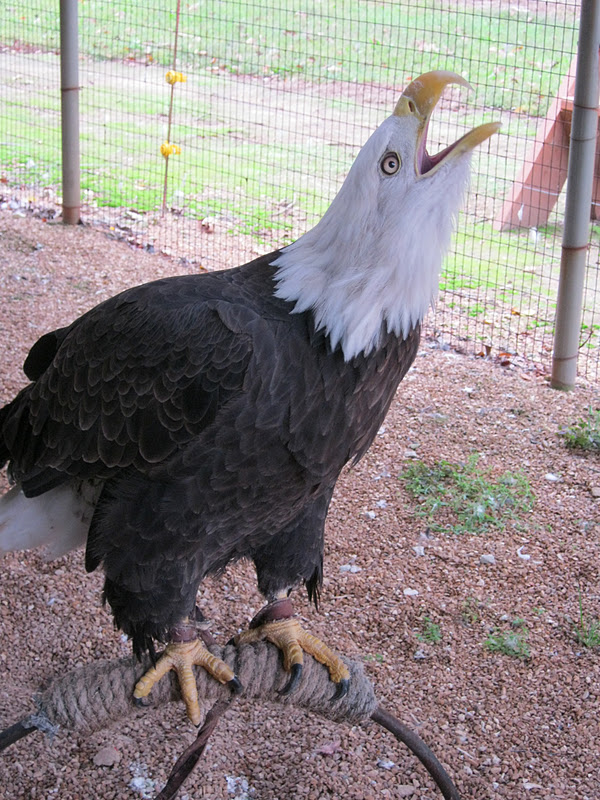
Patriot, Bald Eagle
Prius, Gyrfalcon-Peregrine Falcon hybrid

Some of these birds, like Patriot the Bald Eagle, will be rotated up to the Nature Center and Weathering areas from time to time, or will participate in educational programs over the winter.  Others, particularly those who are cold sensitive, will enjoy the heated quarters in the ETC building and will not be on public display until next summer when they will again be traveling to zoos and other entertainment venues.  For right now these birds are enjoying their winter vacation and the ETC staff is gearing up for a very busy winter.

Submitted by Emily Hall, World Bird Sanctuary Naturalist/Trainer