Tuesday, May 8, 2012

Anthropomorphism

Anthropomorphism is an attribution of human characteristics to a non-human, such as animals, plants, phenomena or inanimate objects.  It is a common occurrence in cartoons, television shows, books and movies. 

A prime example of anthropomorphism is the movie Ice Age.  All the characters had humanlike characteristics.  We all know that animals do not really act and think like people do. 
Tsavo, displaying the regal bearing of a Bateleur Eagle 
When you work with animals as much as we do here at World Bird Sanctuary, it can sometimes be difficult not to wonder what the birds would be thinking if they did think like humans.  So, in my head I often anthropomorphize our birds.  A good example of when I do this is when I am handling Tsavo, one of our beautiful Bateleur Eagles.  In my head I always imagine Tsavo speaking in third person, short and to the point.  Like in this picture I imagine him saying “Tsavo hates symmetry!  Obey Tsavo!” 
A very wet Jack
During the Stone Zoo show season in 2011, there was one very rainy day and the look that Jack, our Harris’s Hawk, had on his face made me think that he was thinking “I hate being wet, can I have a towel please?” 
Baton Rouge loves attention
Baton Rouge, our amazing and sweet King Vulture often slyly walks along the mew in a posture that seems to me as if he is begging for attention.  He often sticks his beak through the wires and makes adorable lip-smacky noises. 
Waylon does the hip hop
Our Blue and Gold Macaw, Waylon, seems to get super excited while sitting on the back of a chair.  In my head I often find myself thinking that he would be saying “Look at me! No hands!  Now I’m gonna dance.” 
Nemo, the African Grey Parrot seems to be saying "Who me?  Would I do that?"
Finally there is Nemo, our African Grey Parrot.  He is very intelligent and he seems to know it.  Sometimes he will mimic the sounds of a Red-Legged Seriema because he seems to know that it will cause the other Seriemas to start their vocal battle of dominance, by seeing who can be the loudest.  After he gets them all calling out, he will sit on his perch with a look on his face that makes me wonder if he’s thinking “Don’t look at me, I didn’t get them started.” 

All in all, at the end of the day we know that they are just birds and they don't think like we do, but it is too much fun not to wonder what it would be like if they did.

Submitted by Mike Cerutti, World Bird Sanctuary Naturalist

Sunday, May 6, 2012

What Does A Field Studies Coordinator Do?

In the past month or so I have been asked the same question numerous times. “So what exactly is your job?”  So, for all of you who have wondered just what a “field studies coordinator” does—here is a short description.
 One of the 330 nest boxes in the St. Louis/Franklin County which we monitor
My workweek is similar in timing to most Monday through Friday workweeks, but that’s where the majority of the similarities end. I am in charge of around 330 nest boxes, or birdhouses, around the St. Louis/Franklin county area. With the support of Ameren Missouri we have developed a study to find the most advantageous way to manage flora (plant life) around the electrical lines while keeping our feathered friends happy.

The three different ways that Ameren manages flora in the power line cuts are by spraying, mowing, and a combination of the two. What we have done is place boxes in the mow, spray, and mow/spray areas. What we are looking for are the success rates of the nests and number of active nests in each of the three areas. With this process being repeated over a number of nesting seasons we should be able to notice a trend. The trend that we are looking for is the most productive nest box area. This in theory will point us towards the best flora management practice.

As noted earlier there are 330 nest boxes that I oversee, and the boxes are located at the base of the electric line stanchions. For those who don’t know what a stanchion is--think of the Eiffel tower scaled down and that’s what a stanchion looks like, with current carrying wires strung between each Eiffel Tower!  Every stanchion has four legs, and on each leg there is a nest box.

My weekly duties are to visit each nest box once a week and record weather or not there is a nest and if there are offspring. If so, I record the nesting material, species, and the number of offspring.  At the correct age I will place a band around the leg of each individual youngster, and the banding information will be sent to the United States Geological Survey (USGS) for their banding records.

So—the next time someone mentions a “field studies coordinator” in casual conversation you can say, “Of course, I know what that is!”

Submitted by Adam Triska, World Bird Sanctuary Field Studies Coordinator

Friday, May 4, 2012

Cupid: The American Barn Owl

I would like to introduce you to a new member of World Bird Sanctuary; Cupid the Barn Owl. 
How could anyone resist this face?
Cupid’s parents are Buffy and Moonshine—one of our newest breeding pairs.  Cupid was hatched on February 14th, 2012 in one of the Propagation Department mews in the Sunnen Building.  His hatch date, fluffy white down, and striking heart-shaped face inspired the name Cupid.  (And if those beautiful brown eyes don’t pierce your heart, it probably isn’t beating).  

When Cupid turned five days old, Roger Wallace, WBS’s propagation coordinator, gently took him out of his parents’ nest and transferred him to a brooder box.  This box keeps the bird warm, like its real mother would, until it is big enough and has a thick, downy coat to keep itself warm.  Some of Cupid’s nest mates remained in the nest to be raised by the parents.  Those birds will have  minimal contact with humans and will be released into suitable barn owl habitat when they are old enough. 
Cupid was removed from the nest at such a young age in order to accustom him to humans.  When Cupid becomes an adult, he will fly in World Bird Sanctuary Education programs as an ambassador for his species, and will help to educate the public about the threats to his wild cousins that have caused them to be put on the endangered species list in some states here in the U.S.  He will need to be handled by, and fly around humans every day.  That is why we want Cupid to not have fear of humans. 
During the earliest days, Cupid--then known as #43 because of its band number--was hand fed, mostly by Roger Wallace.  By the time he turned 30 days old, he had gained enough body mass that he could maintain body temperature outside the brooder box.  At that point I put a carpet square in a small crate, gently placed him inside it, and took him to my apartment.  I felt a little nervous when I first began to take care of him; I had never raised baby barn owls before.  But Cupid responded well when I began to feed him. 
I love watching Cupid grow and change every day.  He spends his days in an owl playpen we built in half of an empty mew in the Educational Training Center.  That way he can get used to the pace and sounds of human activity.  In the evenings I allow Cupid free run of my apartment.  He normally tries to seek out little hiding places, such as behind the couch or under the desk.  I don’t allow him to hide for very long, because the whole point of his spending time in my apartment is to become accustomed to humans.  Even though I know he doesn’t understand, I spend a lot of time talking to him, and he just stares back and “chitters” at me. When I am ready to sleep, I just place Cupid’s crate on the floor and he runs right into it!  He knows which crate belongs to him, even when given the opportunity to go into more than one. 
Cupid has already made his public debut at World Eagle Day.  His next big step will be in April when he will travel with me to Milwaukee to continue his Education Bird training at our Milwaukee County Zoo bird show.  There he will become used to the routines of the day, his equipment and the commotion of the crowds at the zoo.
I am really enjoying the opportunity to help “Clever Cupid” to become a comfortable and proficient Barn Owl Education Ambassador.  After all, how often do you get the opportunity to be a foster mom to a Barn Owl?

Submitted by Leah Sainz, Naturalist/Trainer

Wednesday, May 2, 2012

Spring Camera Day is Here

Spring Camera Day
Bring your cameras! 
Taking photos of our birds has never been easier.  Join us for our Spring Camera Day, when we place birds in natural settings and fly them from trainer to trainer.  Our naturalists position the birds with photographs in mind - no fences or perches to obstruct that perfect photo - just a beautiful bird posing for you!

You have to be a WBS Friend to gain admission to Camera Day.  If you are not already a WBS Friend you can join on the day for as little as $35!

Bring lots of film, data cards and enthusiasm.  Schiller's Camera and Nikon will be on hand to help you get the perfect shot!  Concessions will be available.

·       Date: Sunday 6 May
·       Time: 10am - 2pm

Admission: Must be WBS Friend - you can sign-up on the day!

Monday, April 30, 2012

International Migratory Bird Day


Don't forget International Migratory Bird Day
Join the worldwide celebration of birds! 
 Learn all about bird banding from members of our Field Studies Banding Team
Be part of the worldwide celebration of migratory birds at World Bird Sanctuary's International Migratory Bird Day.  Learn about why it is important to protect migratory birds and their migration flyways:
·       Fun, free children's activities with prizes!
·       Meet naturalists at our bird feeding stations to learn bird watching and identification tips from the experts!   
·       Bird-banding demonstrations - take a tour to watch our field studies crew catch, band and release migrating birds (small fee for transport to the site)!
·       Keeper talks about the migratory species that call World Bird Sanctuary home.

·       Date: Saturday 5 May
·       Time: 8am - 1pm

Admission and parking:  Free!

Saturday, April 28, 2012

365 Photo Project - April

This month has been a great month for photos with the start of spring, vacation and work trips and just generally being out and about.  It is so hard to choose photos to use for this project, but at the same time it is a lot of fun. 

I have recently joined a website call 365.  Here is the link to my page.  This website is so much fun if you love photography from around the world.  I can follow other people and people can follow me.  Everyone can comment back and forth.  It’s like social media for photography.
 Clipper butterfly photographed at the Sophia M. Sachs Butterfly House
My first favorite photo for this month is a photo of a Clipper butterfly which I took at the Sophia M. Sachs Butterfly House in St. Louis.  The light and the colors just came out fantastic and I just love this photo.  I went to the butterfly house with a WBS volunteer and friend Sandra Murray who also loves taking photos.  We spent her lunch hour photographing butterflies and enjoying the hot, humid conditions in the butterfly house.

This was also the start of March Morpho Month at the Butterfly House.  For this special exhibit they release an extra 2000 Morpho butterflies which are free to fly around the interior of the Butterfly House.  It is just amazing!  I took a ton of photos that I really like, but this one of the Clipper just came out fantastic.
 Our new baby Barn Owl--who now has a name....Minerva
My second favorite photo is one that on the 365 Project site made the “popular page” for several days.  It is a photo of the World Bird Sanctuary Education Department’s new baby barn owl.  One night she was home with me getting some socializing time and I took this photo of her sitting on my pink/orange blanket.  With all of her fluff she looks just adorable.

I am loving this project and since I joined this website, I'm loving it even more.  Seeing other photos from around the world and reading other’s comments just makes sharing the photos even more fun and enjoyable.  This also gives me so many more ideas on places to look for that next photo. 

Submitted by Cathy Spahn, World Bird Sanctuary Naturalist

Thursday, April 26, 2012

Really Weird Birds: Part 2

There is such a huge diversity of birds in the world.  Some have unusual feather characteristics, weird facial features, bizarre beaks, unusual coloring, or other physical oddities; and some have very strange behaviors!

This first group of birds exhibit extreme camouflage.
Would you spot these Tawny Frogmouths while walking in the woods?  Probably not!  
Is it an owl?  No!  This is not a bird of prey.  Its name is Frogmouth.  They are more closely related to nightjars.  The three larger species are native to Australia and New Guinea, have large, flat, wide bills and enjoy prey such as frogs and mice.  The twelve smaller species are found in tropical Asia, have smaller rounded bills and eat mostly insects.  The species in the photo is a Tawny Frogmouth, found in Australia.  Unlike birds of prey, these birds do not catch and kill their prey with their talons, they use their beaks.  They are nocturnal predators, the explanation for their large owl-like eyes.  They are ambush predators, similar to some species of owls.  They sit camouflaged in a tree and wait for food to come to them!
This is the African Jacana.
 Jacanas are found worldwide in tropical areas. 
The feet of Jacanas are really bizarre.  The have extremely long toes and claws in order to walk on lily pads!  The claws and toes work like snowshoes and help to distribute its weight and keep it from sinking.  It’s a pretty amazing adaptation!  These birds find insects on the water and on the vegetation in the water.
The Southern Cassowary is the third tallest, (5-6 feet) and second heaviest living bird (75-125 pounds) in the world.
The Cassowary can be considered one of the most dangerous birds.  Native to the tropical forests of New Guinea and nearby islands, these birds have several unusual physical characteristics.  The most common of the three extant, or living species is the Southern Cassowary.  As adults they have blue skin on their necks and part of their head, neon pink to red wattles, and horn-like but spongy crests on their heads called casques. 
 Close up of Southern cassowary
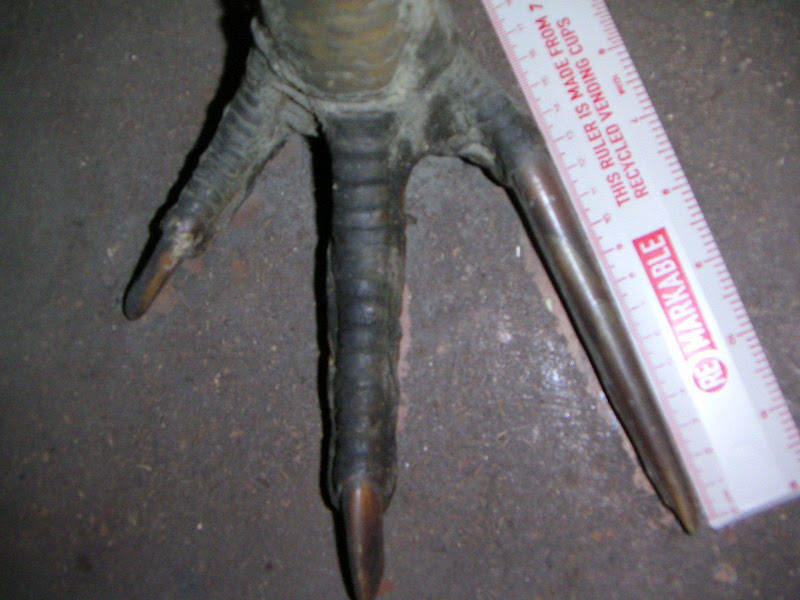
Cassowaries are very shy, but if disturbed, they can inflict serious injury on people and other animals.  On the inner of its three-toed feet grows a five-inch dagger-like claw that has the ability to disembowel people!  They deliver fast, powerful kicks to their enemys and can jump up to 7 feet high.  They mostly eat fruit.  These birds are quite territorial and have given zookeepers serious injuries.  Also interesting is that the females do absolutely nothing to help raise her chicks.  All she does is lay eggs and then she moves on.  The male is left to incubate the eggs for up to two months.  Once they hatch, he protects them for up to sixteen months, and then chases them off to live on their own.
 The Southern Cassowary’s inner claw can grow up to 5 inches.

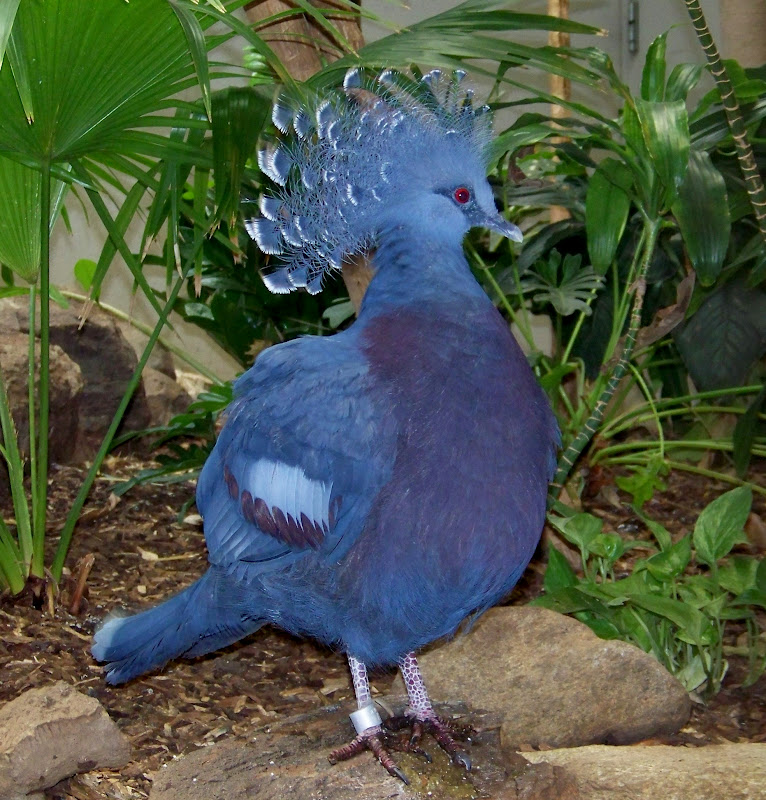
I saw a Victoria Crowned Pigeon for the first time when I visited the Saint Louis Zoo.  They are the largest pigeon species in the world and have a variety of blue and purple feathers, red eyes, and have a beautiful feather crest on their heads.  They are native to lowland and swamp forests of New Guinea and surrounding islands.
 There are 2 other species of crowned pigeons that look similar to this Victoria Crowned Pigeon.

As you can see, the diversity of birds is so vast!  Part of the World Bird Sanctuary’s mission is to maintain biological diversity on our earth so future generations can enjoy the same amazing animals.  Stay tuned next month for part 3 of Really Weird Birds!

Submitted by Sara Oliver, World Bird Sanctuary Naturalist

Tuesday, April 24, 2012

A New Friend

I’ve grown up with pets all of my life.  We’ve had dogs, cats, hamsters, fish, salamanders and frogs living in our St. Charles house all at the same time.

I’d had a pet of my very own before—a teddy bear hamster named Fuzzy—but considering I was a middle-school kid at the time, it was pretty impressive that I managed to take care of him.  Fuzzy lived to the ripe old age of four, and after him, I didn’t really think I’d have another pet of my own until I moved out of my parent’s house (which still hasn’t happened yet…).

However, the week before Christmas this past year, I came home after an evening of caroling to a big surprise…
Unbeknownst to me I was about to meet a new friend! 
Caring for birds has been part of my life since 2009.  I love working with the birds at World Bird Sanctuary, and it gives me great satisfaction to work with them every day.  Because I work so closely with birds on a daily basis, I never considered getting a bird of my own—after all, I have dozens of them at my disposal every day.  There are WBS staff members that share their lives with parrots.  From Cathy Spahn’s African Grey named Simon, right on down to Lisbeth Hodge’s Green-cheeked Conure named Jazz, many of the staff have opened their hearts to our feathered friends.  I certainly didn’t expect to count myself among them.

Apparently, my parents had other plans….

After caroling that evening, I wandered upstairs to go to bed… and there in my room was a large white cage sitting on my desk.  Inside that cage was a little blue and white Budgrigar  which many people call a parakeet.  I called downstairs to my parents, “Hey guys? Why is there a parakeet in my room?” My parents revealed him to be an early Christmas present, obtained from a breeder near our house. From the get go, I was enamored.  I decided to name him Mr. Bingley, after one of my favorite characters from Jane Austen’s Pride and Prejudice.

At first, he seemed overwhelmed by all of the big, scary humans who came to ogle him.  He would not step on my finger, and he did not like to come out of his cage at all.  He was also virtually silent.  I was worried for a while that he would remain scared of humans for a very long time… but after a week or so, he started to bloom.
 He's even accepted the family dog as part of his flock
Now I play music for him when I have to leave the house, and have discovered that he likes to listen to Mumford and Sons, as well as Jack’s Mannequin.  How do I know?  He tweets and chirps incessantly when songs by those two bands come on (of course, he could just be vehemently protesting these songs, but unless I learn how to speak parakeet, I’ll never know). 

Mr. Bingley started out very afraid of coming out of the cage.  But now, he sometimes won’t go back in it.  His flight feathers have grown in beautifully, and he loves to fly in circles around my room, chirping as he flies.  He also gets ‘call of the wild’ moments, when he chirps and whistles very loudly, and hops all over his cage.  He will also preen your fingernails if you hold them up by his beak. 
Mr. Bingley sitting on one of his favorite perches
But by far his favorite thing to do, now that the outside world isn’t so scary anymore, is to sit on my head or my shoulder while I’m on the computer.   In fact, at this very moment he’s perched on my head as I type this blog (allowing a bird to perch on your head or shoulder is not for all birds, and at WBS parrots only perch on our hands).

Though unprepared as I was for a pet of my own, I wouldn’t give Mr. Bingley up for the world.  He makes me smile, makes me laugh, and reminds me that happiness can come from anywhere… even a little ball of feathers.

Submitted by Emily Hall, World Bird Sanctuary Naturalist/Trainer

Sunday, April 22, 2012

May Events


Get outside!  World Bird Sanctuary is hosting several events in May.

Bring your friends and family to World Bird Sanctuary in May for outdoor family-friendly fun!

We have some wonderful fun and free events to celebrate the good weather and the beautiful creatures that share our neighborhoods with us.

International Migratory Bird Day
Join the worldwide celebration of birds! 

Be part of the worldwide celebration of migratory birds at World Bird Sanctuary's International Migratory Bird Day.  Learn about why it is important to protect migratory birds and their migration flyways:
·       Fun, free children's activities with prizes!
·       Meet naturalists at our bird feeding stations to learn bird watching and identification tips from the experts!   
·       Bird-banding demonstrations - take a tour to watch our field studies crew catch, band and release migrating birds (small fee for transport to the site)!
·       Keeper talks about the migratory species that call World Bird Sanctuary home.
·       Date: Saturday 5 May
·       Time: 8am - 1pm
Admission and parking: Free!

Spring Camera Day
Bring your cameras! 
Taking photos of our birds has never been easier.  Join us for our Spring Camera Day, when we place birds in natural settings and fly them from trainer to trainer.  Our naturalists position the birds with photographs in mind - no fences or perches to obstruct that perfect photo - just a beautiful bird posing for you!

You have to be a WBS Friend to gain admission to Camera Day.  If you are not already a WBS Friend you can join on the day for as little as $35!

Bring lots of film, data cards and enthusiasm.  Schiller's Camera and Nikon will be on hand to help you get the perfect shot!  Concessions will be available.
·       Date: Sunday 6 May
·       Time: 10am - 2pm
Admission: Must be WBS Friend - you can sign-up on the day!

Hey! There's Nature in My Woods!
Family-friendly guided nature hikes! 
Join us for a leisurely two-hour hike through our oak hickory forest to see what kind of nature is in our woods.  An expert naturalist will lead you on your hike - where you may see birds, mammals, reptiles and amphibians.  Learn about trees, rocks and who knows what else?  Each hike will be a new experience as the seasons change and we encounter different creatures.
  
·       Fourth Saturday of every month from April through October.
·       9am - 11am (registration at 8.30am)
·       $9 per adult; $7 per child
Reservations required - call 636-225-4390 ext. 0

Bring your family!  Bring your friends!  Bring your camera!  Bring your picnic!  And join us outside in May for fun family entertainment!

Submitted by Catherine Redfern, World Bird Sanctuary Naturalist/Fundraiser

Friday, April 20, 2012

World Eagle Day A Resounding Success

As World Eagle Day dawned on March 18th an early morning rain caused some anxiety among those who had worked so hard to produce this yearly event.

Thankfully, the clouds parted and the sun shone down upon us, warming things up to a balmy 82 degrees.  For World Bird Sanctuary, that’s the perfect scenario for a successful event – and that is exactly what we had!
The sound of clicking shutters was heard all day (Photo by Sandra Lowe Murray)
There were record crowds throughout the day, and our first three shows were so full that there was standing room only.  It’s not every day that you can see a bald eagle fly across a stage to land on a trainer’s glove.  What a sight!  Lewis, the Bald Eagle, did a fantastic job of flying.  Thanks to Lewis, and to Trina Whitener’s lively and educational “Eagles of the World” presentations, the eagle programs received rave reviews from the audiences.
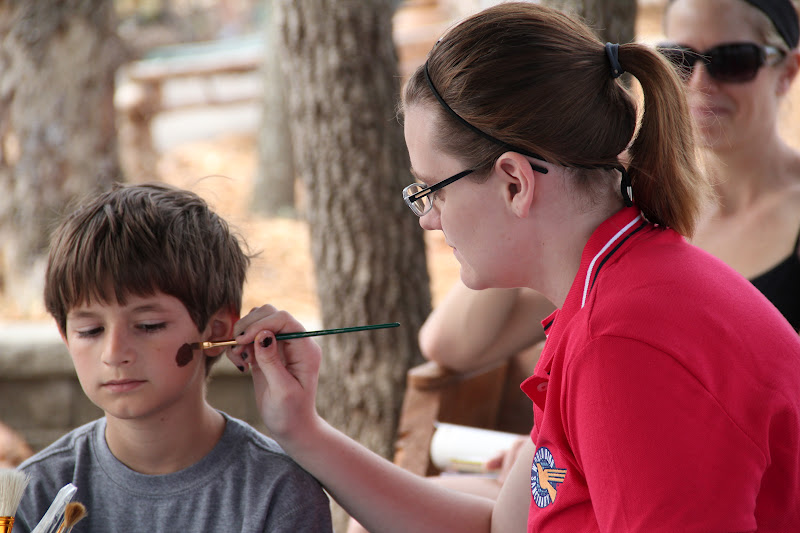
A young guest having his face painted  (Photo by Sandra Lowe Murray)
The youngsters enjoyed the day by attending the presentations, making eagle face masks at our craft table, trying their hands at our “Feed the Eagle” game, having their faces painted, building an eagle nest and checking out our Reading Room Library.
How often does a youngster get to build an eagle nest?  (Photo by Sandra Lowe Murray)
With the record crowds, our sales table and Café stayed very busy.  Our photo opportunity with Patriot, the Bald Eagle, was a huge hit and kept our photographer Gay Schroer snapping photos continuously throughout the day.
The line for the eagle photo op never stopped (Photo by Sandra Lowe Murray)  
All in all, World Eagle Day had its most successful year ever, thanks to our faithful volunteers and staff—but most of all, to every one of our loyal supporters who came out and participated.  We couldn’t do it without you!
Guests enjoying our new and improved exhibit line path (Photo by Sandra Lowe Murray)
We are looking forward to a busy summer season filled with more exciting events.
If you would like to stay up to date on when you can catch an event here at WBS, sign up to receive our email newsletter by entering your email address in the box on the right-hand side of this page. 

You can also become a WBS Sponsor, starting for as little as $35.00, and receive our Mews News newsletter tri-annually – full of events, updates, stories and our Traveling Talons schedule.

As always, for more information you can visit our home web page at www.worldbirdsanctuary.org

Submitted by Billie Baumann, World Bird Sanctuary Outreach Coordinator

Wednesday, April 18, 2012

Alaska Cruise: Day 6 - Victoria, British Columbia

The final day of our cruise found us at sea headed toward beautiful Victoria, British Columbia.
 Entering the port of Victoria, British Columbia
We would only be docked in this port from 6 pm until midnight.  This last port call would give those passengers who had not already taken a whale watching cruise the opportunity to do so.  There were a total of seven land tours offered here, most of which offered the opportunity to see this beautiful city in the evening.
 The beautiful Victoria skyline at night
Since we were headed back to Alaska to Kodiak Island after we docked in Seattle, my husband and I opted not to go ashore on this evening.  We were faced with the daunting task of completely repacking everything (including the souvenirs we had picked up along the way) so that we could leave some items in storage in Seattle.  We would be spending five days in the backcountry of Kodiak Island sitting on a riverbank bear viewing, so we would need a completely different type of clothing and gear than what we had packed for the cruise.  Plus—since we were flying in by bush plane the luggage we could take was severely limited.
Butchart Gardens from the Wikipedia website
Those that went ashore in Victoria gave glowing reports about what a beautiful city it was.   A good many went to Butchart Gardens, which apparently was magnificent in the evening.  Others took this last opportunity to go whale watching and still others went sightseeing in the city by horse drawn trolley, or attended an Empress high tea, or took an Ale and Brewery tour.

Perhaps the next time we will get to see Victoria.

So, now that you’ve had a taste of what Alaska cruising holds, pack your bags, get your passports, put down your deposit, and come cruise with us this fall. 

Details – Alaska  Explorer Cruise 2012
•            Escorted by Walt Crawford, Executive Director, World Bird Sanctuary
•            Aboard Holland America MS Oosterdam
•            Roundtrip itinerary – Seattle, Ketchikan, Juneau, Sitka, Tracy Arm/Sawyer Glacier, Victoria, BC, and return to Seattle
•            Prices start at only $1,168 (inside cabin); $1488 (ocean view); $1,888 (verandah)

Price Includes:
•            7-day cruise accommodations
•            Onboard meals & entertainment
•            Special lectures by Walter Crawford
•            Visit to the Raptor Center in Sitka
•            Private cocktail party onboard
•            $25.00 per person Shipboard Credit
•            All taxes and government fees
*            Also included is a $50 donation to World Bird Sanctuary

FOR RESERVATIONS OR FURTHER INFORMATION
Contact Cathy Robinson at ext. 114 (314) 439-5700 or (800) 527-1059

 Submitted by Gay Schroer, World Bird Sanctuary Volunteer/Photographer

Monday, April 16, 2012

Alaska Cruise: Day 5 – Ketchikan

Day 5 of our World Bird Sanctuary 2009 Alaska Cruise found us exploring the Port of Ketchikan for our last full day ashore. 
 Dockside in Ketchikan
This port had a total of 39 land tour options offered by Holland America Lines.  So many to choose from—so little time!  After poring over the long list of tours we opted to see Totem Bight State Historical Park for it’s beautiful setting and awesome selection of native art, as well as a tour of the Deer Mountain Eagle Center and Salmon Hatchery.
 Our tour guide regaling us with local stories & native lore
On our way to Totem Bight our very knowledgeable and personable tour guide gave us a brief history of Ketchikan, as well as pointing out the unusual architectural style—buildings are built on steep hillsides and most of them have at least one side perched atop wooden pilings.  Some of the homes and apartments have as many as 300 steps to the front door!
 We joined Walter and his fiancee Mary Elise for the day
We spent the next few hours walking through woods lined with beautifully restored and/or duplicated totem poles.  In the early 1900s many of the native people moved to communities where work was available, leaving behind their villages and totem poles.  These were soon over-grown and reclaimed by the forest, and many of these beautiful works of art were eroded by time and weather.  In 1938 the U.S. Forest Service, using Civilian Conservation Corps (CCC) funds began a program of reclaiming and restoring or duplicating these beautiful relics.  They employed some of the older Tlingit natives who still remembered how to make the necessary tools and paints and knew how to carve the totems in the old way.
 Note how the clan house front resembles a face--a stylized Raven
One of the most interesting points on the tour is a reproduction of a native clan house, which could have housed 30-50 people—usually members of the same family.  The corner posts and supports were carved totems and the workmanship was incredible.
 Interior of the clan house
Our next stop after Totem Bight was the Deer Mountain Eagle Center and Salmon Hatchery.  This facility was originally operated by the State of Alaska’s Department of Fish & Game.  The Ketchikan Indian Community took over management of the facility in 1994, and in 1998 they expanded it to include the current Eagle Center.
 Carved sign for the Tribal Hatchery and Eagle Center
The Eagle Center currently has a collection of ten resident birds, which they use to present educational programs similar to those offered by the World Bird Sanctuary.  The tour was unique in that it focused on the cultural significance of the various species in Native American tradition and lore.

My husband was fascinated by the Salmon Hatchery tour where they had many exhibits showing the evolution of a Salmon from egg to adult.  It was really interesting to see the Salmon trying to swim upstream in a stream with simulated rapids and boulders—otherwise known as a fish ladder.

Ketchikan is known as the Salmon fishing capital of the world and one of the land tours offered was a sport fishing trip.  Had we been headed directly home after we left the cruise ship I’m sure my “in house fisherman” would have managed to sign up for this option.  However, upon our return to Seattle we would be headed back to Alaska for a five-day bear watching adventure and some Halibut fishing.  We felt we had to draw the line somewhere.
Dinner was accompanied by entertainment presented by the dining room staff 
Dinner on the cruise ship this night was accompanied by a show in the Grand Dining Room presented by the dining room staff (including chefs, waiters, busboys, etc.)  I can’t say enough about the staff and crew on this ship.  They were unfailingly helpful, accommodating, always pleasant and eager to please.

If you would like to make a reservation to join us on the World Bird Sanctuary’s Alaska Cruise September 9-16 Click Here for more information.

Submitted by Gay Schroer, World Bird Sanctuary Volunteer/Photographer

Saturday, April 14, 2012

There's Still Time to Enter!

Are you a writer?  A poet?  A sculptor?  A photographer?  A musician?  A painter?  A singer?  A wood carver? 


Do you have a budding artist in your household?  

Do you appreciate birds?  Have you ever wondered, "What do they do all day . . .?" as they fly overhead or forage in the trees?


Enter our "What Do They Do All Day . . . " Creative Contest?

We are accepting entries in any creative medium of your choice (as long as it conforms to the size and format specified on the entry form) in four age groups:
6 - 9 years old
10 - 13 years old
14 - 18 years old
19 years old and over

You stand to win some unique prizes!  There will be five finalists in each age category.  From these 20 finalists, judges will select an overall winner.  Each of the 20 finalists will be awarded with a prize, and will have their entries exhibited at World Bird Sanctuary on Saturday, May 5th, as part of our International Migratory Bird Day celebrations.  Prizes include:

1st prize - there will be one overall First Prize Winner

  1. A photo shoot with Marian Brickner, renowned animal photographer.  To find out more about her beautiful body of work, click here to visit her website.
  2. An Adopt-a-Bird Subscription for one year, up to a $200 value.
  3. A 4" x 6" photograph of the artist and his/her entry at the final exhibition, taken by Marian Brickner.

2nd Prize - there will be four Second Prize Winners - one from each age category

  1. An Adopt-a-Bird Subscription for one year, up to a $150 value.
  2. A 4" x 6" photograph of the artist and his/her entry at the final exhibition, taken by Marian Brickner.
3rd Prize - there will be fifteen Third Prize Winners - for each of the remaining 20 finalists in the competition
  1. An Adopt-a-Bird Subscription for one year, up to a $75 value.
  2. A 4" x 6" photograph of the artist and his/her entry at the final exhibition, taken by Marian Brickner.

Entries must be received by 5pm on Sunday, April 22nd 2012 (received via mail by this time, or hand delivered by this time), and must conform to the rules of the competition (on the entry form) to be eligible to enter.

Download an entry form here, or pick one up at World Bird Sanctuary's Visitor Information Center or Nature Center!