Sunday, September 23, 2012

Cooper’s Hawk Kids – Final Update

If you've been following the WBS blog you probably know the story of the pair of Cooper's Hawks who courted and nested within sight of our home.
Here's the female Cooper's Hawk (mama)

...and here's the male (papa)
In my last Cooper's Hawk blog post I described the fascinating (and sometimes hilarious) antics of the three fledglings that resulted from that mating.  (To see the first two chapters click on "Cooper's Hawks" in the list on the right side of this page.)  

Following is the final chapter in the education of the Cooper's Hawk kids.

7/18 – Today my husband saw one of the young Cooper’s Hawks chasing a Dove through the yard.  I think they’ve finally figured out what they’re supposed to hunt.  He didn’t know if it was successful, but it’s a start.

7/21 – I haven’t seen or heard the hawks for several days now.  Perhaps they’ve moved on to more productive territories.  I think they may now be hunting for themselves, since I haven’t heard them hunger screaming in the early morning lately.

7/22 – I hadn’t seen the hawks at the birdbath for several days, but finally saw one of them in a neighbor’s yard this afternoon.

Another neighbor told me that he saw one of them in his birdbath one day, and then shortly thereafter saw it lying prone in the dirt near the birdbath with it’s wings outspread. Our raptors at WBS frequently do this when they are sunbathing.  This behavior is called “pancaking”.   Since the temperatures are in the 100’s I can only guess that perhaps this bird was trying to dry its wet feathers after its bath.

7/23 – The Hawks are back from wherever they’ve been the last few days.  I didn’t see them early this morning, but the yard was absolutely quiet, which tells me they were somewhere in the vicinity.  All the songbirds are either hiding or sitting tight and not calling.  I’ve come to realize that this means the hawks are on the hunt. 
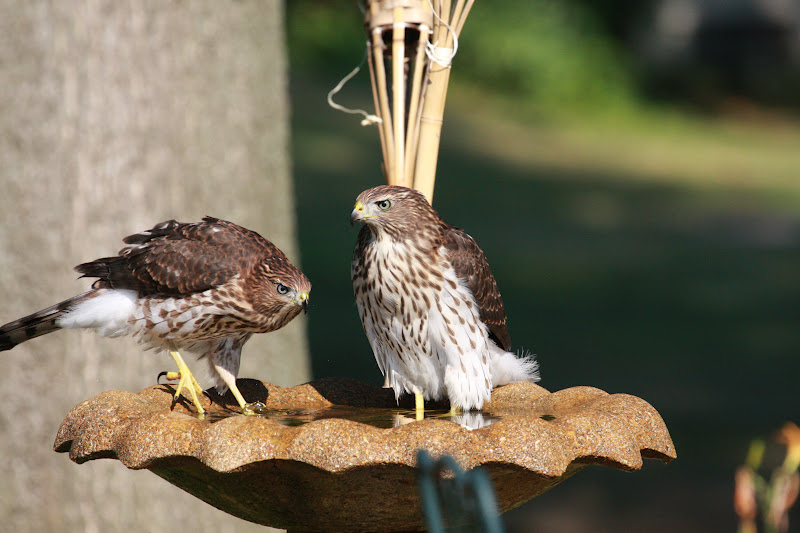
They zoomed by me on their way to the birdbath
This afternoon as I was out in the back yard two of them whizzed by within inches of my head and then landed on the birdbath.  The temperature was 106° and I’m sure they were desperate to cool off.  They usually just stand in the water.  By cooling off the blood supply to their feet it lowers their body temp.  They stood in the birdbath for about 20 minutes and hunger screamed for mom who I’m guessing is trying to wean them.

I haven’t seen the smaller male, but he is usually more wary than the two females.  According to Jeff Meshach, Director of the World Bird Sanctuary, there is good reason for his wariness.  Jeff says …”The male is wary for good reason...if his sisters are hungry enough (and you can bet they are with mom and dad hardly feeding them anymore) they will make a meal of him.  Too much size disparity between the sexes...boys can and will get made into a pellet.”

7/27 – Again, I hadn’t seen or heard the hawks for several days, but this morning as I was walking out to my van to take my granddaughter to Day Camp two of the hawks zoomed overhead and into one of the oak trees in pursuit of a smaller bird.  I think they’ve finally learned to hunt for themselves!
Any small creature who becomes the object of this fearsome stare had best beware
8/15 – I haven’t seen our hawks since that last exciting chase.  I heard one calling from across the road one day, but no sightings since then.  Their visits are becoming less and less frequent.  My guess is that they’ve now become self-sufficient and are claiming their own territories.

Even though I miss watching their antics every day I am thrilled that they’ve survived those first perilous months when so many young birds succumb to hunger, predators, drought, storms, injury, etc. 

If we’re lucky they or their parents will use this area to nest again next year.

Submitted by Gay Schroer, World Bird Sanctuary Volunteer/Photographer


Friday, September 21, 2012

Field Studies Report – July 2012


During the 2012 nesting season July has been the least productive month of the study.

The constant heat and drought have caused many of the birds to abandon their eggs. The rate of success is very meager if any, and the outlook for the remainder of the study is dismal at best. Still the research goes on and I can only keep hoping for a break in the extreme weather conditions.
 Photo by Adam Triska
For July there were a total of 28 active nests, with 24 of them being Eastern Blue Bird nests and 4 House Wren nests.  Of the 109 eggs present, 88 were Eastern Blue Bird eggs and 21 were House Wren eggs.  Only 25 Babies were hatched successfully and 15 were banded. Four of the banded babies were lost due to the extreme weather conditions, so only a total of 11 babies fledged during July. The total of banded birds for this year is 293, and the overall total of birds fledged (banded or not) is still to be determined, but I would suspect the number will be in the ballpark of 350 birds.

The weather, as we all know, has been very unforgiving this month for the birds and also me.  In my weekly route I make note of temperature and other weather related information.  I recorded 12 days that were over 100° F.  This extreme heat combined with less than 1 inch of precipitation has brought the nesting season almost to a stop. From July 10-31 only 2 babies were banded, and this trend will most likely continue.

This month 10 nests and over 45 eggs were lost to predators and the elements. I expect that the number of birds lost will only increase before the nesting season is over if the extreme conditions continue.  Fear not, though!!  Nature continually throws curve balls at its residents, and the residents improvise, adapt and overcome.

Submitted by Adam Triska, World Bird Sanctuary Field Studies Coordinator


Wednesday, September 19, 2012

Enjoy A Fall Day In The Woods


Hey! There's Nature in My Woods!
Family-friendly guided nature hikes! 

Join us for a leisurely two-hour hike through our oak hickory forest to see what kind of nature is in our woods.  An expert naturalist will lead you on your hike - where you may see birds, mammals, reptiles and amphibians.  Learn about trees, rocks and who knows what else?  Each hike will be a new experience as the seasons change and we encounter different creatures.

·       Fourth Saturday of every month from April through October.
·       9am - 11am (registration at 8.30am)
·       $9 per adult; $7 per child
Reservations required - call 636-225-4390 ext. 0

Bring your family!  Bring your friends!  Bring your camera!  Bring your picnic!  And join us outside in May for fun family entertainment!

Monday, September 17, 2012

Cherry


It is with a sad heart that we must inform staff, volunteers and visitors that Cherry, our seventeen year-old Pied Crow, passed away this season from the infirmities of old age after a very long and healthy lifetime

Cherry was the first Pied Crow I worked with at the Sanctuary, and at first I didn’t like the experience.  She was clever and quick and it was always a challenge to keep one step ahead of her.   She could always manage to stash her food in places that you could not find, and if she did not want you in her space, she would poke with her beak until you left.  All and all, not a bird I was expecting to like or come to enjoy working with at all.

Early in her life she had to have 2 of her left foot toes amputated because of a strange fungal growth, but the loss never slowed her down.  As far as we trainers were concerned, the “special foot” gave her even more character.

Even though Cherry was not the most social of our corvids (a general name for crows and their kin), those she did welcome into her “flock” loved and cherished her.  She made affectionate calls to her “flock” in the morning, she built state of the art sisal and stick nests for us and presented us with bountiful gifts of tasty treats.

Over time her inquisitive and mischievous nature won me over.  She was very curious and loved digging for insects in her outdoor enclosures.  She was the best crow by which to gage the training skills of new interns or volunteers because Cherry loved to try to turn the tides and train her new handlers.  She was very good at tricking newbies into doing most of her behavior for her, usually by dropping whatever object she was supposed to be transporting at the time.

An expert recycler and excitable donations collector, Cherry seemed to have a fantastic work ethic, striving to overcome all obstacles.

She wormed her way into my heart and she will be missed dearly.  Thank you Cherry for being the best trainer of people I have ever known, and teaching me to never judge a bird based on the first impression.

Submitted by Leah Tyndall, World Bird Sanctuary Naturalist/Trainer

Saturday, September 15, 2012

Field Studies Report – June 2012

The month of June was very hot and at times humid, but this didn’t stop the birds! 
The blistering heat meant we were out in the field early
This last month I had the delight of having the WBS interns out with me to help with the study.  The interns got to see most of the developmental stages of the offspring, and even helped with banding some birds.  The second clutches, or second nesting cycle, of the season are wrapping up and the season is more than halfway over!

The weather this month has been the biggest battle thus far in the study, but early start times and plenty of water has given some relief.  In the weeks to come it will be interesting to see the impact that the heat and the lack of rain will cause to the survival rate of the offspring in the study.  With this said we still had a fairly productive June.

Having the interns out helping with the study really made a lasting impact on them, as well as me.  It was great to experience the joy of teaching and watching them band birds.  We accomplished more than just banding birds though; there were many encounters with the local area wildlife, conversations with landowners, and back breaking hikes.  In all I think that all of them walked away with a good idea of what this part of WBS field studies is about.

In the study this month there were 42 active Eastern Blue Bird and House Wren nests.  In total 193 eggs were counted and 123 of the eggs hatched.  For the month of June we ended up banding 95 birds, and 115 fledged.  The fatality numbers have increased this month largely in part to snakes preying upon the nests.  There were 6 nests raided and around 20 eggs/babies were lost.  There are many predators of baby birds and it can only be expected that some will fall victim to predators.

Now that July is here we are in the beginning of the home stretch!  The study for this year will be over on August 15, so yes, we’re almost there!

Submitted by Adam Triska, World Bird Sanctuary Field Studies Coordinator

Thursday, September 13, 2012

Owl Prowls Are Back--Don't Delay!


Now Taking Reservations for This Seasons Owl Prowls!

On August 1, 2012, we opened registration for the 2012 – 2013 Owl Prowl Season. 
 Carmelita - a 30-year old Great Horned Owl who came to us as an orphan in 1982

Why is this news?  Last season we had to turn down many registrations for months, as they sell out – completely, and quickly.  Owl Prowls won’t begin until November of this year, but we are already reaching close to maximum capacity for a few of those dates.  Don’t panic – we still have several dates available and have added a few more opportunities to join us.
 Xena - WBS's 13 year old Eurasian Eagle Owl is a celebrity for her appearance in the Tournament of Roses Parade

Not sure what an Owl Prowl is all about?  Many Missouri owls are very vocal throughout the fall and winter as they establish territory boundaries.  This makes for a great opportunity to try and hear a wild owl hooting, to learn different species calls and to try and call an owl for yourself.
Join us for an Owl Prowl and you will have the chance to do just that. 
 Emerson - a Eurasian Eagle Owl - a member of the world's largest owl species is still a youngster at 2 years old

Your adventure will start inside of our Nature Center, where one of our Naturalists will give an educational presentation about several different species of owls.  Not only will you have the opportunity to see multiple species of owls up close, but you will experience their silent flight demonstrations as they fly just inches over your head.
 Timber - a red phase Eastern Screech Owl - was received at WBS in 1999.  Exact age unknown   

After the presentation you will be led on a hike where you will have an opportunity to work on your new owl calling skills.  Hopefully, you’ll get to hear one of our resident wild owls hoot back.
 Tigger - WBS's Tawny Owl - is now 20 years old.  His species is native to Britain and much of Europe

2012 DATES:
11/2  (sold out), 11/10, 11/16
12/1, 12/7, 12/15, 12/21, 12/29

2013 DATES:
1/4, 1/12, 1/18
2/1, 2/8, 2/16, 2/22, 2/23
3/1, 3/9

Owl Prowls start at 7:00 pm and will last 1.5 – 2 hours
Cost:  $9 for adults;  $7 for children under 12
Group rates available for groups of 10 or more
WBS Friends and Adopt-A-Bid parents get a 10% discount!
Reservations required.  Please call (636) 225-4390, xt. 0, to register with MC or Visa
Spaces are limit

Tuesday, September 11, 2012

Bald Eagles in Rehab


We recently received two Bald Eagles in the Wildlife Hospital.  Not an unusual thing for a rehab facility that specializes in injured raptors, you say?  Read on…
One of the two luckiest Bald Eagles in the state of Missouri
These two birds were brought in by different sources and were found on different sides of the state.  One of the things they both had in common was that they each had a broken wing and were starving.  The other thing they had in common was that the broken wing had healed.  In both cases the wing had healed as straight and as well as if our vets had set the wing themselves.

This is “lightning” or “lottery” odds we are talking about!

A bone takes six weeks to heal, and these birds must have found enough food near them to stay alive while they were grounded.  Then they would have had to stay still and the two halves of the bone would have to be in the right place so that it could heal properly.  Against all these odds, something must have worked in their favor. 

These eagles are flying perfectly now.  After spending some time in our rehab enclosures and being given the proper nourishment, they are now fat and well fed.  The best news is that we have now scheduled their return to the wild.

The first was released in early August and the other is scheduled to be released in October.  I hope some of their luck rubs off on me-I’m going to get my lottery tickets tonight!

Submitted by Joe Hoffmann, Sanctuary Manager, World Bird Sanctuary


Sunday, September 9, 2012

Buy a Brick In Time for Open House


Have you been meaning to purchase a WBS engraved brick to honor someone special, but just have not gotten around to it?

If so, now is your chance to purchase that brick and see it installed just before our upcoming Open House on October 20 & 21.  All engraved bricks will be installed on the steps, landings, and seating areas of our amphitheater.  The available spaces on our steps are nearly completed.  These premium spaces are the ones that everyone sees when entering our amphitheater.

Don’t delay--final orders must be in by September 26 in time for us to submit the order, have the bricks engraved and shipped, and then have them installed. 

After this Fall installation we will not be ordering and installing the next batch of bricks until our Spring installation in March.

So to honor that special someone, memorialize a loved one who has passed on, remember a faithful companion, or just give an inspiring message to all who see your brick, be sure to order before 9/26.

To purchase your brick Click here for the ordering page on our website, or if you prefer to pay by check call 636-225-4390, XT 0 and tell the person answering that you want to order a brick.

Then come visit your brick on Open House weekend—or at any other time if you can’t make it to Open House.


Friday, September 7, 2012

Save a naturalist! Sponsor a glove!

How...or why?...would one sponsor a glove you may ask?  Well here's the answer....

World Bird Sanctuary’s Education Department and behind-the-scenes areas are in need of new Kalems, or bird handling gloves, named after the gentleman who originally made us these gloves.  Jim Spohn at Traditions Glove took over Mr. Kalem’s business, and Jim now makes our gloves.
 The powerful feet of our majestic Bald Eagle can inflict serious damage to a glove
Birds of Prey have very strong feet with sharp talons.  We wear Kalems when we handle birds to protect our skin from potential injury.  The Kalem is made up of several thick layers of supple leather, with additional layers padding areas where we need protection most from the talons.
 Even the feet of small American Kestrel can do significant damage
These gloves last for many years.  They are made very well and we take good care of them. Unfortunately over the years they get worn and holes develop.   Holes in gloves can be a major safety issue.  A bird could get their talon stuck in the glove potentially resulting in the bird getting injured.
The talons of a Barn Owl are as sharp as needles
The number of programs we present is growing every year, along with the number of volunteers and interns we have at any one time.  This is good news!  However, when we have many things taking place on the same day, we find that we are quickly running out of gloves that are available to use when handling birds.  This slows down volunteer and intern training.
 The talons of Max, our Tawny Eagle, have unbelievable gripping power
Here's where you come in!  We are looking for funding to help us to purchase new gloves.    We have not made a new Kalem purchase in a number of years, and they are very expensive.  We need 4 new gloves for our Education & Training Center and Eagle Training Center, 10 new gloves for the Education Department and 4 new gloves for our Wildlife Hospital.   At a cost of $72 each, this comes to a whopping $1,296! 
 You can sponsor a pristine new Kalem glove like this one
If you'd like to save a naturalist and sponsor a glove, please contact Catherine Redfern at credfern@worldbirdsanctuary.org or call 636-225-4390 ext. 102.  Or make your donation here via PayPal and specify it for a glove purchase.

Each glove donor will receive a photo of their adopted glove being worn by a grateful naturalist!

Submitted by Cathy Spahn, Naturalist

Wednesday, September 5, 2012

New Digs!

If you haven’t been to Grant’s Farm yet this season, then you are missing out on World Bird Sanctuary’s new bird of prey display.
 Sanibel, the Bald Eagle, in front of the visitors' viewing platform
World Bird Sanctuary has worked with Grants Farm for twenty-five years, flying birds of prey in their Animal Encounters shows and educating visitors about these majestic creatures.  Our weathering area (falconer’s term for an area where raptors on jesses are kept for the day) has always been behind the scenes and could only be seen by the public when the trams went by.  I don’t know how many children or adults alike, I have heard in the past excitedly shouting “An Eagle!” or “Look, it’s an Owl!” as the tram rolled by.
 Prius, the Gyrfalcon/Peregrine Falcon Hybrid in front of the waterfall
Even though I do miss hearing the tram-loads of visitor’s exclamations, I have to say that our new display is quite the improvement.  Now instead of seeing our birds for merely a fleeting moment as the trams roll by, visitors can view the birds at their leisure and take all of the pictures that they want.  There’s a water feature that makes a great backdrop, as well as some mature trees.
 Carmelita, the Great Horned Owl, in front of a very natural looking cliff
With the larger area, we were able to increase the number of viewable birds to seven instead of five.  Most of the birds on display are native to the United States, including a Great Horned Owl, Harris’ Hawk, Barn Owl, Bald Eagle, Red-Tailed Hawk and a Gyrfalcon-Peregrine Falcon Hybrid.  The only non-native species is the spectacular and colorful Bateleur Eagle, which is native to Africa.
 Mars, the Red-tailed Hawk, with a waterfall as a background
I hope that you have a chance to visit the new display area and stay for a show.  The Animal Encounter shows are free from Friday – Sunday at 10:30 am, 12:00, 1:30 and 3:00, from now until 4 November.  You’ll have a chance to witness the spectacular flight demonstrations of our Harris’ Hawk and Barn Owl.  Hope to see you there!

Submitted by Billie Baumann, World Bird Sanctuary Outreach Coordinator

Monday, September 3, 2012

Avian Training Workshop - Register Early-Save $100

If you've been considering attending the World Bird Sanctuary Avian Training Workshop in November there's still time to take advantage of the early registration bonus!  Save $100 by registering before October 1st!

What is an Avian Training Workshop you may ask?
Learn all about weight management and weighing the birds
The WBS Avian Training Workshop is an intensive 4-day workshop which covers all aspects of housing, training, feeding and caring for birds of prey, parrots, corvids, and many other species.  The workshop includes both classroom and hands-on training.
Actually do a gross necropsy on a bird
Subjects covered in the classroom section include:  
*  Establishing your own program--permits, insurance, facilities, staff & volunteers
*  Working with and training your bird--manning and positive reinforcement, desensitizing
*  Choosing the correct species to work with
*  Transportation--crates, permits, driving, flying, shipping
*  Housing--mews, jumpboxes, A-frames, flight cages, climate, hotwiring enclosures, substrates
*  Perch types--bow, platform, screen, etc.--which perch works best for which species
*  Diets--food types, frozen vs. live, storage, prep, raising food colonies, vitamins
*  Training your birds for flying--weight management, base weights, target weighs, flyer food
Learn to fly a Harris' Hawk or Barn Owl
Everybody's favorite--the hands-on section:
Our staff believes the only way to learn is through the hands-on experience of doing things yourself.  At our workshop you will have the opportunity to actually do the following:
*  Make jesses, anklets, leashes
*  Practice imping feathers
*  Experience coping and trimming of a raptor
*  Participate in simple public speaking games and learn how different elements make you a better public speaker
*  Fly a Harris' Hawk and/or Barn Owl with WBS staff
*  Help train a new behavior with a White-necked Raven (continues throughout the workshop)
*  "Be the Bird" in our training game
*  Participate in emergency medical care and do a gross necropsy on a raptor
Learn about some of the techniques used in our hospital to treat sick or injured birds
The workshop also includes an extensive tour of WBS' facilities and opportunities to see birds and housing up close.

RESERVATIONS REQUIRED.  Workshop has a minimum of 10 participants and a maximum of 20.

WHEN:  Thursday, Nov. 1st through Sunday, Nov. 4th
EARLY REGISTRATION:  Sign up by October 1st - Cost - $650
LATE REGISTRATION:  Sign up after October 1st - Cost - $750

$100 non-refundable deposit required by October 1st for early registration, balance due by October 15th.

Registration fee includes lunch each day.

Transportation to and from St. Louis, hotel accommodations and breakfast & dinner are the responsibility of each participant.

To download a registration form CLICK HERE

Further questions?  Contact Teri Graves, 636-225-4390, ext. 0 or email workshop@worldbirdsanctuary.org


Saturday, September 1, 2012

Really Weird Birds Part 6: International Vulture Awareness Day


Since International Vulture Awareness Day is this weekend, in this episode of Really Weird Birds, we will take a look at some weird vultures!  Vultures are unusual and gross birds to begin with, but some are just extra strange. 

First up, the Lammergeier, also called the Bearded Vulture, is native to mountainous regions from Europe  through much of  Asia and Africa.
 Bearded Vultures like mountainous areas, sometimes living as high as 25,000 feet.

Many people know that vultures are scavengers and eat the meat of dead animals.  But the Bearded Vulture will land at the skeletal remains of an animal and have a feast!  Yes, this vulture is happy to eat just the bones! 

Bone marrow is a nutritious and life-sustaining food source for Bearded Vultures, and it makes up 85-90% of their diet.  In fact, to get to the marrow in very large bones, while carrying the bone with their feet they will fly high over a rocky area and drop the bone, shattering it on the rocks.  They will then just swallow the shards not bothering to extract the marrow.  They let their stomachs do the work.  Their powerful stomach acid, with a pH of 1 (the same as battery acid), dissolves the bone.  The Bearded Vulture has a strange but excellent strategy of obtaining nutrients that are inaccessible to most other animals.

Next in our line-up is the Palm-nut Vulture, found in forests and savannahs across sub-Saharan Africa, usually near water.
 The Palm-nut Vulture is the smallest of the Old World Vultures.

Unlike other vultures, this one is omnivorous…mostly vegetarian, in fact.  Their favorite food is the fruit from oil palm trees!  They will hang upside-down underneath the fruit, pull it off with their beak then hold it in their feet to eat it.  Sometimes they will also eat small vertebrates and invertebrates such as fish, crabs, amphibians and mollusks.  Rarely have they been witnessed at the scene of a dead animal. 

Our next candidate, the Egyptian Vulture, performs a very interesting behavior.
The Egyptian Vulture has a wide breeding range from southern Europe to northern Africa east to western and southern Asia.

This is a vulture that has figured out how to use a tool to help obtain a delicious meal. For example, if they find an ostrich egg, the shell is too strong for them to break without help.  An Egyptian vulture will pick up a stone in its beak and repeatedly throw it at the egg until the shell cracks and breaks.
 Osiris, WBS’s Egyptian Vulture, demonstrating how to break an Ostrich egg
 
Vultures are not usually considered handsome, but our final candidate, the King Vulture, is unusual because of its beautiful coloration!  They have the most awesome color arrangement on their heads compared to any other vulture. 
 King Vultures are found in South America.

King Vultures have a variety of colors on their head: red, orange, yellow, blue, purple, black.  In addition, the majority of their body is mostly white with a light rose tint, very unlike the other vultures in the New World, which have mostly very dark feathers. Their powerful hooked beaks are expertly adapted for ripping through tough carcasses.  Other scavenger birds give way when these guys arrive at a dead animal.

To learn about the resident vultures at the World Bird Sanctuary, the threats facing vultures all over the world, and what you can do to help, visit us on September 1st for our celebration of International Vulture Awareness Day!

Submitted by Sara Oliver, World Bird Sanctuary Naturalist

Thursday, August 30, 2012

International Vulture Awareness Day Is Here!

It's International Vulture Awareness Day...in just two more days!

Celebrate Vultures from around the world!

Visit World Bird Sanctuary this Saturday, 9/1, and take part in an international celebration of all things vulture, at International Vulture Awareness Day!

Vultures and condors around the world face threats and persecution.  World Bird Sanctuary joins conservation organizations around the world to bring vultures front and center on this special day.

*  Meet vultures from North America, South America and Africa!
*  Meet Dorothy, a live Andean Condor!
*  Free-flight shows featuring live flying vultures!
*  Free fun kids activity center
*  Gifts and souvenirs on sale

Date:  Saturday, September 1st, 2012
Time:  10am - 3pm
Admission & Parking:  Free!

International Vulture Awareness Day is Sponsored by Ameren Missouri


Eeew!  Vultures are gross!  But we need them the most!  Learn why at International Vulture Awareness Day!

Tuesday, August 28, 2012

Meanwhile . . . back at Grant's Farm . . .

As a follow-up to my first blog, I wanted to write about my experience working at Grant’s Farm and the various things I came to learn about preparing for an animal show with birds of prey.

The Animal Encounter shows started at first on weekends-only in April.  From May until August they are every day except Mondays.  There was a lot of preparation that needed to be done before the first show. The things I needed to get set up seemed like an endless list, and Billie Baumann (she does the shows on Tuesdays when I'm off) was great at helping me get everything ready for the birds.

To name just some of the things we needed to gather to get started at Grant’s Farm, there were; cleaning supplies, newspapers, water bowls, a stepstool, a weighing scale, a bag for collecting molted feathers, sisal rope for wrapping bow perches, bird crates (6 plus 2 for the eagles),  gloves (casting and nylon) and my uniforms. The people at Grant’s Farm did a great job building the special, indoor perches for our seven birds in the zoo barn (where I had to be aware of the temperature changes; a heater kept it above 50 degrees in the spring and two large fans are kept on throughout the summer).

For the first time ever the birds in the show, and even a few others, are on display in a special exhibit.  The Grant’s Farm people prepared the exhibit area with new bedding (wood chips), a really nice weathering sign and new impressive-looking personalized signs for the birds (these signs have both information about the birds and pictures taken of the birds themselves). They also got a new pump for the waterfall in the exhibit after the old one stopped working.
Grant's Farm exhibit area
To be ready for the shows, Billie and I had to work with and train both of the flying birds which turned out to be quite an experience. Stetson (a Harris Hawk) was really grumpy from being taken out of free loft and Riley (a Barn owl) was unmotivated and distracted. Both received special training and we spent a lot of practice time with both birds. It seemed to take a long time just to get Stetson to jump from glove to glove. Now Riley flies great in the shows and Stetson has only an occasional wrong flightJ.

Although, we recently had to change Stetson’s routine when he began showing very little interest in flying. Instead of placing his rewards for flying on top of the tree perches on stage, I’ve started placing them in plastic cups attached just behind both of the perches. This now seems to keep his interest, because every reward is a surprise.

It was difficult in the beginning learning to change jesses of the flying birds. The flying birds have a specific pair of “flying” jesses used for their safety if they should fly off.  Now I am able to avoid their beaks and feet as I change the jesses. Both birds also got reward tags in case they should be lost.

After getting the script for the shows, it was just a matter of making a daily schedule.

Maintaining the health of the birds is of course another very important aspect of working at Grants Farm. Weigh and rejuve day is fun when avoiding being pecked or bitten.

Maintaining Riley and Stetson’s flying weights keeps them food motivated and also took practice using a formula for figuring the amounts of food they get. Both Mars (Red-tailed hawk) and Carmelita (Great Horned owl) are older birds and both had to take some time at the rehabilitation hospital; Mars was put on antibiotics for a sinus infection and Carmelita had her eyes looked at for what was said to be a progressive age-related condition (Carmilita was hatched in 1982!).

Prius (a Peregrine Falcon/Gyrfalcon hybrid) had to have her tomial tooth (a special beak point that only falcons have) filed and each of the birds at one time or another have been looked at for talon and beak trims (birds continually grow their talons and beaks, and in captivity don’t wear them down as much as they would in the wild).

At Grant’s Farm, I had to learn the specific behaviors of each of the eight birds taken there. Both Bald Eagles utilized in the shows, Sanibel and McGwire, sometimes try to fly off the glove. McGwire was worked with behind the exhibit area.

It probably shocked many, and it alarmed me at first, when I saw Carmelita lying flat with her wings spread on the ground. I’ll always remember a woman saying something like, “Your bird is dead.”   Carm was actually just fine.  This was Carm’s behavior when sun bathing.

The response from the public has been great and I love working with each of these birds, which includes Riley, Stetson, Prius, Mars, Shadow (Bateleur eagle), Carmelita, McGwire and Sanibel. I also can’t forget the two eagles kept in our eagle exhibit, Murphy and Largo.

People are always commenting that I must love my job and I can earnestly say I do. I am very grateful that I get to work with these wonderful birds and fly them in the shows.

Submitted by Whitney Cowan, World Bird Sanctuary Naturalist