Tuesday, November 17, 2015

Whooo''s Who?


With the advent of Fall leaf color, Thanksgiving pumpkins, and cold crisp weather, love is in the air here in Missouri—at least it is if you’re an owl!

If you happen to be outdoors in the evening or late at night you may hear an owl calling.  At this time of the year our feathered creatures of the night are busy claiming a territory, and soon will be advertising for a mate. 

In our last blog we posed a little owl quiz with links to some audio bites of owl calls to test your knowledge.  Here are the answers to our quiz, as well as a few facts about each of those fascinating creatures.

Each of the photos is of a resident of the World Bird Sanctuary and represents his or her species.

Owl photo collage: Gay Schroer
Photo #1 is Timber the Eastern Screech Owl (Megascops asio)
Photo #2 is Jake the Great Horned Owl (Bubo virginianus)
Photo #3 is Goblin the Common Barn Owl (Tyto alba)
Photo #4 is Xena the Eurasian Eagle Owl (Bubo bubo)
Photo #5 is Olaf the Saw-whet Owl (Aegolius acadicus)
Photo #6 is Buzz the Tawny Owl (Strix aluco)
Photo #7 is Jersey the Barred Owl  (Strix varia)
Photo #8 is Mia the Spectacled Owl  (Pulsatrix perspicillata)

Now for the answers to our quiz:
Jersey the Barred Owl (photo: Gay Schroer)
A.            This owl’s call seems to be concerned about your dinner.  Photo #7 – Jersey the Barred Owl.  This bird’s call is said to sound like “Who, who, who cooks for-you” “Who, who, who cooks for-you-all”.  Barred owls are one of the most common owls in the Eastern U.S.  This bird is often locally referred to as a “hoot” owl.
Goblin a Common Barn Owl (photo: Gay Schroer)
B.            No wimpy hooting for this bird—it communicates with a high-pitched hissing scream.  This would be #3.  Pictured is Goblin the Common Barn Owl.  Did you know that Barn Owls are found on every continent except Antarctica?  Barn Owls have been on the endangered list here in Missouri due to habitat loss.  For a number of years WBS has been at the forefront of an effort to release captive bred Barn Owls back into the wild to bolster declining populations.
Timber, an Eastern Screech Owl (photo: Gay Schroer)
C.            Don’t let this bird’s sweet trilling call fool you—it’s a fierce little predator.  This would be #1.  Pictured here is Timber the Eastern Screech Owl. Eastern Screech Owls are generally seen in two color phases—red and grey, although there are occasionally intermediate brown shades of these two colors.  Their call is a mellow muted trill—no hooting for this bird.
Olaf, a Saw-whet Owl (photo: Gay Schroer)
D.            This owl’s call is a monotonous “hoop-hoop-hoop”, but its volume belies its diminutive size!  #5 - The Northern Saw-whet Owl has a surprisingly loud call for such a small bird.  Pictured is Olaf, a World Bird Sanctuary resident bird. When prey is plentiful, a Saw-whet Owl will kill as many as 6 mice in rapid succession, without consuming any of them. The excess food is cached in safe places and, in winter, is thawed out later by "brooding" the frozen carcass. When food is plentiful, it is common for only the head of each prey item to be eaten.
Jake, a resident Great Horned Owl (photo: Gay Schroer)
E.            The male of this species calls with a low-pitched monotone “ho ho-ho hoo hoo”, and is answered with a higher pitched “girly” version of the same call.  This would be #2, the Great-horned Owl.  Pictured is Jake, a WBS resident owl.  A Great Horned Owl is powerful enough to take prey two to three times heavier than itself.  Longevity is up to 13 years in the wild and as much as 29 to 38 years in captivity.
Mia, our beautiful Spectacled Owl (photo: Gay Schroer)
F.            This owl’s vocalization sounds like a knocking or tapping, “Pup-pup-pup-pup-o” issued in a rising crescendo.  (Hint – This owl is not native to the U.S., but you may have heard it if you’ve been to the World Bird Sanctuary’s weathering area lately.)  #8 is Mia the Spectacled Owl, and she can usually be found in the weathering area behind the WBS’s Nature Center building.  This owl hales from Mexico, Central and South America, most frequently found in dense tropical rain forests.  Once fledged, at about 5-6 weeks, the chicks depend on the parents for up to a year.
Buzz, a Tawny Owl (photo: Gay Schroer)
G.            This owl was the inspiration for the owl in the Winnie the Pooh tales and is the most common owl in Europe—especially in England.  #6 – The Eurasian Tawny Owl will usually nest in tree holes or nest boxes in trees, and pair bonds last for life.  Even though these owls are small they will defend their nest aggressively, even attacking humans on occasion if they perceive them as a threat to the nest.
Xena, everyone's favorite Eurasian Eagle Owl (photo: Gay Schroer)
H.            This owl issues a long, booming “oo-hooh”, and may even bark and growl if it feels threatened.  This would be #4 – the Eurasian Eagle Owl.  Pictured is Xena, one of our most popular resident birds.  This largest owl species eats mainly voles and rats, but has been known to take prey as large as a Roe Deer fawn.  They nest on cliff ledges, crevices between rocks, and cave entrances, although they are not above using abandoned nests of large birds. 

To meet some of these fascinating creatures, join us for an OWL PROWL  For information on WBS Owl Prowls Click Here or call 636-225-4390, Ext. 101.

Submitted by Gay Schroer, World Bird Sanctuary Volunteer

Sunday, November 15, 2015

Whooo's Calling?


DID YOU KNOW? – That not all owls hoot.  Some hiss, some trill, and some even bark and growl!

Here’s a little quiz we thought you might enjoy.  How good is your Owl IQ?  First, see how many of the owls pictured you can identify, then see if you can match their calls (click on the link below the descriptions) to their pictures (Hint—you can use our blog site as a cheat sheet—at least for some of these).  Check our blog in the next few days to see how owl savvy you are.  Answers will be posted in a “Whooo’s Who?” blog post.


A.            This owl’s call seems to be concerned about your dinner.

B.            No wimpy hooting for this bird—it communicates with a high-pitched hissing scream.  It is often call the “ghost owl”.

C.            Don’t let this bird’s sweet trilling call fool you—it’s a fierce little predator.

D.            This owl’s call is a monotonous “hoop-hoop-hoop”, but its volume belies its size.

E.            The male owl of this species calls with a low-pitched “ho-ho-ho-ho-hoo-hoo”, and is answered with a higher pitched “girly” version of the same call.  It is native to the U.S. and fairly common in Missouri.

F.            This owl’s vocalization sounds like a knocking or tapping, “Pup-pup-pup-o” issued in a rising crescendo.  The female of this species has a hawklike ‘ker-WHEEER” call.  (Hint—This owl is not native to the U.S.—it lives south of the border.   However, you may have heard it if you’ve been to the World Bird Sanctuary’s weathering area lately.)

G..            This owl was the inspiration for the owl in the Winnie the Pooh tales, and is the most common owl in Europe—especially in England. 

H.            This owl issues a long, booming “oo-hooh”, and may even bark and growl if it feels threatened.  (Hint—This owl is not native to the U.S., but is one of the most popular residents at the World Bird Sanctuary and is notable for its size.)

To hear these birds’ calls Click Here.  Find the bird you are looking for and click on the name.  This will take you to a page with detailed information on the species and a link to its calls.

Find out the answers to our quiz and dozens of other facts about our planet’s amazing birds of the night by attending one of our Owl Prowls.  Prowls begin in our Nature Center building where you will meet some of these seldom seen creatures, and be given a short lesson on “hooting”.  Owl Prowl participants then proceed onto our outdoor trails, where we will try our hand at hooting to see if we can get some of our local wild owls to answer.

Owl Prowls are filling up fast!  There are still openings on some of our Owl Prowls beginning 12/11.  To view Owl Prowl dates still available Click Here—or—for more information or TO MAKE RESERVATIONS CALL 636-225-4390, Ext. 101.

RESERVATIONS REQUIRED
Adults - $15.00
Children - $10.00

Owls Prowls start at 7 p.m. and last approximately 1-1/2 hour.

Be sure to dress for the weather, and wear comfortable and warm walking shoes.  Flashlights are not needed, as your Naturalist will provide the only lighting necessary.

Submitted by Gay Schroer, World Bird Sanctuary Volunteer


Friday, November 13, 2015

Patriot


World Bird Sanctuary friend and poet, Marge Biermann, gives us the story of Patriot’s rescue and path back to good health.

The “bad guys” referred to in her prose are World Bird Sanctuary staff members Roger Holloway, Joe Hoffmann and Jeff Meshach, who nursed her back to health, but in the process had to do “bad things” to her such as restraining her to give medications.  Even though this all occurred in 1995, whenever she spies any of them—even at a distance—she loudly issues her territorial call.

Meet a Patriot

Patriot, the Bald Eagle, what a story to tell,
Starting her life from a tree that suddenly fell.
Though thought to die like her siblings in that storm,
She survived with loving hands that kept her warm.

Fed and nurtured, and nursed through pneumonia’s grip,
Her caretakers worked hard to not let her slip.
Finally she thrived and grew…seven pounds in two weeks.
These are the joyous results a true bird lover seeks.

Though now not able to take to the skies,
And feeling her saviors were really the “bad guys”,
She has become a much-loved celebrity…A star,
Having made appearances in places near and far.

Her favorite “Gig” was home plate as our anthem played.
She stood with great pride, her every feather displayed.
Showing us that all creatures can peacefully abide,
Because WBS restored Patriot and her national pride.

To share the satisfaction of the experience in caring,
You might consider a donation in a way of sharing.
Who knows, someday you may see an eagle high in a tree,
And you’ll feel in your heart you helped him fly free.

The next time you visit the World Bird Sanctuary look for Patriot in the weathering area behind the visitor’s center.  That’s where she usually resides when she’s not traveling with our Education Department staff.

As with all of our residents, Patriot is available for adoption through our Adopt A Bird program.


Wednesday, November 11, 2015

Migration


With the advent of fall the leaves change colors (at least here in the Midwestern U.S.) signaling that it is migration time.

Many bird species will be flying south for the colder months of the year.  There are about 4,000 species of birds in the world that migrate.  Not all birds migrate, but of the ones that do, their migrations are very different from bird to bird. 

The Arctic Tern does a round trip migration of over 40,000 miles (photo: wikipedia)

Some birds only migrate a short distance, while others have a very long way to go.  For example, the Arctic Tern will do a round trip migration of over 40 THOUSAND miles.  It is the longest migration of any bird.  The Ruby-throated Hummingbird only migrates about 600 miles. 
The Ruby-throated Hummingbird travels about 600 miles (photo: wikipedia)

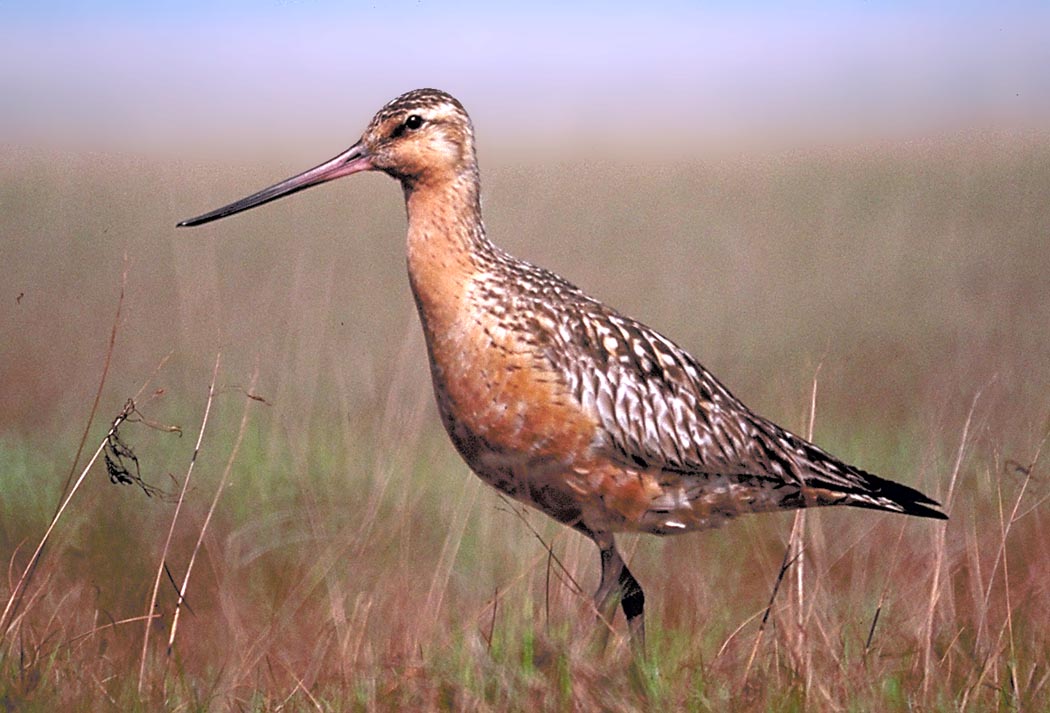
The record for the bird with the longest non-stop flight is the Bar-tailed Godwit.  It flew almost 7,000 miles over a period of eight days.  Some birds even fly over oceans and gulfs during their migrations, spending 100 hours or more in the air before they reach land.  These birds are known as transoceanic migrants. 
The Bartailed Godwit holds the record for the longest non-stop flight (photo: wikipedia)

Some birds only fly 20 or so miles a day, where others have been known to fly for around 600 miles in a day.  The Great Snipe is the fastest migrator, traveling at 60 miles per hour during its migration.  Most raptor species, like hawks, migrate during the day, whereas many songbirds will migrate at night, mostly to stay away from becoming hawk food. 

Speaking of food, many birds go through a stage of hyperphagia before their migration.  This is the technical term for eating A LOT of food.  Some birds, like the Blackpoll Warbler, will even double their body weight for the long trips. 

Flying birds aren’t the only ones that migrate.  Many penguins will swim for their migrations, and Emus will run for miles.  Migrating birds face a lot of threats though.  Weather, temperature, endurance, predators, but most migration deaths are because of people.  Billions of birds die every year due to collisions with windows, TV and radio towers, and power lines.  Even the bright lights of a city can alter a bird’s migration. 

A few things we as individuals can do to help these birds out include: keeping cats indoors all the time (cats are one of the leading causes of bird deaths), put up window stickers or tint your windows to prevent collisions, keep your bird feeders and birdbaths clean, and create a good pit stop for the birds in your backyard.  Keeping native grasses, plants, and trees will greatly help the birds and their environment as they migrate.

Submitted by Mike Cerutti, World Bird Sanctuary Naturalist/Trainer


Monday, November 9, 2015

Meet Consuela


Meet Consuela

Naturalist Trina Whitener introduces us to Consuela, an Orbweaver spider who took up residence on her truck in the World Bird Sanctuary parking lot.

Click Here to view her video.  

Saturday, November 7, 2015

New Kid In Town


If you have been out to World Bird Sanctuary this past summer you may have noticed an area of the exhibit line that was roped off.

 If you took the time to stop and look at the area you might have noticed a small brown fuzz ball on legs in the early part of the summer, and toward the end of the summer a teenager sized crane hanging out.  Our two injured Sandhill Cranes (Grus canadensis) Shawnee and Menomenee, originally from Wisconsin, hatched their first chick this summer.

 New Sandhill Crane baby (photo: Cathy Spahn)
Sandhill Cranes are found throughout North America.  The northern populations are migratory.  Sandhill cranes have the largest wildlife spectacle we can see here in North America.  As the cranes migrate From February to early April hundreds of thousands to over a million Sandhill Cranes will pass through and temporarily stay in a small area of Nebraska along the Platte River.

I have always enjoyed cranes, but when I first saw their gathering along the Platte River I fell in love with this amazing species.  Seeing the amazing amount of birds, hearing their call, and then watching this bird dance I could not help but fall in love. 

There are 6 subspecies of Sandhill Crane; 5 of them are found here in North America. 

Sandhill Cranes stand between 34-48 inches tall and have a wingspan of 73-90 inches.

When our two cranes first arrived at WBS I worked on doing some basic training, which helped with getting them more comfortable around me.  With the help of me rewarding them with superworms (a beetle larva that kind of looks like a worm), the cranes became more relaxed and would allow me to enter the cage.  As long as I kept 6 or more feet between them and I, they were comfortable.

Over the last few years they have become more vocal.  This year they laid a few eggs, and one of them hatched.  This little one we nicknamed Clyde after the middle name of Walter C. Crawford Jr, our Founder and Executive Director, who passed away in July.  This youngster was one of Walt’s last projects with us.
As with all birds, Sandhill Cranes grow rapidly...almost ready for release (photo: Cathy Spahn)

Clyde, our youngster, has now been released at the Squaw Creek Wildlife Refuge in the northwestern part of Missouri.  In fact, Clyde is the first ever, captive bred Sandhill Crane to be released into the wild in the State of Missouri.  Clyde seems to be integrating well with a small flock of Sandhill Cranes that resides in that area.

If you like Shawnee or Menomenee (named after places in Wisconsin where they are from) you may adopt one or both of them.  To adopt a bird Click Here, or call 636-861-3225 and ask for Marion.

 
Submitted by Cathy Spahn, World Bird Sanctuary Naturalist

Thursday, November 5, 2015

Birdlore: The Great Garuda


Mythology has a mixed bag of giant raptor legends, like the Thunderbird and the Roc, or creatures that looked like they came out of a blender with mixed characteristics, like the Piasa Bird.  

Another bird-like creature depicted in Hindu and Buddhist mythology is the part-man, part bird deity, Garuda.   The bird characteristics are usually referred to as eagle-like or kite-like depending on the source.


Garuda, half-man and half-bird (photo: the wikipedia files)

In Hinduism, Garuda was born from a huge egg with the torso and limbs of a man, and the talons, wings, and beak of an eagle.  His father was Kasyapa, an ancient sage, and his mother, Vinata, mother of all birds.  He was born with a radiance that made the gods cry in fear for the end of the world and at their request, Garuda diminished his splendor.

Before his birth, his mother was tricked into slavery with a bet by her sister-in-law, Kadru, mother of serpents.  In a bid to free her, Garuda asked Kadru and her serpent sons what he must do for his mother’s release.  Kadru decreed he must bring them the drink of the gods, amrita, so that she and her sons may become immortal.

However, the amrita was jealously guarded by Indra, King of the gods.  The elixir was protected by a massive fire covering the sky, a spinning mechanical door with spokes on the side blocking the way, and two large venomous snakes guarding the elixir’s resting place.  Not deterred, Garuda fought and defeated the host of gods with his power and drank from many nearby rivers to put out the fire in the sky.  He decreased his size to pass through the deadly spikes of the spinning door.  He snuck past the giant venomous serpents by blowing dust into their eyes.  Garuda took the elixir into his mouth without swallowing it and rose to the heavens.

On his journey back, Garuda was met by Indra, King of the gods.  Indra struck Garuda with his thunderbolt, but Garuda remained unharmed by the strike except for the loss of a single feather.  Faced with the reality of Garuda’s true strength, Indra called for a cease in fighting and formed a pact with the bird-man.  Garuda would be allowed to deliver the elixir to the serpents to fulfill his end of the deal and earn his mother’s freedom.  In return, Garuda would make it possible for Indra to reclaim the elixir from the serpents.  Indra also permitted Garuda to hunt the snakes as food.

Delivering the elixir, Garuda convinced the serpents that a bath of purification was required before partaking in the drink of the gods.  In the serpents’ brief absence, Indra descended from the sky to retrieve the elixir and left for the heavens.  When the serpents returned, they licked the grass on which the elixir had rested, slicing their tongues.  All modern snakes have forked tongues as a result. 

From that day forward, Garuda was a friend to the gods and enemy to snakes everywhere, devouring them at every opportunity.

To learn more about the contemporary bird species that inspire these amazing myths and legends, come to the World Bird Sanctuary and speak with one of our amazing Naturalists.

Submitted by Jessica Bunke, World Bird Santuary Naturalist/Trainer

Tuesday, November 3, 2015

Mississippi Trip


On September 25, 2015, World Bird Sanctuary staff member Kelsey McCord and I packed the van with birds and all of the support equipment that goes with traveling for shows, and off we went on our adventure to Mississippi. 

This was our first year at the Arkabutla Lake Eagle Fest and my first ever trip to Mississippi.  We had a nice drive to Mississippi and arrived mid to late afternoon on a Friday.  Once we arrived at our hotel we got the birds set up in the hotel conference room.  It is always nice when the birds have their own room.

Lake Arkabutla (photo: Cathy Spahn)

On Saturday September 26, we got up early and headed to our program located at Arkabutla Lake.  Mississippi Wildlife Rehabilitation, Inc very nicely provided some fencing for the display area, so we set out the birds for their all day display from 10-4.  Because of close by trees we did not have to worry about shade for the birds, so we put the provided tent over the table we had set up with information about World Bird Sanctuary. 

Mortimer the Turkey Vulture was fascinated with the pinecones and pine needles (photo: Cathy Spahn)

Once we were set up we walked down to the shore of the lake and realized just how beautiful and large the lake is.  We had perfect temperatures for the display and programs.  Both Jersey the Barred Owl and Patriot the Bald Eagle were fascinated with something in the woods.  Mortimer, the Turkey Vulture, on the other hand was so excited to discover pine cones and pine needles.  He had a blast picking up the pine cones and tossing them and then chasing them.

We did two, 30-minute programs, free flying MacGyver, Harris Hawk and Mortimer, Turkey Vulture, and those two birds awed the audience.  Patriot then made her appearance.  You could see the excitement and awe in everyone’s face.  After the program I gave people the chance to have their photos taken with Patriot and Kelsey. 

After the first program there was a sunny spot in the birds’ weathering area and Patriot put on her sun display and started sunning herself to the delight of the passers-by. 

The best reaction I have ever had from a program came at the end of the second program.  As I finished the program Kelsey turned with Patriot and was walking out of the pavilion.  A young boy, about 8-10 years old, spoke up very loudly, saying, “That was Awesome!”  That was the best compliment of the weekend.  We had a ton of compliments, everyone loved the birds and the program, but that one moment was the best.

My first WILD nine-banded armadillo (photo: Cathy Spahn)

After we packed up at the end of the day and thanked everyone, we got on the road, and that is when the day got even better and I photographed my first wild nine-banded armadillo.  We did not think the trip could go any better and then that happened.

We are looking forward to returning to this great festival at a beautiful peaceful location!

Submitted by Cathy Spahn, World Bird Sanctuary Naturalist/Trainer

Sunday, November 1, 2015

The Great Horned Owl


We are steadily approaching the autumn season.  The weather is changing, the foliage is turning into beautiful orange and red colors, and we see as well as hear more presence of our nocturnal friends, the owls. 

Missouri is home to various species of owls.  One of the most interesting of all the owls, in my opinion, is the Great Horned Owl.  All you have to do is look at one to see why they have earned the name, “Great Horned Owl.”

Junior, one of the resident Great Horned Owls here at the World Bird Sanctuary (photo: Gay Schroer)

The Great Horned Owl is one of the larger sized species of Owls, with documented weights ranging from 1.5 pounds up to 4.5 pounds.  As with most species of raptors, the females usually weigh more than the males.  Great Horned Owls have a long life span.  They can live well into their late 20’s in the wild, while there have been documented captive Owls that have lived up to 50 years of age.   Junior is 29!

After they leave the nest, these birds do not have any natural predators due to their size and strength.  They are capable of lifting more than their own body weight.  Because of this, their appetite goes well with their name, “Great!”  These guys do not eat nuts and vegetables.  They are strictly meat eaters.  They will eat pretty much anything that moves.  Great Horned Owls have the most diverse diet of any other species of owl.  This means they are capable of surviving in almost any type of habitat.  So whether you live in an urban area or a rural community, it is possible to have a Great Horned Owl sighting.
At a WBS Owl Prowl you may meet Junior or one of our other resident Great Horned Owls (photo: Gay Schroer)

If you would like to learn more about our nighttime friends, the owls, look into scheduling an Owl Prowl with us.  Owl Prowls are available on select weekends starting in November and run until the middle of March.  You can learn more about our Owl Prowls by going to the World Bird Sanctary website and clicking on the Events tab or giving me a call at 636-225-4390, extension 101.  You never know who or what you might find while attending an Owl Prowl.  We hope to see you there!

Submitted by Erica O'Donnell, World Bird Sanctuary Education Programs Coordinator


Friday, October 30, 2015

First Time Speaker


If you work in the Education Department at the World Bird Sanctuary then you will eventually be a speaker at our education programs.  I have just recently started speaking these programs.
Barnaby the Barn Owl landing on my glove during an Amazing Animal Encounter (photo: Linda Wibbenmeyer)

How do you prepare for this you may ask?  To begin with, I have been the handler in several Amazing Animal Encounters (our weekend programs at the World Bird Sanctuary from Memorial Day weekend to Labor Day weekend).  These programs are smaller than our full- length Raptor Awareness programs, but they are a great way to learn about the birds we fly and present.  I learned several facts and tips on presenting programs by listening to several Amazing Animal Encounters speakers while presenting the birds in these shows.  There is also a basic script that I was given to read over and learn my parts.

The next step is to start small. I presented my first Birdday Party at the WBS Visitor’s Center.  You present four different animals in a small setting.  This was great practice and the kids at the Birdday Party loved it (as did the adults)!  It really helped to boost my confidence, too.
The "Royal Falconers" at K.C. Renfaire, Kelsey McCord, Matt Levin and Paige Davis (photo: B. J. Talley)

As we come into fall the Renaissance Festival in Kansas City starts, and WBS presents programs as the Royal Falconers Theater each weekend.  Cathy Spahn, a WBS naturalist with many years’ experience, told me that on the second weekend she wanted me to be the speaker for a few of the shows.  These would be my first real presentations as a speaker. These shows are only a half hour long though, so they are good “stepping stone” programs.  I was a little nervous and a little excited.

I was still a little nervous about getting the timing down right when Paige Davis suggested I speak some of the same lines from our last Amazing Animal Encounters.  She suggested being the speaker for a few birds in a show, rather than the whole show, with some flyers and some non-flyers, so that I could get a feel for it and get some feedback from the other people helping in the show.  So the next day I received a bit of coaching before the program started, and then spoke for three of our birds. 

I learned during that first show that being the speaker is more than just talking.  You still have to remember to move about the stage when flying the birds.  I made sure to get that part right for the second show.  I received some great pointers after each of the programs to improve my role as the speaker.  I also felt much more ready for the following weekend at the Renaissance Festival.

As the day of my first full show began, Paige took the first show so that I could listen to her and get a feel for this particular setting.  At the Renaissance Faire we do four shows each day, and this weekend we had three speakers.  When my turn came up for the second show I briefly went over what I should be saying with Paige and Matt Levin, past WBS employee and current volunteer.  I took a deep breath and walked out on stage.  I introduced each bird as they came out and spoke about each of their species as they flew over the audience’s heads.  After they fly, each bird is walked between the aisles.  The birds did their part wonderfully which helped me to stay focused.  I introduced our last bird in the show (a Bald Eagle), then explained how the audience could hand their cash donations to our American Crow, Aesop, and the audience applauded!  I checked the clock, and my timing was perfect!  I had survived!!

After the program I got a few more tips and pointers, and I presented two more shows the following day.
Shadow, a beautiful Bateleur Eagle, was a new bird for me to handle (photo: Paige Davis)

About a week later, Paige and I presented three full Raptor Awareness programs at a campground for fifth graders.  This time it was a full length Raptor Awareness program which runs 45 to 50 minutes.  In these 3 shows we also had a bird that I had never met, let alone spoken about.  We brought Shadow, the Bateleur Eagle, for our finale.  Paige spoke the first two programs so that I could learn all about Shadow as a bird and a species.  The final program started and I introduced our first bird.  The program went great, and the kids loved it!  I got it to 47 minutes and then another few minutes for questions.  Perfect!  It was my best program to date.

I look forward to speaking many more programs and learning about more of our birds as I continue to work for the World Bird Sanctuary.

Submitted by Kelsey McCord, World Bird Sanctuary Naturalist