Wednesday, March 11, 2015

Snowies of the North


Unlike most birds of prey, I typically migrate to the north to my Michigan roots during the winter holidays to visit my family.  My most recent visit yielded a most unexpected and joyous surprise....I glimpsed my first wild Snowy Owl!

The Snowy Owl was perched high above the farm fields looking for prey. (Photo by Connie Bunke)
The Snowy Owl (Bubo scandiacus) is a large, white owl with striking yellow eyes and a black beak.  Females are typically larger and have a brown bar pattern mixed with the white of their plumage.  Snowy males will also have the brown coloration to a lesser degree and will become more white as they age.

These majestic owls live solitary lives in the harsh arctic tundra, following the population movements of lemmings, a type of rodent.  Lemmings are the primary food source for Snowy Owls.  A single Snowy Owl can eat 1,500 to 1,600 lemmings in one year.

A lemming is a tasty meal for Snowy Owls (photo: The wikipedia files)
Sightings of Snowy Owls in the thumb of Michigan was once a really rare occurrence.  My mother could only recall seeing a Snowy Owl out in the countryside once in the thirty-five plus years she’s lived there.  Now, neighbors and friends talk as though seeing two or three snowies in a single day is a normal event!

My family and I took a drive one afternoon to go looking for the Snowy Owls.  In the span of an hour, we came across six snowies perched on telephone poles overlooking the fields.

We almost didn’t spot this fellow.  At a distance, he simply looked like an extension of the telephone pole (photo by Connie Bunke)
In recent years the explosion of Snowy Owls appearing across the northern United States is likely due to an unusually high abundance of lemming populations across Quebec, Canada, according to an article by the Cornell Lab of Orinthology BirdCast.  The high population levels of lemmings allow Snowy Owl pairs to rear larger clutches of chicks.  With the current Snowy Owl baby boom, we’re likely to have more frequent sightings of Snowy Owls for recurring years.

If you wish to learn more about Snowy Owls, come visit the World Bird Sanctuary to meet Tundra, the Snowy Owl, at our Education Department, as well as Ookpik and Crystal, our Snowy Owl pair, living on the sanctuary’s display line. 

Submitted by Jessica Bunke, World Bird Sanctuary Naturalist/Trainer

Monday, March 9, 2015

Raptors and Wetlands


I am getting old but, partly, that is a good thing….

Back in the 1980’s – when I was in my twenties – the only place that I could see bald eagles in abundance was to take a trip to Alaska.  Flying into Juneau, I looked out the window to see the eagles roosting on the electrical towers close to the water where the fish were in abundance.  So, too, were the Peregrine Falcons, catching their favorite food of ducks in midair, swooping down as the ducks were taking off.   Both species of birds of prey migrated with the species they preyed on – the spawning fish and migrating duck species, but the raptors’ populations were still in sad, sad shape after years of DDT.

An Audubon print depicting Peregrine Falcons with their prey (photo: wikipedia files)

Fast forward 35 years with concentrated human effort (at places like World Bird Sanctuary) to bring raptor populations back to a healthy level….  My gray hair has increased, but so have the bird populations and even the wetlands where they find their favorite prey.  It was only a few years ago that I watched a mature Bald Eagle swoop in front of a tractor-trailer on Highway 55, barely missing death, but headed for the ‘safe zone’ of the median strip, of all places, to eat his large fish. 

It has also been a success of World Bird Sanctuary’s efforts in the last few years to have nesting peregrines on the tall office buildings of downtown St. Louis.  But, especially in recent years, I have enjoyed watching builders, developers, and city/county/federal government programs help bring back the wetlands, to bring back the fish, to bring back the waterfowl, and to ultimately bring back the raptors.


Peregrines, especially, will ultimately benefit from the wetlands habitat increase.  According to the website http://www.defenders.org/peregrine-falcon/basic-facts, there are approximately 1650 breeding pairs in North America, not a large number but a bigger population base than in years past, especially within my lifetime. To quote from the same site: “Adults have blue-gray wings, dark brown backs, a buff colored underside with brown spots, and white faces with a black tear stripe on their cheeks.  They have a hooked beak and strong talons.  Their name comes from the Latin word ‘peregrinus’, which means “to wander.”  They are commonly referred to as the Duck Hawk.  Peregrine Falcons are the fastest-flying birds in the world – they are able to dive at speeds in excess of 200 miles per hour….Peregrine Falcons eat other birds, such as songbirds and ducks, as well as bats.  They catch their prey in mid-air….”   Right now, I can only imagine the sight of watching such a mid-air swoop over a rising flock of ducks from a constructed wetlands, but it is on my bucket-list now because that would be a success story where mankind ‘finally got it right.’

In future blogs, I hope to discuss in more detail about the intricate layers of wetlands as an important habitat for raptor populations.  It all starts with the water….

Submitted by Paula Arbuthnot, World Bird Sanctuary Part-time ETC Employee

Saturday, March 7, 2015

Graduation Day


In this blog I’ve talked quite a bit about Zeus our Golden Eagle over the last couple of years. 

His training has been a huge part of my job, as well as a milestone in my life.  Last summer he completed another landmark by working at his first World Bird Sanctuary zoo show program at the Milwaukee County Zoo, and I couldn’t be more proud of that bird.  WBS has presented a bird show at the Milwaukee County Zoo for 30 of the last 31 years.

Zeus peering curiously at the camera (photo: Erica Fenske)

Last year was all about helping him to feel comfortable around people, especially large crowds.  We started him out small, placing him in our public weathering area every morning for increasingly longer periods of time.  Since there were many new things (vans, strollers, lots of people, construction equipment, etc.) we always had a pouch of treats to reward him for calmly tolerating all of the above.  This caused Zeus to associate going out to the weathering area with getting food, making it a very positive experience.

Being a clever eagle, Zeus would sometimes use these rewards to his advantage.  The big cat exhibit was under construction and many of the front loaders drove on the main road behind our weathering area.  This frightened Zeus at first.  We started rewarding him for jumping back up onto the perch once they went past and then for staying on the perch as they went by until he didn’t even flinch when he heard them coming.  Problem solved!  However Zeus remembered that we used to give him treats for hopping back up onto his perch (a subtle training error by me).  So, he started to jump off his perch for seemingly no reason, looked at me (and my bag of treats), hopped back up to his perch, and then looked at me again.  From then on we only rewarded him while he was sitting on his perch, which put a stop to this particular behavior.

Once Zeus was comfortable in the weathering area, we started putting him in shows as a walk on (he perched on our glove and we walked him around the theater).  His first audience was 68 people, but he quickly worked his way up to triple digit audiences.  We continued to reward him while he was being walked around so that he would want to be on stage, since it meant he was going to get treats.  The audience loved seeing a Golden Eagle, and we loved showing him off.

Zeus was unruffled by all the equipment and strangers (photo: Leah Tyndall)

Zeus became so famous at the Milwaukee County Zoo that Marquette University wanted to use him in a photo shoot (their mascot is the Golden Eagle).  I have to admit at first I was incredibly nervous.  Yes, Zeus had made great strides, but a photo shoot had all sorts of variables that could frighten him.  Cameras are strange, the backdrop might scare him, he was going to be surrounded by people he didn’t know, and a lot closer than he was used to.  What if a peacock wandered in…the list went on and on.  Turns out I need not have worried!  Zeus was amazing, he sat perfectly on his perch, didn’t seem bothered by the camera and no extraneous peafowl were afoot.

In the beginning Zeus eating from my hand was cause for celebration (photo: Mike Cerutti)

I cannot even describe the sense of pride I felt watching him.  This was a bird that trusted no one when I first met him in a huge free flight chamber.  He had to watch me for several minutes before he came down to eat the food I offered him.  Now he was sitting with a seemingly curious expression in front of cameras and strangers-- he even started preening; the ultimate sign of comfort for a bird!  He had come so far!  Sorry, I’m gushing, but I’m just so proud of this bird.

Zeus had a terrific season up in Milwaukee.  He learned a lot, he taught me a lot and he educated thousands of people about Golden Eagles.  Based on his performance and progress last season I am incredibly confident about his first flying season this year.  That’s right ladies and gentlemen.  For the first time in the history of the sanctuary, we’re free flying a Golden Eagle…stay tuned!

Submitted by World Bird Sanctuary Naturalist/Trainer Leah Tyndall

Thursday, March 5, 2015

What is a Blood Feather?


Depending on size, species and age, birds may have between 940 (hummingbird) and 25,216 (swan) feathers. Each of these feathers is molted and replaced on average every six months.

Feathers on a bird are not evenly distributed.  They grow in distinct tracts or lines called pterylae, inbetween areas of bare skin called apteria.  The apteria help cool the bird.  Apteria vary in size and are typically covered with contour, or body feathers, that overlap the apteria.  Because of the effects of water on feathers and ultimately on body temperature, water birds have small apteria and penguins have almost none.

New feathers emerging on the head of an African grey parrot. (photo: Dawn Trainor Griffard)


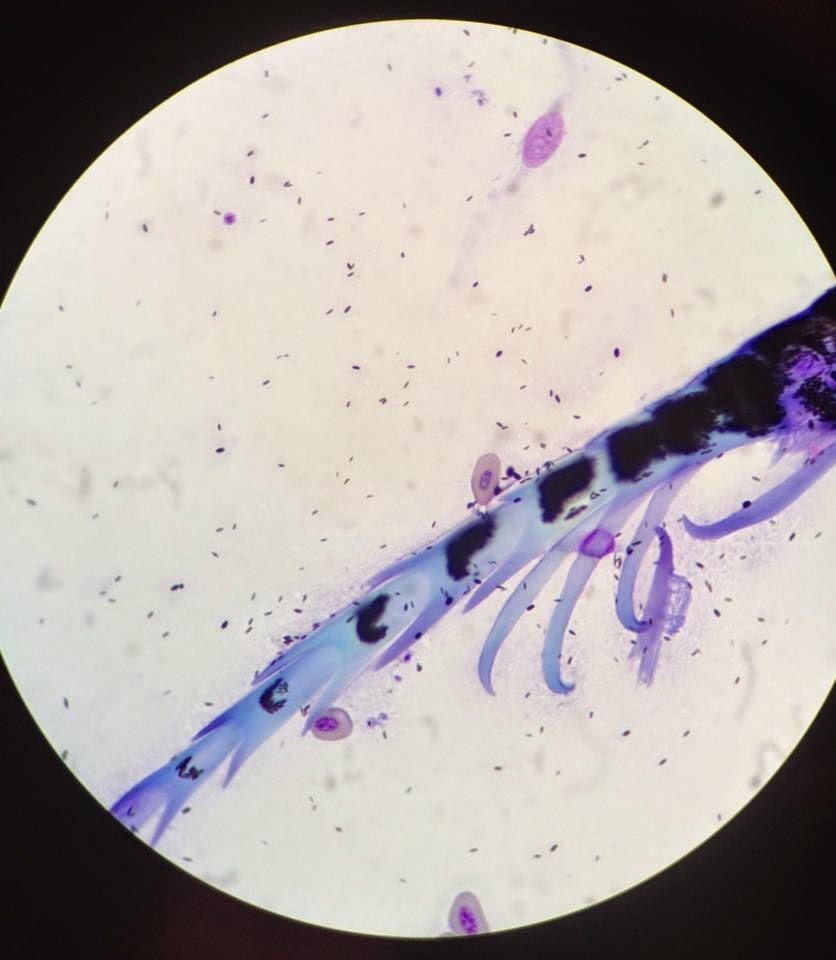
As a bird molts a feather, the new emerging feather pushes up into the base of the older feather, eventually forcing the older feather out of the follicle (place of feather growth) altogether.  As a new feather grows into place, it is nourished with blood by a small artery, which allows for its growth.

The growing sheath the new feather, along with the feather itself,  is formed of keratin – just like human fingernails.  The growing sheath is semi-sharp and hard enough so it can press through the epidermis (outer layer of skin).  During a heavier molt, this is the part of the process that makes our companion birds a little uncomfortable and crabby. It’s probably an annoying and itchy process!

 Actively growing primary flight feather with a blood supply (photo: Dawn Trainor Griffard)


Before the new feather erupts from the growth sheath, it’s referred to as a “pin” feather until the keratin sheath falls off or is removed, and you can see the actual feather.  As the feather grows the protective sheath either sloughs off or is preened off by the bird. When a feather completes its growth, the blood supply to the feather stops.

Problems can arise when a feather is accidentally damaged during its growth period. If a blood feather is damaged during its development, it can bleed profusely, endangering the health of the bird. Birds with actively bleeding blood feathers must be attended to immediately.  However, only intervene if the feather will not stop bleeding.  Usually the broken blood feather bleeds a little, then stops bleeding on its own.  Then the body usually stops blood flow to the feather, the bird preens the broken feather out, and a new feather starts to grow.  It’s most important to figure out how the bird broke the feather and make sure it doesn’t happen again.

Microscopic view of the “birth” of a feather (photo: Dawn Trainor Griffard)


If the bleeding will not stop, the blood feather is either carefully trimmed or completely pulled out – the latter of which is probably a painful procedure as the feather is often attached to a bone, so removal must be done expertly and quickly.

If the damage is slight yet the bleeding won’t stop, you can stop it with cornstarch and/or direct pressure. However, care must be taken that the feather does not receive further damage.  In almost all instances the bird would have to be restrained for this procedure, so letting the bird’s body naturally take care of the broken blood feather is best.

Through its daily preening, the growth sheath is removed by the bird itself or a conspecific – usually the mate. In captivity, the bird’s keeper can often gently remove those growth sheaths the bird cannot reach (like on the back of the head), as long as the bird tolerates being touched.

At the World Bird Sanctuary our birds are fed nutritious diets and are monitored very closely to ensure that the molting process goes smoothly.  If we see that one of our birds is having a problem with a bloodfeather or that a growth sheath is not being shed, we can step in and intervene to ensure the health and comfort of our birds.

Submitted by Dawn Trainor Griffard, World Bird Sanctuary Naturalist


Tuesday, March 3, 2015

Last Chance to experience Eagle Days before winter is over!

You can still join World Bird Sanctuary and our partners as we celebrate Bald Eagle Season around the region!  

For those of us who live along the Mississippi flyway the colder temperatures herald the arrival of some of the most admired and magnificent creatures of them all.  This is the season for eagle watching!  The season is in full swings, with just a few weeks left to catch this natural wonder.

Eagle watchers regularly see Bald Eagles on the frozen Mississippi River during eagle days.
Photo with kind permission of Sandra's Shooting Gallery.
If you can bear braving the cold and wind along the river, chances are that you will see wild Bald Eagles in action, hunting their prey, perching in a tree, or soaring up above. Eagle watching is an annual tradition for many of us, even those of us that are lucky enough to see and work with them every day.

If you want to see a live bald eagle up close and in person, you can visit the World Bird Sanctuary, or catch one of the displays or presentations below:

March 10th, 2015 | 5:30 pm & 7 pm
Rolla Middle School Auditorium
1111 Soest Road
Rolla, MO 65401
Raptor Awareness Program with eagle
Features birds of prey including an eagle, falcons, hawks, owls and vultures. Not only will you see different species of raptors, but you'll also learn a vulture's secret weapon and how to identify a bird of prey in the wild. Sit back and enjoy an up close view as some of the birds soar right over your head!

Meet a live bald eagle and other birds of prey in person
at these last Eagle Days events of the season.
Photo with kind permission of Sandra's Shooting Gallery.
April 4th, 2015 | 10 am—3pm
Wetlands for Kids—Missouri Department of Conservation
Busch Wildlife Area
2360 Hwy D
Saint Charles, MO 63304
Birds of Prey Display
A wetlands themed 4 bird display featuring birds of prey.  Naturalists will be on hand to talk about the animals.

With all these eagle programs, indoors and outdoors, there is no reason for you not to get outside this winter to enjoy our National Symbol!

Submitted by Catherine Redfern


Sunday, March 1, 2015

Hawk of the Highway


The Barred Owl is the most common bird we admit to the Kathryn G. Favre wildlife hospital.

Next in line is the Red-tail Hawk.  We receive around a hundred per year.  Of this number, the majority have been hit by cars.  You may have seen the Red-tail Hawk hunting near a roadside, perched on fence posts and telephone poles.  They use their excellent eyesight to find mice, rats and rabbits in the grassy areas near the road.  These hunters are sometimes struck by vehicles as they swoop down to catch their prey. 

Volunteer veterinarian Dr. Stacey Schaeffer and Sanctuary Manager Joe Hoffmann examine a newly admitted hawk (photo: Pat McGrath)

Red-tail hawks are very common and they are very helpful to us.  Many farmers have told me stories of Red-tail Hawks accompanying them as they drive their tractor or combine in their fields.  As the tractor spooks the rodents out of the crops, the hawk captures them for its dinner and to feed its family. 

Many people are unaware of the wild kingdom outside their car windows.  Sometimes family, friends and I count hawks along the road just to make the time fly as we travel.  It is good to realize there is more than just traffic out there. 

Distracted driving was invented by bird watchers.  It might not hurt if we were all more aware of our surroundings while driving, so we will not have an accident.  We might just save ourselves, our world, and a few hawks along the way.

Submitted by Joe Hoffmann, WBS Sanctuary Manager


Friday, February 27, 2015

Alaska State Bird: the Willow Ptarmigan


Alaska – a state usually associated with ice, snow, and cold. The winters are long and dark, with only a few hours of sunlight each day, while the summers are cool and bright, the sun barely dipping below the horizon at night. Although such a climate might seem harsh and unforgiving to some of us, there are plenty of animals that call Alaska home – including the Alaskan state bird, the Willow Ptarmigan (Lagopus lagopus).
 Young male Willow Ptarmigan in summer plumage (photo: the wikipedia files)

A member of the game bird order (turkey, quail, grouse, chickens), the Willow Ptarmigan is a species that thrives in cold, northern climates. In fact, its scientific name, Lagopus lagopus, literally translates to “hare-footed,” a reference to its feather-covered feet, which help to keep the bird warm in sub-zero temperatures. Alaskan weather isn’t always snowy, though. The summers in parts of Alaska can actually get quite warm, with temperatures in the 70’s (Fahrenheit). To successfully camouflage themselves in both seasons, Willow Ptarmigans have plumage that changes with the season. In the summer, their feathers will be brown with a hint of red, sporting a black tail and white underbelly. During the winter, however, their plumage becomes mainly white with the occasional black feathers.
Willow Ptarmigan in winter plumage (some become totally white) (photo: the Wikipedia files)

As the plumage of these birds is affected by the season, so is their diet. Willow Ptarmigans feed on low shrubs and, as their name suggests, willow trees. In the summer, the Ptarmigans will eat leaves, berries, flowers, and seeds. The winter months of course bring snow, which limits their diet. Heavy snowfall can cover shorter shrubs, preventing the Willow Ptarmigans from getting to the buds that comprise much of their winter diet. Fortunately in these cases, the Ptarmigans can still access the buds of the Alaska willow.
Willow Ptarmigan chicks (photo: the wikipedia files)

Willow Ptarmigans also make good parents. They are the only species of grouse in which the male helps to raise the chicks until they are independent. Most male birds of the world are monogamous, remaining with one mate for the entirety of the breeding season, and are extremely protective of territory, nest site, and mate. Despite such devoted parents, life as a chick is dangerous, and less than a third of the young will survive their first year. Not to worry, though.  The Willow Ptarmigan is a common and widespread species, in no current danger of extirpation or extinction.

At the World Bird Sanctuary we have a few of our own northern, cold-weather species. Next time you are visiting, keep an eye out for our Snowy Owl and Rough-legged Hawk. They’ll be happy to teach you a thing or two about surviving the cold of winter.

Submitted by JoHanna Burton, World Bird Sanctuary Naturalist

Wednesday, February 25, 2015

New Box Turtle Exhibit


Thank heaven for volunteers!  At World Bird Sanctuary that phrase is repeated many times a day.  If they could, I imagine our Box Turtles would be shouting it from their new exhibit box.
Joe Dolezal and Dan Cone put the finishing touches on their poject (photo: Melissa Moore)

Earlier this month Tuesday Crew volunteers Joe Dolezal and Dan Cone put the finishing touches on the new Box Turtle exhibit. The turtles reside just below the small exhibit enclosures in front of the windows that look out onto the Nature Center weathering area deck.

Our four Box Turtles are named Rose, Blanche, Dorothy and Sofia (the smallest one) after the characters in the television series, The Golden Girls.  Our “Golden Girls” are Three-toed Box Turtles Terrapene carolina triunguis a subspecies of the Common (Eastern) Box Turtle. 
One of our "Golden Girls" (photo: Melissa Moore)

When constructing the new Box Turtle exhibit Joe and Dan and Don Marcinkiewicz, who designed and installed the electrical components, took into account the specific needs of this species:

            Reptiles cannot regulate their own body heat, so you have to produce an ideal temperature for them within their enclosure.  There should be a heat bulb that produces a temperature of about 85f.  This should be to one side of the enclosure so that they can move closer to or further away from the heat source as needed.

            Water and humidity is important. There must be fresh water within the enclosure constantly.  There should be a large shallow body of water that they can soak in and you must be able to use a spray bottle on the enclosure several times daily to keep the humidity level up.
The turtles are free to use their pool whenever they feel the need (photo: Melissa Moore)

            Box Turtles do not like glass, and will often try to climb through it pointlessly.  The enclosure should have walls that they cannot see through to give them better peace of mind.  Our enclosure does have one wall of Plexiglas for better viewing, but this is offset by the fact that the majority of the exhibit has numerous hiding places if they desire.

            There needs to be plenty of artificial brush and bedding that they can burrow into.
Volunteers Joe Dolezal and Dan Cone admiring the results of their handiwork (photo: Melissa Moore)

The World Bird Sanctuary’s new Box Turtle exhibit meets all these criteria and more.  Many thanks to Joe, Dan and Don, members of the World Bird Sanctuary’s Tuesday Crew….we don’t know what we’d do without you.

The new habitat more than meets the criteria for a healthy and happy turtle exhibit (photo: Gay Schroer)

For more information about this species Click here.  

The next time you visit the World Bird Sanctuary be sure to look for our “Golden Girls” in the Nature Center.

Monday, February 23, 2015

Birdlore: Ruffed Grouse, The Drumming Bird


As the snow slowly melts away and the buds and greens of the new season spring forth, a rapid thumping resonates throughout the deep woods. 

Is that a drum you ask? Is someone chopping a log?

Nay!  The Ruffed Grouse sits atop his ‘drumming log’ beating his wings frantically in a territorial and courtship display!

A male Ruffed Grouse fanning his tail feathers and extending his neck feathers (creating a ruff) in a courtship display.
(photo: the wikipedia files)

In the northern reaches of North America, the Ruffed Grouse (Bonasa umbellus) lives in the thick bush of mixed hardwood trees.  When male ruffed grouse set out from their wintering areas to claim their own territory, they select a ‘drumming log’ as a stage for their display.  They do not beat their wings on the log or their breast to create this ‘thumping’ noise.  Rather, the speed at which they flap their wings in the air creates a temporary vacuum and a ‘thump’ results when air rushes in to fill the empty space.

The male will use this display year around on his ‘drumming log’ to announce his territory, but will increase in frequency during the spring mating season.  Once the males attract a prospective mate, they will initiate a brief courtship before actually mating.  The female leaves afterwards to establish her nest while the male waits for other receptive females.

The main avian predator of the Ruffed Grouse is the Northern Goshawk.   The Ruffed Grouse is a popular game bird for human hunters in the proper hunting season. The bird is often improperly referred to as a partridge, which is a smaller game bird related to grouse. 

One Native American tale tells how the thumping of the partridge made him the canoe-builder for all the birds.

“An Algonquin Tale:  How the Partridge built good canoes for all the birds and a bad one for himself.

As a partridge thumps a hollow log he sounds much like an Indian chopping and carving into a great log to create a canoe.  For in the ancient days, the Partridge was the builder of canoes for all birds of the earth.

On a chosen day, all the birds came together to receive their canoe, and what a grand sight it was to behold.  First the greatest of all the birds, the Eagle, entered his hollowed out log and pushed off into the water using the tips of his wings.  Then came the Owl, the Crane, the Bluebird, the Snipe, and the Blackbird all racing away proudly across the water in their canoes.  Even the diminutive Humming-Bird sailed in an elegant little boat with a specially made paddle provided by the good Partridge.

As the birds sailed proudly in their canoes, their attention turned back to Partridge, the canoe-builder, and asked why he did not have a canoe of his own.  Partridge remained closed mouthed and looked away.  Persistent, the other birds questioned him further and finally he relented and hinted that his canoe would be a marvel, a wonder, something only possible to conjure up in a dream.  So for many days, the birds waited for Partridge’s masterpiece.

Finally, at long last, a roar rose among the birds that Partridge’s canoe was ready.  At a designated time, all the birds gathered at the water’s shores to behold the marvel.  Partridge had pondered that if a canoe with two ends could be rowed in two different directions, surely, a boat that was completely round, like a nest, could be rowed in any direction.  His idea amazed all the birds that such a simple idea had not yet been done.

Yet, what should happen when Partridge entered the water with his marvelous canoe?

He would paddle and paddle, but no distance could he cover for he would turn in endless circles no matter his effort.  Weary and tired, he fled from the canoe to shore and hid beneath low bushes, too embarrassed to come out.  To this day the Partridge steers clear of seas and rivers and remains an inland bird.”

Submitted by Jessica Bunke, World Bird Sanctuary Naturalist/Trainer

Saturday, February 21, 2015

Internship Opportunities at WBS


The World Bird Sanctuary provides internship opportunities for applicants over the age of 18. 

This program runs year round, and can offer unique work experience to its applicants, along with possibly receiving college credit if you are enrolled at a college.  Interns are given the chance to work full time in all different areas of the sanctuary including the animal hospital, propagation department, and education department and with our various field studies teams when they are active.

Interns are involved in all aspects of daily life at the World Bird Sanctuary.  Responsibilities include managing the resident animals at the sanctuary, husbandry and maintenance of the facilities, field study work, wildlife rehabilitation, and more!

Through working in all different areas of the sanctuary, interns are given the opportunity to discover which aspects fit their career goals best.  This can be helpful when choosing a career in which you work with animals.  Some people may find that they enjoy working in the animal hospital, helping to nurse sick and injured birds back to health.  Others may find that they prefer working in education, presenting programs for the public.  This internship opportunity gives interns the chance to find out what they are passionate about.

A WBS intern about to release this rehabilitated Red-tailed Hawk back to the wild. (photo: Paige Davis)

While working side by side with WBS staff, interns are taught numerous important skills for working with birds (and other species).  For example, interns will learn how to prepare diets for all of the animals they care for.  The World Bird Sanctuary is home to over 200 animals, and each animal needs care on a daily basis.  Interns will get hands on experience working with many of these species, from eagles to snakes.  They will also get the chance to help present educational bird and other animal programs for the public!  Flying live birds over an audience is a unique experience opportunity at WBS.


Bald eagles are one of many species that interns get to work with here at the sanctuary. (photo: Paige Davis)

For receiving college credits for your internship, you must speak with your college advisor about the internship to make sure credits can be received.  If you are thinking about a career in the field of wildlife, an internship at the World Bird Sanctuary is a great way to gain experience and see what the job is really like.  Not only will you get hands on experience with numerous different species, but you will also find out what working in each area of the sanctuary is like.  It is a unique opportunity to get firsthand experience with rare species from all across the globe.

For more information or an application form, click here.


Submitted by Paige Davis, World Bird Sanctuary Naturalist

Thursday, February 19, 2015

Sandhill Crane Migration-Nebraska


Do you want to see the greatest wildlife spectacle in the United States?  If so, you need to go to Kearney Nebraska in March.  The locals pronounce the city of Kearney (Car Knee).  

In March the Sandhill Cranes gather by the tens of thousands on the Platte River between Kearney and Grand Island, Nebraska.
The migration can be viewed along a forty mile stretch of the Platte River (photo: Outdoor Nebraska website)
There is a 40-mile stretch of the Platte River where the Sandhill Cranes come to roost every night during March.  The birds stand in the shallow river overnight.  Some stand on sand bars, but almost all of them stand in the cold water overnight.  They roost in mass numbers in close proximity to each other.  Presumably there is safety in numbers--safety from Coyotes.  The numbers of these majestic birds along this stretch of the river are estimated to be over 400,000 Cranes.

My favorite spot to observe the Cranes in the evening in the past has been the State Park south of Kearney on an old bridge.  It is called Fort Kearney Hike and Bike Trail.  It is an old railroad bridge and is a five minute walk from where you park your car.  You can watch there for a small fee (honor system when paying).  Unfortunately, this historic wooden bridge was destroyed by a wildfire in March 2009.  Construction is underway to rebuild the bridge and widen and pave the trail, but is not expected to be complete before this spring’s migration.  Target date for completion is sometime in late 2015.  Hopefully this viewing area will be reopened in time for the 2016 spring migration.  

Just before dusk the cranes begin to arrive on the Platte R. (photo: Mike Zieloski)
However, don't let the above information deter you from a trip to view the cranes, as there are many other areas that provide excellent views of this spectacle.  For a list of viewing  areas Click Here.  Once there, you will meet people from all over the world who also came to watch the spectacle--that is if you decide to converse with the Humans.  You may just want to soak up the sights and sounds of the birds.  The birds start arriving a couple of hours before dark.  They fly in …in flocks of 3 to 3,000, and they keep coming until dark.  The waves of birds keep arriving and arriving.

Among the din you can hear the voices of individual birds.  You can hear the higher pitched younger birds calling out to locate their family.  There will also be Green-winged Teal, Pintails, Mallards and other ducks flying in with the Cranes.
The din from thousands of birds is incredible (photo: Mike Zieloski)
No matter how hard I try to describe it, the noise of the Cranes is something you have to experience for yourself.   You can hear so many Crane voices.  Then after it gets dark, you can turn on your headlamp and hike off the bridge, back to your car. You will be amazed at what you just witnessed.

In the morning, you will want to head to Rowe Sanctuary to slip into your viewing blind before daybreak.  You will need a reservation for one of the precious spots in the viewing blind.  You will be in the dark, above the river, in very close proximity to the resting birds.  The Cranes will be fairly quiet.  But as Dawn approaches, the Cranes get more and more excited…and they get louder and louder.  Then a Bald Eagle may fly over…or a Coyote may be spotted, and thousands of Cranes get air born at once. The morning lift off is so much different from the evening’s staggered arrivals.

You can make reservations for the morning blind by calling 308-468-5282 or going to  rowe.audubon.org  online.
It was my pleasure to share this experience with my cousin Phil (photo: Mike Zieloski)
My last trip to Nebraska was with my cousin Phil Besendorf of Louisville, Kentucky. He was amazed at the spectacle.

Previously I had been to see the Cranes with my coworker Cathy Spahn. We were the naturalists on a bus tour to experience the Cranes. I have seen this wildlife spectacle four different years now and never tire of it.  I have no idea how many more times I will go.  You should experience this, too.
WBS's resident Sandhill Cranes (photo: Gay Schroer)
If you’re unable to make the trip to Nebraska, you can see these regal birds at the World Bird Sanctuary.  We have two Sandhill Cranes who sustained injuries that make it impossible for them to migrate. 
Meet Menomenee (photo: Gay Schroer)
So Shawnee and Menomenee, our resident Sandhill Cranes, will spend the rest of their days educating the public and being catered to by WBS staff, interns and volunteers.  You can even adopt one or both of these beautiful birds through the WBS Adopt A Bird program. 


Submitted by Michael Zeloski, World Bird Sanctuary Director of Education