Showing posts with label Bird Show. Show all posts

Friday, August 21, 2015

A Busman's Holiday


In late June I traveled to the Milwaukee County Zoo for a quick trip to see the World Bird Sanctuary’s Bird Show and to see Zeus, our Golden Eagle, fly for the first time. 

This was the first time I have been back to the Milwaukee County Zoo in over 9 years.  My first 5 years with World Bird Sanctuary were spent there because the zoo sponsored WBS to present a summer and winter show back then, so in some way it was like going home after being away for a long time. 

I went to the zoo with a few friends and volunteers for a nice full day’s trip.  We arrived nice and early.  We walked around for a little while before the first show.  Right before the show we stopped by the WBS weathering area (a falconer’s term for exposing captive birds of prey to weather) to see some of the stars before the show.  At that time we learned Zeus was not yet flying in front of big groups, so we would have to wait until the end of the day to see him.

 The show started and birds started flying--Harris Hawk, Tawny Owl, Barn Owl, a chicken, Augur Buzzard, a skipping Black Vulture, Parrots, a snake slamming Red-legged Seriema and 3 flying eagles make for more pictures than you know what to do with.  My personal favorites were the skipping Black Vulture, snake slamming Seriema, Wedge-tailed Eagle, Bald Eagle and Zeus. 
There's just something about a skipping Black Vulture that brings a smile to your face (photo: Cathy Spahn)

All of the birds are fun to see fly, but when a Black Vulture starts to skip across the stage you cannot help but smile. 
The snake slamming Seriema was a crowd favorite (photo: Cathy Spahn)
Then, seeing Evita the Red-legged Seriema run out, pick up her fake snake, and start slamming away was just incredible.  The real “ooh” moment was when Duncan the Wedge-tailed Eagle was seemingly launched over the perimeter fence, and you see this bird with a 7- 8 ft wingspan coming right at you.  The last bird of the show was Clark the Bald Eagle flying strong--glove to glove--over the audience!
Of course, Clark our free flying Bald Eagle, is always a favorite (photo: Cathy Spahn)
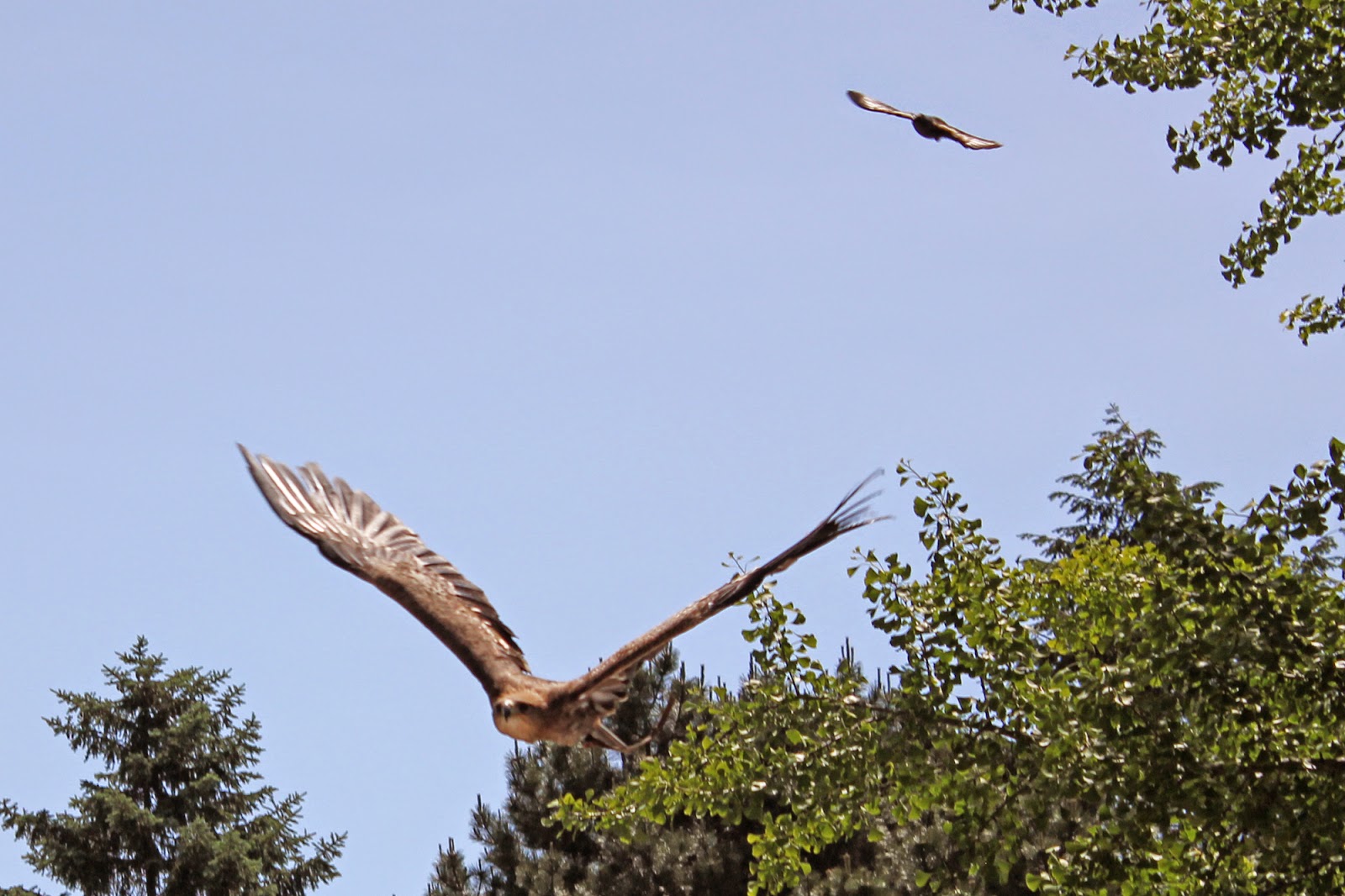
After the last show we returned to see Zeus fly.  We (all 3 of us) were the largest audience Zeus, the Golden Eagle, had ever seen while flying to that point in his training.  Zeus is a good-sized eagle and to see him come over the fence, open his wings and fly to his stump, back and forth, and then offstage, was fantastic.  It is not a difficult flight pattern, but with young birds you sometimes start with simple and always positive.  For me it was so exciting to see this bird fly, since a few summers ago I worked very hard on training him.
Zeus the young Golden Eagle flew for his first audience--the three of us  (photo: Cathy Spahn)
After the shows I also stopped behind the scenes to visit Trinidad, the Military Macaw.  He was not in the shows due to the construction in the area, which he does not like.  Trinidad’s facial skin immediately turned bright red upon seeing me and he started his excited dance.  I love that he goes to zoo shows to fly, but he is the one bird I miss when he is gone.  Trinidad was the first parrot I ever flew with WBS and we have always had a special relationship.

The Milwaukee County Zoo Bird Show runs only through Labor Day and is free with admission to the zoo, but you'll have to hurry--only 18 days left to see these amazing flying raptors.  It is a great weekend trip from the St. Louis area.  

Submitted by Cathy Spahn, World Bird Sanctuary Naturalist

Thursday, July 16, 2015

The Rookie Class of 2015


The arrival of summer at the World Bird Sanctuary can mean only one thing--zoo shows are here!  And by Zoo Shows I of course mean those educational and entertaining programs WBS staff and birds present at zoos around the nation.

With every new zoo show season we have a new class of rookies ready to make their mark.  This year is an especially large graduating class so to speak, because not only do we have brand new birds, but an old pro that has come out of retirement.

Zeus, a young Golden Eagle is one of our new fliers (photo: Gay Schroer)

This year we have one rookie flyer at our Stone Zoo show and five at the Milwaukee County Zoo, plus one returning flyer after a six year vacation.  It is always exciting teaching new birds to fly.  Most new flyers do what I like to call “prong horning,” where they hop straight up into the air and then make a horizontal flight.  This is very common the first several times they take off until they learn how to better control their flights.  Many new fliers also overshoot their landing spots, since they have not yet learned how to apply their brakes or to properly calculate distance.  Discerning the distance to and from a perch and other objects is a skill that birds obtain through practice.

When we first started practicing Zeus our Golden Eagle he would fly away from his stumps if they appeared to be too close to the bleachers.  We moved the stumps and over several days and flying sessions we gradually pushed them back to their original positions.  Now Zeus loves his stumps wherever we place them on stage.

 Technically this is Evita's debut year (photo: Flannery O'brien)

 Even birds that don’t do a whole lot of flying, like Evita the Red-legged Seriema, have to start out slow so that they can get used to new situations.  Technically Evita was in two shows at the very end of the season last year, but this year is her big debut season.  We started out slowly, gradually leading her closer and closer to the stage.  Her first time on the stage she wandered around for five minutes exploring everything the theater had to offer.  After carefully checking out all three sets of bleachers she was ready to exit and hasn’t really wandered since.

The key with rookies is to start small, get the birds used to the behavior or pattern first and then transition it to the theater.  The audience must be built up gradually until they are used to people.  They often need time to check out their new surroundings, either by wandering or sitting on a high perch and just scoping out the area.  Giving a bird time to do this is very important because it makes them feel safe.  They learn the surrounding area, determine that there are no predators and make a mental map so they can get back in case they ever leave the theater.

Chique the Blue-fronted Amazon parrot (photo: Leah Tyndall)

Sherlock an African Pied Crow is currently practicing his recycling routine in his enclosure, but soon we will be able to practice him in the theater.  Chique (a Blue-fronted Amazon parrot) is just starting to do her vocal cues on the hand rather than in her cage.  Once she is comfortable on the hand, she will also move to the stage. 

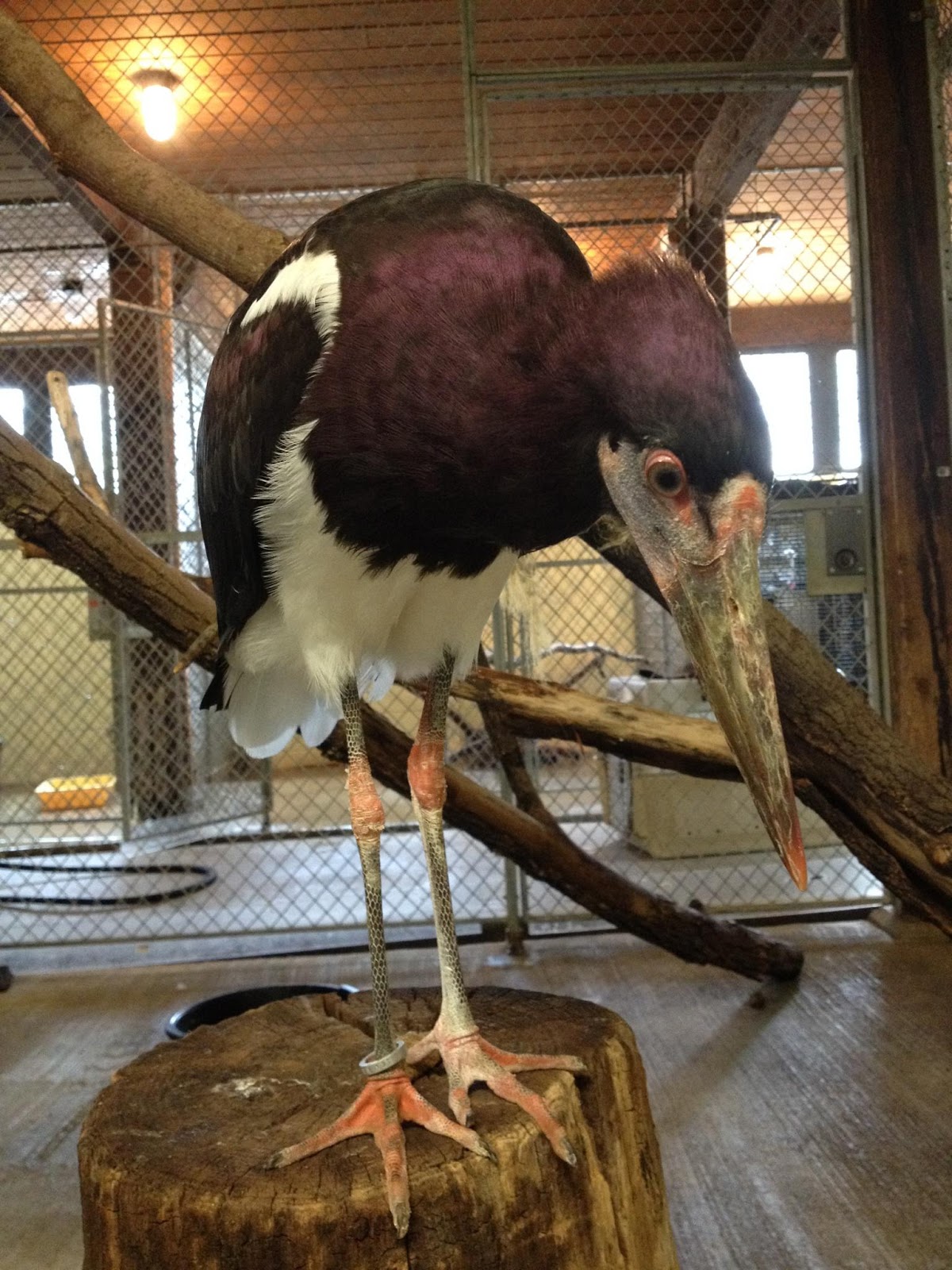
Azizi the White-bellied Stork rounds out our rookie line-up (photo: Flannery O'Brien)

Our last MCZ rookie is Azizi the White-bellied Stork.  He is learning to follow us, and our trail of meat, wherever we go.  This includes short walks outside of both his indoor and outdoor enclosures.

Skinner the Turkey Vulture is our returning veteran (photo: Flannery O'Brien)

The returning champion is Skinner the Turkey Vulture, who has already proved he is an excellent homing vulture.

Every new zoo show season means a new crop of rookies. Be sure to visit the Milwaukee County Zoo this summer and see Zeus, Azizi, Evita, Sherlock, Chique and Skinner. Also be sure to pay a visit to Roderigo the Common Buzzard up in Boston. Come see all of their hard work pay off.

Submitted by Leah Tyndall, World Bird Sanctuary Naturalist/Trainer


Tuesday, July 14, 2015

Flying Gunk


They say time flies when you are having fun.  This year, I am having more fun than ever working at the World Bird Sanctuary’s Milwaukee County Zoo Bird Show.

Duncan, the Wedge-tailed Eagle executes a beautiful flight (photo: Flannery O'Brien)
However, the birds and time are not the only things that are flying at the bird show.  Blood.  Guts.  Poo.  Slobber.  All of these things are constantly soaring around those of us who work these amazing programs.  Unfortunately, sometimes these soaring pieces of “gunk” find their way onto our arms, face, and even into our mouths.

I like to talk--a lot! (photo: Ian Wright)

I like to talk; a lot.  It’s kind of my thing.  My job sort of requires that I talk constantly and nine times out of ten my sentences seem perfectly timed for my mouth to be open just as the bird is sending a slobber, blood, or meat filled shower my way.  I can talk my way through a lot of unexpected situations, such as a bird deciding it wants to take the scenic route to its perch.  However, when an unwanted bird shower ends up in my mouth, it’s impossible to not be taken aback for a few seconds.

Whiskey Sam Adams, our African Augur Buzzard (photo: Flannery O'Brien)
Earlier this year, our African Augur Buzzard, Whiskey Sam, decided to become a part of the Africa section of the zoo by hanging out in a tree within the Bongo exhibit.  After running out of my long list of “Fun Fowl Facts with Flannery,” I decided to ask the audience for questions.  Of course, the first hand into the air was a little girl in the front row.   She obviously had been itching to ask me the question for a while.  I called on her and she eagerly opened her mouth and asked, “What would happen if a baby was crying and a bird flew over and pooped in that baby’s mouth?”

I love kid questions.  They are so creative.  However this was by far the most creative and unexpected question I have ever been asked.  After hesitating for a moment and rewording the question so everyone could hear, I came up with the only answer I could think of, “Well, the mom would probably run to the bathroom and rinse that baby’s mouth out.”


At the time, that was probably the worst scenario I could have imagined happening with flying bird “gunk.”  Until, that is, a couple of weeks later.  At the end of the show, as I am delivering a particularly delightful conclusion, Clark, our Bald Eagle, decided that the piece of meat he was in the middle of consuming, needed to be shared.  He shook his head and sent a shower of slobbery, disgusting, gooey meat directly towards my face and into my mouth!

All was going well until Clark decided to "share" (photo: Ian Wright)

As mentioned earlier, I can usually pretend the situation never happened and keep talking--but a piece of meat flying into my mouth was not a situation I can handle with much grace.  Instantly, I started sputtering, trying to get the gunk out, but to no avail.  The only thing that resulted was that the speakers were echoing my sputtering into the stands, and that was not professional.  My left hand was in a glove that Clark was seated on top of, and my right was covered in blood and gore from handling food for the rest of the birds.  So I did the only thing I could do.  I took a deep breathe, thought, “Yep, I’m doing this,” swallowed as best I could, and continued with the rest of the conclusion.  The second that show was over, and I had joked with several people about being more patriotic now that the Bald Eagle had given me that deliciously disgusting piece of food, I gracefully put Clark down, and did exactly what I had told the little girl.  I ran to the sink and rinsed my mouth profusely with water.

When you work with animals, you sign up for the fun things like speaking shows and watching a bird problem-solve on its own.  You also sign up for the not so fun stuff, like scrubbing poo and apparently sometimes sharing their dinners.  It was easily the most disgusting experience of my life, but that was the moment I knew that I was hooked on this career and that I found where I belong.  Because if I can suck it up, eat a ball of slobber and gore, and still keep a smile on my face, I can do anything that this job throws at me.  Literally.

Submitted by Flannery O’Brien, World Bird Sanctuary Milwaukee County Zoo Show Naturalist/Trainer

Thursday, June 18, 2015

Come Visit Us At Grant's Farm!


All summer long through October, World Bird Sanctuary will be at Grant's Farm with some of our birds.  It is free to visit!  You will not only find some of our raptors on display, you will also get to see a few of our birds perform in the Animal Encounters show.

Otis the Abdim’s Stork is one of the stars of the Animal Encounters show (photo: Paige Davis)

The Animal Encounters show features all sorts of different animals, many of which the audience gets to interact with, hands on.  From reptiles to mammals to birds, the animal encounters show has it all.  World Bird Sanctuary stars include Otis the Abdim's Stork, Emerson the Eurasian Eagle Owl, and McGuire and Sanibel the Bald Eagles.  This show is unique to Grant's Farm and can't be seen anywhere else. Be sure to stop by this summer and see us!   You can also meet some of the stars up close and personal at our periodic sidewalk interactions throughout the day.

Shadow the Bateleur Eagle can be found in the WBS weathering area (photo: Paige Davis)

World Bird Sanctuary also has birds on display during visiting hours.  At our Grant’s Farm weathering area, you can find the following birds: Bald Eagle, Red-tailed Hawk, Bateleur Eagle, Great-horned Owl, Eurasian Eagle Owl, Red-shouldered Hawk, and Peregrine/Gyrfalcon hybrid.  These birds make great models for anyone interested in bird photography.  We also have an open enclosure with two Bald Eagles roaming freely.  These eagles came to WBS with injuries that make them permanent captive birds.  These eagles can often be found perching on their enclosure logs, looking majestic for visitors.

Visitors can get a photo with a live Bald Eagle at the entrance to Grant’s Farm (photo: Paige Davis)

Something new this year is a photo opportunity with one of World Bird Sanctuary's Bald Eagles.  While waiting in line to get into the farm, you can have your photo taken with a live Bald Eagle!  This year you will find both Sanibel and McGuire posing for photos at the entrance.  Photos are taken in front of a Grant’s Farm backdrop, making a great trip souvenir.  Don’t miss your chance to meet and greet a live bald eagle up close and personal!
One of the many residents at Grant’s Farm, an African Sulcata Tortoise (photo: Paige Davis)

Grant's Farm is an exciting place to visit with lots of critters to see.  With elephants, parrots, giant tortoises, baby goats, zebras, camels, and more, it is a great stop for animal lovers!  Come by for a visit, always free!

Submitted by Paige Davis, World Bird Sanctuary Naturalist


Tuesday, September 30, 2014

Meet the Neighbors


There are many challenges when doing a zoo show program.  Weather has to be taken into account, wind speeds compensated for, and the crowd carefully monitored to make sure no one tries to stand up during the show.  These challenges I was always prepared for; one thing I never took into account was the neighbors.

By neighbors I mean the wild (or semi-wild) birds that call the zoo home.  When our birds first move into the neighborhood in the spring they are generally ignored by the wild birds unless they end up in a tree while learning their new patterns.
Many zoos and theme parks release peafowl such as this albino Peacock  (photo by Gay Schroer at Magnolia Plantation)
The biggest problem we have when we first arrive is the peafowl.  Peafowl are not native, and are intentionally released by zoos and theme parks for their guest’s enjoyment.  The fowl quickly call wherever they are released home, and rarely wander off grounds.  Both Milwaukee County Zoo and Grant’s Farm have free ranging Peacocks and Peahens that consider the entire zoo their territory.  In the winter months they have free range of the exhibits where we keep our birds, so they are often surprised and upset when they suddenly cannot cross into “their” territory.  They wander into the theaters during practices and we have to stand guard in the weathering area (the outdoor area where we keep our birds on display) to prevent Peahens from charging our poor birds.  Peafowl may look ridiculous, but they have strong kicks and they could do a fair amount of damage to our birds, especially the Peacocks, which have spurs on their legs.  After a while the peafowl start to realize they cannot enter certain areas, but we still have to stay on guard because peafowl are not the only birds that are not pleased with our birds’ presence.
A Peahen wandering under our bleacher seating 
Songbirds, understandably, are not thrilled when a group of predators move into their territory--especially during breeding season.  Once songbirds have eggs in their nests they begin to display a behavior called mobbing.  They will gather in groups and dive bomb large birds of prey to “encourage” them to leave the area.  Unfortunately, these birds do not realize that our birds have little interest in them or their young—our birds get three free meals a day.

The worst offenders are the Common Grackles, black songbirds that leave nothing to chance.  I am especially bitter about them because they chased a kestrel I worked with into the woods.  Every time he tried to fly back into the theater they chased him further into the woods (don’t worry we got him back…it just took a while).

The grackles this year were especially numerous.  Diablo (a Tawny Eagle), Reese (Great Horned Owl) and Clark (Bald Eagle) got the worst of it.  Both Reese and Diablo had clouds of five to seven grackles following them throughout their patterns.  We used the grackles’ natural fear of humans to our advantage, strategically placing ourselves between them and our birds or flying our birds into the crowd.  Robins, especially juveniles, will also harass our birds--often lurking in the trees above the weathering area in wait.
 The scariest scenario is wild raptors who chase our birds (photo: Laura Bailey)
The scariest case of wild bird interaction however did not involve songbirds, but a wild juvenile Cooper’s Hawk who wanted to chase our Military Macaws my first year doing shows.  Suddenly instead of two birds doing loops around the theater there were three!  Luckily we were able to call our birds down to safety and we never saw the young hawk again.

Despite all of the trouble wild birds cause, I will admit there is no better way of finding a bird that has flown off or been blown out of the theater by wind.  Just follow the sound of angry songbirds and nine times out of ten we find our bird.  Although sometimes we find wild birds of prey!

There are many challenges to face during zoo show programs, but none quite as unpredictable as the local bird population.  They can be an annoyance, an amusement and even aid you, assuming they did not cause the bird to seek shelter in a tree in the first place.  Regardless, they certainly keep us on our toes!

If you live in or are visiting the Milwaukee, Wisconsin area this summer be sure to visit the Milwaukee County Zoo, and in particular the bird show presented by the World Bird Sanctuary.

Submitted by Leah Tyndall, World Bird Sanctuary’s 2014 Milwaukee Zoo Show Supervisor

Friday, September 26, 2014

Height: Help or Hindrance


I'm easy to pick out of a crowd, and I've heard the question, "How tall are you," too many times to count.  My height (I'm 6'6") has been helpful for most of my life, but when I started working for World Bird Sanctuary’s bird show at the Milwaukee County Zoo, I considered it more of a hindrance at times.

I started volunteering at WBS’s nature center in February 2014 because I could work with both the birds and reptiles there, and at the same time interact with the public.  I found my niche in the daily chores, but I wanted to help more with the animals, especially the birds.  Once I started handling the birds, I wanted to participate more in their flying exercises.  When Jeff noticed my thirst for knowledge and drive to help out more, he recommended I try the bird show.  That is how I ended up becoming a trainer in Milwaukee for the summer.

Being tall has many perks when it comes to bird shows.  During the initial setup, it helped in the construction of the outdoor bird enclosures, since I could reach on top of them without any problems.

When it came time to shape birds’ flying patterns, I got designated the "official creance tester" (creance being a long line used in initial raptor free flight training), since during later training I could place birds on high perches others couldn't reach.  The main advantage I utilize every day is that I don't have to use a step stool to reach into the raptor's night stalls (picture below).  This helps me get them out of their stalls faster and easier during the morning weigh/change and later during shows for faster transitions.

Cleaning the stalls (photo by Erika Fenske) 
While being tall has some advantages when working with the birds, it also has some  disadvantages when it comes to training and doing shows with them.  My size tended to intimidate/scare a lot of the birds at first (and still does for some), so I have to limit my interactions with them during the initial stages of training.  When it comes to shows I have learned to adjust my height a lot, because the fence covering the behind the scenes area is only 6' in most places.  So, I have to crouch a lot to hide my movements from both the audience and the birds on stage. 

"Hidey ho neighbor"–A Wilson quote from the Tim Allen Show, Home Improvement (photo: Erica Fenske)
I have accepted the fact that I'm tall and I can't do anything about it.  That just means I have to devise new techniques to work with the World Bird Sanctuary’s amazing birds while doing bird shows.

Submitted by William Oberbeck III, World Bird Sanctuary’s Milwaukee Zoo Bird Show Trainer/Naturalist

Wednesday, May 14, 2014

Art in the Park


Art in The Park Day to benefit WBS Wildlife Hospital

On Sunday May 18, 2014, the World Bird Sanctuary is proud to host Art in the Park Day. 

Come join us for this unique wildlife art exhibition and sale.  Approximately 15-20 artists will be on site demonstrating their unique talents in the artistic styles of painting, sketching and drawing. Their works will also be on display and available for purchase. 

Just one of the many pieces of artwork available

What you need to know:

Date: Sunday, May 18th, 2013
Time: 10:00 am to  4:00 pm. 
Admission and Parking: FREE
Fine Art Silent Auction: 11:30-12:30 pm
Bird show: 1:00pm – 1:30pm in the amphitheater at the Nature Center.

All proceeds will benefit the care and treatment of birds admitted to the World Bird Sanctuary’s Kathryn G. Favre Wildlife Hospital.


Friday, May 2, 2014

Art in the Park


Art in The Park Day to benefit WBS Wildlife Hospital

On Sunday May 18, 2014, the World Bird Sanctuary is proud to host Art in the Park Day. 

Come join us for this unique wildlife art exhibition and sale.  Approximately 15-20 artists will be on site demonstrating their unique talents in the artistic styles of painting, sketching and drawing. Their works will also be on display and available for purchase. 

What you need to know:
Date: Sunday, May 18th, 2013
Time: 10:00 am to  4:00 pm. 
Admission and Parking: FREE
Fine Art Silent Auction: 11:30-12:30 pm
Bird show: 1:00pm – 1:30pm in the amphitheater at the Nature Center.

All proceeds will benefit the care and treatment of birds admitted to the World Bird Sanctuary’s Kathryn G. Favre Wildlife Hospital.

Below are just a few examples of the artworks that will be on sale.

Saturday, October 1, 2011

WBS Presents Bird Show at Silver Dollar City

Branson, Missouri has long been considered the “Nashville of the West” because of all of the music shows it sports. 
Music isn't the only thing happening at Silver Dollar City this fall - Photo by Jena Baumgarten
A drive down Route 76 in Southern MO would help anyone understand.  Names like Andy Williams and Dolly Parton flash in big, bright lights from the tops of their theaters.  Branson also has one of the country’s premier theme parks--Silver Dollar City.  Silver Dollar City has one of the country’s premier bird shows produced and casted by the World Bird Sanctuary.  We call the show “Birds of Prey in Flight,” and to say the least, it is aptly named.
The beautiful Echo Hollow Theater at Silver Dollar City - Photo by Jena Baumgarten
To begin with, the theater the birds perform in, Echo Hollow Theater, is one of the biggest and steepest theaters in which we have ever presented a bird show.  You can ask the trainers for the show, Leah Tyndall, Lindsay Focht, Leah Sainz and Dana Lambert, about how many stairs they must climb and descend before, during and after each show.  By the end of the show they all look forward to having ripped bodies and thighs of steel.
Tsavo the Bateleur Eagle takes off for the long flight down to the stage - Photo by Jena Baumgarten
Many of the birds fly from the very top of the theater to the stage, and in order to do this they fold their wings into their sides and attain speeds that will defy your logic, yet they nimbly slow in time to lightly touch down on trainer’s gloves or stage perches.


Hunter, our Eurasian Eagle Owl is a big bird, having about a 5-foot wingspan.  He flies from as high in the theater as you can get.  He folds in his wings and becomes an air force missile as he heads for the speaker’s glove.  His and all the birds’ flights around the theater will take your breath away! 
Norbert the Bald Eagle  lands at the top of the amphitheater after one of his flights- photo by Jena Baumgarten
The show also has spectacular flights by Wagner, the Red-tailed Hawk, Marshmallow, the European Barn Owl, Trinidad and Carmen, our Military Macaws, Jack, the Harris Hawk, Vader, the Black Vulture, Tsavo our Bateleur Eagle, and Norbert our Bald Eagle, all of whom fly 6 flights for every show.
There goes Norbert again thrilling the crowd - photo by Jena Baumgarten
As Assistant Director of the World Bird Sanctuary I have been working in and producing bird shows for WBS for 26 years.  In that time I have been part of thousands of shows in 29 different zoos, theme parks and aquariums around the nation.  I can say without a doubt the best flights I have ever seen in any bird show are going on right now at Silver Dollar City.
Norbert accepts applause from the crowd after six thrilling flights - photo by Jena Baumgarten
The park is open Wednesdays through Sundays from now through 29 October.  WBS presents 3 shows a day at 11:00, 1:00 and 3:00, weather permitting.  Branson is just 4 hours from St. Louis. 

Come on down and see us!

Submitted by Jeff Meshach, World Bird Sanctuary Assistant Director