Showing posts with label zoo shows. Show all posts

Friday, June 26, 2015

Zoo Show “Radar”


When sitting in the audience of a World Bird Sanctuary bird show at a zoo, the setup may appear simple enough; one person is talking (the Speaker) while two others are mostly backstage (the Trainers) cueing perches for birds to fly to or walking birds offstage.

While memorizing a roughly twelve page long script and fifteen or so different bird flight patterns (the places on stage a particular bird flies to) may not seem too bad, we have a lot more than just script and patterns on our radar!  Like the birds we work with, we must be acutely aware of anything and everything going on around the theater, and react to those things at a second’s notice.

Locust, the Red-legged Seriema, pausing to watch a plane

The main things that we are watching are the behaviors of the avian members of the team.  On the occasion a bird goes to an incorrect perch or is not flying to the next one, it is our job to determine why.  It’s often as simple as trying to look at whatever the bird is looking at!  A plane flying overhead may have caught their attention for a moment, or an audience member sifting through a purse across stage.  Usually re-pointing to a location is all we have to do to re-catch a bird’s attention, and as the Speaker we always have extra facts ready to share to fill in the time.

Riley taking off to fly to his next cue in the bleachers

The second thing everyone has an eye on is the audience.  One of my favorite parts of our show is getting into the bleacher seats and flying Riley, an American Barn Owl, right above and very close to the audience.  As you are walking to the set of bleachers in Riley’s pattern, you have a few sentences to decide where exactly you should go.  A giant snake stuffed animal resting in the back row?  To Riley that looks like a Godzilla-sized predator…not a good spot!  Everyone must keep an eye on the extra-antsy young members in attendance as well.  Emergency bathroom trips are quite common.  Trainers know when the Speaker delays saying a release cue (a point in the script that signals the next bird to appear), it’s a signal that audience members are making their way out of the theater.  Norbert the Bald Eagle should definitely not fly through the entryway at that moment.

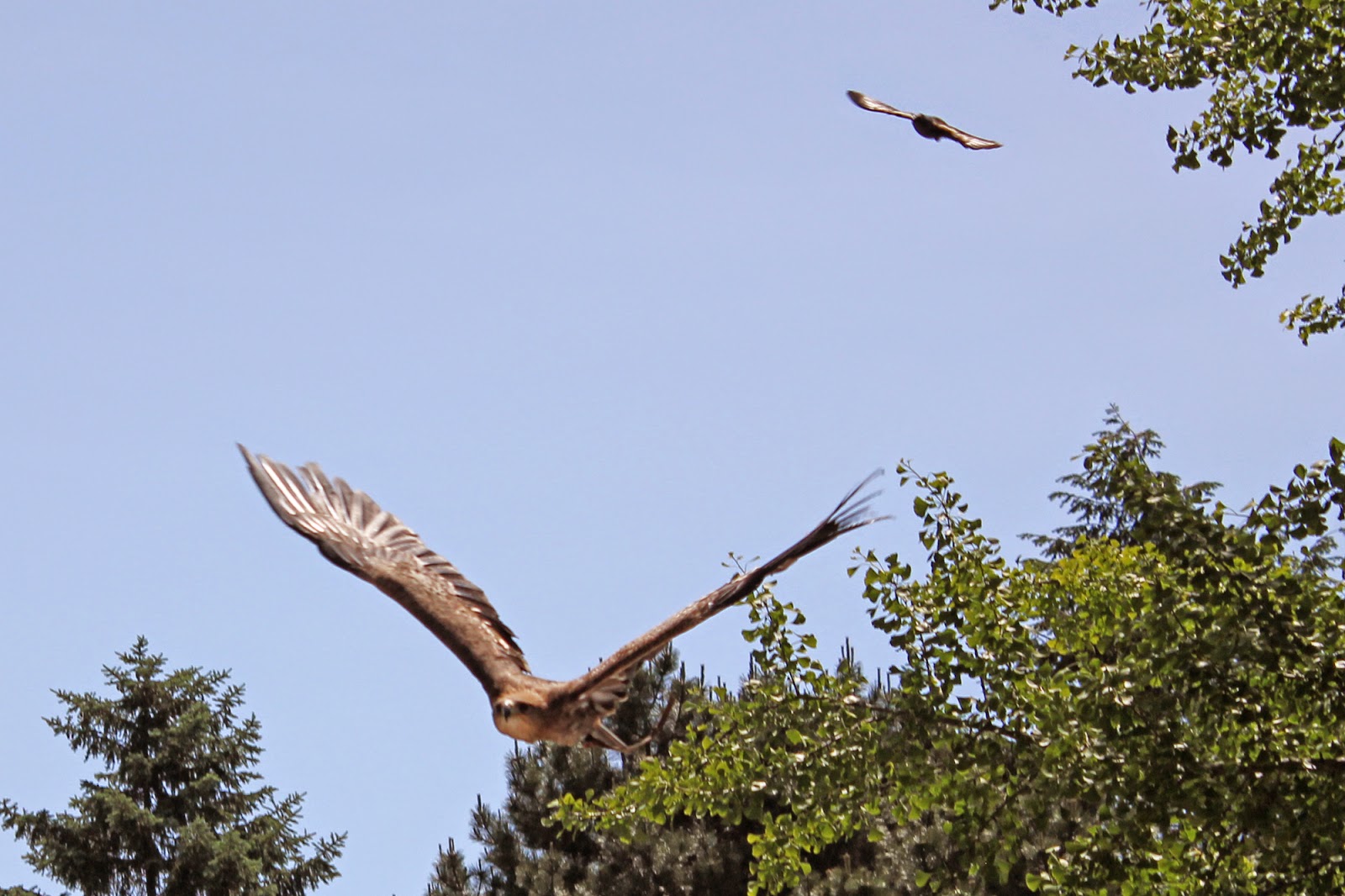
Our radar expands to outside the theater too.  Sometimes wild raptors make an appearance in the sky above us.  While a wild Red-tailed Hawk gliding by is no threat to the eagles in the show, stalling is sometimes required if the next bird just so happens to be a smaller species.  It’s almost a guarantee the wild raptor won’t attack any of our birds, but the smaller birds could still react like the wild bird would attack.

The classic “All’s Clear!” sign

This leads to another thing all the human members of the show team are watching--each other!  A Trainer arm appearing above the fence could signal several things to the Speaker.  Pointing skyward, for example, means a wild predator is overhead.  The ever-changing and always-different environment of zoo shows is one of the things I love about them.

Now, after reading this you may be thinking that an awful lot of things can cause a Speaker to stall for time during a show.  However, if you watch a World Bird Sanctuary zoo show at Stone Zoo or Milwaukee County Zoo this summer, you probably won’t be able to tell if anything out of the ordinary is happening!  Our goal during zoo shows is to educate and entertain the audience about the amazing birds of our world.  After all, “stalling” really just means sharing more cool facts!

Submitted by Carmen Volante, World Bird Sanctuary Naturalist/Trainer

Sunday, May 31, 2015

Pack it on up. Move it on out.


As show supervisor for World Bird Sanctuary’s zoo shows I enjoy a transient lifestyle.  I’ve mentioned before how the ever-changing scenery and people keep me on my toes and free of boredom.  This is true but there is one thing I don’t enjoy about constantly being on the move—Packing!

Time to pack the car (photo: Neal Cowan)
 I hate packing.  I loathe packing.  It doesn’t help that I’m not particularly good at it.  I’m great at gathering things, checking and double checking a list, and sorting.  I’m not so good at the actual packing…or moving. Putting things in boxes, carrying them around, making them fit in a car.  All of it is not fun. 

Not only do I have to pack all of my own things, but I also have to pack for the birds and the show.  Both zoos we frequent allow us to leave items in storage, but we still cart the majority of our supplies back and forth.  It is important to make sure we have everything we need, as there are very few opportunities to bring the missing items to us from St. Louis.  That is a lot of pressure when packing, which makes it even less fun.

So much “stuff” and I’ve only just begun (photo: Leah Tyndall)
 I will admit there have been occasions, when I am very tired, that I’ve pondered the possibility of training birds to pack for themselves--not that they have a whole lot of experience when it comes to packing.  Well Sherlock the African Pied Crow will pile his toys in his crate, but that’s about it.

Hmmm…do you think?  Uh….no, I guess not! (photo: Mike Cerutti) 
In the wild, birds don’t have to pack up and move their things from one nest to another.  In most cases they build their nest from scratch.  In some cases they don’t even build the nest.  Owls for instance build a scrape.  This is a depression either in the ground or in a tree cavity.  They usually line these with feathers before laying their eggs.  Abandoned nests will often be used by different birds, even different species.  It is not uncommon for Great Horned Owls to take over abandoned Red-tailed Hawk nests.  On occasion they don’t even wait for the nests to be abandoned.

Brood parasites are a group of birds including European cuckoos and cowbirds.  These birds will lay their eggs in another bird’s nest.  Not only do they not have to raise their own young, but they also do not have to expend the energy to build a nest in the first place.  Bald Eagles are the closest to being movers, although they don’t move between nests as much as they build onto their existing nest.  Bald Eagles will return to the same nest year after year, adding more and more sticks.  The largest Bald Eagle nest ever recorded was nine and a half feet wide, twenty feet deep, and weighed over three tons before it broke the tree in which it was built. That weighs more than my car--my car being a RAV 4, so I can pack all of my stuff or fit an eagle size crate in it!

Zoo show life is fantastic, except for moving myself, and 15-20 birds and all of their items, across the country.  In the wild birds do not need to move anything but themselves from one place to another.  In some cases they do not even need to build a nest in the first place. If only moving zoo shows were that simple…and don’t even get me started on unpacking!

And just about the time I have reached the point of exhaustion and am throwing myself a real pity party, I am reminded why we at zoo shows do all this packing, unpacking and moving of personal items, equipment and birds.  The first time a bird swoops over the heads of audience members and we hear the gasps of amazement from a theater full of adults and children we know that “OH YEAH…that’s why we do it!”

So, if you happen to be in the Milwaukee area this summer, be sure to make the Milwaukee County Zoo one of your stops.  Our amazing birds will demonstrate for you why all that furious packing and transporting was well worth the effort.

Submitted by Leah Tyndall, World Bird Sanctuary Naturalist/Trainer and Zoo Show Supervisor.


Tuesday, September 30, 2014

Meet the Neighbors


There are many challenges when doing a zoo show program.  Weather has to be taken into account, wind speeds compensated for, and the crowd carefully monitored to make sure no one tries to stand up during the show.  These challenges I was always prepared for; one thing I never took into account was the neighbors.

By neighbors I mean the wild (or semi-wild) birds that call the zoo home.  When our birds first move into the neighborhood in the spring they are generally ignored by the wild birds unless they end up in a tree while learning their new patterns.
Many zoos and theme parks release peafowl such as this albino Peacock  (photo by Gay Schroer at Magnolia Plantation)
The biggest problem we have when we first arrive is the peafowl.  Peafowl are not native, and are intentionally released by zoos and theme parks for their guest’s enjoyment.  The fowl quickly call wherever they are released home, and rarely wander off grounds.  Both Milwaukee County Zoo and Grant’s Farm have free ranging Peacocks and Peahens that consider the entire zoo their territory.  In the winter months they have free range of the exhibits where we keep our birds, so they are often surprised and upset when they suddenly cannot cross into “their” territory.  They wander into the theaters during practices and we have to stand guard in the weathering area (the outdoor area where we keep our birds on display) to prevent Peahens from charging our poor birds.  Peafowl may look ridiculous, but they have strong kicks and they could do a fair amount of damage to our birds, especially the Peacocks, which have spurs on their legs.  After a while the peafowl start to realize they cannot enter certain areas, but we still have to stay on guard because peafowl are not the only birds that are not pleased with our birds’ presence.
A Peahen wandering under our bleacher seating 
Songbirds, understandably, are not thrilled when a group of predators move into their territory--especially during breeding season.  Once songbirds have eggs in their nests they begin to display a behavior called mobbing.  They will gather in groups and dive bomb large birds of prey to “encourage” them to leave the area.  Unfortunately, these birds do not realize that our birds have little interest in them or their young—our birds get three free meals a day.

The worst offenders are the Common Grackles, black songbirds that leave nothing to chance.  I am especially bitter about them because they chased a kestrel I worked with into the woods.  Every time he tried to fly back into the theater they chased him further into the woods (don’t worry we got him back…it just took a while).

The grackles this year were especially numerous.  Diablo (a Tawny Eagle), Reese (Great Horned Owl) and Clark (Bald Eagle) got the worst of it.  Both Reese and Diablo had clouds of five to seven grackles following them throughout their patterns.  We used the grackles’ natural fear of humans to our advantage, strategically placing ourselves between them and our birds or flying our birds into the crowd.  Robins, especially juveniles, will also harass our birds--often lurking in the trees above the weathering area in wait.
 The scariest scenario is wild raptors who chase our birds (photo: Laura Bailey)
The scariest case of wild bird interaction however did not involve songbirds, but a wild juvenile Cooper’s Hawk who wanted to chase our Military Macaws my first year doing shows.  Suddenly instead of two birds doing loops around the theater there were three!  Luckily we were able to call our birds down to safety and we never saw the young hawk again.

Despite all of the trouble wild birds cause, I will admit there is no better way of finding a bird that has flown off or been blown out of the theater by wind.  Just follow the sound of angry songbirds and nine times out of ten we find our bird.  Although sometimes we find wild birds of prey!

There are many challenges to face during zoo show programs, but none quite as unpredictable as the local bird population.  They can be an annoyance, an amusement and even aid you, assuming they did not cause the bird to seek shelter in a tree in the first place.  Regardless, they certainly keep us on our toes!

If you live in or are visiting the Milwaukee, Wisconsin area this summer be sure to visit the Milwaukee County Zoo, and in particular the bird show presented by the World Bird Sanctuary.

Submitted by Leah Tyndall, World Bird Sanctuary’s 2014 Milwaukee Zoo Show Supervisor

Tuesday, August 26, 2014

My Preparation for Zoo Shows


I first started volunteering (as a part of the World Bird Sanctuary Junior Volunteer Program) in 2007 when I was 13 years old.

I spent my first seven years volunteering at the World Bird Sanctuary’s ETC (Educational Training Center) doing pretty much anything I was told. Whether it was cleaning mews, prepping food, or doing whatever projects we had that day, I was always on it.

For the first 3 years I was always at the ETC, but when I turned 16 I was brought into a whole new world. Now able to handle birds, I was getting more into my work as a whole. Since I was able to do more with bird handling I would tag along with staff members on trips to feed and care for some of the birds on the exhibit “line” at the upper site (This is the area that is always open to the public.)

While I was there I was finally able to interact with the public.  It was something new and amazing to be able to talk to people who thought what I did was incredible. I now had a whole new appreciation for what I do. But I wanted to get out more without leaving the ETC, so I volunteered to work at any special events that appeared on the calendar.

There is World Eagle Day that I always enjoyed being apart of. It gave me a chance to help out on the upper site. I got the chance to walk the “line” and answer people’s questions, and I found that to be one of my favorite things to do. It always made me feel good to help anyone out or help clarify an “old wives tale” about birds.

Whenever a new event would come along I would do anything to try and be able to lend a helping hand to the public. But there was no event quite like Open House.  It gave me a chance to be at the ETC and also interact with the public--working displays, answering questions, and most of all giving tours. This gave me the chance to share the store of information that I had learned over the past seven years with guests, and they truly appreciate it.


After seven years of hard work I now know what it was all for—WBS Bird Shows that we present at zoos! That is what I have been training for most of my life--flying birds every day, hearing the “ooos” and “aaahs” from the crowd as our birds fly over their heads, and being front and center to bring the public a show like they have never seen before.  Every day I get to meet hundreds of new people and a few old familiar acquaintances.

I truly feel like the bird show is where I am meant to be.  I feel it’s what I am meant to do.  Now I know the energy I get from performing a show will never leave me.

Submitted by Ian Wright, World Bird Sanctuary Milwaukee County Zoo Show Trainer


Thursday, June 19, 2014

There’s no Business like Show Business!


World Bird Sanctuary’s educational bird programs at zoos can be an interesting lifestyle.  I’ve been doing zoo shows for World Bird Sanctuary since 2008 and supervising since 2011 and I still get excited every year.  There is nothing quite like moving to a new city, meeting new people and educating a whole new population of zoo goers.
Even the stage may change from year to year

Every year is a new experience, not only because the staff changes every year, but so do the birds, and occasionally the location.  One year I might be in Boston, the next in Milwaukee, and even if I return to a city the next year, the stage itself might be completely different.  That means coming up with new creative patterns for the birds to fly.  I think that might be one of the things I love most about zoo shows.  No two years are ever going to be the same.

My first year as a trainer was different than my first year supervising, and even now with three years and four shows of supervising under my belt things are still different one year to the next.  This means I will probably never tire of zoo shows.  In fact it is more than likely that I will physically exhaust myself before I become bored.

Every year is a new challenge both because of the new staff and the new birds.  Some years I have recurring staff members who have done zoo shows before; some years I have mostly rookies.  It is amazing to watch people learn and grow as they discover the unique way that zoo shows operate.  It’s interesting to watch the light bulbs go off over trainers’ heads as they learn how to manage time in order to be ready for shows, as well as learning how to think ahead in the show.

The oh so important show pouch

During our shows we move quickly from one bird to the next, with little to no time between them.  For new speakers for the show this is especially challenging, since they need to learn how to pack a show pouch (our oh so stylish fanny packs) properly.  During the show a speaker needs to able to switch effortlessly from one bird to another, pulling out the food rewards without slowing down or stopping to look into the pouch.  It is a learned skill and everyone has their own way of packing their pouch.  Some people use “snap caps”, tiny plastic cups with lids, empty applesauce cups and even pill containers to hold the food so that it does not spill during the show.

The staff members are not the only rookies.  Every year we have at least one new bird.  Sometimes a bird may be at zoo shows not to actually be in the show, but so it can be acclimated to people and the daily routine.  It is one of the best ways to get an education bird ready for shows and programs.
One of this year's rookies--Chique, a Blue-fronted Amazon

This year we have four rookies to zoo show programs: Chique a Blue-fronted Amazon, Suk a Common Raven, Evita a Red-legged Seriema, and Zeus the Golden Eagle.  We even have a few sophomores this year, like Reese our Great Horned Owl and Vader the Black Vulture, who both had great rookie seasons last year and are ready to amaze again.  Even birds that have been doing shows for years might begin doing new patterns or behaviors, both to keep them enriched and make things interesting for the audience.

Show season is my favorite time of year because it is both familiar and different every year.  Be sure to stop by the Milwaukee County Zoo in Wisconsin or Stone Zoo in Boston, Massachusetts to see what we have planned for this year.  Feel free to visit multiple times!  When you work with live birds, no two shows are ever the same!

Submitted by Leah Tyndall, World Bird Sanctuary Zoo Show Supervisor
             

Tuesday, April 22, 2014

A New Friend


For the last 6 months I have had the opportunity to help train a Golden Eagle that we call Zeus.  The process has been a learning experience for all that have been involved.

Zeus waiting for his new phase of training (photo by Mike Cerutti)

Coming up this summer Zeus will be going to the Milwaukee County Zoo with a coworker of mine, Leah Tyndall, and a team of 3 other World Bird Sanctuary staff.  This staff will have around 20 birds, and the whole team will be presenting educational programs or, for short, “Zoo Shows.”  With that being said, the date is approaching that Zeus will be on his way to Milwaukee.

Zeus was given to WBS by a local falconer and brought to us in August 2012 as a young bird with a very strong spirit.  It was decided from the beginning that Zeus would be trained to one day fly in our educational programs, and help us educate the public about Golden Eagles. 

With the end goal set, the team of trainers set out to teach this amazing bird.  There are many, many other behaviors to train before the ultimate goal is achieved, and many of these behaviors were trained from September 2012 to August 2013.  Let’s move to last September.  It was decided that when Leah and all of our other staff and volunteers returned from Zoo shows, we would kick the training into another gear to make sure Zeus would be ready to go to Milwaukee this season.
   
When this was all decided in September I was thrown into the mix because Zeus needed to learn to trust many trainers; not just one or two trainers.  I have worked at WBS for almost 3 years, and in that time I have handled and done several events with our two other Golden Eagles, but they had been with WBS for over ten years and were already well trained.

Zeus our young Golden Eagle is in the process of learning many new behaviors (photo by Gay Schroer)

Every day presents new hurdles for Zeus and the trainer, but because of what Zeus has already learned, these hurdles are small and easily jumped.  In looking back on his accomplishments, he has grown up and learned so many things. We now are able to walk with him while he is sitting on our eagle glove and calmly stand in front of small groups of people.  He stands on a scale, steps confidently from a perch to 8 different trainers’ gloves, and the list goes on and on and is always growing!

Zeus will be missed by many this summer while he’s in Milwaukee, but when he comes back he will be even closer in his training to moving toward the final goal of free flying in front of the public!

Submitted by Adam Triska, World Bird Sanctuary Naturalist/Trainer

Saturday, January 11, 2014

I Love My Job


I love my job--working with birds at the World Bird Sanctuary and seeing the look on a kid's face right after a bird flies just above their head.  But for me, the single best part of my job is doing zoo shows; more precisely, training different behaviors that our birds perform during those shows.

The process of working with a bird to teach, refine and perfect a behavior is the single coolest thing I get to do.  During our zoo shows we get to showcase these amazing behaviors for others to witness.  

For example:
Locust, our Red-Legged Seriema will slam a rubber snake into the ground, mimicking how they do this in the wild to kill snakes and break up the bones to make it easier for the Seriema to swallow.  

Red-legged Seriemas have a unique method for capturing and killing prey...the Seriema Slam!

Cupid, one of our American Barn Owls, can find and fly to a trainer offstage without being able to see them.  This is possible because of a special "pish" cue.  Barn Owls can find the audible cue because of a specialized facial disc made of controllable stiff feathers that will direct sound to their ears.  In the wild they use this ability to track down prey at night, sometimes even in complete darkness.  

Scarlett, our Red-Shouldered Hawk can fly out from behind a corner and find a trainer in mid-flight.  This is called a "blind release" because they can't see where the trainer is before they start flying.  In the wild, Red-Shouldered Hawks live in woodlands near rivers, flying through the trees.  So, it is important for them to be able to quickly see where they need to go in case they are flying at prey to catch and eat.  
Scarlett, the Red-shouldered Hawk executes a blind release to the on-stage trainer 

Hugnin, a White-Necked Raven, will take generous dollar donations from your hand and put them inside of her donation box, mimicking how in the wild ravens, crows, jays and other birds will hide or 'stash' items that they find valuable.  This can also include food—just in case they can't find enough another day--then they can go back to their stash to eat.  

These are just a few examples of some of the different behaviors our birds do during our educational shows at different zoos throughout the summer.  To see these amazing behaviors and many more, you will just have to come visit us next summer at Milwaukee County Zoo in Milwaukee, Wisconsin, or at Stone Zoo, just north of Boston, Massachusetts.

We will be in Milwaukee from Memorial Day until Labor Day and Boston's Stone Zoo from 1 May through Labor Day, every day of the week, three times a day, weather permitting, of course.  We hope to see you there!

Submitted by Mike Cerutti, World Bird Sanctuary Naturalist/Trainer


Tuesday, January 7, 2014

A Trainer's Pride


The end of the year is a time for reflection. You look back on how you grew throughout the year, what you learned, the mistakes you made, and the risks you took.

I reflected a few years back about how I became a bird person (a total surprise to me) and then later a parrot person( again a shock).  This year, though, is the year that I finally feel like a bird trainer.

I started with World Bird Sanctuary as an intern in 2008.  From there I was given command of our Grant’s Farm show; six display birds and one flyer, but all of the birds were already trained and established in their patterns before I came along.  In 2009 I went to my first World Bird Sanctuary zoo show program, where we present bird programs for zoo guests for a whole summer, and learned a lot.  In 2010 I was an assistant supervisor, and in 2011 I became supervisor of a zoo show.  For all of those years, though, I was either in the beginning stages or just did not know enough to feel confident in my own ability.  By 2012 I felt better, trained a few birds and started training Zeus our almost 2 year old Golden Eagle. It wasn’t until the other day though that everything really clicked.
Zeus taking food from my glove

I was standing in the atrium of Zeus’ outdoor mew watching a fellow staff member work with Zeus on the glove for their first time.  I was nervous I’ll admit.  I still remember walking Zeus around before he had anything attached to his legs that I could hold onto.  I remember when he would try and crawl up my glove, or hop off and over to his training perch.  I was picturing the countless training sessions, when we first started out, where he would not come down to his perch.  Just then he stepped up.  He let my co-worker lock his jesses.  He delicately took food from her hand and then stepped back onto the perch—beautiful!…and it hit me!   I helped do that! 

I helped take a bird that was parent raised and basically wild, who wanted nothing to do with people, and I taught it to sit on a glove.  Countless people aided in Zeus’ training and I know they all must share the same sense of pride, because it was amazing.  Suddenly I flashed back to Zeus coming to the training perch for the first time, taking a piece of food with me watching, then standing next to the perch, his first step up, his first walk around his enclosure, the first time he stepped up after being put on equipment…I could go on and on.  It was an amazing moment for me, and at first I thought it was an epiphany, but then I recalled a similar feeling from this summer when Reese flew in our shows.
 Reese during an early-on training session trying to figure out why he was not rewarded for flying to the vending machine...it was flat topped like his stump!
We took Reese, our one year old at the time, Great Horned Owl to the Milwaukee County Zoo for the summer season so that he could get used to the daily routine of being a zoo show bird.  Then we got ambitious and decided to train him to free fly.  For the final month of shows Reese flew in shows.  His first show I could not have been more proud of him!  I think I made that poor audience applaud for him about five different times!  He flew perfectly, didn’t even glance at the audience and flew for larger and larger crowds.  I may have stopped talking briefly because I was smiling so hard.  There is no feeling in the world quite like watching your bird do what you trained it to do…except maybe parental pride?  I wonder if I can get a bumper sticker for my bird’s accomplishments.
Reese making a spot-on landing on his stump--and about to collect his reward

A few years ago if you had asked me what exactly I do, I would have told you that I work with birds.  Last year I might have said I help train birds.  This year however I finally feel like I train the birds, and though I am still learning more and more every day and seeking help when I need it, it is an amazing feeling! 

Honestly the sense of pride I get when watching my birds is quite possibly the best way I could ever think of to end 2013, and who knows what adventures await me in 2014.

Submitted by Leah Tyndall, World Bird Sanctuary Naturalist/Trainer