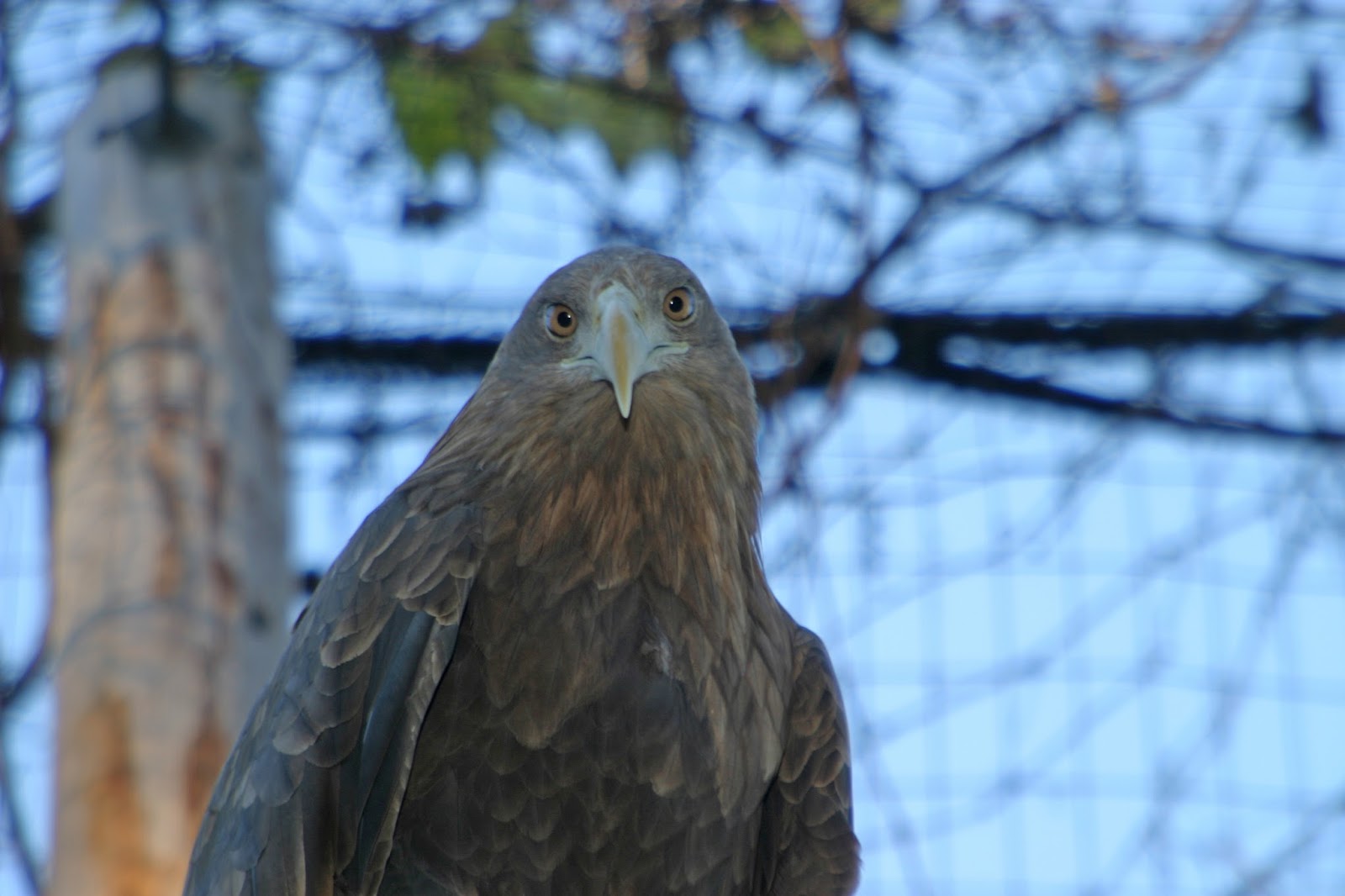
Showing posts with label White-tailed Sea Eagle. Show all posts

Thursday, January 8, 2015

Eagles of the World: Madagascar Fish Eagle


The Madagascar Fish Eagle has been described as one of the rarest birds on Earth with only about 40 breeding pairs in existence today.

A rare Madagascar Fish Eagle (photo: The wikipedia files)

The Madagascar Fish Eagle (Haliaeetus vociferoides) is a large diurnal bird of prey that surprisingly resides within the Madagascar dry deciduous forests.  No irony there.  They are actually confined to Madagascar where they survive in small quantity along the west coast

This eagle is considered a medium size eagle with a wingspan averaging around 65-70 inches long.  Male Madagascar Fish Eagles have been recorded weighing anywhere up to 6 pounds, while the slightly larger females can weigh up to 8 pounds.

The Madagascar Fish Eagle feeds mostly on fish and other aquatic life (photo: The wikipedia files)

These birds are characterized by having a dark body and wings, a light brown head with a white throat and cheeks, a white tail, a dark grey colored beak with a paler base, and pale grey legs.  Unlike adult Madagascar Fish Eagles the juveniles have paler bellies with yellow markings, a dark tail, and streaking on their heads.  It is not until a juvenile has reached five years of age that they develop their full adult plumage.

These Eagles, being endemic to the island of Madagascar, mostly feed on fish and other aquatic life, such as crabs and turtles.
 
These rare birds of prey face diminishing numbers due to many threats to its breeding habitat, including deforestation, soil erosion, and the development of wetland areas for rice paddies.  Not only does this raptor have to face the significant impacts from losing its habitat, but also faces harsh competition for fish from human competitors.

Two Madagascar Fish Eagles(photo: The wikipedia files)

According to the International Union for the Conservation of Nature, also known as the IUCN, this species holds the rank of critically endangered.  According to this index this species has been assigned this rank because it is facing a very high risk of extinction in the wild.
 
The Madagascar Fish Eagle population has remained at low numbers for what some believe to be hundreds to even thousands of years.  This means that although the population is small, it may also be stable, which will hopefully lead to a less critical ranking in the near future.

Even though the World Bird Sanctuary does not have one of these rare eagles in our collection, we do have two of its cousins—the Bald Eagle and the White-tailed Sea Eagle on the exhibit line, which is open to the public 363 days of the year.   

Submitted by Callie Plakovic, World Bird Sanctuary Outreach Coordinator


Sunday, October 26, 2014

Steller’s Sea Eagle (Haliaeetus pelagicus)


Being a Steller’s Sea Eagle (emphasis on Sea Eagle) these large birds of prey love to gorge on fresh fish and water birds.  On average, they are the heaviest eagles in the world.  Weighing in at anywhere between 11-20 pounds they give the Harpy Eagle and the Philippine Eagle some intense competition in the realm of size.
An adult Steller's Sea Eagle  (photo: The wikipedia files_Markus-Riesenseeadler)
These massive birds have the second largest wingspan of any eagle, which ranges from 6.4 to 8.2 feet.  Females have an average weight of anywhere between 15-20 pounds; males are significantly smaller weighing in around 11-13 pounds on average.  In addition, they have a very large skull and bill; their skull and culmen (upper ridge of a bird’s beak) measuring the largest among eagles.
The Steller's Sea Eagle has a massive beak (photo: The wikipedia files_Greg Hume)
This Eagle has dark plumage covering the majority of its body and high contrasting white on parts of its upper-wing coverts, under-wing coverts, thighs, and under-tail coverts.  Many adults have an extremely bold pied (meaning black and white) coloration.  This raptor has a distinct tail that is relatively longer than those of the White-tailed Sea Eagle and is structured in a wedge-like shape (center tail feathers longer than outer ones).  Like many eagle species they have yellow colored eyes, bills, and feet.  Nestlings have significantly lighter plumage, which is mostly white though it does not take long for their juvenile brownish-grey plumage to start appearing.
Another view of that massive beak (photo: The wikipedia files)
Steller’s Sea Eagles are known to make a deep barking cry, ra-ra-ra-raurau, when they find themselves in an aggressive interaction.  White-Tailed Sea Eagles have a similar call although the Steller’s call is much deeper.
Steller's Sea Eagle with fish (photo: The wikipedia files)
It has been observed that Steller’s Sea Eagles may favor pink salmon and chum salmon, which are sometimes supplemented by grayling and three-spined stickleback (both northern river fish species).  This species of eagle prefers to hunt almost exclusively in shallow water where they hunt active spawning rivers in August and September. In winter, once spawning season has died down, their main diet becomes leftover dead salmon and carrion as they start to move inland.  To see a video of Steller’s Sea Eagles in action Click Here

Steller’s Sea Eagles are classified as Vulnerable by the International Union for Conservation of Nature.  Their total population is estimated at 5,000 and is continuing to decrease.  In areas such as Japan they are regarded as a “National Treasure” and are legally protected.  The factors that threaten their survival include habitat alteration, industrial pollution, and over-fishing.

To see close relatives of this magnificent sea eagle come out and visit the World Bird Sanctuary and stroll down the path just beyond the hospital to many of our Bald Eagles and our beautiful White-tailed Sea Eagle, Cousteau.  The World Bird Sanctuary is open 363 days of the year (barring inclement weather closings).  For directions and hours Click Here.    

Submitted by Callie Plakovic, World Bird Sanctuary Outreach Coordinator

Sunday, July 13, 2014

Birdlore: White-tailed Sea Eagle, the Eagle with the Sunlit Eye


The White-tailed Sea Eagle is the reigning king of the skies in northern Europe and Asia.

As the largest European raptor, they are an apex hunter (top of the food chain).  They can be found soaring along the coast at heights of 200 - 300 meters looking for prey (typically fish) in calm waters.  They also possess, on average, one of the greatest wingspans among eagles at 1.78 to 2.45 meters (8.04 feet) and rival only the Stellar’s Sea Eagle for the title of greatest wingspan!  The Stellar’s Sea Eagle although larger in weight and length is the closest rival for median wingspan at 1.95 to 2.5 meters (6.4 to 8.2 feet) amongst living eagles.  A Bald Eagle by comparison has a wingspan of 5.8 to 7.5 feet.

A Norway White-tailed Sea Eagle stretching its broad wings in flight!
 The White-tailed Sea Eagle has longed been admired for its size and majesty among early European societies.  The Gaelic name, iolaire suile nag rein, translates as “eagle with the sunlit eye” inspires a sense of fantasy and awe.  The name may reflect the White-tailed Sea Eagle’s very prominent pale yellow eyes.

On the Orkney Isles, an archipelago north of Scotland, a 3000-year-old tomb was found in the 1950’s with bones belonging to the White-tailed Sea Eagle species scattered among human remains.  While the exact purpose of the Sea Eagle bones hasn’t been determined, researchers speculate that they are religiously important or a clan’s symbolic sign.  In some places in Scotland some people would actually leave their dead out in the open to be scavenged by eagles before burying the bones.

Fishermen of the Shetland Islands, farther north than the Orkney Isles, still refer to the White-tailed Sea Eagle by its Anglo-Saxon name, Erne or “the soarer”.  Centuries back, fishermen believed the White-tailed Sea Eagle had magical abilities to call fish up to the surface with belly up in submission for a successful catch!  In hopes of improving catches, fishermen would rub eagle fat on their hooks.

Unfortunately, the White-tailed Sea Eagle has been extirpated in the British Isles since the early 1900’s due to persecution and loss of habitat.  The last Sea Eagle in the British Isles, also a rare albino, lived on the Shetland Isles and was protected for thirty years by the island’s inhabitants.  Sadly, this beautiful bird was shot in 1917, officially making the White-tailed Sea Eagle extinct in the UK. (Extirpation refers to a species which ceases to exist in a chosen geographic area of study, though it still exists elsewhere.  Local extinctions may be followed by a replacement of the species taken from other locations as is the case for the White-tailed Sea Eagle.)

In the last decade or so, reintroduction efforts have seen the slow return of the White-tailed Sea Eagle to the shores of Scotland, and more recently Ireland.  Chicks from thriving Sea Eagle populations in Norway were raised and then released to establish their own territories and mates. 

Cousteau, WBS's White-tailed Sea Eagle (photo: Jessica Bunke)
If you wish to meet this bird of legend, come to the World Bird Sanctuary to meet the White-tailed Sea Eagle’s ambassador--Cousteau.  He lives on the WBS display line year round for the public to see.  Often times, you’ll see and hear him calling out with a loud keening greeting.

Cousteau is available for adoption in our Adopt A Bird program.  Your adoption fee will help to feed, house and care for Cousteau in the coming year.

Submitted by Jessica Bunke, World Bird Sanctuary Naturalist/Trainer

Sunday, June 1, 2014

Eagles of the World: The White-tailed Sea Eagle


 The White-Tailed Sea Eagle, “Haliaeetus albicillo,” is a very large bird that is considered closely related to the Bald Eagle. 

Head shot - White-tailed Sea Eagle (photo: wikipedia)

Its wingspan can measure anywhere between five and eight feet in length.  This Eagle is known to be one of the largest Eagles in the world averaging slightly larger than the Bald Eagle.  Moreover, the White-Tailed Sea Eagle is ranked on average the fourth largest and fourth heaviest bird in the world.  The largest recorded weighed in at 17lbs.

Full body photo - White-tailed Sea Eagle (photo: wikipedia)

This Eagle is characterized by thick yellow beak and feet, broad wingspan, and large head.  The White-Tailed Sea Eagle has mostly brownish-gray plumage with the exception of a slightly lighter head and neck, dark, nearly black flight feathers, and its distinctive white tail feathers.  The average lifespan of a White-Tailed Sea Eagle is 21 years, although some have lived upwards of 25 years.

White-tailed Sea Eagle fishing (photo: wikipedia)

Like most birds of prey the diet of a White-Tailed Sea Eagle varies due to season and opportunity.  Because these birds inhabit mostly coastal areas, the majority of their diet is in the form of scavenged mammals, birds, or fish.  Any fish that is near the surface of the water is likely to fall victim to this large predator.  Their main source of food during the winter months consists primarily of carrion, although it seems they prefer fish and ungulates.  They have sometimes been known to target water-based birds as well as land birds.  They will repeatedly fly towards a water bird causing it to dive again and again until the bird has become exhausted and is no longer hard to catch.  Once the water bird has been killed the White-Tailed Sea Eagle will fly the prey across the top of the water to the shore where it will then be consumed.
 
These Eagles reach sexual maturity around 4 or 5 years of age whereupon they will then find a mate and pair for life.  If one eagle dies they are usually comfortable finding a replacement fairly quickly. 

Pairs usually produce between one and three eggs a year, which are laid about 2 to 3 days apart.  Once the eggs have been laid they are then incubated for another 35-40 days by both the male and female.  At 11-12 weeks the nestlings are now mature enough to feed themselves and promptly fledge.  The youngsters remain close to their nest for another 6-10 weeks, then leave their parents’ care completely.  Juveniles tend to disperse from breeding areas and become more migratory than the mature Eagles. 

Range of the White-tailed Sea Eagle (photo: wikipedia)

For the most part, these apex predators can be found mainly around Europe.  However, they have been known to range anywhere from Greenland to Southern China and often inhabit areas close to water. 

Cousteau, WBS's resident White-tailed Sea Eagle (photo: Gay Schroer)

The World Bird Sanctuary is fortunate to have one of these magnificent birds on our display line.  The next time you visit WBS be sure to stroll down the line to see Cousteau, our resident White-tailed Sea Eagle.

 
Submitted by Callie Plakovic, World Bird Sanctuary Outreach Coordinator

Friday, July 5, 2013

Cousteau - The Regal Eagle


If you love eagles, then you are reading the right blog!  In this one I will discuss a very special eagle that I have come to know since I have been working at the World Bird Sanctuary.  His name is Cousteau and he is a White Tailed Sea Eagle (Haliaeetus albicilla).

Meet Cousteau, a White-tailed Sea Eagle

These impressive eagles can be found in small areas of Europe and northern areas of Asia.  Even though they do not have any natural predators, human activity, such as poisoning, stealing eggs, loss of habitat, and decreased food sources has forced them to become protected by organizations such as the Mull Eagle Watch in Scotland and the International Migratory Bird Act.

Adult and juvenile White Tailed Sea Eagles are visually dimorphic.  This simply means that as the juvenile ages, its plumage (feather color) changes.  Juveniles have very dark brown plumage and adults have lighter brown plumage with a completely white tail.  This process takes from 5-6 years to complete. 

As with most birds of prey, the females are about a third larger than the males. White Tailed Sea Eagles weigh from 9-12 pounds and are 27-36 inches in length.  Their wingspan is the same as the Bald Eagle’s--6-8 feet wide.

After the White Tailed Sea Eagle has become an adult, it will search for a mate.  Females normally lay 1-2 eggs, sometimes 3 eggs per clutch (a group of eggs or chicks) in a nest in a tree.  The chicks will fledge (leave the nest) at 13-14 weeks of age, but still continue to stick around the parents begging for food even though they can manage on their own.  Their diet consists mainly of fish, but will also include mammals, reptiles, birds, and carrion (dead animals).

In this photo you can see the white tail from which this species takes its name 

Cousteau was hatched in captivity at the Kansas City Zoo on April 1st, 1997, making him 16 years old this year.  The lifespan for these eagles ranges from 20-25 years in the wild, but in captivity they can reach 40-50 years old.  There are a small handful of reasons why their lifespan is longer in captivity than in the wild.  These include protection from predators, available food on a daily basis, medical attention availability if necessary, and full or partial shelter from the elements.

Cousteau has lived at the Mesker Park Zoo in Evansville, IN and the Greater Baton Rouge Zoo in Louisiana before coming to the World Bird Sanctuary in 1998.  From the spring of 1999 to the end of the show season in 2001, he was part of WBS’s educational bird show at Busch Gardens in Williamsburg, VA.  Since then, he has been on display on our exhibit line.  When I or someone else he recognizes walks by his exhibit, he vocalizes and follows me/them down the exhibit line.  He is a very interesting bird with fascinating behavior!

Cousteau is available for adoption in our Adopt a Bird program.  To find out more information, call 636-861-3225.  All adoption donations are tax deductible. 

This summer Cousteau can be seen on the exhibit line at the World Bird Sanctuary, which is open daily from 8am-5pm.  Cousteau is definitely a regal eagle.  You should stop on by and visit him!

Submitted by Lisbeth Hodges, World Bird Sanctuary Naturalist