Showing posts with label Weird Birds. Show all posts

Sunday, January 18, 2015

Really Weird Birds: Vulturine Guineafowl


Vulturine Guineafowl (Acryllium vulturinumare found in sub-Saharan Africa, from Uganda to eastern Kenya.  Their habitat consists of dry desert areas with patches of scrub, bushes, and tall grass.

Currently, there are seven species of guineafowl, all found in Africa.  This family of birds is related to turkeys, grouse, quail, pheasants and chickens (Order Galliformes).

 Vulturine Guineafowl showing full plumage (photo: the wikipedia files)

Vulturine guineafowl are the tallest and most colorful of the guineafowl.  They have longer wings, necks, legs, and tails than any other in their family.  An individual stands between 2 and 2.5 feet tall and weighs between 2.5 and 3.5 pounds. 

They have mostly a cobalt blue body with black and white striped feathers draping from the neck and small white dots on the side and back feathers.  What makes them strange is that they have mostly featherless faces and heads like vultures, except for some fluffy brown feathers on the back of their head (which resembles a monk’s haircut!).  They also have featherless necks.  Their skin is bluish-gray and their eyes are red.  Other guineafowl have featherless heads as well, but this species, especially up close, looks like a vulture.
Vulturine Guineafowl closeup - notice the bald head which resembles that of a vulture (photo: the wikipedia files)
Vulturine guineafowl are usually seen living in groups of 25-30.  Males and females look the same, with the female being slightly smaller.  Males tend to be aggressive towards females most of the time.  One way to tell them apart is by looking at their posture.  Males tend to stand as tall as possible.  In contrast females portray a more submissive posture.

Females lay 3-18 eggs, and sometimes nests contain eggs from more than one mother.  The shells are very thick and hard to crack and the chicks outgrow the egg and break out rather than chip their way out.  They are well developed when they hatch and are ready to fly within a few days.

Vulturine Guineafowl are omnivorous and eat seeds, roots, grubs, rodents, small reptiles, and insects.  When there is competition for food, they have been known to fatally injure their own kind, and even chicks will attack one another!

This species in not threatened or endangered in the wild.  These birds do well in captivity and can become very tame.  They are popular and highly sought after in aviculture.

The next time you visit the World Bird Sanctuary be sure to check out this unusual bird’s relatives—the turkeys and chickens that reside on our display line.


Submitted by Sara Oliver, former World Bird Sanctuary Naturalist          

Friday, December 19, 2014

Really Weird Birds: Red-tailed Tropicbird


The Red-tailed Tropicbird is found throughout the Indian and Pacific Oceans.  It nests on tropical islands, including Hawaii, but is otherwise mainly seen far out at sea, rarely near the shore.  They are more pelagic (seen on the open ocean) than other tropicbirds.

There are three species of tropicbirds making up the sole members of the family Phaethontidae: Red-tailed, White-tailed and Red-billed Tropicbirds. They are very graceful and fluid in flight.

The Red-tailed Tropicbird is about 16 inches long and its tail is another 14-21 inches long.  Its entire tail is not that long however; it has a few very long red tail feather streamers. Like its other family member species, they have mostly white feathers with long pointed wings, short necks, and wedge-shaped tails. Their bills are dark red, and they have black eye patches with a stripe.


Red-tailed tropicbird in flight
 Tropicbirds are incredibly graceful and agile in flight; however, they are very awkward and clumsy walking on land.  They have extremely short legs and webbed feet, well adapted to paddling in the open sea, but not for walking on solid ground.  Click here to watch a video of them waddling as best they can!  They have to scoot around on their bellies for the most part.

Even though they are clumsy on land, they are excellent flyers.  They can remain at sea for indefinite amounts of time, soaring up on riding ocean wind currents and flying with rapid wing beats.  When hunting, they will spiral downwards and plunge into the ocean to catch fish in their serrated beak.

These birds perform complex aerial courtship displays.  They will fly backwards and in circles, meanwhile waving their tails back and forth.  They may also engage in courtship bicycling flight, where one bird hovers over the other and then they shift positions.

Females lay one egg on the ground in a shaded area and both parents take turns incubating the egg.  After the chick hatches, it looks like the cutest white ball of fluff you have ever seen!  It looks like it’s been overtaken by fluff and the only thing visible are their tiny black beaks and beady little eyes.  In about 3 months fledging occurs and they begin to leave the nest.

None of the three species of tropicbirds are endangered or threatened.  With so many other seabirds becoming threatened by pollution, sea fishing, and disturbance of their island breeding grounds, this is a welcome anomaly.

Submitted by Sara Oliver, World Bird Sanctuary Naturalist

Sunday, March 30, 2014

Really Weird Animals - Potoo

Potoos are a group of seven species of tree-dwelling birds native to the Neotropics of Central and South America.  They are not much to look at and you’ll struggle to see them at all!  They are not brightly colored like many tropical birds or fierce like raptors, but they are masters of disguise. Their complex feather patterns of grays, browns, and black resemble tree bark perfectly.  They can stand perfectly camouflaged atop a dead tree branch.  A potoo will position itself to mimic an extension of the tree branch itself.

A Common Potoo camouflaged on a stump (wikipedia.org)

They are nocturnal and spend the day resting, out in the open on the end of a dead tree limb.  They have unusual slits in their eyelids which allow them to sense movement even when their eyes are closed.  The instant a potoo detects an intruder it slowly moves its head straight up and freezes.  With its beak pointing up to the sky, it stays perfectly still until the threat passes, looking like no more than the end of a broken branch.  They can move their heads unperceptively slow in order to watch a predator carefully.  They will squint their eyes as to not expose themselves by revealing too much of their bright yellow irises.  These birds are so amazing at camouflage that they show complete composure under pressure and only break free from their disguise if a predator is almost upon them.  


A Long-tailed Potoo (wikipedia.org)

The Rufous Potoo is the smallest of the seven species and is invisible among dead leaves and trees.  To increase their camouflage even further, they may rock back and forth while roosting to even closer resemble a dead leaf that’s waving in the breeze. 

Potoos are very selective nesters.  They will not build a nest, but will find an upright broken tree branch with just enough depression or crevice for a single egg to rest.  Both parents will take turns shielding the egg from predators and bad weather. Potoos feed on flying insects at dusk and at night.  They will regurgitate partially digested food to feed the chick.  When the chick is too large to hide under its parent’s protection, it will assume the same freeze position resembling a clump of fungus, since it has gray downy feathers.

Potoos have proportionately large heads for their body size and long wings and tails.  The large head is dominated by enormous eyes and a massive broad bill, helping them to see prey in little light and to then catch and swallow that prey whole.  Beetles and other flying insects are their main source of food. However, one Northern potoo was found with a small bird in its stomach!

Fortunately all seven species of potoos are not on the endangered or threatened species list, but like all tropical wildlife, they are still subject to rapid loss of habitat by deforestation.   

Submitted by Sara Oliver, Naturalist

Saturday, November 16, 2013

Really Weird Birds - The Alpine Swift


The Alpine swift is an amazing migratory bird that spends its breeding season, which is the Northern Hemisphere summer months, in and around the Mediterranean and the northern Middle East, including the United Arab Emirates, through to western Asia and India. 

Before the arrival of winter, they migrate south to southern and eastern Africa, where there is a seasonal abundance of insects.  They have wide gaping mouths perfect for catching and swallowing insects while in flight.

Alpine swift in flight. 
Recently published in the journal Nature Communications, is a study that shows the first evidence that the Alpine swift can fly day and night for 200 days straight during their migration.  This is longer than any other recorded bird.  Six birds were affixed with a device that recorded acceleration and ambient light.  This determined when the birds flapped their wings, glided, and when they rested.  The results show that they didn’t fly during their breeding season, when they had to incubate their eggs and land on the nest to feed babies.  However, they glided and flapped during their entire southern migration (which included across the Sahara Desert!).  They also glided and flapped during their entire overwintering period in sub-Saharan West Africa! Then of course the return migration was non-stop also, meaning this little bird spends more than six and a half months of non-stop, day and night flight, which covers about 6,200 miles!

Flying and staying airborne uses up a lot of energy and Alpine swifts must be able to recover and rest while still aloft.  The results from the study are still inconclusive as to whether the birds actually sleep during their time above ground.  Perhaps these birds, like some other organisms, use unihemispheric sleep, where half the brain powers down into sleep mode while the other half remains alert; or perhaps they only sleep during their breeding season. 

They are of course very well adapted to eating in the air.  They will swallow small insects, but what also nourishes them is called aerial plankton.  It’s a mixture of fungus spores, bacteria, minute seeds, and those tiny insects.  Aerial plankton also contains enough water for Alpine swifts to last them indefinitely.

This research team next hopes to discover the evolutionary causes responsible for this extraordinary behavior.

Submitted by Sara Oliver, World Bird Sanctuary Naturalist

Friday, October 25, 2013

Really Weird Birds: Kagu


The Kagu (Rhynochetos jubatus) is only found in the mountain forests of New Caledonia, which are islands to the east of Australia. 

The Kagu is the sole surviving member in the family Rhynochetidae and the only known close relative is the Sunbittern.  Kagus are listed as an endangered species by the IUCN Red List.

Kagus live on the forest floor, but the strange thing about this bird is, at first glance, they don’t seem to have adapted well to that type of habitat.  Most creatures that live in forests and on the forest floor have excellent camouflage in order to blend in and remain undetected by predators or prey.  The Kagu however has an unusual look for a forest-dweller.  It has light gray feathers, a bright orange beak and legs, a head crest, and bold stripes on its wingtips.  They are known locally as the “ghosts of the forest.”


A Kagu showing off its wings. 
The Kagu is flightless, although it does not have reduced wings like some other flightless birds.  It has a wingspan of about 2.5 feet but they lack the muscles for flight.  They are used mainly for display and can be used for gliding to escape danger. 

These birds are carnivorous and eat a variety of small animals including worms, snails, insects, and lizards.  They find most of their prey in the leaf litter and soil.  If digging is required, they use their beak, not their feet.  They are the only birds to possess ‘nasal corns’, structures covering the nostrils that prevent debris from entering when prodding in the soil.  Another unique characteristic of this bird is that it has only one-third the red blood cells and three times the hemoglobin per red blood cell compared to other birds!


 Kagu with feather crest on display. 
Before Europeans colonized New Caledonia, there were no natural predators for these birds.  Europeans brought cats, dogs, pigs, and rats.  Feral pigs and rats will eat Kagu eggs and chicks; cats and dogs go after both young and adult birds.  It is estimated that there are only between 250-1000 mature Kagus remaining in the wild today.  They also suffer from habitat loss caused by mining and forestry.

Kagus are protected in New Caledonia and have been the subject of conservation efforts, including breeding and releasing, and eradication of the unnatural predators.


Submitted by Sara Oliver, World Bird Sanctuary Naturalist

Friday, October 11, 2013

Really Weird Birds: The Terror Bird


Terror Birds were very large, flightless, carnivorous birds which are now all extinct.  They were the largest group of top predators in South America during the Cenozoic Era (62-2 million years ago). 

Terror Birds ranged in height from about 3 to 10 feet tall.


Image of Terror Bird species Paraphysornis brasiliensis, measuring about 6 feet tall 
These birds had unusually massive skulls and beaks.  The largest bird skull yet found belongs to the Terror Bird species Kelenken guillermoi.  This bird’s skull measures 28 inches long, including its 18 inch beak.  It stood about 9.8 feet tall!


Image of Kelenken guillermoi, largest head of any known bird 
What was the purpose and benefit of having such a large head and large beak?  Surely to capture and kill prey, but how?  One opinion is that they captured prey with their beak and in order to kill it, shook it vigorously until its neck or back broke.  A second opinion is that after capture they would bite straight down on the animal in order to kill it.  A third opinion is that when in pursuit of prey, the bird would hammer and jab its prey at the opportune moment.
 
In order to figure out which method Terror Birds most likely used, scientists used CT scans of the bird’s skulls and biomechanical computer models highlighting the physical stress put on the bones when executing the different methods of kill.  The method that showed the least stress was pulling back with the neck and hammering prey with the beak.  The scan showed the skull to have rigid beam-like bones where almost all other known birds have flexible joints.  The beams strengthen the skull and beak, making them extremely powerful for up and down jabbing motions.  Scans also revealed a hollow beak.  Models showed that thrashing the head back and forth with a wiggling prey item makes the hollow beak susceptible to breaking; therefore a method most likely not used.


Skull of terror bird species Paraphysornis brasiliensis
The Terror Bird’s legs were well adapted for quick, agile movement.  They most likely chased prey until either it was cornered or worn out; then the Terror Bird would swing its beak down on the animal like a hatchet, over and over again!

All in all, one could easily see how this bird got its name, for it must have been a truly terrifying creature!

Submitted by Sara Oliver, World Bird Sanctuary Naturalist

Thursday, August 8, 2013

Really Weird Bird Behavior: The Great Tit


The Great Tit is a small (4.9–5.5 inches in length) passerine bird, but large in the family Paridae, which includes chickadees and titmice.  The species is very widespread, found in woodlands across Europe, the Middle East, Central and Northern Asia, and parts of North Africa. 

 A pair of Great Tits

These birds consume mostly insects during the spring and summer.  Once colder weather arrives and insects are scarce, they eat more seeds, nuts, and berries.  Similar to birds of prey, tits will hold larger food items in their feet in order to eat.  They will also strike at the food with their beak until it is ready to devour.  They can break open a hazelnut with this method in about twenty minutes.  They will hammer off the heads of large insects when feeding them to their young.  They will also hold down large caterpillars with their feet and rip out their guts so the chicks do not consume tannins (found in the plants eaten by caterpillers), which could inhibit chick growth.

When food becomes very scarce in the winter, these small birds turn into ravenous predatory beasts!  They will seek out and hunt hibernating common pipistrelle bats!


A Common Pipistrelle Bat in flight. 

A study done at a Hungarian cave, published in 2009, discovered that it was not an opportunistic feeding behavior.  The Great Tits actively and purposely searched for the bats, then pulled them out of their roosting cavities and pecked at their heads until they died.  The bird then proceeded to eat their brains…so nutritious!

The Great Tit has also been witnessed to kill smaller passerine birds and eat their brains.  One case reports Pied Flycatchers with smashed skulls were found in a nest box taken over by Great Tits.  There have also been reports of Great Tits attacking and killing birds that were caught in nets or traps.  They will attack small or weak birds and split their heads open with their beaks to get to the brains! 

Submitted by Sara Oliver, World Bird Sanctuary Naturalist


Sunday, August 4, 2013

Really Weird Birds: The Shoebill Stork


Shoebill storks are native to East-Central Africa.  They favor freshwater swamps and dense marshes where they eat fish, young waterfowl, amphibians, and small reptiles – including baby crocodiles!  

These birds are very prehistoric-looking and have a very unusual beak!  It can be up to twelve inches long and five inches wide and it resembles the shape of a wooden shoe.
The beak resembles the shape of a wooden shoe
Shoebills are fairly large birds, with some reaching up to five feet in height with a wingspan of seven to eight feet in length.  They are quite solitary birds; even a mating pair will often forage at separate ends of their territory.  The monogamous pair builds a grassy nest on a floating platform of vegetation, up to nine feet wide, often amid dense stands of Papyrus, which is similar to reeds in our country.  The female lays up to three eggs but usually only one hatchling will survive.  The younger chicks are considered to be back-ups in case the eldest chick doesn’t survive.  Both parents will help to feed and protect their young.  They become reproductively mature at three to four years old and can live up to thirty-six years in captivity.

Some Shoebills may reach up to five feet in height
The Shoebill Stork is mostly an ambush predator.  They stand absolutely still waiting for prey.  Sometimes they will wade through the marsh very slowly in search of their next meal.  Once prey is spotted they can move with amazing speed and power.  The hook at the end of their large beak helps to grip and crush.  Click here to see some amazing footage of a Shoebill Stork hunting lungfish!  Their very large feet are well adapted for standing and walking on aquatic vegetation while hunting.  Their middle toe measures up to seven inches in length!

Shoebills are listed as a vulnerable species by the IUCN Red List of Threatened Species.  Their population is declining because of habitat loss, hunting, and capture for the black market bird trade.  Their habitat is being destroyed in order to create farmland and pasture.  These birds are also hunted for food in some countries and their eggs are collected and sold as food or to zoos or collectors.  Capture and sale of these birds is a problem, especially in Tanzania, where trading of the species is still legal.  In Zambia, fire and drought threaten shoebill habitat, and nests are often crushed by large herbivores foraging in the swamps.

If you want to help endangered birds, part of the World Bird Sanctuary’s mission is to secure the future of threatened bird species in their natural environments.  You can help us fulfill that mission by simply visiting us and spreading what you’ve learned, becoming a member or friend, or adopting-a-bird and feeding that bird for a year!

Submitted by Sara Oliver, World Bird Sanctuary Naturalist


Monday, March 4, 2013

Really Weird Birds: Part 13


A bird dancing like Michael Jackson?  That’s pretty weird! 

The most odd thing about the Red-capped Manakin bird is the male’s courtship display.  During his performance, he rapidly shuffles backwards across a branch demonstrating a dance called the moonwalk!
 A beautiful Red-capped Manakin (photo courtesy of Wikipedia)
You have to see it to believe it!  Click here to see some amazing footage of this Michael Jackson wannabe.

The Red-capped Manakin is one of sixty species of Manakin birds.  Manakins use a lek mating system where males gather in a relatively small area to dance, call, and compete for the female’s attention.  Males are not monogamous, nor do the males help to raise their young.  A single male could inseminate all the local females.  Therefore competition for females is high and creates strong pressures for sexual selection.  Only the best dancers or dancer gets to mate! 

Manakins will use the movement of their wings to make interesting sounds during courtship.  They can move their wings faster than the eye can see at 80 beats per second, faster than a hummingbird!  Part of this video shows a mating dance in slow motion at 500 frames per second.  Humans only see at about 60 frames per second and an average camera sees about 90 frames per second.    

The Red-capped Manakin is a small passerine (all birds from the order Passeriformes), measuring 4 inches in length and weighing only 16 g (0.56 oz).  They are found from southeast Mexico south through Central America to Panama, and then along the Pacific slope of South America to northwest Ecuador.  They prefer mainly humid forests and second growth woodlands and are frugivores, eating mostly fruits.  These birds aid in the dispersal of seeds in the forest through the passing in their feces. 

Luckily the Red-capped Manakin is not listed as endangered or threatened.  However all birds and creatures native to rainforests are suffering from habitat loss every day.  If you want to help endangered birds, part of the World Bird Sanctuary’s mission is to secure the future of threatened bird species in their natural environments.  You can help us fulfill our mission by simply visiting us and spreading what you’ve learned, becoming a member or friend, or adopting-a-bird and helping to feed that bird for a year!

Submitted by Sara Oliver, World Bird Sanctuary Naturalist

Friday, January 11, 2013

Really Weird Birds Part 11


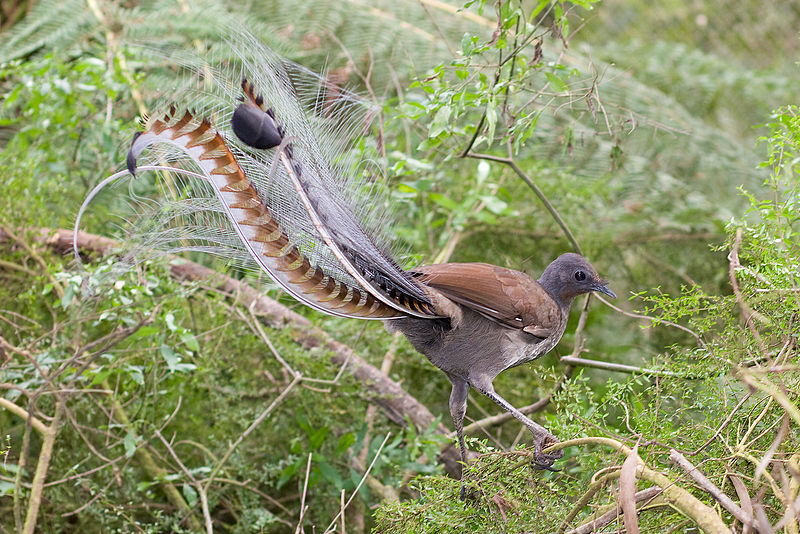
Australia has some amazing species of birds; one such example is the Superb Lyrebird.  The name “Lyrebird” comes from the resemblance of the male’s tail to a Greek lyre, especially when he is on full display (a Lyre is a type of a harp often seen in ancient Greek frescoes or pottery such as the photo below).

The only other species of Lyrebird, called Albert’s Lyrebird, has a more subdued version of the Superb Lyrebird’s tail.  They of course use their tails in courtship displays.  The rest of their body is quite drab, a brownish gray coloration. 
Male Superb Lyrebird in full display
During mating season, males will defend their territory against other males.  They are polygamous, meaning they will mate with more than one female, and display to as many females as possible.  The ladies will check out several different males before choosing to mate.  During courtship, the male will stand on a platform made of soil.  He will sing and dance and display his beautiful tail.  He inverts his tail over his head, fanning out his feathers to form a silvery white canopy.

The vocalizations of the Lyrebird are very impressive.  It has species-specific noises but most of its song consists of mimicry of other birds, animals, and other sounds.  The Lyrebird's syrinx (vocal organ) is the most complexly muscled of the songbirds, giving it amazing skill, unrivaled in song and mimicry.  The Lyrebird is capable of imitating almost any sound.  They have been recorded mimicking human caused sounds such as camera shutters, car alarms, and chainsaws, as seen in this video.  They have also been heard to mimic rifle shots, dogs barking, crying babies, music, and even the human voice.

Lyrebirds are among the largest of the passerines or songbirds (order Passeriformes, which includes warblers, sparrows, and even crows).  They are fairly long-lived birds and can live up to thirty years old.  They also start breeding later in life than other passerine birds.  Females are sexually mature at five to six years and males not until six to eight years of age.  Females typically lay a single egg in a ground nest and are the sole caretakers of the chick.

Lyrebirds find their food on the ground by scratching their feet through the leaf litter.  They eat a wide range of invertebrates such as cockroaches, beetle larvae, earwigs, fly larvae, moths, centipedes, spiders, earthworms, lizards, frogs and occasionally, seeds.
Male Superb Lyrebird foraging

The Superb Lyrebird, once seriously threatened by habitat destruction, is now classified as common.  Albert's Lyrebird has a very restricted habitat and had been listed as Vulnerable by the IUCN (International Union for Conservation of Nature), but due to careful management of the species and its habitat the species was downgraded to Near Threatened in 2009.

Even so, lyrebirds are vulnerable to feral cats (house cats that were allowed to wander outside and went wild), house cats allowed to wander outside, and foxes.  It remains to be seen if habitat protection schemes will stand up to increased human population pressure.

Never let your pet cats wander outside.  In addition to the fact that cats kill millions of birds, rodents and other wildlife every year, allowing them to wander outdoors shortens their life spans by exposing them to disease, attacks by other animals, and the danger of being injured or killed by collision with vehicles.  


Submitted by Sara Oliver, World Bird Sanctuary Naturalist


Tuesday, December 18, 2012

Really Weird Birds Part 10


Here’s an unusual bird for you: the Cock-of-the-rock!  There are two species native to South American rainforests and mountainous areas, the Andean Cock-of-the-rock and the Guianan Cock-of-the-rock.
 A male Guianan Cock-of-the-rock.  They are found in the Guianan Shield in humid forests near rocky areas.
  
The males of these species have beautiful orange coloration and feather crests on their heads used to help them attract a mate.  The females are much duller in color in comparison to the males. 
A male Andean Cock-of-the-rock.  They are found in the tropical forests of the Andes.

These birds are polygamous, a trait that started a unique courtship ritual.  At the beginning of breeding season, males will gather at a lek, or a communal area where they perform exuberant mating dances and displays to compete for females.  Each male has its own territory within the lek where they dance.  They jump up and down, strut about, bob their heads, ruffle their tail feathers, spread their wings, and utter unique calls.  The females walk through the lek analyzing all the displays.  Often two males will pair up and challenge each other to a dual!  They won’t get physical but they will face each other and have a dance off!  When a female approaches, the flapping and squawking gets even more intense.  When she chooses, she taps the male from behind and mating quickly occurs.

The males have nothing to do with nesting or raising the chicks.  The females will build a nest made of mud and plant material and attach it with her saliva to the side of a cliff, in a rock crevice or in a cave, always close to a water source and in a shaded area.  They lay 1 to 2 eggs that hatch in about 28 days. The chicks are fed fruits, small snakes, lizards, and insects.    
 Female Andean Cock-of-the-rock.

Cock-of-the-rocks are mostly fruit eaters and they serve an important role in the rainforests by contributing to the spread of local plant diversity.  The seeds from the fruit they consume pass unharmed through their digestive system and allow trees to grow greater distances away from their parent trees.

Fortunately the populations of the Guianan and Andean Cock-of-the-rock are doing well in their range.  They are not considered to be a threatened species and are listed as Least Concern on the IUCN Red List of Threatened Species.     

 Submitted by Sara Oliver, World Bird Sanctuary Naturalist

Tuesday, December 4, 2012

Really Weird Birds Part 9


A bird very few have even heard of, the Maleo, is found only on the Indonesian island of Sulawesi.   They have black upper parts and white under parts that are tinted with a rosy salmon color.  Their head is adorned with a helmet casque, which is thought to protect them from the sun.  
 The Maleo is about the size of a domestic hen.  
It is included in a group of birds called the Megapodes, or family Megapodiidae.  They are characterized by small heads and big feet!  They are the only group of birds that do not use their own body heat to incubate their eggs.  The Maleo in particular will bury them in open sandy areas, volcanic soils, or beaches so the sun or geothermal energy can heat the eggs.  Some other Megapode species will use fermenting compost to incubate their eggs!  The male and female Maleo will take turns digging holes for the eggs.  After they cover the eggs, the parents have nothing more to do with them. 

The Maleo’s egg is about five times larger than a domestic chicken’s egg.  It contains a huge yolk that offers plenty of nourishment for the chick to grow enough to be fully independent upon hatching.  The young birds will have to dig their way up and out of the sand and run to the forest for cover.  Unearthing itself from the ground is probably the most difficult part of the bird’s life.  It can take several days and predators like monitor lizards, snakes, and feral cats and dogs may be near.  (This reminds me of a sea turtle hatchling’s journey!)  The Maleo hatchlings are fully capable of flight and must find food and defend themselves on their own. 

The Maleo is listed as endangered on the IUCN Red List of Threatened Species.  They have been protected by the Indonesian government since 1972.  Unsustainable harvesting of eggs combined with human disturbance of nesting grounds has led to the abandonment of many nesting areas and continues to be the major threat to those remaining.  Forest destruction and fragmentation threaten surviving populations as well.

In 2009, the U.S. based Wildlife Conservation Society and other local environmental groups purchased a 36-acre stretch of beach on Sulawesi for $12,500 to help preserve the Maleo.  The birds nesting there now have their own private beach!  The protected area has also raised awareness about the bird.

If you want to help endangered birds, the World Bird Sanctuary’s mission is to secure the future of threatened bird species in their natural environments.  You can help us fulfill our mission by simply visiting us and spreading what you’ve learned, becoming a Member or Friend, or adopting-a-bird and helping to feed that bird for a year!

Submitted by Sara Oliver, World Bird Sanctuary Naturalist