Showing posts with label golden eagle. Show all posts

Thursday, July 16, 2015

The Rookie Class of 2015


The arrival of summer at the World Bird Sanctuary can mean only one thing--zoo shows are here!  And by Zoo Shows I of course mean those educational and entertaining programs WBS staff and birds present at zoos around the nation.

With every new zoo show season we have a new class of rookies ready to make their mark.  This year is an especially large graduating class so to speak, because not only do we have brand new birds, but an old pro that has come out of retirement.

Zeus, a young Golden Eagle is one of our new fliers (photo: Gay Schroer)

This year we have one rookie flyer at our Stone Zoo show and five at the Milwaukee County Zoo, plus one returning flyer after a six year vacation.  It is always exciting teaching new birds to fly.  Most new flyers do what I like to call “prong horning,” where they hop straight up into the air and then make a horizontal flight.  This is very common the first several times they take off until they learn how to better control their flights.  Many new fliers also overshoot their landing spots, since they have not yet learned how to apply their brakes or to properly calculate distance.  Discerning the distance to and from a perch and other objects is a skill that birds obtain through practice.

When we first started practicing Zeus our Golden Eagle he would fly away from his stumps if they appeared to be too close to the bleachers.  We moved the stumps and over several days and flying sessions we gradually pushed them back to their original positions.  Now Zeus loves his stumps wherever we place them on stage.

 Technically this is Evita's debut year (photo: Flannery O'brien)

 Even birds that don’t do a whole lot of flying, like Evita the Red-legged Seriema, have to start out slow so that they can get used to new situations.  Technically Evita was in two shows at the very end of the season last year, but this year is her big debut season.  We started out slowly, gradually leading her closer and closer to the stage.  Her first time on the stage she wandered around for five minutes exploring everything the theater had to offer.  After carefully checking out all three sets of bleachers she was ready to exit and hasn’t really wandered since.

The key with rookies is to start small, get the birds used to the behavior or pattern first and then transition it to the theater.  The audience must be built up gradually until they are used to people.  They often need time to check out their new surroundings, either by wandering or sitting on a high perch and just scoping out the area.  Giving a bird time to do this is very important because it makes them feel safe.  They learn the surrounding area, determine that there are no predators and make a mental map so they can get back in case they ever leave the theater.

Chique the Blue-fronted Amazon parrot (photo: Leah Tyndall)

Sherlock an African Pied Crow is currently practicing his recycling routine in his enclosure, but soon we will be able to practice him in the theater.  Chique (a Blue-fronted Amazon parrot) is just starting to do her vocal cues on the hand rather than in her cage.  Once she is comfortable on the hand, she will also move to the stage. 
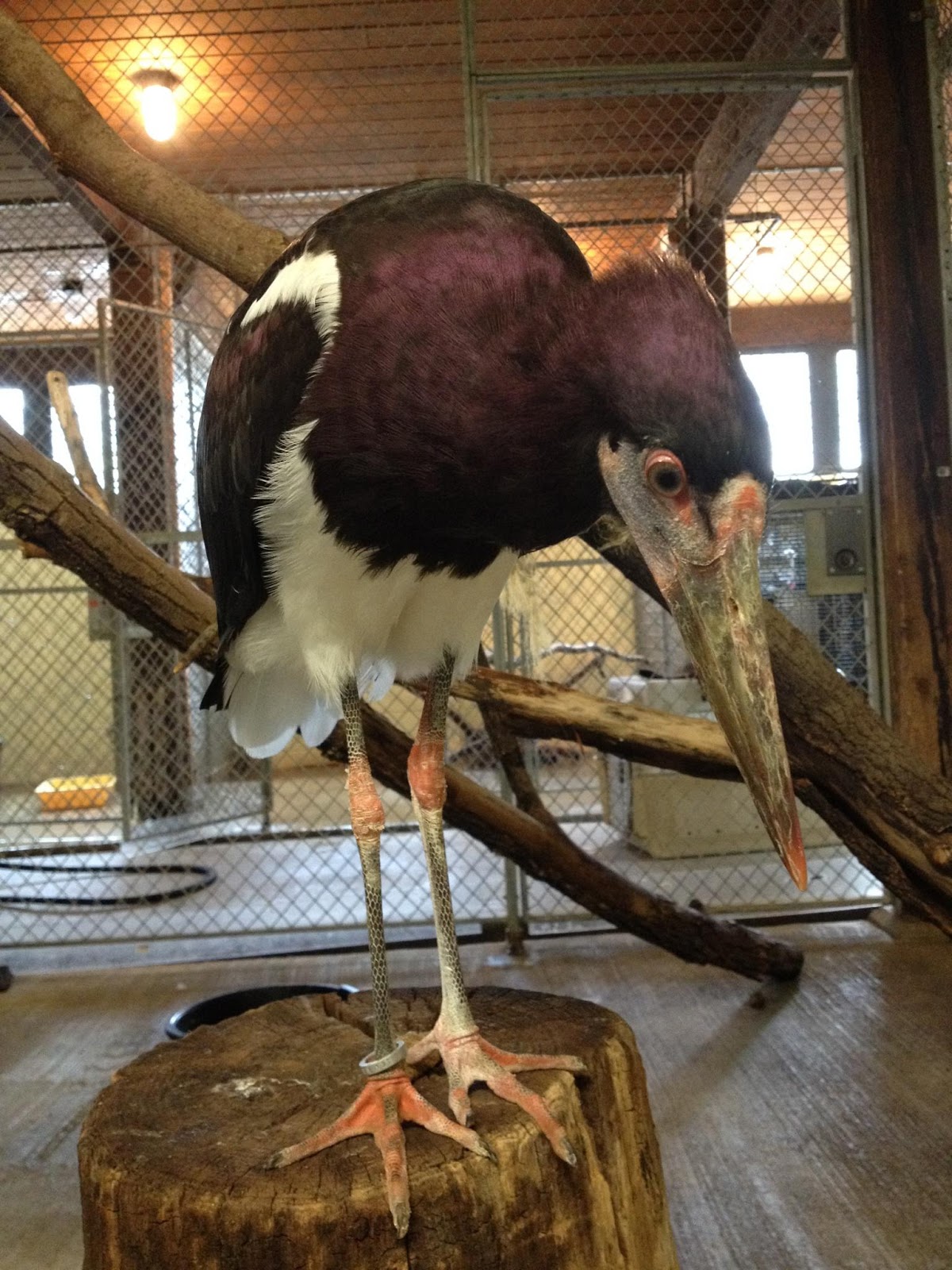
Azizi the White-bellied Stork rounds out our rookie line-up (photo: Flannery O'Brien)

Our last MCZ rookie is Azizi the White-bellied Stork.  He is learning to follow us, and our trail of meat, wherever we go.  This includes short walks outside of both his indoor and outdoor enclosures.

Skinner the Turkey Vulture is our returning veteran (photo: Flannery O'Brien)

The returning champion is Skinner the Turkey Vulture, who has already proved he is an excellent homing vulture.

Every new zoo show season means a new crop of rookies. Be sure to visit the Milwaukee County Zoo this summer and see Zeus, Azizi, Evita, Sherlock, Chique and Skinner. Also be sure to pay a visit to Roderigo the Common Buzzard up in Boston. Come see all of their hard work pay off.

Submitted by Leah Tyndall, World Bird Sanctuary Naturalist/Trainer


Saturday, March 7, 2015

Graduation Day


In this blog I’ve talked quite a bit about Zeus our Golden Eagle over the last couple of years. 

His training has been a huge part of my job, as well as a milestone in my life.  Last summer he completed another landmark by working at his first World Bird Sanctuary zoo show program at the Milwaukee County Zoo, and I couldn’t be more proud of that bird.  WBS has presented a bird show at the Milwaukee County Zoo for 30 of the last 31 years.

Zeus peering curiously at the camera (photo: Erica Fenske)

Last year was all about helping him to feel comfortable around people, especially large crowds.  We started him out small, placing him in our public weathering area every morning for increasingly longer periods of time.  Since there were many new things (vans, strollers, lots of people, construction equipment, etc.) we always had a pouch of treats to reward him for calmly tolerating all of the above.  This caused Zeus to associate going out to the weathering area with getting food, making it a very positive experience.

Being a clever eagle, Zeus would sometimes use these rewards to his advantage.  The big cat exhibit was under construction and many of the front loaders drove on the main road behind our weathering area.  This frightened Zeus at first.  We started rewarding him for jumping back up onto the perch once they went past and then for staying on the perch as they went by until he didn’t even flinch when he heard them coming.  Problem solved!  However Zeus remembered that we used to give him treats for hopping back up onto his perch (a subtle training error by me).  So, he started to jump off his perch for seemingly no reason, looked at me (and my bag of treats), hopped back up to his perch, and then looked at me again.  From then on we only rewarded him while he was sitting on his perch, which put a stop to this particular behavior.

Once Zeus was comfortable in the weathering area, we started putting him in shows as a walk on (he perched on our glove and we walked him around the theater).  His first audience was 68 people, but he quickly worked his way up to triple digit audiences.  We continued to reward him while he was being walked around so that he would want to be on stage, since it meant he was going to get treats.  The audience loved seeing a Golden Eagle, and we loved showing him off.

Zeus was unruffled by all the equipment and strangers (photo: Leah Tyndall)

Zeus became so famous at the Milwaukee County Zoo that Marquette University wanted to use him in a photo shoot (their mascot is the Golden Eagle).  I have to admit at first I was incredibly nervous.  Yes, Zeus had made great strides, but a photo shoot had all sorts of variables that could frighten him.  Cameras are strange, the backdrop might scare him, he was going to be surrounded by people he didn’t know, and a lot closer than he was used to.  What if a peacock wandered in…the list went on and on.  Turns out I need not have worried!  Zeus was amazing, he sat perfectly on his perch, didn’t seem bothered by the camera and no extraneous peafowl were afoot.

In the beginning Zeus eating from my hand was cause for celebration (photo: Mike Cerutti)

I cannot even describe the sense of pride I felt watching him.  This was a bird that trusted no one when I first met him in a huge free flight chamber.  He had to watch me for several minutes before he came down to eat the food I offered him.  Now he was sitting with a seemingly curious expression in front of cameras and strangers-- he even started preening; the ultimate sign of comfort for a bird!  He had come so far!  Sorry, I’m gushing, but I’m just so proud of this bird.

Zeus had a terrific season up in Milwaukee.  He learned a lot, he taught me a lot and he educated thousands of people about Golden Eagles.  Based on his performance and progress last season I am incredibly confident about his first flying season this year.  That’s right ladies and gentlemen.  For the first time in the history of the sanctuary, we’re free flying a Golden Eagle…stay tuned!

Submitted by World Bird Sanctuary Naturalist/Trainer Leah Tyndall

Tuesday, April 22, 2014

A New Friend


For the last 6 months I have had the opportunity to help train a Golden Eagle that we call Zeus.  The process has been a learning experience for all that have been involved.

Zeus waiting for his new phase of training (photo by Mike Cerutti)

Coming up this summer Zeus will be going to the Milwaukee County Zoo with a coworker of mine, Leah Tyndall, and a team of 3 other World Bird Sanctuary staff.  This staff will have around 20 birds, and the whole team will be presenting educational programs or, for short, “Zoo Shows.”  With that being said, the date is approaching that Zeus will be on his way to Milwaukee.

Zeus was given to WBS by a local falconer and brought to us in August 2012 as a young bird with a very strong spirit.  It was decided from the beginning that Zeus would be trained to one day fly in our educational programs, and help us educate the public about Golden Eagles. 

With the end goal set, the team of trainers set out to teach this amazing bird.  There are many, many other behaviors to train before the ultimate goal is achieved, and many of these behaviors were trained from September 2012 to August 2013.  Let’s move to last September.  It was decided that when Leah and all of our other staff and volunteers returned from Zoo shows, we would kick the training into another gear to make sure Zeus would be ready to go to Milwaukee this season.
   
When this was all decided in September I was thrown into the mix because Zeus needed to learn to trust many trainers; not just one or two trainers.  I have worked at WBS for almost 3 years, and in that time I have handled and done several events with our two other Golden Eagles, but they had been with WBS for over ten years and were already well trained.

Zeus our young Golden Eagle is in the process of learning many new behaviors (photo by Gay Schroer)

Every day presents new hurdles for Zeus and the trainer, but because of what Zeus has already learned, these hurdles are small and easily jumped.  In looking back on his accomplishments, he has grown up and learned so many things. We now are able to walk with him while he is sitting on our eagle glove and calmly stand in front of small groups of people.  He stands on a scale, steps confidently from a perch to 8 different trainers’ gloves, and the list goes on and on and is always growing!

Zeus will be missed by many this summer while he’s in Milwaukee, but when he comes back he will be even closer in his training to moving toward the final goal of free flying in front of the public!

Submitted by Adam Triska, World Bird Sanctuary Naturalist/Trainer

Friday, April 4, 2014

Birdy, It's Cold Outside

Recently I went to get my eyes checked and had a very enjoyable chat with my optometrist. She had recently visited World Bird Sanctuary, loved it and was curious as to how the birds were handling the cold weather. I realized that others might have the same question, so I decided to write my blog about our birds and the cold.
Peabody, the Tawny Owl, is native to Europe, where members of his species thrive in cold conditions.
Most of the birds that are on our display line in the winter are adapted for cold weather. They are either native to Missouri or even more extreme climates. Some species that are not native to Missouri can remain on our display line throughout the winter with additional wind protection or building shelters and providing them with heat lamps. Other species that are from warmer climates, such as the Brown Pelicans, move indoors for the winter and move back out once it warms up. Every now and then we need to bring birds indoors for the very cold spells, such as that week when we hit negative temperatures, but in general if a bird is out on our display line it is because it is adapted for the cold.

Ookpik the Snowy Owl - well-adpated to the cold.
How exactly are the birds adapted for the cold, you might ask. The short answer is feathers! Yes, those wonderful things that allow birds to fly also allow birds to live pretty much anywhere. Feathers have the highest insulation quality of any substance known to humans. You are probably familiar with this if you own a down comforter or jacket. You know that warm toasty feeling you have when bundled up? The temperature difference between the outside and the inside of the feather coat of a song bird can be one hundred degrees. Due to this amazing insulation birds from warmer climates tend to have more skin exposed to aid in heat exchange. Unfortunately that extra exposure means that in Missouri those particular birds are at risk of frostbite, hence why we need to move them indoors. The birds native to colder environments tend to have more feathers. For example Golden Eagles, which are found in the Northern Hemisphere have feathers all the way to the tops of their feet. These extra feathers keep their legs warm, as well as protecting them from the bites of their prey. Golden Eagles are members of the group of eagles called booted eagles, which also include Tawny Eagles. Snowy owls, native to the tundra not only have feathers on their feet, but also on the bottoms of their feet. Since Snowy owls are ground nesters, this helps to protect their feet from the snow and frozen ground. Even when it snows birds are not as affected as we are due to the feather’s structure. Feathers are made up of barbs and empty spaces between them called touch points. These suspend water away from the feather preventing it from soaking into the feather and the bird’s skin. Feathers are not the only “winterizing” on a bird of prey.

Golden Eagles are 'booted eagles' - an important factor in helping them to keep warm.
The scales on a bird’s feet also play an incredibly important role. These scales form in layers and depending on the species can be incredibly thick and act as built in snow boots causing ice to flake off rather than sticking to the bird and leading to frostbite. Bald eagles have these thick scales as well as feathers that stop before the tops of the feet, preventing feathers from freezing when they fish in icy water.

Bald Eagle feet have thick scales to help deal with the cold.
Birds, especially birds of prey, have a number of adaptations to help them keep warm. We make sure all of our birds are comfortable during these cold spells, whether that means keeping them indoors, or letting their natural adaptations take care of it. In fact during these cold spells, our birds probably feel even warmer than we feel!

Submitted by: Leah Tyndall, Trainer

Monday, March 10, 2014

This Weekend - World Eagle Day 2014!

This Weekend –World Eagle Day 2014!

During the month of March the Bald Eagles wintering in our area start to fly back to the north, but that doesn’t mean you can’t see eagles until next winter.  Join us this Sunday, March 16th, 2014 as World Bird Sanctuary celebrates eagles from around the world!

You’ll meet eagles from North America, Africa, Australia and Europe.  Kids will enjoy fun, free crafts and activities.  Learn all about eagles through naturalist talks and free-flight shows featuring live flying eagles.  Get up close and personal and have your photo taken with a real Bald Eagle!

Bald Eagle in flight at World Bird Sanctuary.
Photo: (c) Sandra Lowe

New in 2014!  
We welcome special guests Bill Volker and Troy from Sia – The Comanche Nation Ethno-Ornotholigical Initiative.  They will be conducting presentations about the unique importance of eagles to Comanche culture.

Mariah, Golden Eagle at World Bird Sanctuary.
Learn about the importance of Golden Eagles in Comanche Culture at World Eagle Day 2014
Photo: Gay Schroer

All this, and more, is made possible by Ameren Missouri, who are sponsoring our “Fun in Flight” 2014 series.

  •      Meet vultures from North America, South America and Africa!
  •      Meet Dorothy, a live Andean Condor!
  •      Free-flight shows featuring live flying vultures!
  •      Free fun kids activity center.
  •      Gifts and souvenirs on sale.

 Date: Sunday, March 16th, 2013
Time: 10am – 4pm
Admission & Parking: FREE!

Sponsored by Ameren Missouri.


Join us as we wave winter goodbye, and welcome the Spring, at World Bird Sanctuary’s World Eagle Day 2014!

Submitted by:
Catherine Redfern, World Bird Sanctuary

Sunday, March 2, 2014

A Day of Firsts


January 26, 2014:  This was going to be a day of firsts.

My first Eagle Days program in Clarksville, MO: Naturalist Trina Whitener and I, along with our awesome volunteer, Inga, left that morning with the Bald Eagle, Sanibel, and the Golden Eagle, Kili.  I was nervous.  I had worked with Sanibel on numerous occasions but Kili was another matter entirely. 

Working with Kili was an intimidating first 

Working with Kili, the fourteen pound behemoth, was going to be another first.  I only had to take her in and out of her crate for five different shows, in front of hundreds of people, and have her sit on my arm with talons that can exert about 450 pounds per square inch (psi) of pressure.  No big deal, right?!  And just to put that 450psi into perspective, the average human hand can only squeeze about 100psi of pressure. Yeah, I had nothing to worry about…

And I didn’t.  Kili was just as good as everyone told me she would be.  Every time I opened that crate door I was greeted with excited little chirps.  We had a towel in her crate that she could play with and when she would step up, she would hold onto that towel and look at me as if to say, “Hey, can I show everyone this fun toy I have?”  She seemed to love the attention she was getting, and the guests loved her.

The entire day went by smoothly.  In each show Trina discussed the enormous amounts of Bald Eagles that were flying around the area and encouraged guests to go and see the wild eagles along the river for themselves.  As of Saturday, Jan 25th, the conservationists had reported nearly 200 Bald Eagles.  So when our last show ended around 2:30pm we packed up quickly to go witness the wild, majestic birds ourselves.

There were nearly 200 Bald Eagles on the river (photo by Dawn Kernrich)

Majestic it was!  The event was another first for me as we witnessed several Bald Eagles flying around the river, swoop down to grab a fish, and then fly back to the trees to feast.  We even named one Pirate Bob.  Whenever he saw an eagle catch a fish, Pirate Bob would fly in and try to steal that fish.  I think he didn’t want to do the work of catching one himself.

On top of seeing all the eagles, there were nearly one hundred White Pelicans in the water and across the river hunting—another first!

There were easily a hundred White Pelicans on the river (photo by Dawn Kernrich)

If you haven’t had the chance to see the eagles during this time of the year, make time to do so.  It really is an awe-inspiring site that allows you to appreciate the wildlife that we have on this earth.

If you don’t have the opportunity to attend Eagle Days or see the wild ones on the river, you can always visit us at the World Bird Sanctuary to see our nation’s symbol (and many other species) up close.  The World Bird Sanctuary is open seven days a week from 8 to 5 except for Thanksgiving and Christmas. 

 Submitted by Dawn Kernrich, World Bird Sanctuary Naturalist

Monday, February 24, 2014

Coming Soon - World Eagle Day 2014!

Coming Soon –World Eagle Day 2014!

During the month of March the Bald Eagles wintering in our area start to fly back to the north, but that doesn’t mean you can’t see eagles until next winter.  Join us on Sunday, March 16th, 2014 as World Bird Sanctuary celebrates eagles from around the world!

You’ll meet eagles from North America, Africa, Australia and Europe.  Kids will enjoy fun, free crafts and activities.  Learn all about eagles through naturalist talks and free-flight shows featuring live flying eagles.  Get up close and personal and have your photo taken with a real Bald Eagle!

Bald Eagle in flight at World Bird Sanctuary.
Photo: (c) Sandra Lowe

New in 2014!  
We welcome special guests Bill Volker and Troy from Sia – The Comanche Nation Ethno-Ornotholigical Initiative.  They will be conducting presentations about the unique importance of eagles to Comanche culture.

Mariah, Golden Eagle at World Bird Sanctuary.
Learn about the importance of Golden Eagles in Comanche Culture at World Eagle Day 2014
Photo: Gay Schroer

All this, and more, is made possible by Ameren Missouri, who are sponsoring our “Fun in Flight” 2014 series.

  •      Meet vultures from North America, South America and Africa!
  •      Meet Dorothy, a live Andean Condor!
  •      Free-flight shows featuring live flying vultures!
  •      Free fun kids activity center.
  •      Gifts and souvenirs on sale.

 Date: Sunday, March 16th, 2013
Time: 10am – 4pm
Admission & Parking: FREE!

Sponsored by Ameren Missouri.


Join us as we wave winter goodbye, and welcome the Spring, at World Bird Sanctuary’s World Eagle Day 2014!

Submitted by:
Catherine Redfern, World Bird Sanctuary

Tuesday, January 7, 2014

A Trainer's Pride


The end of the year is a time for reflection. You look back on how you grew throughout the year, what you learned, the mistakes you made, and the risks you took.

I reflected a few years back about how I became a bird person (a total surprise to me) and then later a parrot person( again a shock).  This year, though, is the year that I finally feel like a bird trainer.

I started with World Bird Sanctuary as an intern in 2008.  From there I was given command of our Grant’s Farm show; six display birds and one flyer, but all of the birds were already trained and established in their patterns before I came along.  In 2009 I went to my first World Bird Sanctuary zoo show program, where we present bird programs for zoo guests for a whole summer, and learned a lot.  In 2010 I was an assistant supervisor, and in 2011 I became supervisor of a zoo show.  For all of those years, though, I was either in the beginning stages or just did not know enough to feel confident in my own ability.  By 2012 I felt better, trained a few birds and started training Zeus our almost 2 year old Golden Eagle. It wasn’t until the other day though that everything really clicked.
Zeus taking food from my glove

I was standing in the atrium of Zeus’ outdoor mew watching a fellow staff member work with Zeus on the glove for their first time.  I was nervous I’ll admit.  I still remember walking Zeus around before he had anything attached to his legs that I could hold onto.  I remember when he would try and crawl up my glove, or hop off and over to his training perch.  I was picturing the countless training sessions, when we first started out, where he would not come down to his perch.  Just then he stepped up.  He let my co-worker lock his jesses.  He delicately took food from her hand and then stepped back onto the perch—beautiful!…and it hit me!   I helped do that! 

I helped take a bird that was parent raised and basically wild, who wanted nothing to do with people, and I taught it to sit on a glove.  Countless people aided in Zeus’ training and I know they all must share the same sense of pride, because it was amazing.  Suddenly I flashed back to Zeus coming to the training perch for the first time, taking a piece of food with me watching, then standing next to the perch, his first step up, his first walk around his enclosure, the first time he stepped up after being put on equipment…I could go on and on.  It was an amazing moment for me, and at first I thought it was an epiphany, but then I recalled a similar feeling from this summer when Reese flew in our shows.
 Reese during an early-on training session trying to figure out why he was not rewarded for flying to the vending machine...it was flat topped like his stump!
We took Reese, our one year old at the time, Great Horned Owl to the Milwaukee County Zoo for the summer season so that he could get used to the daily routine of being a zoo show bird.  Then we got ambitious and decided to train him to free fly.  For the final month of shows Reese flew in shows.  His first show I could not have been more proud of him!  I think I made that poor audience applaud for him about five different times!  He flew perfectly, didn’t even glance at the audience and flew for larger and larger crowds.  I may have stopped talking briefly because I was smiling so hard.  There is no feeling in the world quite like watching your bird do what you trained it to do…except maybe parental pride?  I wonder if I can get a bumper sticker for my bird’s accomplishments.
Reese making a spot-on landing on his stump--and about to collect his reward

A few years ago if you had asked me what exactly I do, I would have told you that I work with birds.  Last year I might have said I help train birds.  This year however I finally feel like I train the birds, and though I am still learning more and more every day and seeking help when I need it, it is an amazing feeling! 

Honestly the sense of pride I get when watching my birds is quite possibly the best way I could ever think of to end 2013, and who knows what adventures await me in 2014.

Submitted by Leah Tyndall, World Bird Sanctuary Naturalist/Trainer

Sunday, February 10, 2013

Regional Feeding Behaviors of the Golden Eagle


The Golden Eagle (Aquila chrysaetos) is one of the world’s most successful birds of prey and is found almost everywhere in the northern hemisphere. 

Probably because they can catch and eat so many kinds of animals, they can occupy many types of habitat.  The Golden Eagle primarily feeds on small mammals, but is known for its ability to take much larger prey, such as newborn goats, deer, and livestock.  With over 200 different species of prey known, the Golden Eagle is a formidable and opportunistic hunter.

Ordinarily the Golden Eagle is found on or near the slopes of mountains.  They have a few different ways of capturing food.  Most often they can be seen gliding on the thermals and updrafts created by the mountain slopes as they scan for prey.  However they have also been documented pouncing on unexpected prey from a high vantage point, catching birds in mid flight like an accipiter, flying to great heights and tucking their wings and going into a stoop to gain speed and catch prey like a Falcon, and finally Golden Eagles will steal and feed on prey from other predators.

Regionally the Golden Eagle will hunt a wide variety of prey.  In North America the primary food source consists of rabbits and ground squirrels, but are not limited to just small prey.  During the nesting season the adult eagles must feed their young and are forced to hunt much more frequently to feed the nestlings.  Another alternative is to take larger prey, and this drives the Golden Eagle to hunt prey items such as deer, goats, and small or young livestock (sheep/cows).   The majority of the time the Eagle will dispatch the larger prey items with their incredibly strong and large feet and very long talons, and frequently will return to visit the carcass, taking manageable portions to their young.

In Europe the Golden Eagle has shown its true adaptability when picking out its prey.  In the Southeast of Europe Golden Eagles have taken advantage of the abundance of tortoises.  Similar to the Lammergeier, the Golden Eagle will pick up the tortoise, gain altitude, and then drop the tortoise and let gravity take care of the rest.  

In the breeding grounds of a Caribou herd in the arctic tundra the Golden Eagle is one of the most frequent predators of newborn calves. 

On the island of Gotland in Sweden, the Golden Eagle has become a specialist.  Their primary food source in this area is Hedgehog’s, and they have developed the ability to peal the spiny backs off to avoid injury. 

The most famous Golden Eagle prey items in my opinion are the mountain goats of Kazakhstan.  There, Golden Eagles have been filmed swooping from the sky and picking up young goats to toss off the side of a cliff.

The Golden Eagle is foremost an opportunistic hunter that will prey on animals that it can overpower, but is not limited to only small prey due to the size of the Golden Eagle. This large eagle is for the most part the apex predator of the sky in its home range. The only place where they are not the apex avian predator is in Russia where the Stellar Sea Eagle claims that title.

The Golden Eagle is such a successful predator in part due to their opportunistic behavior, large size, and adaptability to different environments. 

To get a close-up view of this apex predator, visit the World Bird Sanctuary where there are several of these magnificent birds on display every day.  


 Submitted by Adam Triska, World Bird Sanctuary Field Studies Coordinator

Saturday, August 4, 2012

Mariah the Golden One, and I Don’t Mean the Singer


The World Bird Sanctuary has a handful of Golden Eagles.  One in particular just happens to be one of the sweetest and most well behaved birds we have.  Her name is Mariah.  Following are some fascinating facts about Mariah and her species.
 Mariah - The World Bird Sanctuary's matriarch
To start things off, did you know that the Golden Eagle is Mexico’s national bird?  This eagle represents regality, strength and courage to them.  The Golden Eagle is arguably the largest eagle in the Northern Hemisphere!
 In this photo of Buchanan you can clearly see the golden feathers on his head
The Golden Eagle (Aquila chrysaetos) got its name from the light shimmery golden color on the back of its head.  These birds can be found in western North America, northern Africa, Asia and most of Europe.  They have a wide range of habitat that can include grasslands, tundra, desert, shrubland, farmland and coniferous forest areas. 
 Mariah is a truly majestic bird
The Golden Eagle’s current population is doing well and their species conservation status is of least concern.  In the wild, a Golden Eagle's lifespan ranges between 15 and 30 years.  In captivity they can live up to 50 years.  At 41 years of age Mariah is the World Bird Sanctuary’s oldest bird. 

As with most birds of prey, male Golden Eagles are smaller than the females.  They may range from six to fifteen pounds.  Mariah is currently around 12 pounds!  She gets up to 14 pounds in the winter, when her body tells her to put on weight for cold weather.  Their wingspan can reach up to seven feet. 

These eagles are carnivores that eat mostly small mammals, but will also eat carrion (dead animals), birds, reptiles, and occasionally fish.  Some Golden Eagles eat tortoises, too.  In order to get the meat from inside the shell, they fly up high with it in their talons and then drop it on rocks to break the shell. 

Golden Eagles are a monogamous species.  Monogamous refers to having only one partner at a time.  If their partner passes away they will search for another mate.  They usually breed between March and August.  Their nests are composed of sticks that are built on top of high cliffs, tall trees or even telephone poles.  The females lay from one to four eggs per clutch (a group of eggs).  The chicks usually fledge (leave the nest) around 3 months old.  

 Immature Bald Eagles, such as Norbert above, are often mistaken for Golden Eagles
Golden Eagles and juvenile (young) Bald Eagles look similar to each other, especially at a distance.  One way to tell the difference between a juvenile Bald Eagle and a Golden Eagle is to look at their legs - Golden Eagles have feathers that cover their entire leg all the way to the top of the foot, whereas Bald Eagles have featherless lower legs. 

Mariah came to WBS from a falconer.  The falconer trained her to like him and hunt for other animals in his presence.  As birds age they can develop some of the same health problems as humans.  They can get cataracts in their eyes, get arthritis or succumb to diseases as their immune systems become weaker.  Because of Mariah’s age, she has developed cataracts.  She cannot see very well and because of this she is brought inside the wildlife hospital at the end of each day. 

Each morning Mariah is taken outside to spend her day outside near Kili, another Golden Eagle, and Duncan, a Wedge-Tailed Eagle.  While Mariah can be such a gentle bird to handle, as handlers we can never forget how powerful she can be with her strikingly sharp talons and very strong feet. 

You can help support World Bird Sanctuary's mission by adopting Mariah through our Adopt a Bird program.   Mariah can be seen daily near the Wildlife Hospital at the World Bird Sanctuary.  You should stop on by and visit her!  She is very beautiful!

Submitted by Lisbeth Hodges, World Bird Sanctuary Naturalist.
