Showing posts with label Reese. Show all posts

Thursday, July 30, 2015

Raptors Extinct and Extant


While working at World Bird Sanctuary’s Stone Zoo bird show in Boston, I have learned to make three major distinctions indicative of raptors: excellent eyesight, strong grasping feet and a sharp, curved beak.

Steven Spielberg’s Jurassic Park has made Velociraptors famous, but what do these prehistoric “raptors” have in common with modern raptors? They certainly don’t have a curved sharp beak or grasping feet.

It turns out Velociraptors and other theropod dinosaurs with raptor in their name such as Oviraptor or Eoraptor aren’t even closely related.  However they are united under the Maniraptoran clade, which means “seizing hands,” a nice parallel to extant (meaning living today) raptors’ seizing feet. They are defined as being more closely related to birds than other dinosaurs.


Dromaeosaurid (photo: wikipedia by Tom Parker)

Dromaeosaurs, or “running lizards,” are a group of Maniraptors containing Velociraptors and other “true” prehistoric raptors defined by their large grasping hands, a stiffened tail and one large, slashing claw on each foot. Modern birds of the Aves class are the sister group to Dromaeosaurs. You can compare an artists’ rendition of an extinct  raptor to our extant raptor, Diablo the Tawny eagle below.


Today we have many different raptors within Aves, which belong to different groups as well. The orders Accipitriformes, Strigiformes and Falconiformes are an example of convergent evolution and each produced unique raptor species.

Accipitriformes is the most diverse raptor order consisting of many different families of eagles, hawks, harriers, kites, osprey, the secretary bird and Old World vultures.  New World vultures of the Americas are not related to Old World vultures of Africa, Europe and Asia.  They have merely evolved to fulfill similar ecological niches.


Osiris, the Egyptian Vulture is an Old World Vulture (photo: Gay Schroer)


Baton Rouge, a King Vulture, is a New World Vulture (photo: Gay Schroer)

New World vulture phylogenic placement has proven to be difficult with DNA evidence supporting their inclusion in both the bird orders of Accipitriformes and Ciconiiformes or storks. Old World vultures are true raptors, while New World vultures lack the strong grasping feet of raptors. You can make this comparison between Osiris the Egyptian vulture (Old World) and Baton Rouge the King vulture (New World) at our Stone Zoo bird show.

Riley, a Barn Owl (photo: Aurora Potts)

Strigiformes consist of two main families of owls; barn owls and typical owls. Owls are mostly nocturnal and are therefore more sound sensitive than other raptors. Barn owls belong to the family Tytonidae.  Their face is heart-shaped and their legs are longer than that of Strigidae owls. Typical owls belong to the more varied family, Strigidae. You can see these distinctions on Riley the American Barn owl and Reese the Great Horned owl at our Stone Zoo bird show.

Reese, a Great Horned Owl (photo: Aurora Potts)

Naturally, Falconiformes are falcons, which are more closely related to songbirds and parrots than they are to any other raptor (believe it or not). Falcons are the speedy and agile birds of prey that use their tomial tooth at the end of their beak to break their prey’s spine. You can see the notch that is the tomial tooth on this Peregrine falcon on exhibit at Stone Zoo.

A Peregrine Falcon on exhibit at Stone Zoo

Even though extinct and extant raptors are hardly related, you can see all these fascinating predators possess many adaptations.   Their unique characteristics allow for a wide variety of species to share the generally speedy seizing and grasping raptorial name in prehistoric times and up to modern day.

Submitted by Aurora Potts, Naturalist/Trainer for World Bird Sanctuary’s Stone Zoo Show


Saturday, May 24, 2014

Special Delivery


Throughout my time at World Bird Sanctuary I have helped to transport many birds.  Every so often new birds arrive that are coming from someplace far away, so we receive them by plane.  If you think it is a hassle to pick up people from the airport, just wait until you are waiting for a bird to arrive!

Scarlett the Red-Shouldered Hawk (photo:  Gay Schroer)
I have picked up three different birds for World Bird Sanctuary during my time, and each one has been a different experience.  Scarlett, our Red-shouldered Hawk, was the first bird I was ever charged with getting from the airport, and I was very excited.  Of course since it was the first time that meant I had to first find the Air Cargo depot, which took me a lot of trial and error and some help from a (friendly) airport security guard.  Once I finally found my way to “Cargo City” it was a piece of cake.   I just gave them my confirmation number and they gave me my hawk.

Reese the Great Horned Owl (photo:  Leah Tyndall)
Simple and quick!  “Well, that was easy and totally repeatable,” I foolishly thought to myself.  Since things went swimmingly for my first go round (minus getting lost) I was eager to pick up the next bird (Reese, the Great Horned Owl) a month later.  As an added bonus I got to stretch my naturalist skills and tell everyone in the Air Cargo office all about Great Horned Owls.  He was a quiet little passenger on the ride back, except for the occasional hoot every time that I coughed.  Once again, I thought to myself that that was easy and if it needed to happen again, I was totally game!

Azizi, our young Abdim's Stork (photo:  Leah Tyndall)
Finally, on March 6 I had another chance!  We were getting a new, young Abdim’s Stork (native to Africa, but this one was hatched in Delaware) and he needed to be picked up from the airport.  His flight was supposed to get in at 6:30.   I would have to wait about an hour for him to go through security and then back to WBS.  I may have been so excited I jumped the gun and got there at 6:45, but I didn’t mind.  I figured I would just wait in the office and play on my phone…you can see where this is going, right? 

I sat down for a bit since I knew the stork wouldn’t be ready until later and watched people pick up their dogs.  At around 7 they asked for my confirmation number and told me that the plane had been delayed in taking off due to mechanical issues, so the bird arrival would be closer to nine.  An hour later I found out the stork was not due until 11!  The plane had taken off, returned to Dulles airport and was waiting to take off again!  At this point my phone decided it was a great time to flash low battery, so I pulled out my pocket logic puzzles, bought a soda and settled into my surprisingly comfortable chair.  The plane was delayed twice more. 

The office closed, although the wonderful people at United Cargo let me stay, and finally the plane arrived at midnight, and then I waited an hour for the stork to go through security.  Finally at 1:02 AM I glimpsed the little bundle of joy. 

We drove back in silence and bright and early in the morning I let him out of his crate.  As he chittered happily and flapped his wings to beg for food I realized all of the trouble was worth it.  He was precious, and so we named him Azizi, which means precious in Arabic.

Azizi, bravely checking out his new quarters (Photo:  Leah Tyndall)
Life with birds is never boring and not just training them. Each airport visit will always stick with me, whether it was the terror of being followed by Airport security, the quiet hoots from my back seat or the first time I laid eyes on a precious stork.  Despite my last trip, I’m psyched about the opportunity to pick up the next bird.

Submitted by Leah Tyndall, World Bird Sanctuary Naturalist/Trainer


Tuesday, January 7, 2014

A Trainer's Pride


The end of the year is a time for reflection. You look back on how you grew throughout the year, what you learned, the mistakes you made, and the risks you took.

I reflected a few years back about how I became a bird person (a total surprise to me) and then later a parrot person( again a shock).  This year, though, is the year that I finally feel like a bird trainer.

I started with World Bird Sanctuary as an intern in 2008.  From there I was given command of our Grant’s Farm show; six display birds and one flyer, but all of the birds were already trained and established in their patterns before I came along.  In 2009 I went to my first World Bird Sanctuary zoo show program, where we present bird programs for zoo guests for a whole summer, and learned a lot.  In 2010 I was an assistant supervisor, and in 2011 I became supervisor of a zoo show.  For all of those years, though, I was either in the beginning stages or just did not know enough to feel confident in my own ability.  By 2012 I felt better, trained a few birds and started training Zeus our almost 2 year old Golden Eagle. It wasn’t until the other day though that everything really clicked.
Zeus taking food from my glove

I was standing in the atrium of Zeus’ outdoor mew watching a fellow staff member work with Zeus on the glove for their first time.  I was nervous I’ll admit.  I still remember walking Zeus around before he had anything attached to his legs that I could hold onto.  I remember when he would try and crawl up my glove, or hop off and over to his training perch.  I was picturing the countless training sessions, when we first started out, where he would not come down to his perch.  Just then he stepped up.  He let my co-worker lock his jesses.  He delicately took food from her hand and then stepped back onto the perch—beautiful!…and it hit me!   I helped do that! 

I helped take a bird that was parent raised and basically wild, who wanted nothing to do with people, and I taught it to sit on a glove.  Countless people aided in Zeus’ training and I know they all must share the same sense of pride, because it was amazing.  Suddenly I flashed back to Zeus coming to the training perch for the first time, taking a piece of food with me watching, then standing next to the perch, his first step up, his first walk around his enclosure, the first time he stepped up after being put on equipment…I could go on and on.  It was an amazing moment for me, and at first I thought it was an epiphany, but then I recalled a similar feeling from this summer when Reese flew in our shows.
 Reese during an early-on training session trying to figure out why he was not rewarded for flying to the vending machine...it was flat topped like his stump!
We took Reese, our one year old at the time, Great Horned Owl to the Milwaukee County Zoo for the summer season so that he could get used to the daily routine of being a zoo show bird.  Then we got ambitious and decided to train him to free fly.  For the final month of shows Reese flew in shows.  His first show I could not have been more proud of him!  I think I made that poor audience applaud for him about five different times!  He flew perfectly, didn’t even glance at the audience and flew for larger and larger crowds.  I may have stopped talking briefly because I was smiling so hard.  There is no feeling in the world quite like watching your bird do what you trained it to do…except maybe parental pride?  I wonder if I can get a bumper sticker for my bird’s accomplishments.
Reese making a spot-on landing on his stump--and about to collect his reward

A few years ago if you had asked me what exactly I do, I would have told you that I work with birds.  Last year I might have said I help train birds.  This year however I finally feel like I train the birds, and though I am still learning more and more every day and seeking help when I need it, it is an amazing feeling! 

Honestly the sense of pride I get when watching my birds is quite possibly the best way I could ever think of to end 2013, and who knows what adventures await me in 2014.

Submitted by Leah Tyndall, World Bird Sanctuary Naturalist/Trainer

Tuesday, May 14, 2013

Whoo’s that? Reese!


It’s true dear readers, there is a new man in my life.  He’s handsome, talkative, about a foot tall and nocturnal.
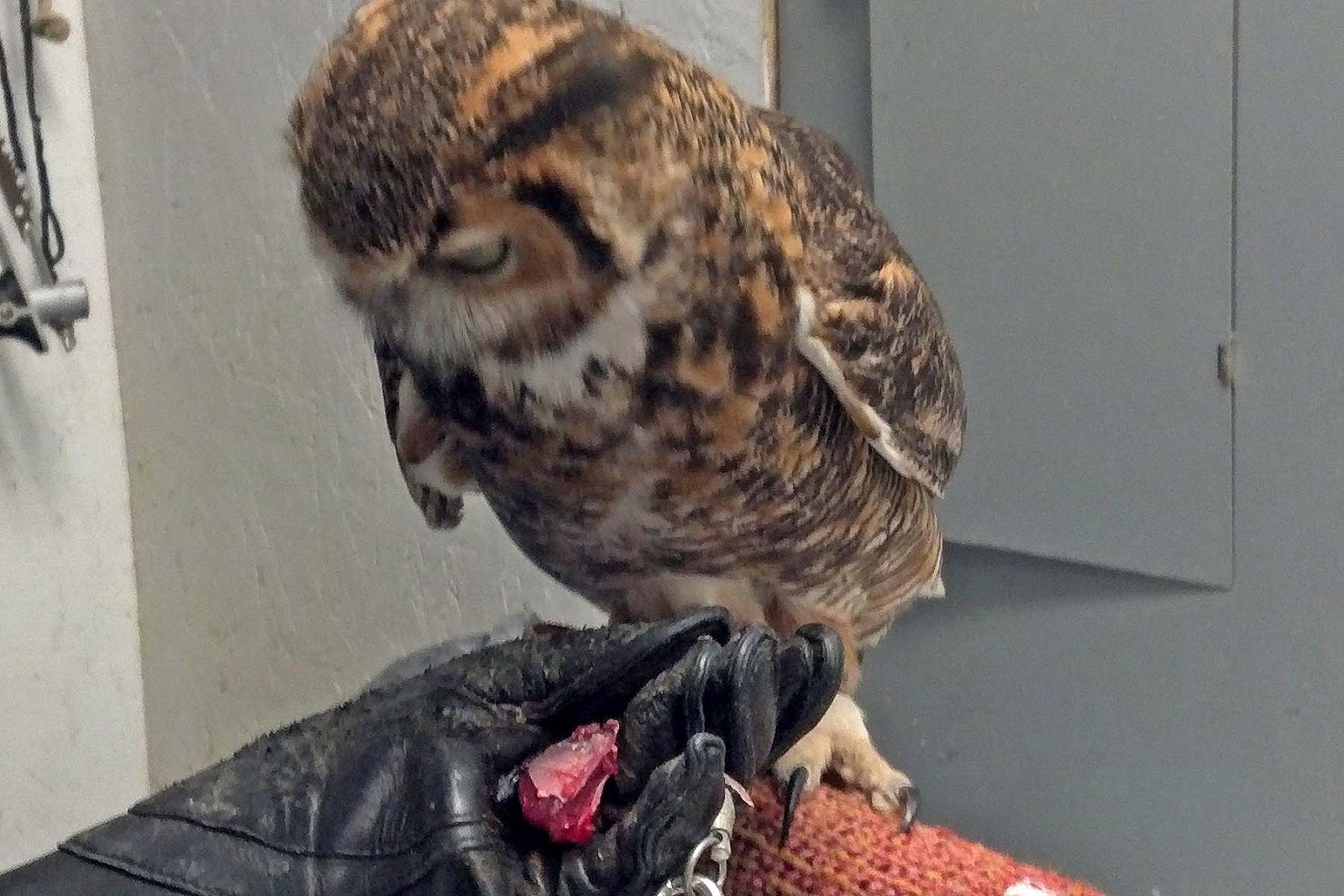
Reese learning to stand on the glove
Okay, so he’s not a man, he’s a Great Horned Owl.  Yes, this girl, who arrived at World Bird Sanctuary with an odd fear of Great Horned Owls from the movie Rock-a-Doodle is thrilled to be working with one.

I overcame my bizarre issues with Great Horned Owls with the help of Carmelita, a beautiful female Great Horned Owl I worked with when I started as a staff member.  My issues with Great Horned Owls aside, I still had issues. 

Then I met Reese, a young male Great Horned Owl that came to us from another facility.  When I picked him up from the airport he was very quiet, sitting a little warily in his crate.  Then on the ride back to the Sanctuary I coughed.  Suddenly there was an explosion of hooting from the back of my car!  I coughed again, and more hoots burst forth.  We hooted back and forth the whole ride back, and as he came out of the crate he sat on a perch and hooted right in front of me.  Clearly the fear of people was not going to be an issue for this bird.

Although Reese was very comfortable around people, he was not a glove bird.  He was never on equipment (the anklets and jesses we use to secure our birds), and had never sat on the glove.  The first time we put him on the glove he did well, sitting for stretches of time even transferring from one glove to another.  Imagine that you are standing on the glove of a giant, which despite the best efforts of the giant may move like a fun house floor.  Sounds a little scary, but Reese was a champ! 
Reese in his training stall
Next we tethered him in a training stall where the perch parallels and is close to the wall, rather than perpendicular it.  This allows him to make the decision whether or not to come to, or at least toward us for food.  When we first put him in the stall, he was great about eating in front of us when we were in the room and right in front of him.  What he wasn’t good about was the glove; he was wary of it at first.  To help him we put a spare glove in his stall, out of the way so that he couldn’t get tangled or hit it if he got scared.  This way he could see the glove in a non-threatening way.  We also made sure to put his food on the glove so he would associate the glove with food.  Over time he began to take food from our glove.

Getting him to step up onto the glove was a little tricky.  In most cases a piece of food is held firmly on top of the glove and a bird will put its foot up to get the leverage to tear or pull food from the glove.  Reese however grabbed the piece in his beak, planted his feet firmly on the ground and pulled as hard as he could, which usually resulted in him scooting backwards and ripping his treat into pieces (Reese’s pieces!).  After some careful maneuvering of the glove and his food we finally got Reese to step up and not over.  Now Reese goes on walks on the glove. 
Reese learning to step to the scale
He is now learning to step up onto the scale and soon he will go outside on a perch.
 Several years ago I never would have dreamed I would be so excited to be training a Great Horned Owl (seriously, watch the movie, that owl is disturbing).  Since that first moment in my car to his patented butt scooting to snag food, everything Reese does reminds me how every training experience is different.  No matter how many birds you have helped to train, there is always something new to learn and see.

Submitted by Leah Tyndall, World Bird Sanctuary Naturalist/Trainer