Showing posts with label Cooper's Hawk. Show all posts

Wednesday, October 22, 2014

The Birds in My Backyard


When most people think of the birds in their backyard, they think of the Northern Cardinal or the Mourning Dove.
A Northern Cardinal at a backyard bird feeder (photo: Gay Schroer)

When I think of the birds that I see in or near my backyard I think of the Barred Owl and the Red-tailed Hawk that frequent the big oak tree in the neighbor’s yard.  Songbirds are the first birds that come to mind for most individuals, but I oftentimes think of the predatory species found in and around my neck of the woods.  The Saint Louis area is well populated with various species of birds of prey.  To the surprise of many, they live in our very own neighborhoods.


Many bird of prey species found in Saint Louis are not here by mistake.  Rather, they are part of a successful population coexisting with their human neighbors.  We can find about 14 species of predatory birds in Saint Louis.  Some of the most common species are the Barred Owl, Great Horned Owl, Eastern Screech Owl, Cooper’s Hawk, Red-tailed Hawk, Red- shouldered Hawk and the American Kestrel.
A juvenile Cooper's Hawk perched on a neighboring fence (photo: Gay Schroer)

Other species are only found in particular areas during certain times of year.  Summertime sightings may include Mississippi Kites, Peregrine Falcons, and Broad-Winged Hawks.  Winter weather brings in Sharp-Shinned Hawks, Northern Saw-whet Owls, and Bald Eagles.

A juvenile Red-tailed Hawk devouring a starling it has just caught in my backyard (photo: Gay Schroer)
Predatory birds have found Saint Louis to be a nice place to call home.  The Peregrine Falcons nesting atop the AT&T building downtown, the Great-Horned Owls that live in Forest Park, and all the other birds mentioned fill a niche that cannot be occupied by any other organism.  For that, we should take the time to appreciate their beauty and roles in our ecosystem. People often view predatory animals as “bad” or “scary,” but they play a very important part in keeping prey species populations in check.
A fledgling Red-tailed Hawk rehabilitated and released by WBS (photo: Adam Triska)

To see some of the birds of prey that may inhabit your neighborhood visit the World Bird Sanctuary and become familiar with these local denizens.  Your visit to WBS may help you to identify that strange large bird that just whizzed past your window.

Submitted by Adam Triska, World Bird Sanctuary Naturalist/Trainer


Friday, April 12, 2013

Return to the Wild


This month I wanted to take the time to tell everyone about a wonderful experience that the World Bird Sanctuary’s Wildlife Hospital provides to the public.

Sick and injured birds of prey that enter our wildlife hospital oftentimes need an area to be released into the wild, so we have designed a program to make this a unique experience for the general public to enjoy.  The program is called “Return to the Wild,” and it gives donors the opportunity to actually release a bird of prey back to the wild.

A rehabilitated Red-tailed Hawk ready to be released

The World Bird Sanctuary’s Wildlife Hospital specializes in the rehabilitation and reintroduction of birds of prey to the wild.  The actual reintroduction to the wild is where the public can be of great help to our organization and provide a memorable experience for those who witness and take part in the release.  From my perspective as an employee in the hospital, releasing a bird of prey that has been rehabilitated is quite possibly the best paycheck there is.

The way the program is set up is that prospective donors can call the World Bird Sanctuary’s Wildlife Hospital and explain that they would like to participate in the Return to the Wild program.  As long as the habitat is correct for the species, you are able to do the release at your house or another location as desired.  For those who have a particular species in mind, you may request it, but availability of a particular species will depend on which birds are currently ready to be released. 

A Cooper's Hawk being released back to the wild

On the day of the release a World Bird Sanctuary staff member will drive to the release location with the bird.  From there donors have the option to release the bird out of their own hands or by simply opening the travel crate to let the bird fly away at its own leisure.


This is a memorable way to celebrate a special occasion – birthday, anniversary, wedding, the passing of a loved one from this life into the next, Girl Scout Fly-up ceremonies, Boy Scout passages from one level to the next, or just for the thrill of being the one to return a magnificent creature back to the wild.

A Cooper's Hawk after release surveying his new environment

This is always a wonderful experience for all who participate, and I highly recommend this great program.  It’s an excellent opportunity to help out the wildlife that is all around us, and learn more about the fascinating creatures in our region.
  
For more information about our Return To The Wild Program Click Here (link), or call 636-225-4390 and ask for Catherine Redfern.

Submitted by Adam Triska, World Bird Sanctuary Field Studies Coordinator

Sunday, September 23, 2012

Cooper’s Hawk Kids – Final Update

If you've been following the WBS blog you probably know the story of the pair of Cooper's Hawks who courted and nested within sight of our home.
Here's the female Cooper's Hawk (mama)

...and here's the male (papa)
In my last Cooper's Hawk blog post I described the fascinating (and sometimes hilarious) antics of the three fledglings that resulted from that mating.  (To see the first two chapters click on "Cooper's Hawks" in the list on the right side of this page.)  

Following is the final chapter in the education of the Cooper's Hawk kids.

7/18 – Today my husband saw one of the young Cooper’s Hawks chasing a Dove through the yard.  I think they’ve finally figured out what they’re supposed to hunt.  He didn’t know if it was successful, but it’s a start.

7/21 – I haven’t seen or heard the hawks for several days now.  Perhaps they’ve moved on to more productive territories.  I think they may now be hunting for themselves, since I haven’t heard them hunger screaming in the early morning lately.

7/22 – I hadn’t seen the hawks at the birdbath for several days, but finally saw one of them in a neighbor’s yard this afternoon.

Another neighbor told me that he saw one of them in his birdbath one day, and then shortly thereafter saw it lying prone in the dirt near the birdbath with it’s wings outspread. Our raptors at WBS frequently do this when they are sunbathing.  This behavior is called “pancaking”.   Since the temperatures are in the 100’s I can only guess that perhaps this bird was trying to dry its wet feathers after its bath.

7/23 – The Hawks are back from wherever they’ve been the last few days.  I didn’t see them early this morning, but the yard was absolutely quiet, which tells me they were somewhere in the vicinity.  All the songbirds are either hiding or sitting tight and not calling.  I’ve come to realize that this means the hawks are on the hunt. 
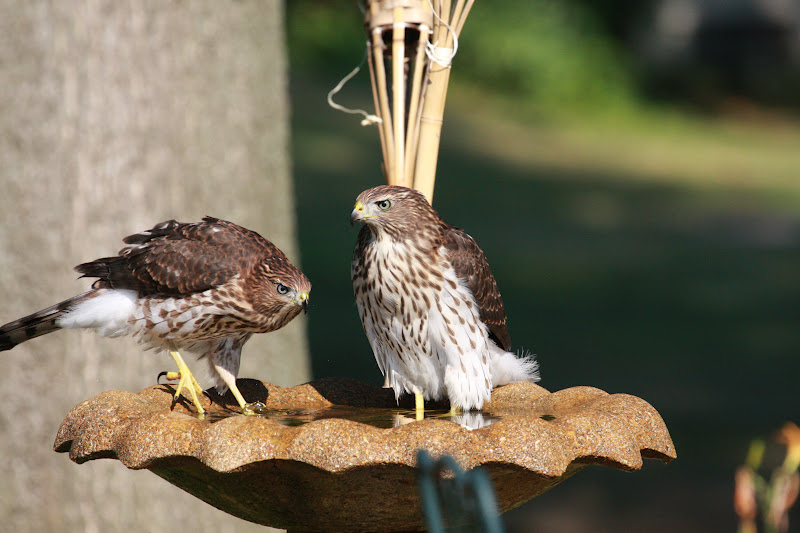
They zoomed by me on their way to the birdbath
This afternoon as I was out in the back yard two of them whizzed by within inches of my head and then landed on the birdbath.  The temperature was 106° and I’m sure they were desperate to cool off.  They usually just stand in the water.  By cooling off the blood supply to their feet it lowers their body temp.  They stood in the birdbath for about 20 minutes and hunger screamed for mom who I’m guessing is trying to wean them.

I haven’t seen the smaller male, but he is usually more wary than the two females.  According to Jeff Meshach, Director of the World Bird Sanctuary, there is good reason for his wariness.  Jeff says …”The male is wary for good reason...if his sisters are hungry enough (and you can bet they are with mom and dad hardly feeding them anymore) they will make a meal of him.  Too much size disparity between the sexes...boys can and will get made into a pellet.”

7/27 – Again, I hadn’t seen or heard the hawks for several days, but this morning as I was walking out to my van to take my granddaughter to Day Camp two of the hawks zoomed overhead and into one of the oak trees in pursuit of a smaller bird.  I think they’ve finally learned to hunt for themselves!
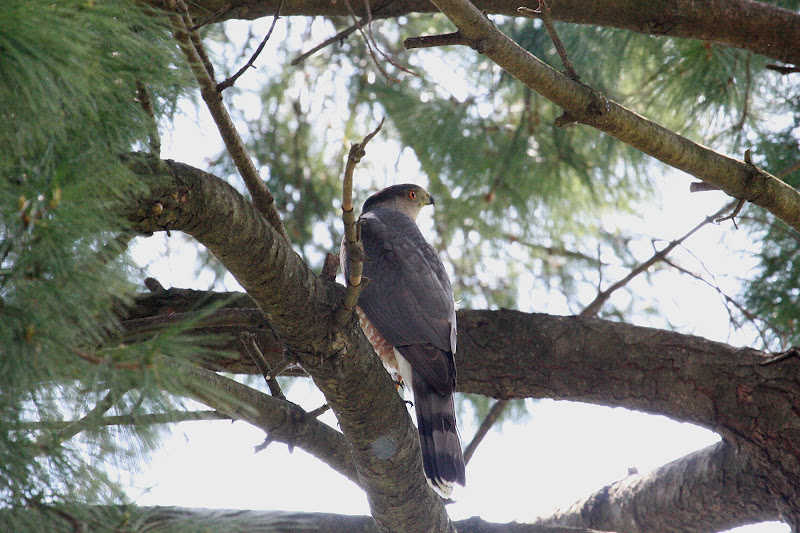
Any small creature who becomes the object of this fearsome stare had best beware
8/15 – I haven’t seen our hawks since that last exciting chase.  I heard one calling from across the road one day, but no sightings since then.  Their visits are becoming less and less frequent.  My guess is that they’ve now become self-sufficient and are claiming their own territories.

Even though I miss watching their antics every day I am thrilled that they’ve survived those first perilous months when so many young birds succumb to hunger, predators, drought, storms, injury, etc. 

If we’re lucky they or their parents will use this area to nest again next year.

Submitted by Gay Schroer, World Bird Sanctuary Volunteer/Photographer


Tuesday, August 14, 2012

Cooper's Hawk Journal Update: The Kids

This summer my husband and I have had the rare privilege of having a ringside seat to the fledging and education of three young Cooper’s Hawks.  The hawks were hatched in our next-door neighbor’s oak tree.

In an earlier blog post I described the courtship and mating ritual of a pair of Cooper’s Hawks that I was lucky enough to observe from my back yard.  However, once they laid and began incubating the eggs I saw very little of the adult pair or the nestlings, since the tree cover was so thick.
This perching business isn't as easy as it looks!
Around the middle of June I began to see the fledglings taking their first tentative flights into the surrounding trees.  At first there was only one, then two—and finally three.  From their relative sizes there appears to be two females and one male.  (In most raptors the females are larger than the males.)
Small twigs prove to be serious obstacles.
Soon they began to entertain us with their antics. At first they were like human toddlers, clumsily walking the large branches of the oak trees and teetering when they were faced with the obstacle of smaller branches along a limb.
Either Mama or Papa was always close by
Flights were mostly short hopping flights from one branch to another.  While they were navigating their new world mama was never far away.
After a few days of practice their perching and landing skills had improved immensely
Soon they were zooming from one tree to another and perching on the power lines, fences and other objects that filled their environment.  Occasionally I would see them on the ground devouring a meal delivered to them by one of the parents.
Their hunger screams made them fairly easy to locate in the early mornings
In the early morning I could usually locate their whereabouts by listening for the youngsters’ hunger screams.

Then, one day as I was sitting on my patio with my morning coffee I spotted one of the youngsters trying to hunt!  I say trying because the chosen quarry was a squirrel, albeit a small one.  A Cooper’s Hawk’s main prey is usually small birds, along with some small rodents, large insects, etc.  Squirrels are listed as prey on occasion, but I have a feeling that this prey is usually reserved for the older, more experienced, adult birds.

This squirrel must have been quite young, since it was almost as clueless as the young Cooper’s Hawk.   The squirrel was starting across the lawn when the hawk launched itself from its perch on a fence.  Of course, the squirrel promptly scampered up the trunk of the tree from which it had emerged, leaving the hawk somewhat befuddled on the ground.  However, the squirrel didn’t continue up the tree trunk.  It turned around and came back down to the ground and confronted the young hawk.  It was a standoff!  The hawk hopped and flared its wings, at which the squirrel again scampered up the tree—only to return and lunge at the hawk, which hopped backwards several steps.  The show continued like this for a few more minutes until the hawk seemed to decide this wasn’t working quite like it had expected. 

In the meantime the hawk’s sibling was making a pass at a full-grown rabbit, which easily evaded its pursuer.  Of course, my camera was inside the house and I got none of this on film.  Suffice it to say I now rarely venture onto my patio without my camera in tow.
When it's over 100° any bit of water is a welcome place to cool off
A couple of days later, as I was packing to leave for vacation, my husband spotted one of the hawks in our birdbath!  The temperature that day was reading 111° on our driveway and our young bird was trying to cool off.  This time I was ready.  I grabbed my camera, with long lens attached, snuck slowly around the corner of the house, and was able to get a few photos.  By now these young birds had become so habituated to our presence that I believe they consider us just another part of their environment.  As long as we don’t move too abruptly or try to get too close they seem to tolerate us. 

While we were gone on vacation for a week in July the temperatures in St. Louis hovered in the 100-105° area.  Since our sprinklers were on a timer I hoped that the birds were taking advantage of the water.  When we returned it was evident from the amount of “bird splash” on our patio and patio furniture that our youngsters had been there while we were gone.
These youngsters have now become daily visitors
Ever since returning, we’ve seen one or all of the three youngsters at the birdbath every day.  They’ve even begun landing in the birdbath while my husband and I are sitting on our patio—just as long as we keep a respectful distance and don't move too quickly.
An overgrown abandoned dog kennel is a perfect place to practice hunting skills
One morning I spotted one of the hawks sitting on a wooden fence that had once been a dog kennel—long since abandoned.  The neighbor had allowed weeds and brush to grow up inside the kennel.  This has proven to be a perfect playground for the three young hawks as I’m certain it’s an ideal environment for insects and mice.  The hawk would watchfully sit on the fence top, and then every so often dive into the underbrush.  The other two hawks were doing the same thing from the other side of the enclosure.
I'm not sure what they were rootiing for, but all three were doing it
I assumed that they were practicing their hunting skills until I saw one of them swoop to the ground under a bush in a more open area of the yard.  The hawk began rooting with its beak and feet at the base of the bush, presumably for insects or mice.  Soon it was joined by the other two hawks, who also rooted around at the base of the bush. 
Apparently even young hawks take time out to play
This learning to hunt was serious business!  However, being youngsters, this soon turned into a game in which they began to chase each other round and round the bush like kids playing “Ring Around The Rosey”.  This went on for about 15 minutes until they tired of the game, and then all three decided to take a dip in their own personal pool—my birdbath.
They seem to consider my birdbath their own personal pool
I have yet to see them make a kill, and they’re still hunger screaming for mom and dad in the early mornings, so they still have some serious growing up to do.  But mom and dad are owed a real round of applause for being able to provide for these three healthy youngsters up to this point. 

Submitted by Gay Schroer, World Bird Sanctuary Volunteer/Photographer

Monday, June 11, 2012

Coopers' Hawk Journal


Pulling weeds is never a pleasant chore—even when you love to garden.

However, this Spring I had some entertainment that went along with my weed pulling.  Following is a short journal describing the show.
The female gave a few short "Kek's" (apparently this species' "come hither" call)
Saturday 3/24 -    Today as I was working in my yard, I saw a Cooper’s Hawk sitting in the pin oak tree in our yard.  At first I thought it was a small red-tail hawk, but on closer inspection knew that it couldn’t be.  Every so often this bird would give out a short sharp “Kek” call.  After several “Keks” I heard an answering “Kek, kek, kek,” call and saw another hawk sitting in the Burr Oak about 30 feet from the first bird.  There was no doubt about the second bird—it was definitely a Cooper’s Hawk.  Then it dawned on me—this was a pair!  I’d been seeing two hawks soaring in tandem over the neighborhood for most of the winter.  This must be them.

                                As I watched, the smaller bird (the male) took off over our rooftop.  The larger bird, the female, remained for a while, then she took off in the same direction toward the front of the house. 

                                I returned to my yard work and a short time later rounded the front of the house to discover both birds on the lowest limb of the pin oak in the front yard.  She was eating a morsel that the male had brought her.  As I watched he mated with her. 

Sunday 3/25 -    The hawks are still hanging around.  I haven’t spotted any nesting activity yet, nor have I been able to find what looks like a nest large enough for these birds.  There is one nest perched precariously halfway out on an overhanging limb in our next door neighbor’s yard, but I can’t believe they would be using this one. 
The male would answer the female with a longer call
Monday 3/26 -    The hawks are still here, and today I spotted what looked like breeding activity in the neighbor’s tree.  Again, the larger bird (the female) called with a few short “Kek” calls whereupon the male answered with his longer call and shortly thereafter mated with her.  Apparently, the female initiates the breeding by issuing her invitation.  Soon after they mated I saw one of them soar between our houses with its talons full of nesting materials—away from the nest mentioned earlier.  Unfortunately, I couldn’t determine its destination.  There is a wealth of large trees in our neighborhood and it could be any one of them.

                                This afternoon I saw one of the hawks fly from the neighbor’s backyard tree carrying a stick.  It flew into the tree in our neighbor’s front yard where I spotted a now substantial nest in a large crook of the tree.  I think we’ve found their nest!

Tuesday 3/27 -    Early this morning we spotted one of the birds in the neighbor’s backyard tree.  It’s early and she’s just a silhouette, but clearly she’s dining on something.  As we watched, the male landed in the same tree, plucked a few sticks from it and then made a beeline for the front yard nest.  Soon he returned with a gift for his bride and then promptly mated with her again.  It appears that the backyard tree is their favored perch from which to hunt, breed and guard the nest.   I saw him mate with her three more times today.

Wed 3/28    I watched them mate several times today.  As evening approached both birds settled onto the branch near the “practice nest,” where they’ve mated several times.  My husband and I thought they might be going to roost there tonight, but just before dark they flew off.

Thu 3/29 -    I’ve only seen them flying into a tree several yards away today—but then I wasn’t out in the yard much

Fri 3/30 -    One of the birds spent quite some time on the branch near the “practice nest” today.  It eventually took off and flew into our pine tree.  This “practice nest” is within sight of the nest that we think they’re going to use in the crotch of the pin oak tree in our neighbor’s front yard.  Never did see the other bird—so possibly she may be in the nest.
We believe this is the male who is now bringing food to his mate on the nest
We’ve had a very early Spring this year, and unfortunately for me the leaves in the tree canopy have now become so thick that I can barely see the nest, even when standing directly under it.  I continue to see the male bird, but have not seen the female recently.  I believe she’s sitting on eggs.

Over the next few weeks I spotted the male flying back and forth toward the nest tree, so know they are still in the neighborhood.  Then, one morning I spotted three hawks in the backyard tree.  I think the young have fledged.  One of the birds was the larger female with what appeared to be a younger smaller bird in hot pursuit—obviously looking to mama for food. 

Because of the thick canopy I’ve not been able to tell if there is more than one fledgling. However, it has certainly made my weed pulling less of a chore; and certainly much more entertaining since I could watch the Cooper's Hawks and their antics.

Submitted by Gay Schroer, World Bird Sanctuary Volunteer/Photographer


Sunday, August 15, 2010

SPRUNG’S SPRING BABY HAWKS FROM CERTAIN DEATH

What are these two Cooper's Hawks doing reclining on a local suburban patio bench?  Read on for the amazing story.
 I took the call late Friday morning, 4 June.  

A woman on the other end said, “A hawk nest has blown out of a tree in my back yard.  Two of the babies died when they hit the ground, and one has survived.  What should I do?”

 Admittedly, I was skeptical of whether or not the birds were hawks.  WBS has permits to rehabilitate only birds of prey.  After asking all the questions to narrow down what the woman had, I concluded the youngsters were in fact hawks, and probably Cooper’s Hawks (one of my favorite birds of prey in the world).  

Because our rehabilitation department continues to operate on a shoestring budget, we do not have the ways or means to drive and pick up downed raptors.  I asked the woman if she could bring the hawk to us, stating I would coach her on how to safely acquire the hawk.  “I’ve just had surgery on my hand, my husband’s at work, I have no neighbors to help me, and I don’t want my son or daughter to handle the bird.  Please, you must help me.”

 As cruel as it might sound, in most instances we must say, “I’m very sorry, but we cannot do anything.”  Back when we used to do pick-ups, there were so many instances where, a) we got bad directions and never even got to the place the bird was down; b) the bird was a sparrow and not a hawk; or c) we got to the destination and the person who called us would say, “The bird was just right here a minute ago.”  Too much time and money was wasted attempting to do pick-ups that proved to be futile.  Still, something about this plea stuck in my mind, and the fact the baby was probably a Cooper’s Hawk is probably what pushed me over the edge.  I said, “I have to be away from headquarters later on today.  I’ll call you when I’m out and you can tell me if the bird is still in your back yard.  If it is, I’ll come out.”  After many sincere thank you’s, Amy (I finally did get her name) hung up.

 Later on that afternoon I drove up the driveway of a pretty home in a nice neighborhood.  When I rang the doorbell a young man and 2 bouncing dogs answered the door (I’m a dog man, so score 2 more for these concerned people).  Amy was close behind.  When I tried to shake Amy’s hand she could only extend her left hand because 2 fingers on her right hand were in thick bandages.  I was becoming very glad I did this pick-up.  Again, many sincere “thank you’s” were extended for me driving out.

 Amy, her son, daughter, and dogs showed me through the house and out the back door.  There, laying on a big rock by their pool was a baby, female Cooper’s Hawk.  By my best estimate she was about 15 days old.  Amy showed me the sticks from the downed nest and pointed out 2 other baby hawks, about 30 feet up in a Pin Oak.  Luckily they were just strong enough to hold onto branches as the nest came down (I thought to myself that if the wind blows too hard, those little guys are coming down, too).  They were probably the oldest of the 5, and probably the youngest 2 of the clutch were the ones that died when they fell. 
The little female Cooper's Hawk, WBS Assistant Director Jeff Meshach, and Nicholas Sprung
This young female I now had in my hands flew just well enough during the unfortunate event to flutter, but not crash to the ground.  I was glad to see she had no injury, but I quickly concluded she would not be strong enough to be placed on a branch 10 to 12 feet off the ground.  If baby hawks are old enough and strong enough to perch well, we instruct the people calling to get the bird more than 8 feet off the ground so raccoons and other ground predators cannot find them, and mom and dad hawks will still care for the youngsters.  Of course, it’s way better to let the parents continue to care for their kids than bringing the babies into captivity, especially if there’s no injury. 

For better or worse, this feisty female would have to come with me, but I promised Amy I would be back in about 5 days, when she could fly and perch better, to release her.  Not only did Amy thank me for coming out, she donated money to help us help the baby.  It’s important to note that our rehabilitation department works almost solely on donations, so when any bird is brought in a donation of at least $25 goes a long way toward its care and medical expenses.

On Saturday, 5 June, I got a call from Mike Sprung, husband of Amy.  Just as I had suspected, the other 2 hawks that were still in the tree the day before had fluttered to the ground.  Before I could say, “I’ll be right out,” Mike asked if there was anything he could do to care for the hawks.  In most cases we say no, but I did have an idea.  I asked Mike if he had a basket he could tie a rope to, throw the rope over a branch, place the babies in the basket and haul the contraption off the ground; viola, an instant, makeshift nest.  
The other two baby Cooper's Hawks in their makeshift nest
Mike had an even better idea.  He took a portable basketball hoop/backboard, tied the bottom of the net so nothing could fall through, placed a blanket at the bottom of the net and stuck some sticks from the downed nest through the nylon net to make an even more stable nest than my idea.  Mike pulled the portable “Cooper’s Hawk Nest” into his back yard, placed the 2 babies in it and within a few minutes mommy Cooper’s Hawk came in and fed her kids.
 WBS Assistant Director Jeff Meshach places the little female in the makeshift nest with her two siblings
I arrived back at the Sprung’s at 10:30, Monday morning, 7 June with the young female I had to take away.  I tried shaking Amy’s hand (habit).  After posing for some pictures and marveling at Mike Sprung’s artificial nest building ingenuity, I lowered the “nest”, placed the female in it and pushed it back to its highest setting.  I wish all birds we have to take into our rehabilitation department could be saved as easily as this one.
 WBS Assistant Director Jeff Meshach watches on as the three Cooper's Hawks settle into their unorthodox "nest"
Our sincere thanks goes out to Mike, Amy, Nicholas and Natalie Sprung for helping to save the lives of three Cooper’s Hawk kids.
So now you know "the rest of the story".  Even though these three suburban birds (the third one took off just before this photo was snapped) are every bit "wild" birds, they clearly view patio furniture as just another part of their environment.

Submitted by Jeff Meshach, World Bird Sanctuary Assistant Director

Wednesday, September 30, 2009

Coopers Hawk Mating Ritual

Following is a fascinating description of the Coopers Hawk mating ritual which was sent to us by guest contributor Jason G. Harrison.


All of these images were taken over a 1 week time frame, beginning with April 3, 2009.  I spent nearly 6 days observing this very active pair.  I observed several matings and I was very surprised with what I saw.  The male would fly out from the nest site in search of food.  He would very quickly catch a bird or small mammal, dispatch it, and then fly to a nearby tree close to the nest where the female was sitting.  He would carefully place the captured meal on a nice sized branch and fly off while calling out.


The female would then leave the nest and fly directly to the meal placed on the limb.  She began eating the meal.  Soon thereafter, the male would then return, and land directly next to her.  He would then mount her and mate while she ate the meal.


I observed this several times.  On one occasion, the male brought in a bird it had killed and like before, laid it upon a branch and called out and flew off.  The female flew right in, like always, and looked at the meal in front of her.  The male did not “clean” up the kill this time.  In all my other observations of this ritual, the male had just about perfectly removed every feather from the carcass before placing it out for the female to eat.  She looked at the feather-covered meal in front of her and she then called out and flew back to the nest. 


The male returned, and began cleaning the feathers off of the carcass.  Once done, he then called out again and the female returned.  She quickly accepted the meal this time and like before, as soon as she began eating, the male returned and mated with her.


Due to the location of the nest site, and the impending foliage that was growing thicker every day, I soon lost sight of the nest and could no longer observe them.  The thick canopy of the trees prevented any further study of the nest and this wonderful pair.


Story and photos submitted by guest contributor Jason G. Harrison.  

Monday, September 28, 2009

WHAT'S FOR BREAKFAST??

This morning I was treated to a most amazing aerobatic display through my office window!!


Our house is surrounded by forty year old trees, and we feed the birds.  Anyone who has this same set of circumstances knows that in addition to feeding the birds, you also feed the squirrels.  Not that we intentionally do it—it’s just a fact of life.  Our squirrels run in herds and sometimes it seems as if our lawn is alive!  Keeping food in the feeders and actually feeding the BIRDS is a daily challenge.  We’ve come to the conclusion that no adult human being is “…as smart as the average squirrel”… and have come to grudgingly accept that fact.  We’ve slowed them down a little by putting up so-called “squirrel proof” feeders that close when a squirrel hops on, and have found that they won’t eat the “hot pepper suet”, but by and large, the yard belongs to the squirrel herd.


This morning as I was working at my office computer, and watching three of “the herd” scamper up, down and around the trunk of our forty year old Burr Oak tree, from the corner of my eye I spied what at first appeared to be a huge leaf hurtling to the ground.  When I got up to look I was surprised to see a Cooper’s Hawk sitting at the base of the tree.  He (or she) had apparently tried to grab one of the squirrel herd and missed.  As I watched, he focused on another group of squirrels  in the neighbor’s yard, and took off in another attempt to catch breakfast—another miss! 

Now, a Cooper’s Hawk usually preys on birds and small rodents such as mice, and I believe this particular hawk has dined at my feeder before.  But this is a young bird, and apparently has big ideas.  This morning he had a real craving for squirrel tenderloin.  I watched in awe as he tried six more times to catch one of those #@!! squirrels with no success.  One time he even tried to pluck one off the trunk of the tree, wingtips coming within inches of the trunk!  Finally he flew off to find easier prey, leaving me in awe and the squirrel herd intact

Monday, June 8, 2009

Feeding The Birds


When you feed the birds, you feed ALL the birds!

I was startled the other day by a loud THUMP! against the wall of my house.  I immediately recognized it as the sound of a bird hitting (I thought) the kitchen window.  Some of the new crop of woodpecker babies are having trouble figuring out how to land on the nut feeder, and frequently thump into the window, although not hard enough to do any damage.  But this thump was LOUD!  

When I looked outside I saw this Cooper's Hawk feeding on a dove that he had apparently caught when it took off from our patio.  It must have been close enough that predator and prey hit the wall of the house.  Of course, I ran for the camera, and proceeded to photograph the hawk plucking the dove through my kitchen window.  I won't tell you how many photos I took.  Let's just say "Thank God for digital".  

I know there are some who would be distressed by this situation.  However, the hawk needs to eat just as does the dove, and this is Mother Nature's way of keeping the species strong.