Showing posts with label Stone Zoo. Show all posts

Thursday, June 19, 2014

There’s no Business like Show Business!


World Bird Sanctuary’s educational bird programs at zoos can be an interesting lifestyle.  I’ve been doing zoo shows for World Bird Sanctuary since 2008 and supervising since 2011 and I still get excited every year.  There is nothing quite like moving to a new city, meeting new people and educating a whole new population of zoo goers.
Even the stage may change from year to year

Every year is a new experience, not only because the staff changes every year, but so do the birds, and occasionally the location.  One year I might be in Boston, the next in Milwaukee, and even if I return to a city the next year, the stage itself might be completely different.  That means coming up with new creative patterns for the birds to fly.  I think that might be one of the things I love most about zoo shows.  No two years are ever going to be the same.

My first year as a trainer was different than my first year supervising, and even now with three years and four shows of supervising under my belt things are still different one year to the next.  This means I will probably never tire of zoo shows.  In fact it is more than likely that I will physically exhaust myself before I become bored.

Every year is a new challenge both because of the new staff and the new birds.  Some years I have recurring staff members who have done zoo shows before; some years I have mostly rookies.  It is amazing to watch people learn and grow as they discover the unique way that zoo shows operate.  It’s interesting to watch the light bulbs go off over trainers’ heads as they learn how to manage time in order to be ready for shows, as well as learning how to think ahead in the show.

The oh so important show pouch

During our shows we move quickly from one bird to the next, with little to no time between them.  For new speakers for the show this is especially challenging, since they need to learn how to pack a show pouch (our oh so stylish fanny packs) properly.  During the show a speaker needs to able to switch effortlessly from one bird to another, pulling out the food rewards without slowing down or stopping to look into the pouch.  It is a learned skill and everyone has their own way of packing their pouch.  Some people use “snap caps”, tiny plastic cups with lids, empty applesauce cups and even pill containers to hold the food so that it does not spill during the show.

The staff members are not the only rookies.  Every year we have at least one new bird.  Sometimes a bird may be at zoo shows not to actually be in the show, but so it can be acclimated to people and the daily routine.  It is one of the best ways to get an education bird ready for shows and programs.
One of this year's rookies--Chique, a Blue-fronted Amazon

This year we have four rookies to zoo show programs: Chique a Blue-fronted Amazon, Suk a Common Raven, Evita a Red-legged Seriema, and Zeus the Golden Eagle.  We even have a few sophomores this year, like Reese our Great Horned Owl and Vader the Black Vulture, who both had great rookie seasons last year and are ready to amaze again.  Even birds that have been doing shows for years might begin doing new patterns or behaviors, both to keep them enriched and make things interesting for the audience.

Show season is my favorite time of year because it is both familiar and different every year.  Be sure to stop by the Milwaukee County Zoo in Wisconsin or Stone Zoo in Boston, Massachusetts to see what we have planned for this year.  Feel free to visit multiple times!  When you work with live birds, no two shows are ever the same!

Submitted by Leah Tyndall, World Bird Sanctuary Zoo Show Supervisor
             

Sunday, October 13, 2013

Growing Up Flamingo


One of the many exciting things about working in a zoo all summer is that you get to see the baby animals growing up every day.  I got to work at Stone Zoo with WBS’s educational bird show last summer, so I saw first-hand many youngsters grow up.
These Flamingos nested in full view of the public
While most young animals are off exhibit until they reach a certain age, the flamingos build their nests, lay eggs, and raise their young in full view of the public.  This year six American Flamingos hatched at the Stone Zoo near Boston.  During our many visits to see these adorable little fuzzy flamingos, we realized that while almost everyone recognizes these birds as flamingos, many inquisitive kids (and adults) would like to know more about them.

There are actually six species of flamingos found around the world--in Africa, Europe, Asia, Central and South America, the Caribbean islands and occasionally southern Florida.  They can be found living in the tropics or mountains, but always near shallow brackish waters such as lagoons, swamps, marshes, estuaries, and mudflats where they find their food.  Flamingos are filter feeders and filter tasty blue and green algae, mollusks, crustaceans, plankton, insects, small fish, and seeds from the mud and water. 
This bird's striking pink color comes from the food they eat
The flamingo's pink color actually comes from the carotenoids in the food they eat.  Their unique downward bent beak is well adapted for filtering food out of the water and is lined with rows of hair-like lamellae for capturing their food.  The beak, and sometimes the entire head, is dipped into the water upside down and swept back and forth to filter the food out.  By using their spiny tongue as a pump, water is sucked in and pushed back out across the lamellae as fast 4 to 20 times a second, depending on the species. 

The flamingos' long legs and necks allow them to feed in deeper waters.  They sometimes use their webbed feet to stomp around in the water and bring the food off the bottom and closer to the surface where it can be filtered more easily.  The webbed feet also help flamingos stand on soft mud and make them excellent swimmers in water that
 is too deep to wade. 

While flamingos are most often seen standing in shallow water feeding and preening, they are also good fliers.  However, flamingos need a running start in order to take off, explaining why most of the flamingos at the zoo are fully flighted even though the enclosure has no roof.

Flamingos are very social birds and form colonies of a few dozen to over a million individuals.  Larger colonies split up for the breeding season.  These colonies perform synchronized displays such as marching, wing salutes, and head flagging.  Individuals pair up for the breeding season and form strong pair bonds.

Both parents assist with the building of the nest, which is constructed by pulling mouthfuls of mud, pebbles, feathers, and other nearby material up into a mound. This mound is built up until it is high enough so that the egg won't be washed away during a flood and is protected from the heat of the ground.  This can be a few inches or a foot high and has a slight indentation on the top to prevent the single egg from rolling out.  The parents are very territorial of their nest, which is usually located just out of reach of the neighboring nests.  Both parents take turns incubating the egg for about 26-31 days.

When the egg hatches, the chick is white and fuzzy with a straight pink beak and pink legs.  At the zoo, the chicks were standing up at about two days old.  Within a week, the chicks began to leave the nest and their pink legs and beak turned black.  At this point in the wild, fledglings would group up into microcreches and then later larger creches of thousands of other chicks for protection from predators. During these first few weeks, the chick's beak is not developed enough for feeding on its own, so food is provided by both parents in the form of crop milk.  This reddish milk is secreted by the upper digestive tract and is high in protein and fat.
This chick's beak is beginning to form its characteristic bend
By about eleven weeks, the hatchlings grow in brown juvenile plumage and their beaks gradually begin to get their characteristic bend and lamellae.  Juvenile flamingos get their bright pink adult plumage gradually between 2 and 4 years of age. Males and females look the same, but males are slightly larger. Flamingos live about 20-30 years in the wild, but in captivity, they can live to be 50 or older.

At the Stone Zoo each juvenile flamingo was given a unique identification band when they were old enough.  It has been quite exciting to watch these six flamingos grow up this summer!

Story and photos by Michaela Henneberg, World Bird Sanctuary Zoo Show Staff Member

Friday, June 21, 2013

Duncan The Magnificent


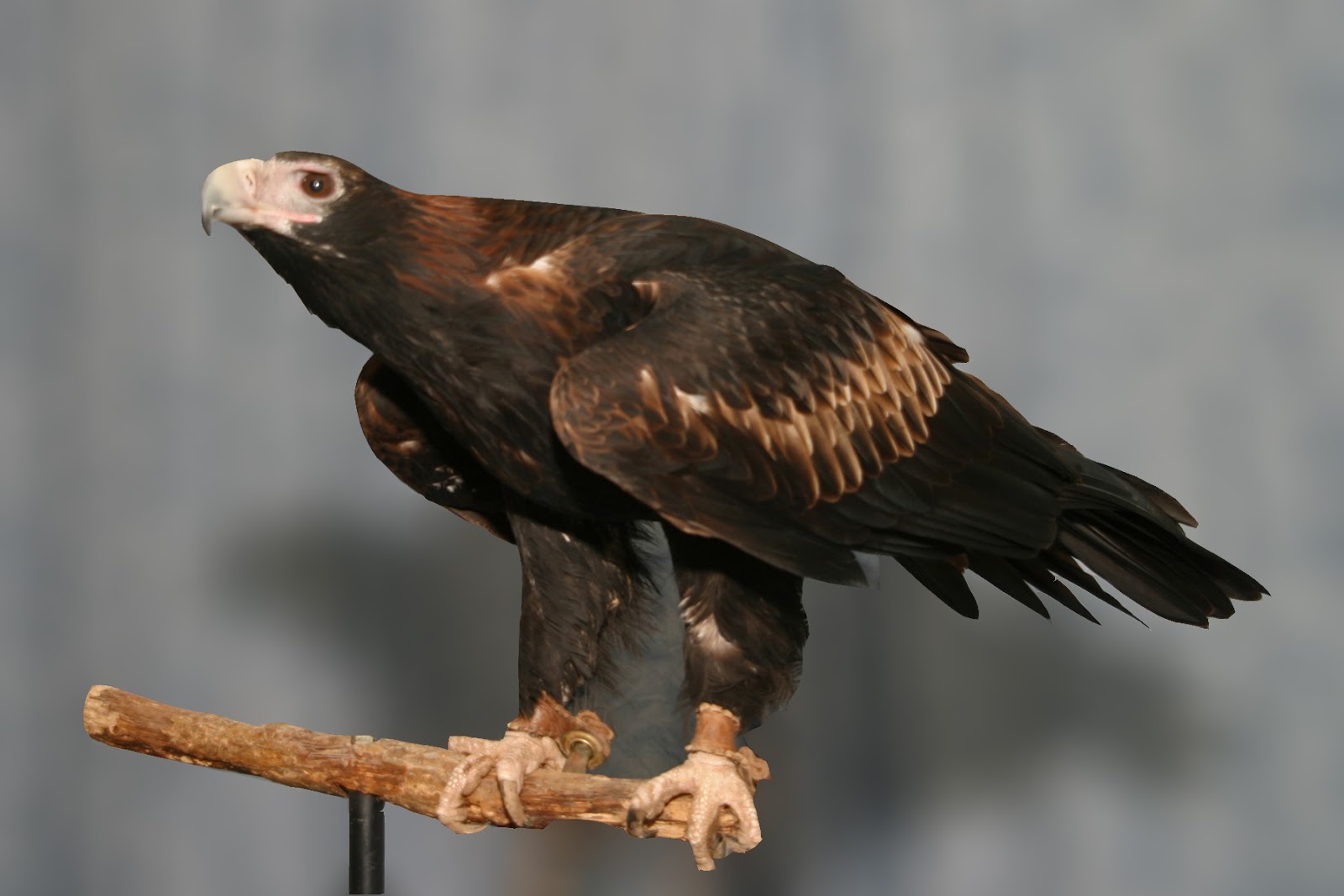
Duncan, our 26-year-old Wedge-tailed eagle, recently came out of retirement to wow audiences at WBS’s educational bird shows at Stone Zoo near Boston, MA.

Meet Duncan, WBS's Wedge-tailed Eagle
The last time this bird flew in our education programs was in 1994. This summer she is back and flying at our zoo program at Stone Zoo in Boston, MA, and doing quite well. At first I was unsure of how this would go, but I was very excited to have this opportunity to, basically, retrain this bird.

Training birds, and any animal I would assume, is very challenging. The first thing that we have to figure out is the “working weight” of the bird. The working weight is the weight we keep them at during their flying season (6 months of flying 6 months off), and this is a weight at which they’re food motivated (in other words, a weight at which they want food, but they’re not starving). The working weight is heavier than they would be naturally in the wild, but lighter than they would be if they were offered as much food as they wanted without working for it. In order to find that magic number it takes observation. Too light and your bird gets aggressive, too heavy and your bird won’t fly. Once you find this magic number you then have to do a lot of practicing and getting the bird back in shape because just like us, birds also get out of shape. We usually take about a month and a half to two months to get all the birds back in shape.

Photo courtesy of Alex Navarro, Educational Specialist, Stone Zoo
Once that training period has gone by its then time for shows to start.  This is when you learn even more about your bird. You have to get them used to seeing people in the theater, because during show practice time you practice in an empty theater. If the bird is new to flying for an audience you have to slowly build up from just a few people to more and larger crowds. You quickly learn all the strange things that individual birds may not like.  I’ve worked with birds that don’t like the strangest things, like big necklaces or strollers, or crutches. A very few don’t like sunglasses, perhaps because they can see themselves in them—or that’s what we think at least.

Photo courtesy of Alex Navarro, Educational Specialist, Stone Zoo
After learning the quirks of individual birds and doing our best to keep that object away from them, you then have to regularly deal with uncontrollable factors, like wind.  Very windy conditions may sometimes blow a free flying bird off course, but with the right flight muscle conditioning (in other words, lots of practice), our birds fly very well when the wind is blowing.

Photo courtesy of Alex Navarro, Educational Specialist, Stone Zoo
After taking all these factors into consideration, and even if you do everything right, sometimes the unexpected still happens--they are live animals after all.  Most times, though, things work out perfectly, and you get what I would imagine to be a “proud parent” moment the first time your bird does the exact behavior you’ve been training. Then, when the behavior you’re asking of your bird becomes consistent, that is one of the best feelings a trainer can have.

Photo courtesy of Alex Navarro, Educational Specialist, Stone Zoo
All of this is what my staff and I have dealt with while getting Duncan back into the swing of things.  And finally, after tons of practice and hard work, she is doing very well and flying for all our audiences at Stone Zoo. We are all very proud of this magnificent bird.

Submitted by Jaimie Sansoucie, World Bird Sanctuary Naturalist/Trainer

Tuesday, May 10, 2011

Boston We're Here!


So long to the cast and crew of the Masters of flight; birds of prey show.

They shoved off from WBS the last week of March in search of greener pastures at the Stone Zoo in the Boston area. 

The previous several weeks had involved not only packing up personal belongings, but also preparing the birds for their long trip. 
 We're on the road again! 
The stars of the show (the birds) and their supporting cast (the staff) have started their show season a little early this year--the first weekend of May.  Usually our shows run from Memorial Day to Labor Day, but this year we will have an extended season.

Unless you plan to visit the Stone Zoo in Stoneham, MA (right outside Boston) this summer, this is the last time you will see many of these birds until fall.  So, meet the cast.

Greeting you, and handing you a program, will be one of our official "Greeters": 


Gomer, a Military Macaw
McCoy, a Green Winged Macaw, or

Waylon, a Blue and Gold Macaw.


Stars and Cast members will include:

Marz- a Red- tailed Hawk, 


Sam- an Auger Buzzard


Jack- a young Harris Hawk 

Osiris- an Egyptian Vulture and one of our veteran performers

Baton Rouge- King Vulture 

Otis- Abdim Stork 


Buddy- Double Yellow Headed Amazon Parrot 


Rio- Green Wing Macaw


Riley- Barn Owl 
Detour- American Kestrel 


Cherry, the Pied Crow


McGwire- the Bald Eagle 


and finally, Hugnin- White-Naped Raven 

And of course, a generous thank you to our comedy relief cast who make appearances throughout the show, Black, Brown, Yellow (Cochin chickens), as well as Moose and Squirrel (‘Fancy’ Rats.)

So if you live in, or are planning to visit, the Boston area this summer, be sure to catch our cast of characters as they entertain the crowds at Stone Zoo in Stoneham, Massachusetts (just north of Boston).  Performances are at 11:00 am, 1:00 pm and 3:00 pm every day.  We promise to keep you entertained (and you may even pick up a few nuggets of knowledge in the process).


Wednesday, April 6, 2011

The Rookie Files: On the Road Again

The changing of the seasons can signify many things in nature. Breeding season, migration season, flowers blooming and trees leafing out are all common sights in spring.  At World Bird Sanctuary it means another show season is upon us.

The life of a World Bird Sanctuary employee that moves from town to present programs at zoos is a nomadic one. During the winter we come home to roost, so to speak, at the main site.  We train and care for the show birds as they enjoy their six month vacation.
Osiris, the Egyptian Vulture, packed and ready to go--"Got egg? Check!", "Got rock? Check!"
Come spring, however, as the leaves begin to appear we begin to pack. Items that have not been used in months are pulled out of storage--printers, short sleeve shirts, personal dishes, maps and city guides.  Most of us can fit the majority of our life into our car.  It also helps that many of us have vehicles with a lot of trunk space. Food is divided among those who remain on site and off we go!
 No--this isn't Spring Cleaning--it's a zoo show crew gathering up necessary supplies!
For four to six months we will be living in a completely new city, new home with new neighbors and in the case of the crew heading to Boston, new time zone.  The first time I picked up and moved across country for a show it was a fun, but strange experience.  Caravanning there is half the fun, playing leap frog with your fellow travelers, trying not to be hypnotized by the swaying equipment trailer in front of you, taking a lunch break and talking about the random radio stations you found.  Then you get to the new city and you realize that this place is going to be home.  Time to find a new grocery store, movie theater, park etc.  It is a little disorienting to be somewhere completely new, but luckily with people you generally know.

Not only do we ourselves have to pack up and move, but we need to pack the birds and any equipment we may need as well.  Since different venues have different facilities we never really know just what we’ll need for a season, so we leave prepared.  There is an extensive four-page checklist that we use for packing purposes.  Once the red checks start to appear then it becomes real that we are leaving soon.  The birds also notice that something is different though we try to act as normal as possible.  They can see the crates being moved and the items being gathered.  Soon they will be packed up and driven to a new home, for them a completely new territory.  After a short “check-the-place-out time,” they adapt and are fine.
 Some of the birds' "stuff" ready to move for the summer
For most people spring means a change in the weather and vegetation.  For us, and the birds, in means a change in location, routine and people.  For most people the idea of packing their life up in their car twice a year is a horrible thought, but for me, and the birds, it means its show time!  And show time is the best time of year!

If you find yourself in the Boston area between 1 May and 5 September 2011, come to Stone Zoo in the North of Boston (the town of Stoneham to be exact) and see our bird show, presented at 11:00, 1:00 and 3:00  every day. 

Submitted by Leah Tyndall, World Bird Sanctuary Naturalist/Trainer