Open House starts tomorrow!
Join us this weekend, Saturday, October 16 and Sunday October 17, for one of the most entertaining events in the St. Louis area.
There will be free flight demonstrations by our birds of prey, a concert by our band The Raptor Project who will perform some of their original songs performed while our birds entertain you with their amazing talents.
Have your photo taken with our majestic Golden Eagle, Mariah.
Many of our birds will be on display with no wire or mesh barriers between them and our guests--perfect for taking those wildlife photos!
On Sunday come and watch a chainsaw carving demonstration. Our guest chainsaw carver will create a one-of-a-kind work of art from a log as you watch.
There will be facepainting and a craft station for the little ones (and the not so little ones). Food will be available at the Raptor Cafe booth.
Come and join us this weekend, Saturday and Sunday, from 10 am to 4 pm for these one of a kind activities.
As always, admission and parking are free.
For the safety of our guests and our animals, no pets please.
Open House is sponsored by AmerenUE
Friday, October 15, 2010
Wednesday, October 13, 2010
The Rookie Files: Learning how to fly 101
The Bald Eagle is onstage, donations are being collected by our Raven, and the post show adrenaline is buzzing through my system.
The end of a show is always a great experience, not because the show is over, but because now I can interact with the audience on a personal level and answer any questions they many have, and there is always at least one person who asks the question. “How to you get the birds to fly around like that?”
Flying comes naturally to all of our birds, even the rookies. We simply have to direct them where to go. Birds of prey spend about ninety to ninety-five percent of their day sitting on a perch. They are motivated to move if they need to flee from a predator, impress another bird because it’s breeding season or for food. Motivating our birds to fly in patterns for us must be accomplished with positive reinforcement. For ease of training this leaves us with the third motivation option from those listed above--food.
Encouraging Hoss to fly to a baited stump
Food is a great motivator. It motivates me to get out of bed in the morning, and it motivates birds like Hoss (our Eurasian eagle owl rookie) to fly to stumps. Using food as part of positive reinforcement, we can encourage our birds to fly where we want them to go. Our birds have the option of whether they would like to fly their pattern or not, but every time they do they get a treat. Over time they learn that by doing their patterns there is a tasty reward in it for them.
Hoss devouring his reward for executing a successful flight to a perch
Using our motivator/reward of food, we can begin to shape the bird’s flight pattern. For example if I want Hoss to fly across the stage and land on a series of stumps, then I would bait each stump with a piece of rat meat. The key to executing the long complicated patterns that are seen during a show is to start small and work from ending point to starting point. When I first started training Hoss to fly I did not start with him at one end of the stage and his stump at the other. Instead his first flight was more of a hop from my glove to a baited stump less than a foot away. Once he made the connection between hopping to the stump and receiving food, I gradually backed up until he was flying the whole length of the stage.
Hoss attempting a longer fight
In our shows and programs we usually have two types of flying--perch flying and glove flying. Perch flying involves having the bird fly to or between perches. This method is good for larger owls, birds that might become food aggressive when receiving their reward (vultures) and birds that tend to grip with their feet (some hawks).
Hoss executes a perfect landing on a stump after a long flight
Glove flying, on the other hand, is where the bird flies to or between gloves. It starts out much like perch flying in terms of training, with two trainers standing less than a foot away from one another and the bird hopping from one glove to another ( known as leash hopping). When first starting out, the food is visible to the bird on top of the glove, after a few hops the bird associates food and the glove and so the food can be hidden inside the glove. Glove flying is much more mobile than perch flying and works very well where the program venue changes constantly. It allows us to go right into the audience and fly birds over their heads. Trainers can also move to locations away from frightening objects or loud noises, helping the bird to feel safe. Glove fidelity helps especially if a bird has been frightened or blown into a tree. It is much easier to call a bird to a glove than to try and find or move a perch or stump on which to offer meat.
Training a bird to fly is far more complicated than I have described here. Entire books have been written on the subject, but it is also incredibly rewarding. There is nothing like watching your bird start to make connections, pick up on cues, or listen to and watch audience reactions as a bird flies right over their heads. No matter how many times you experience it, watching a bird you trained do its pattern correctly will bring a goofy smile to your face, and nothing in the world beats that feeling.
Submitted by Leah Tyndall
Monday, October 11, 2010
Greetings from Down Under!
No, not Australia--the Education Training Center (ETC).
The ETC is the behind the scenes valley area of the World Bird Sanctuary where many of our birds spend the winter months between show seasons. It is also where our cold sensitive birds spend the winter months in heated quarters.
ETC interior enclosures where cold sensitive birds spend the winter months
The past month of September has been very busy with the comings and goings of our birds and staff. To begin, since the visitor information center (VIC) and the area it is in was under construction for most of the summer, all birds that were normally housed there were kept at WBS’s Education Training Center (ETC). On Saturday, 4 September, those birds were finally moved back to the VIC. But the ‘calm’ and ‘quiet’ that this provided didn’t last long because within 4 days the summer bird show from Milwaukee returned with all the supplies, birds, and 2 staff members.
The show staff had left in early May with 23 birds to prepare for the show at the Milwaukee County Zoo. The summer was busy with 23 birds, 4 staff, a script to memorize and a lot of new behaviors to train before shows started on Memorial Day Weekend.
Riley has perfected the art of looking cute--so on to bigger and better things
Some of the biggest challenges for the staff included many rookie birds. Riley (American Barn Owl) spent the previous summer getting socialized to the crowds as a beginner and just being cute. This year he was required to be cute as he flew over the audience.
Hoss trying to match Riley's cutness factor
Hoss (Eurasian Eagle Owl) assumed Riley’s role from the previous year, learning how to stand on the glove and getting socialized in front of our audiences. Mesquite (Harris Hawk) was going through accelerated learning. He spent a couple of weeks in the spring being trained to sit comfortably on the glove. For the show in Milwaukee he was flying to perches, and even some without a trainer to cue him there!
With Tsavo, our Bateleur Eagle, it's not all about being cute--his role is about being impressive!
Tsavo (Bateleur Eagle) spent the previous summer as a glove or display bird at Grant’s Farm. According to his file before he migrated to the Sanctuary, he had flown at shows but this was his first time flying at a sanctuary show. Now was the time to see what he could do. After passing all tests, he cruised into the theater and into the bleachers and right over the crowd awing them with his bright red face and feet.
Many birds have gone to shows before, but they still had to learn their patterns for this show (and we did too!) Some behaviors were tweaked or added to.
Black - Our little chicken hawk impersonator
Our chickens have always been the ‘fowl’ part of the show, but Black showed a lot of promise in an interactive part of the show with a young victim… I mean volunteer. Guests had the opportunity to be a perch for Black, our “chicken hawk” impersonator.
Rio, part of our triple Macaw Madness, wowing an audience
Our flocking Military Macaws (Carmen and Trinidad) found themselves with an additional macaw flying in the theater. While the green blurs passed outside the theater, buzzing by bystanders on the paths, Rio (Green Winged Macaw) flew a couple of loops right over audience heads, providing many with new hair dos! This part of the show was lovingly referred to as Triple Macaw Madness.
Millwaukee pre show talk at the weathering area
So, in the end, we presented more than 325 shows, performing seven days a week from Memorial weekend to Labor Day, and educated more than 31,000 guests!! I mention “more than” because before shows even started for the day, we spoke to zoo guests about the raptors that were in our weathering area in the morning.
At the end of the show we asked guests to fill out a survey. A quarter of the guests surveyed enjoyed the bald eagle the best, followed closely by the Triple Macaw Madness and the parrots that sounded like people. Guests gave many accolades including a few of my favorites. “Very informative and entertaining. Nicely Done.” Another guest said “We are the best part of the zoo!” Another visitor remarked “Fun and entertaining for both children and adults.” And my favorite one of all “The best show in 20 years!”
All the birds have since settled in from the summer and are ready for the ‘relaxing’ winter to come, where they get breakfast in bed, sight- seeing opportunities, views of the local wildlife, and room service to their mews (winter hotel room.)
Also, Grants Farm has slowed down but you may still see several of our raptors in the show Fridays thru Sundays. Hunter (Eurasian Eagle Owl) and Richie (Harris Hawk extraordinaire) fly in the Animal encounter programs that occur 3-4 times a day. Several other birds might also be spotted, including Carmelita (Great Horned Owl veteran), Shadow (Bateleur Eagle) and Sanibel (Bald Eagle).
If this was September, lets hope October slows down a little and cools off.
Saturday, October 9, 2010
Who Loves Halloween? Me!
It’s true. Fall has always been my very favorite time of year—it’s finally cooling off. Soon the leaves will be changing colors, and you won’t be able to turn around without coming face to face with a pumpkin! Halloween is a big part of what I love about fall. Even at 32 years old, now is when I excitedly start to concoct this year’s costume.
Long dead Naturalist Dana Lambert and "friend" erupt from their coffin to find they have been transported to the 21st century
Halloween is quickly making its way to the World Bird Sanctuary as well, and I’d like to invite you all to join in. When darkness descends on Friday, October 29th, our annual Creatures of Halloween show will begin.
Dana introduces her friend, Monty, to all the little ghouls and goblins in attendance
During this family-friendly event for little goblins of all ages, you will learn about some of nature’s own “creatures of the night!”
Bogart, the Eurasian Eagle Owl, transfixes the audience with his mesmerizing stare
See swooping vultures, hooting owls, creeping tarantulas and more, while sorting out the facts of these animals’ lives from the fiction foisted on them by Hollywood’s horror movies.
Dana introduces the audience to a real live tarantula
We encourage our visitors to dress in costume if they please. After all, I can’t vouch for what type of creature might try to pass for your Naturalist for the evening! No one combines learning with Halloween hjinks better than the World Bird Sanctuary!
The show begins promptly at 7 pm at the Office of Wildlife Learning Nature Center, so we ask that you arrive to check in by 6:45pm. Program fees are $9 for adults, $7 for children 12 and under, and groups of 10 or more pay $7 dollars for all ghouls involved.
Reservations are required, so please call 636-225-4390 Ex. 0 to speak with one of our program schedulers. We promise you won’t have to sell your soul to reserve your spot! J
Submitted by Dana Lambert, World Bird Sanctuary Naturalist
Thursday, October 7, 2010
Archaeopteryx
Last week I saw a drawing of a very strange bird in the wildlife hospital. It looked like a small bird, but it had an oddly shaped tail, talons on its wrists, and a jaw containing teeth! It was a drawing of Archaeopteryx, one of the most primitive birds known. Although there is still some debate in the scientific community as to whether this speciies was actually a dinosaur or a bird, these fossils provide some great examples of the transition from reptiles, particularly Theropod dinosaurs, to birds.
Although many names have been given to the various specimens found, the most commonly used species designation is Archaeopteryx litographica. The genus stems from the Greek words “archaios”, which means “ancient,” and “pteryx”, which means “wing.” The first fossilized Archaeopteryx skeleton was discovered in 1861, in a very unique limestone formation that is only found in Solnhofen, Germany. At the time, this valuable limestone was hand quarried for use in lithography. It was through this quarrying process that many fossils, including Archaeopteryx, were discovered.
Archaeopteryx was an important discovery also because it was the first fossil ever found where you could clearly see feathers. Because feathers are softer than bone they usually biodegrade well before the fossilization process can take place. So, before Archaeopteryx it was impossible for archaeologists to trace the ancestry of birds.
Photo of Archeopteryx model on display at the Oxford University Mueum of Natural History by Michael Reeve, 30 May 2004 from the New World Encyclopedia website
Archaeopteryx lived around 150 million years ago during the late Jurassic period. Then, Europe was just an archipelago of islands located much closer to the equator than today. Archaeopteryx has features that are common to dinosaurs in the theropod family. It had a jaw with sharp teeth and a long tail containing bones. It also had three fingers with claws on the front edge of each wing, which it probably used to hold onto the sides of trees. Archaeopteryx also had a hyperextendable middle talon on each foot that worked a little like a switchblade. The flight feathers are highly evolved, meaning they already looked and probably worked like the flight feathers of birds of today. This demonstrates that dinosaurs of this family probably had feathers even earlier than the late Jurassic period.
Archaeopteryx seems to lack strong breast muscles or structures that would enable it to have the strong wing upstroke needed for flapping flight. So, this animal probably used its feathers mostly to glide. Although Archaeopteryx may not be the direct ancestor of modern birds, it is at least closely related to that ancestor and provides a very clear demonstration of how birds originated.
Tuesday, October 5, 2010
It's Almost Time!
Time for what, you may ask?
It’s time for one of the most exciting and entertaining two day Fall Events in the St. Louis area – World Bird Sanctuary’s Open House!
We know there are other Fall Festivals—but where else can you have your photo taken with a live bird of prey, be entertained by hawks, owls and falcons swooping overhead, sing along with talented musicians who will regale you with their own original songs about the creatures who inhabit the World Bird Sanctuary, watch a chainsaw carver create an original work of art right before your eyes--all while enjoying a picnic lunch items purchased from our raptor cafe and strolling the trails of our oak-hickory forest?
Be sure to mark your calendars for this unique event.
DATE: October 16 & 17
Sunday, October 3, 2010
End of the Season
With the baseball season drawing to a close the World Bird Sanctuary would like to thank the St. Louis Baseball Cardinals for their support during the 2010 season.
Pictured with Fredbird is Liberty the Bald Eagle and World Bird Sanctuary volunteer Hank Heberer.
Friday, October 1, 2010
Odd Admission
Teri Schroer, WBS’s Director of Education, took the call. I was busy doing office things when she came in and said, “Jeff. You need talk to the person on line 1.” After just one sentence from the voice on the other end, I knew why Teri put her through to me. “Do you help snakes?” I am a snake enthusiast, and have several of my own at my house. Aside from birds, snakes have some of the most dazzling colors on their bodies in the animal world. Most are an excellent control on rodent populations. Rodents eat the same grains humans eat, so snakes help save the world hundreds of millions of dollars per year.
WBS does not have the expertise to rehabilitate snakes. Also, we don’t have the permits that would allow us to do it. Still, I couldn’t just hang up on the woman, and besides, I just needed to know what kind of snake she had. “My children and I looked it up on the internet, and I think it is a racer of some kind.” The St. Louis area is home to the Yellow-bellied Racer and Black Racer. Both can grow to 4-5 feet, are dark on the top and lighter on the underside, have relatively small heads and big eyes. They feed mostly on cold-blooded animals, like frogs and lizards, but will occasionally eat mice. They are aptly named because they can crawl incredibly quickly.
I asked what the problem was. Carrie Lewis from Imperial, MO said, “I placed a fine mesh netting over my raspberry bushes, and the snake got caught in the net.” This happens a lot. There are many different kinds of plastic and nylon netting that are used for many different purposes around the yard. Snakes can get their heads through the netting, but cannot get the fatter parts of their bodies through, and because a snake’s scales point toward the tail, when the snake tries to back out of the netting, their scales get caught. Usually the snake struggles, which makes its predicament worse.
WBS Assistant Director Jeff Meshach, Carrie Lewis and two of her children, and Odd, the Black Rat Snake
We at WBS will try to help anyone that calls with an animal problem. Since Missouri does allow a resident to possess as many as 5 native snakes as personal pets, I told Carrie to bring the snake in. I would personally care for it.
Carrie, her 4 children, and the snake arrived about 2 hours later. I took the snake out of the pillowcase they transported it in. Yes, it was a Racer (or so I first thought), and it was thoroughly tangled in the netting and had struggled so much there were wounds where the netting got tightest on its body. Its body was dry and rough to the touch, and it was limp and not moving. I thought it was dead, but slowly it started to move as I held it. I asked Carrie and her children to stay in our rehabilitation hospital waiting room and watch through the window. Dana Lambert, one of WBS’s Trainer/Naturalists, happened to be in Rehab, and I quickly recruited her help. She and I gingerly removed all the netting and spread an antibiotic cream on the wounds. I took Carrie’s phone number and told her I would keep her informed, and if and when the snake got better, I would give it back to her and she could release it back to the wild.
I set up an aquarium in my office and placed the snake in it. I had a water bowl in with it, but the snake seemed too weak to get up and over the bowl’s edge, so I placed the snake’s head and neck in the water. The snake immediately started to drink…a very good sign!
Katrina Whitener, another WBS Trainer/naturalist and a fellow snake enthusiast, came into my office 2 days later. She took one look at the snake and proclaimed, “This is a Black Rat Snake and not a Racer.” I couldn’t believe I made such a mistake, but sure enough, it was a Black Rat Snake. The snake was so dehydrated when I first saw it that its features were distorted. With its rehydration its features and color became more pronounced, and now it was easy to tell it was a Black Rat Snake. Black Rat Snakes constrict their prey to kill it before swallowing it whole, eat warm-blooded prey, and are a great natural rodent control.
I gave the snake another day to drink and rehydrate, then I placed a dead mouse in its aquarium. WBS feeds mice to many of its birds, so it was no problem to find one for my patient. The snake immediately ate the mouse, but as I feared, when the mouse got to the wounded part of the body on its way to the stomach, it stopped. It took about an hour, but finally the mouse lump moved past the wounded section and came to rest in its stomach. I tried feeding the snake another mouse, but it wouldn’t have anything to do with it. A snake of this size (about 40 inches long) could easily eat 3 adult mice in one feeding, but Odd (for obvious reasons) seemed quite sore from struggling over just one mouse. Still, eating was a huge step toward healing, so I was happy.
I waited another week and fed Odd another mouse. This second mouse was a little bigger than the first, and odd had an even harder time pushing the mouse past the wounds on its body. I deduced if Odd was going to survive in the wild, it would have to be able to eat full grown mice with me, so I intentionally fed it a large mouse. After struggling for another hour, Odd pushed the mouse past its wounds and down to its stomach.
The next week Odd shed his skin. About 5 days before a snake is going to shed its eyes become cloudy. Snakes do have a clear scale over each eye, so during this 5 day period they cannot see very well and usually stay hidden and inactive until they shed. Odd’s shed came off its body in pieces rather than one, long shed because of its wounds, but it did shed the skin across the wound. The wounds were definitely smaller, so I could tell Odd was healing.
The next day I fed odd 2 adult mice. It ate them both, and both mice slid through the wounded part of the body with no hesitation. Odd was going to be just fine!
On 28 September Carrie and 2 of her children, Jesse and Jamie, came to pick Odd up, and it was released back to the wild. Thank you, Carrie, for showing concern and compassion for an animal that most don’t think too fondly of.
Unfortunately snakes still get a bad rap in our society. Most people cannot identify the many different species we have in Missouri, so many assume any snake they see is a venomous snake, and the snake is killed. Even venomous snakes are shy and retiring, and except for when they are feeding, the only reason they strike is when they feel the need to defend themselves. If you leave the snake alone it will go about its business controlling the small rodents that actually do cause us harm.
If you choose to have a snake as a pet, as with any pet, do research so you can provide correct housing, water and food. Remember, some snakes, like pythons, are great as youngsters, but can grow to well over 10 feet long, weigh hundreds of pounds and will require a lot of expensive food. Pythons are not native to the United States, so you can’t just release it to the wild if it gets too big. The snake will be yours for its life, which can be as many as 50 years. Always remember to choose your pets wisely.
Submitted by World Bird Sanctuary Assistant Director Jeff Meshach
Wednesday, September 29, 2010
Another Step Coming Soon!
With Open House just around the corner, we are getting ready to install another new inscribed brick step leading to our amphitheater!
We want to thank all the friends of the World Bird Sanctuary who have purchased an inscribed brick to memorialize their loved ones, celebrate a special occasion, or to state their dedication to helping the environment.
Look for your brick when visiting. If you haven't purchased one yet, please remember us when the next occasion arises.
To order a brick click on the link on the right hand sidebar on this page. Our bricks are tax deductible to the full extent of the law.
Submitted by Gay Schroer, World Bird Sanctuary volunteer
Monday, September 27, 2010
A Special Brand of Insanity
Have you ever been on vacation with someone whose passion is nature photography?
A photographer's spouse becomes very adept at finding roadside pullouts - Rialto Beach - Olympic Peninsula, Washington
Ask anyone who is wed to a wildlife photographer, and they will tell you that while driving down the road there is a special brand of insanity that seizes their nature photographer spouse—especially while on vacation.
Aspens - Henry's Lake - Idaho
I have to admit it—I’ve been severely afflicted! We’ve trained our spouses to stop on a dime when we yell “STOP!” because we’ve spotted just the right stand of Aspen trees. They’ve become very adept at gauging just how far they can go to get to a safe pullout spot before we completely lose it because the shot was “back there”—not a quarter of a mile down the road.
A New Zealand Pigeon - one of the many places I have been seriously"stuck" - Wenderholm NR, North Island, NZ
Photographers’ spouses deserve a special award for patience. You see, one of the symptoms of this malady is that we get “stuck” while on a hike. “Stuck”, is the term my husband coined in New Zealand to describe how a 20 minute hike can turn into 2 hours (or more). It goes something like this: Take 20 steps…stop and listen for the bird we hear singing loudly….take five minutes to find said bird in the treetops….Identify bird….take 30 or 40 photos of bird….walk about 10 steps….oops, this is a better angle….take 30 or 40 more photos….walk quickly to catch up with spouse, who by now has walked on….hear another bird (well, you get the picture).
Sometimes you just have to get into the right position - Yellowstone National Park
Not only do photographers’ spouses need patience, but they need to develop a thick skin. This comes in handy when the photographer is belly down in the sand (or dirt, or boardwalk) to get just the right angle for a shot. The thick skin part kicks in when he begins to hear other people snickering at the sight of a grown woman in such a position.
I don't know the lunatic lying in the middle of the boardwalk - Cape Flattery Trail, WA
Of course, if he’s lived with the photographer’s idiosyncrasies for a very long time, he’s probably perfected the fine art of nonchalantly walking on and pretending he doesn’t know the lunatic lying in the middle of the hiking trail or boardwalk.
To get a really good shot you have to photograph from the subject's eye level if possible - Francis Biedler Forest, South Carolina
The other prerequisite for a photographer’s spouse is a knowledge of first aid. This point was driven home to me this summer in Yellowstone. Each day as we made our way from Montana to the West Yellowstone entrance of the park we spotted a lone Trumpeter Swan at a distance, always in the same place in the river that parallels the road. Perhaps it had claimed this bend of the river as it’s territory—or perhaps it had a mate and a nest nearby, but whatever the reason it was always in the same area. There was no safe pullout point on this road near where the Swan was seen, so we passed it five times without stopping. As we were leaving the park for the last time I just couldn’t stand it any more. I told my husband that if the bird was there again he needed to stop at the nearest pullout point and I would hike back to get a photo. I knew I could do this without invading the bird's comfort zone since I had a newly purchased long lens and had been scoping out the terrain as we passed it each time.
My long-suffering spouse dutifully stopped at the first safe spot, and I got out and began hiking down a narrow Bison trail that paralleled the river As I passed two fly fishermen with my eyes firmly fixed on my quarry, carrying a camera and lens about the size of a mini bazooka (or so it seemed), I stepped in a hole and went sprawling face first into the Bison trail. As the two fishermen came running to see if I was OK, they heard me babbling about whether my camera and lens were OK—never mind the blood dripping from the small cut on my forehead, the scratched glasses, or the rocks embedded in my palm. After mentally calculating the date of my last tetanus shot I assured them that “….really I’m OK”, and “…No thank you I don’t need to be escorted back to my vehicle”, I again proceeded along the path in pursuit of the Swan, leaving the fishermen shaking their heads. The Swan was still a very long distance away. By the time I found a spot to take the photo, not only was I somewhat shaky from my fall, but the wind had picked up and was gusting enough that it made a steady shot almost impossible, but by now I was determined that even if it was a white blob I was going to get the photo.
Trumpeter Swan photo (such as it is) - Gallatin River near West Yellowstone
Needless to say, I had a lot of ‘splainin to do (as Ricky Ricardo would have said in the old "I Love Lucy" TV show) when I appeared back at the vehicle in less that pristine condition to a chorus from my family of “What happened to YOU?”
If you enjoy wildlife photography, but would prefer to pursue it without resorting to the above mentioned antics, you can visit us at the World Bird Sanctuary 363 days of the year for much more easily obtained and close-up photos of our birds. Your spouse will thank you.
Submitted by Gay Schroer, World Bird Sanctuary Volunteer
Saturday, September 25, 2010
The Rookie Files: Black, Brown & Yellow
Warning: The following blog may contain an excessive use of puns. Anyone sensitive to puns or fowl jokes should leave now…Ooops, too late!
What’s black, brown and yellow, great at playing follow the leader, and Buddy the Double Yellow Headed Amazon’s best friend? Our Chickens, aka Black, Brown and Yellow! Yes these eggcellent little Bantam Cochin chickens are quite the crowd pleasers at WBS’s Milwaukee County Zoo bird show, not too bad for a trio of two year olds.
Black, Brown, and Yellow (yes those are their names) have been doing shows for their whole lives and each one has their own personality. Black never bawks at a challenge and anytime she can jump on or squeeze under something for food, she’s all for it. Brown is very quick at catching onto behaviors and does most of the egg laying in the group. Yellow gets frightened easily and may appear to not understand a behavior right away, but she’s also the one who realized she didn’t have to follow us around the ETC, and that she could run back into the pen and wait for the food to return. All three love to pile up together at night, and have recently discovered that fruit is tasty and not frightening. Now we just have to introduce them to greens, which are a favorite of fellow Cochins Dumpling and Daisy.
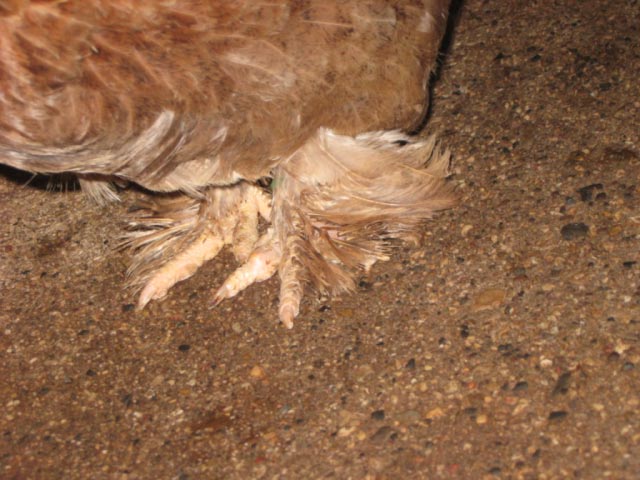
Bantam Cochin chickens are a breed native to Asia, and many people keep them as pets. After watching these three trail along after us I can certainly understand why. They are great pest controls in gardens, eating unwanted insects with relish. In fact they have specially adapted feathers that cover their feet (and look kind of like pantaloons) that help them to sense the vibrations of insects in the soil. The Chickens are also prolific egg producers, usually laying one or two eggs every other day. Not only do they produce fresh eggs, but they also produce some of nature’s very best organic fertilizer. Best of all is the eggciting fact that chickens can be trained.
Black, Brown and Yellow know a variety of behaviors. They are great at following us between their indoor and outdoor pens at the zoo. Black and Brown can spin in circles on cue (in opposite directions) and Black will fly up to a trainer’s arm. Last year, in the Milwaukee Count Zoo bird show, they had a fairly simple pattern. They ran from one part of the stage, up a ramp, and back into their pen. This year we are having a little more fun, although the basic A to B pattern is still there--we didn’t need to start from scratch after all. In addition though, Black is also playing the role of our chicken hawk. Imagine you are an unsuspecting child volunteer, waiting with arm outstretched to receive the chicken hawk you’ve been told is going to land on you. Suddenly from out of nowhere there is a small black chicken on your arm eating grapes from the show speaker’s hand. Pretty fowl right? Black does an excellent job of surprising and then delighting children in shows while Brown and Yellow run around excitedly at their feet. Then all three chickens run off the stage and back to their pen while the audience cracks up.
Many people love the Chickens, perhaps because they are small and run in an amusing waddling gallop. Or maybe it’s because black jumps onto a child’s arm and the other two wait before all three leave. For whatever reason, they are eggceptional people pleasers and definitely a lot of fun to work with and train.
....AND THAT’S NO YOLK!
Thursday, September 23, 2010
August in Rehab
August has been a busy month in our wildlife hospital.
We have been working hard to save as many birds as possible. We started the month with three Great-horned Owls and two Red-tailed Hawks that were emaciated and starving. They were most likely recent hatches that were finally having to hunt on their own and were no longer getting supplementary food from their parents.
Raptor parents do not teach their offspring how to hunt – hunting is an instinctual behavior triggered by the movement of prey near the raptor and hunger. We keep them for a week or two to fatten them up and provide them with an 'energy buffer' so that they have some time to figure out the hunting thing once they have been released.
We also received three Cooper's Hawks – all of which had flown into windows. Two weren't that badly injured and could be released after a little rest and recuperation from concussion. The third bird was more seriously injured and seemed to have a bruised spine or a broken pelvis. Birds with injuries like this are slow to recover. They need to be hand fed for a number of weeks and receive very intensive care as they slowly recover. It is very rewarding to have a hawk that could not stand or eat start to eat on its own and fight back when we handle them for medicating or physical therapy.
As always, we do everything we can to get each patient admitted to the hospital back out into the wild. Sometimes everything we can do is not enough, and they do not survive. But many do survive, and nothing beats the feeling we get when we watch one of our patients return to the wild, flying strong.
Subscribe to:
Posts (Atom)