Thursday, October 11, 2012

Wings Around the World – Annual Open House


 Many of you are familiar with our Annual Open House.  It is always held on the third weekend of October, this year being on October 20 and 21, from 10 am – 4 pm. 

Open House is a free event, and definitely one of my personal favorites.  It’s a great event for the whole family.  This year, guests are in for an extra special treat.  WBS staff and birds have been working hard all summer to bring the most unique show ever to our Open House 2012.

This year we are adding some of our very special non-native birds to the shows.  These birds have been away for the summer wowing audiences in WBS’s bird shows at the Milwaukee County Zoo and Stone Zoo in Boston. 

You will marvel at the beauty and magnificence of Tsavo, our Bateleur Eagle as he takes his maiden flight in our amphitheater at this year’s Open House.  Watch and listen to the silent flight of an adorable Tawny Owl.  Don’t think vultures are beautiful?  Wait until you see our gorgeous King Vulture!  Witness the special talents of the snake wrangling Red-legged Seriema. 

We will also still have everyone’s old favorites such as a flying Harris’ Hawk, a falcon, owls and a Bald Eagle flight that just might take your breath away.

This year we will also feature special educational shows and displays in our Outdoor Classroom which is located at our Monsanto Environmental Educational Center, by our very special guest: The Butterfly House.  There will be Missouri Native Arthropods on display, in addition to the presentations.

As with every Open House, you will be able to take Behind the Scene tours of our Breeding Barn, Animal and Behavioral Training Center and our Wildlife Hospital, which are normally closed to the public. 

We will also have free children’s activities and a craft center. 

“The Raptor Project” will close out each day with a concert held in our amphitheater, playing everyone’s favorite environmentally friendly and educational tunes, featuring many of our own animals.  Make sure the kids wear their dancing shoes! 

WBS will be offering a photo opportunity with a live bird of prey, face painting, concessions and souvenirs for a nominal fee.

Be sure to bring your cameras!

Open House comes but once a year, so make sure to mark your calendars.  You won’t want to miss this year’s new and improved line up.

Save the date:
*            Saturday, October 20
*            Sunday, October 21
Time:  10 am – 4 pm

For directions to our site Click Here 

As always, for the safety of our animals and our other guests, no pets please.

Open House sponsored by Ameren Missouri
Submitted by Billie Baumann, World Bird Sanctuary Outreach Coordinator

Tuesday, October 9, 2012

Christie Barnhart - Super Coordinator


Over the years World Bird Sanctuary has worked with many wonderful sponsor corporations to present our environmental education message to the public.

In many cases we are assigned a liaison to coordinate these presentations.  For the past few years Christie Barnhart has been our liaison for the Western District of Missouri American Water Company.  Following the tornado that devastated the Joplin area in 2011, Christie coordinated several World Bird Sanctuary presentations to help Joplin residents move forward from the terrible consequences. Her efforts were outstanding.
Christie Barnhart
Once the arrangements had been made between Missouri American Water and the World Bird Sanctuary to present the message of the importance of clean water to the people of Joplin and Warrensburg, it remained for someone to work out all the complicated details.  Christie Barnhart was that go-to person, and she took the ball and ran with it.

The task of coordinating a series of WBS presentations in a distant city can involve some complicated and often difficult scheduling.  When an organization such as WBS travels to a distant location with a troop of humans, animals and equipment for a stay of more than one day there are a thousand little details to be worked out.  If you’ve ever planned a vacation itinerary you’ve had just a taste of what’s involved in scheduling.  Throw animals and equipment into that mix and the complexity increases exponentially.
Christie at one of our school programs
Christie’s list of details included but was not limited to:

*            Contacting all the schools and meeting places for the live bird presentations and working out a schedule that fit in with class times, yet allowing us to travel from school to school with a minimum of down time

*            Making arrangements for volunteer Linda Tossing and I to visit all the grade schools affected by the 2011 Joplin tornado
WBS volunteer Linda Tossing, Christie Barnhart, & WBS trainer Roger Wallace 
*            Making arrangements to fly the Bald Eagle at the 2011 home opener of the Joplin High School football season after the tornado

*            Making arrangements to have the WBS in-house band, The Raptor Project, perform for Joplin

*            Arranging radio, TV, and newspaper coverage and interviews

*            Arranging for hotel accommodations for humans and birds

*            Christie always meets us at the hotel to chauffer the birds to each event so that we do not get lost when we are out of our hometown
WBS trainer Roger Wallace, Clark the Bald Eagle & Executive Director Walter C. Crawford, Jr.
Christie’s attention to detail enabled the World Bird Sanctuary staff to focus on the message we want to bring to our audience about the importance of clean water for humans and birds.  She helped the people who attended our programs realize that everything they put on their land affects their watershed.  The health of a watershed (and people’s drinking water within that watershed) is directly affected by those who live in that area.  The audiences were reminded that their actions determine how safe and clean their drinking water will be.

Although the Joplin area is not the only Missouri American Water sponsored series of programs, we always look forward to working with Christie when we are in her area.

Submitted by Mike Zieloski, World Bird Sanctuary Naturalist/EEC Manager

Photos by Mike Zieloski

Sunday, October 7, 2012

What Makes Eagles Laugh?


Normally I choose to write about things from long ago or which may seem unbelievable. However, this month I choose to write about events that have happened to me while at the World Bird Sanctuary.
 One doesn't usually think of the stately Bald Eagle laughing, but read on....
All sorts of interesting things have happened; things I will never forget for the rest of my life. However, there are some things that stand out more than others. One of the things that stood out the most is when I got the eagles to laugh.

I know what you are saying. Eagles don’t laugh--especially at people and what they do. Well that is true…but from a human perception it often seems that eagles do laugh.  They also seem to laugh when they are proud of themselves. Attributing human emotions to animals is called anthropomorphism and I believe that all animal lovers have been guilty of it at one time or another.  As a writer of fables I tend to give human traits to inanimate objects, as well as animals, so humor me for the next few paragraphs.

As the Supervisor of the Education Training Center (we call it the ETC for short) for the summer of 2012, I get to work with many of our resident Bald Eagles. For the most part they are rather quiet, and happily sit on their perches and wait for their food to come. That’s one thing that can get an eagle to laugh. They see us coming with a big fish in our hands and start to get excited. How do they get excited you ask? Well they start to flap their wings and call out as we pass by. With a quick toss, the fish lands in front on them, at which they quickly jump on top of them like the fish would swim away. I assure you that they can’t… the fish are… well… dead of course.
 Lewis having a good laugh--or so it seems
Many of the Bald Eagles throw their heads back and release a long and hardy call which sounds just like a laugh. What does an Eagle laugh sound like? Well, you’ll have to come by and listen for yourself. It is quite contagious. Good food is always something to laugh about and have a good time over.

Bald Eagles don’t just laugh about food--though that seems to be the case most of the time. They also tend to laugh when they are proud. Sometimes when we train the eagles, instead of getting a mouse or a piece of rat as a reward, they get to go after a lure. Yes, that’s right, birds like lures too, but they’re a little different from the ones people use to catch fish--a lot different.

When the bird sees the lure being swung around by the trainer, they know they are going to have a bit of fun. They swoop in low and take hold of the lure.  One of our eagles, Lewis, loves the lure. He pounces on it and throws his head back and lets loose a long loud laugh. He likes to let the other eagles know that he got to play with the lure and he’s proud that he did. Though sometimes he gets a little carried away and tries to bring his prize back to the perch with him. Of course, he’s not allowed to.

The funniest thing that make eagles laugh are things their trainers and keepers do. Just recently, I was eating my lunch in the ETC. It was just about one o’clock and time to head back to work. I had been sitting for some time and was a little stiff. All of a sudden I heard a “tink tink” on the roof. It didn’t hit me at first, but then I grabbed my keys and ran to my car. It had started to rain rather hard and I had left my windows down. My leg wouldn’t work and my glasses were slowly filling with water. By the time I got to my car, my seats were wet and so was everything else in my car. I quickly rolled up my windows. As soon as they were up, the rain let up and was barely a sprinkle. I sat in my car for a moment and released a sigh. I got out and started to walk back to the building. As I stumbled and grumbled, all of the eagles that had watched me run started to laugh and cackle. I’m not exaggerating. They all started to laugh.

I look back and think of that surreal moment--Eagles laughing at me because I was trying to keep the interior of my car dry. I’m sure they weren’t thinking that. They probably thought it was funny to see a person running and then grumbling at the sky. As if the sky cared that my windows were opened. As if they cared that the inside of my car was now wet. They really did seem to enjoy watching me run like a mad woman.

It is kind of nice to know that I can at least make an eagle laugh.

Submitted by Allison Brehmer, World Bird Sanctuary ETC Supervisor

Friday, October 5, 2012

Meet Mortimer


What are the first three adjectives that come to mind when you think of a Turkey Vulture?  Well, if they aren’t “cute”, “sweet” and “adorable” then you haven’t met Mortimer!!
It's really hard to resist Mortimer's charms.
Mortimer is one of the newest residents at the World Bird Sanctuary.  Mort’s egg was laid by two of the resident Turkey Vultures, Attila and Hinkley, in our behind the scenes area breeding mews.

When he was just a few weeks old he was brought to our Nature Center to be raised by our Naturalists so that he could become accustomed to all the sights, sounds and activities he would encounter as one of WBS’s avian ambassadors. (Since we do not routinely subject our birds to surgical sexing, we will assume Mortimer is a male until such time as he proves us wrong by laying an egg.)

When he first joined our staff he appeared white!! – or at least his baby down feathers were white.  He also had a black head rather then the red head usually associated with Turkey Vultures.  (As he matures his head will turn the familiar red color.)  As time passed he began to lose his baby down and his first set of “real” feathers grew in.  However, at this point he looks like a little old man with a scraggly white beard, since some of his down feathers are still clinging in places. 
Mortimer is gradually losing his white down feathers
At first, since he was unable to fly, Mortimer was allowed the freedom to roam freely in an enclosed area, getting used to the comings and goings of our staff.  His major accomplishment in the ensuing weeks was exercising his wings and stealing everyone’s heart.  However, once he began to take his first tentative flights it was time to outfit him with jesses, and introduce him to his perch in the weathering area, where he joined our other avian stars.  Click here for a video of those early days.

At this point it was time to begin his formal “education.”  Training one of our avian ambassadors is serious stuff!  They need to learn things like stepping to a trainer’s glove, then balancing on the glove while being walked around the Nature Center amongst visitors.  They need to learn to go into and out of a travel crate without being afraid, and that doors will not eat them as they pass through.  They learn to step onto a scale to be weighed, and then to step back to the glove from the scale.  Mortimer has mastered all these skills with flying colors.
Mortimer and Naturalist Cathy Spahn at Birds in Concert - Photo by Sandra Lowe Murray
The next big step for Mortimer was to perform before large crowds—which he did this past August when he appeared at our Birds In Concert series.  A few people in the safety of the Nature Center is one thing—but two hundred people in the amphitheater, a band, and cameras flashing is another!  However, because Mortimer totally trusts his handlers and he got small doses of all the other things mentioned during his initial training, he passed this test like a pro.

Since that first public appearance he has passed another hurdle—traveling in the van to a distant location and then appearing at the Kansas City Renaissance Festival.  This was a true test of all his careful training, since there is nothing more chaotic than a Renfaire with it’s crowds, banners, music, parades, strange animals (such as dogs, horses, snakes, etc.).  Mortimer took all of this in his stride and is well on his way to becoming a real pro.

When you visit the World Bird Sanctuary be sure to look for Mortimer.  It’s not often that you will have the opportunity to see a baby Turkey Vulture.  Check him out while he still has his juvenile plumage.

As with all our birds, Mortimer is available for adoption through our Adopt A Bird program.  If you don’t see Mortimer (or any bird you are interested in adopting) on our website you can call 636-861-3225, XT 10, and tell the person answering that you would like to adopt a bird.

Submitted by Gay Schroer, World Bird Sanctuary Volunteer/Photographer

Wednesday, October 3, 2012

2012 Nestbox Study - Summary


The 2012 Ameren Missouri/World Bird Sanctuary nesting box study has come to a close.
 You never know what you will see while doing field studies
The data collected still must be analyzed before any solid conclusions can be drawn.  The study this season went well and now it is time for the birds to migrate to their winter homes.

The official end of the study was August 10, and unfortunately a large percentage of the last clutch was lost because of extreme heat.  The good news is that the first half of the study was very successful.

Another great finding was that the newest power line cut we have nest boxes in, or the Rockwood Substation line, produced fledglings at the rate of the other two established lines.  Despite the very hot weather, overall I still kept busy with banding and monitoring throughout the summer.

So down to the numbers; The Rockwood Substation nest boxes yielded 32 nests, 171 eggs, 92 babies banded, and 107 fledged.  Robertsville and Robertsville State Park yielded 43 nests, 288 eggs, 118 babies banded, and 145 fledged.  Highway 100 yielded 27 nests, 156 eggs, 92 babies banded, and 95 fledged.  Overall the study produced 102 nests, 615 eggs, 302 babies banded, and 347 fledged.

This year would not have been as successful without the help of many people.  I would like to take the time to thank personally my Ameren Missouri representative Tim Webbers for taking the time to answer many emails and phone calls this last nesting season.  I would also like to thank The Landowners who were involved in the study.  The interns this summer at WBS helped me push through the hot times and I would like to think that they enjoyed going out to monitor the nest boxes.  To the boy scouts of America; thank you for providing us with the nest boxes used in the study.

In closing I would like to thank the WBS staff for training me on how to find all 240 nest boxes and conduct field studies in a timely fashion.   

Submitted by Adam Triska, World Bird Sanctuary Field Studies Coordinator        

Monday, October 1, 2012

Open House....Coming Soon!


The summer’s blistering temperatures are behind us and Fall is in the air.  The leaves are beginning to turn and pumpkins are appearing on front porches.  It’s time to get out and enjoy the beautiful Fall weather.  What does all this mean for the World Bird Sanctuary?  You guessed it—Open House 2012 is just around the corner!

The theme for this year’s Open House is “Wings Around The World”, featuring new birds never before seen at Open House programs! 
Shadow, one of our majestic Bateleur Eagles
Programs this year will feature a flying Bateleur Eagle, a flying Tawny Owl, a beautiful King Vulture, and a snake wrangling Red-legged Seriema.  In addition we will have old favorites such as flying Hawks, a flying Bald Eagle, Falcons, Owls – and more.

The Butterfly House will join us this year with a special activity for the youngsters—a “Bug Detective” program. 

In addition, there will be behind-the-scenes tours of our breeding barn, animal behavioral and training center, and wildlife hospital.  
Have your photo taken with one of our live birds of prey
For a small fee our photographer will be taking photos of guests posing with a live bird of prey.   

And there will be free fun craft centers and activities for the kids.  Our in-house band, The Raptor Project will be on site to entertain with their original songs about some of the wildlife you will encounter.
Just one of our free kids' activities--make a craft to take home with you
Bring a picnic lunch or take advantage of our concession stands.  Be sure to bring your camera as there will be photo opportunities at every turn. 

The main paths in our triangle area are now paved and handicapped accessible, and restrooms are conveniently nearby, but be sure to wear comfortable walking shoes as you will want to explore all the attractions that will be spread out throughout our site.  For those more adventurous souls we have several hiking trails that wind through our oak/hickory forest and are natural and unpaved. 

SO….Mark your calendars!….Save the date!
 
Saturday, October 20
Sunday, October 21
10am – 4pm

Admission and parking are free!

For directions to our site Click Here

As always…for the safety of our other guests and our animals—no pets please.

Saturday, September 29, 2012

The Peacock's Many Eyes: A Fable


Following is another fable by our talented storyteller and ETC Supervisor, Allison Brehmer.

The Peacock’s Many Eyes

Have you ever wondered why Peacocks have so many eyes on their long, beautiful tails?

A long time ago, when humans and animals could still understand one another, there lived a Peacock and his lovely wife, the Peahen.  They had a sweet little nest built out of wood and stone.  Within this little nest, they cared for their eggs.  The Peahen would sit on them all day and turn them just so.  The Peacock would provide for her and give her everything she could possibly want.  He worked hard every day and came home late at night.

One day, while the Peacock was foraging in the woods, a snake came across the nest and couldn’t resist the lure of the Peahen’s eggs.  He snuck up behind her and swallowed up an egg without her notice.  He soon swallowed another and then another.  Happy with his meal, the snake slithered away with a fat belly.  That evening the Peacock came home and greeted his wife.  She stood to welcome him, but noticed that there seemed to be fewer eggs than there were before.  Perplexed, the Peafowl couldn’t think of a reason why an egg would suddenly disappear.  They were saddened by this find and the Peahen promised to be more vigilant.

The next day, the Peacock went back out into the woods to forage for food.  The Peahen watched every which way she could to see what could possibly be taking her eggs.  Then, out of the tall grass, she saw him come.  The snake had returned, hoping to find another easy meal.  The Peahen puffed up and tried to chase away the snake, but he was just too quick for her.  In one swallow, three more eggs were in his belly.  Satisfied, he slithered off, leaving a very distraught Peahen.

The Peacock came home that night to find his wife crying over what was left of their eggs.  She told him that a big snake came up and swallowed up their eggs.  The Peacock decided to stay and fend off the snake if he came back.  The next day, the Peacock sat on the eggs and waited.  Soon enough, the snake came crawling through the grass in search of more eggs.  The Peacock fought valiantly, but the snake was just too fierce. The Peacock laid his long, beautiful tail over the remaining eggs, but the snake just slipped between them.  He enjoyed his meal and left only one egg. The Peacock and Peahen were devastated by the loss and didn’t know what to do. 

Then a thought came to the Peacock.  In the nearby village there was an artist that painted terrifying images that frightened even the bravest of warriors and fiercest of tigers.  He went to the artist and asked to be made terrifying to scare the snake.  The artist,, who loved the beauty of the Peacock, refused the request.  But the Peacock pleaded and begged until the artist could take no more.  He agreed, but only if he choose what to paint.  The Peacock agreed and spread his long tail feathers.

The artist worked all night and used the brightest and darkest colors he had.  As the sun rose he announced that he was finally done.  The Peacock looked at himself in the mirror and spread out his feathers behind him.  He nearly jumped out of his skin at the sight. It looked like a thousand eyes were glaring back at him.  He thanked the artist and ran straight home.

Within the hour the snake came to finish off the last egg.  When the snake saw the Peacock standing over his wife and egg, he laughed to himself, knowing that there was nothing they could do to stop him.  The snake approached confidently and the Peacock stood his ground.  Just as the snake was about to reach him, the Peacock opened his tail and spread it out behind him.  The snake froze at the sight of a thousand eyes staring back at him.  The Peacock took a step forward and the snake slithered back.  With a shake of his tail, the Peacock released a loud cry.  This sent shivers up and down the snake’s spine.  If he could, he would have been running away with his tail in between his legs… that is if he had legs.

The Peacock slowly put down his tail and stood proudly.  He had saved his wife and their egg from the snake’s greedy hunger.  The egg soon hatched and a little Peacock came into the world.  From then on, every Peacock was hatched with a thousand eyes on their brightly colored tail.

Submitted by Allison Brehmer, World Bird Sanctuary ETC  Supervisor

Thursday, September 27, 2012

Just Four More Days to Save $100


If you've been considering attending the World Bird Sanctuary Avian Training Workshop in November there's still time to take advantage of the early registration bonus!  Save $100 by registering before October 1st!
 The "Classroom" portion of our workshop is not your average classroom
What is an Avian Training Workshop you may ask?  

The WBS Avian Training Workshop is an intensive 4-day workshop, which covers all aspects of housing, training, feeding and caring for raptors, parrots, corvids and many other species.  The workshop includes both classroom and hands-on training.
Learn how to manage weight by training your bird to step to a scale
Subjects covered in the classroom section include:  
*  Establishing your own program--permits, insurance, facilities, staff & volunteers
*  Working with and training your bird--manning and positive reinforcement, desensitizing
*  Choosing the correct species to work with
*  Transportation--crates, permits, driving, flying, shipping
*  Housing--mews, jumpboxes, A-frames, flight cages, climate, hotwiring enclosures, substrates
*  Perch types--bow, platform, screen, etc.--which perch works best for which species
*  Diets--food types, frozen vs. live, storage, prep, raising food colonies, vitamins
*  Training your birds for flying--weight management, base weights, target weighs, flyer food
 Participants learn how to free-fly a raptor
Everybody's favorite--the hands-on section:
Our staff believes the only way to learn is through the hands-on experience of doing things yourself.  At our workshop you will have the opportunity to actually do the following:
*  Make jesses, anklets, leashes
*  Practice imping feathers
*  Experience coping and trimming of a raptor
*  Participate in simple public speaking games and learn how different elements make you a better public speaker
*  Fly a Harris' Hawk and/or Barn Owl with WBS staff
*  Help train a new behavior with a White-necked Raven (continues throughout the workshop)
*  "Be the Bird" in our training game
*  Participate in emergency medical care and do a gross necropsy on a raptor
 A workshop participant learning how to tube feed an ailing bird
The workshop also includes an extensive tour of WBS' facilities and opportunities to see birds and housing up close.

RESERVATIONS REQUIRED.  Workshop has a minimum of 10 participants and a maximum of 20.

WHEN:  Thursday, Nov. 1st through Sunday, Nov. 4th

EARLY REGISTRATION:  Sign up before October 1st - Cost - $650
LATE REGISTRATION:  Sign up on or after October 1st - Cost - $750

$100 non-refundable deposit required by October 1st for early registration, balance due by October 15th.

Registration fee includes lunch each day.

Transportation to and from St. Louis, hotel accommodations and breakfast & dinner are the responsibility of each participant.

To download a registration form CLICK HERE

Further questions?  Contact Teri Graves, 636-225-4390, ext. 0 or email workshop@worldbirdsanctuary.org

Tuesday, September 25, 2012

365 Photo Project - July


My 365 Photo Project has slowed down some recently due to the excessive heat.

The record breaking 100 plus degree temperatures in the St. Louis area have made it difficult for me to do many of my favorite outdoor activities; but luckily this month I had a short vacation with my family at the family cottage in Northern Wisconsin.  Of course I took many photos, and trying to pick just a few is very difficult.  However, I do have a couple photos that are my favorites.

The first two are similar--they are of my niece Madilyn.  We went to this small zoo in Minocqua, Wisconsin called Wildwood Wildlife Park.  There they have this budgie experience were you can go into a large flight cage with tons of budgies (short for Budgerigar Parakeet).  For $1 you can get a seed stick and the budgies flock to you to get their treat.  My nieces are 2 and 4 and they just loved this experience. 

 I managed to get two photos of Madilyn that show her pure joy at having these seemingly fearless, little creatures land on her hand.  The photos show just how much she loved the budgies. 

My next pick is a photo of my nieces Hailey, Madilyn and their dog Mollie all looking at a sailboat as it went by on the lake.  This is just a peaceful photo that transports me back to the serenity of that day when I look at it.

Submitted by Cathy Spahn, World Bird Sanctuary Naturalist

Sunday, September 23, 2012

Cooper’s Hawk Kids – Final Update

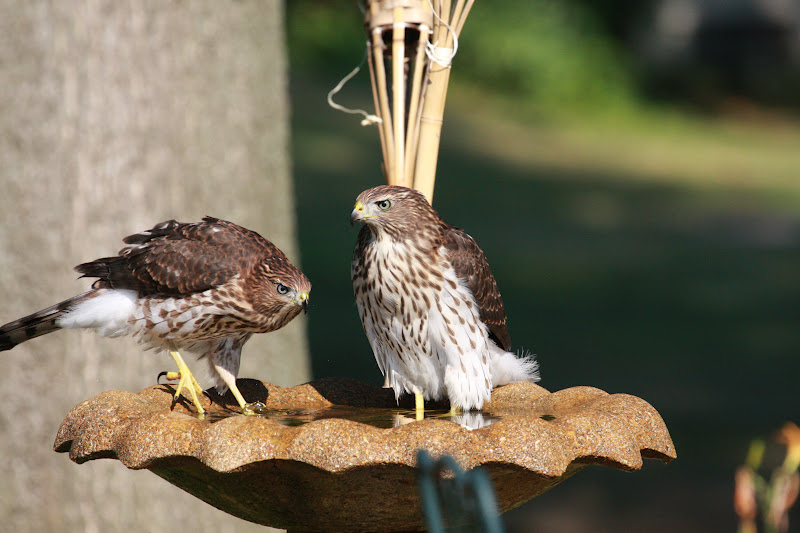
If you've been following the WBS blog you probably know the story of the pair of Cooper's Hawks who courted and nested within sight of our home.
Here's the female Cooper's Hawk (mama)

...and here's the male (papa)
In my last Cooper's Hawk blog post I described the fascinating (and sometimes hilarious) antics of the three fledglings that resulted from that mating.  (To see the first two chapters click on "Cooper's Hawks" in the list on the right side of this page.)  

Following is the final chapter in the education of the Cooper's Hawk kids.

7/18 – Today my husband saw one of the young Cooper’s Hawks chasing a Dove through the yard.  I think they’ve finally figured out what they’re supposed to hunt.  He didn’t know if it was successful, but it’s a start.

7/21 – I haven’t seen or heard the hawks for several days now.  Perhaps they’ve moved on to more productive territories.  I think they may now be hunting for themselves, since I haven’t heard them hunger screaming in the early morning lately.

7/22 – I hadn’t seen the hawks at the birdbath for several days, but finally saw one of them in a neighbor’s yard this afternoon.

Another neighbor told me that he saw one of them in his birdbath one day, and then shortly thereafter saw it lying prone in the dirt near the birdbath with it’s wings outspread. Our raptors at WBS frequently do this when they are sunbathing.  This behavior is called “pancaking”.   Since the temperatures are in the 100’s I can only guess that perhaps this bird was trying to dry its wet feathers after its bath.

7/23 – The Hawks are back from wherever they’ve been the last few days.  I didn’t see them early this morning, but the yard was absolutely quiet, which tells me they were somewhere in the vicinity.  All the songbirds are either hiding or sitting tight and not calling.  I’ve come to realize that this means the hawks are on the hunt. 
They zoomed by me on their way to the birdbath
This afternoon as I was out in the back yard two of them whizzed by within inches of my head and then landed on the birdbath.  The temperature was 106° and I’m sure they were desperate to cool off.  They usually just stand in the water.  By cooling off the blood supply to their feet it lowers their body temp.  They stood in the birdbath for about 20 minutes and hunger screamed for mom who I’m guessing is trying to wean them.

I haven’t seen the smaller male, but he is usually more wary than the two females.  According to Jeff Meshach, Director of the World Bird Sanctuary, there is good reason for his wariness.  Jeff says …”The male is wary for good reason...if his sisters are hungry enough (and you can bet they are with mom and dad hardly feeding them anymore) they will make a meal of him.  Too much size disparity between the sexes...boys can and will get made into a pellet.”

7/27 – Again, I hadn’t seen or heard the hawks for several days, but this morning as I was walking out to my van to take my granddaughter to Day Camp two of the hawks zoomed overhead and into one of the oak trees in pursuit of a smaller bird.  I think they’ve finally learned to hunt for themselves!
Any small creature who becomes the object of this fearsome stare had best beware
8/15 – I haven’t seen our hawks since that last exciting chase.  I heard one calling from across the road one day, but no sightings since then.  Their visits are becoming less and less frequent.  My guess is that they’ve now become self-sufficient and are claiming their own territories.

Even though I miss watching their antics every day I am thrilled that they’ve survived those first perilous months when so many young birds succumb to hunger, predators, drought, storms, injury, etc. 

If we’re lucky they or their parents will use this area to nest again next year.

Submitted by Gay Schroer, World Bird Sanctuary Volunteer/Photographer


Friday, September 21, 2012

Field Studies Report – July 2012


During the 2012 nesting season July has been the least productive month of the study.

The constant heat and drought have caused many of the birds to abandon their eggs. The rate of success is very meager if any, and the outlook for the remainder of the study is dismal at best. Still the research goes on and I can only keep hoping for a break in the extreme weather conditions.
 Photo by Adam Triska
For July there were a total of 28 active nests, with 24 of them being Eastern Blue Bird nests and 4 House Wren nests.  Of the 109 eggs present, 88 were Eastern Blue Bird eggs and 21 were House Wren eggs.  Only 25 Babies were hatched successfully and 15 were banded. Four of the banded babies were lost due to the extreme weather conditions, so only a total of 11 babies fledged during July. The total of banded birds for this year is 293, and the overall total of birds fledged (banded or not) is still to be determined, but I would suspect the number will be in the ballpark of 350 birds.

The weather, as we all know, has been very unforgiving this month for the birds and also me.  In my weekly route I make note of temperature and other weather related information.  I recorded 12 days that were over 100° F.  This extreme heat combined with less than 1 inch of precipitation has brought the nesting season almost to a stop. From July 10-31 only 2 babies were banded, and this trend will most likely continue.

This month 10 nests and over 45 eggs were lost to predators and the elements. I expect that the number of birds lost will only increase before the nesting season is over if the extreme conditions continue.  Fear not, though!!  Nature continually throws curve balls at its residents, and the residents improvise, adapt and overcome.

Submitted by Adam Triska, World Bird Sanctuary Field Studies Coordinator