Friday, January 11, 2013

Really Weird Birds Part 11


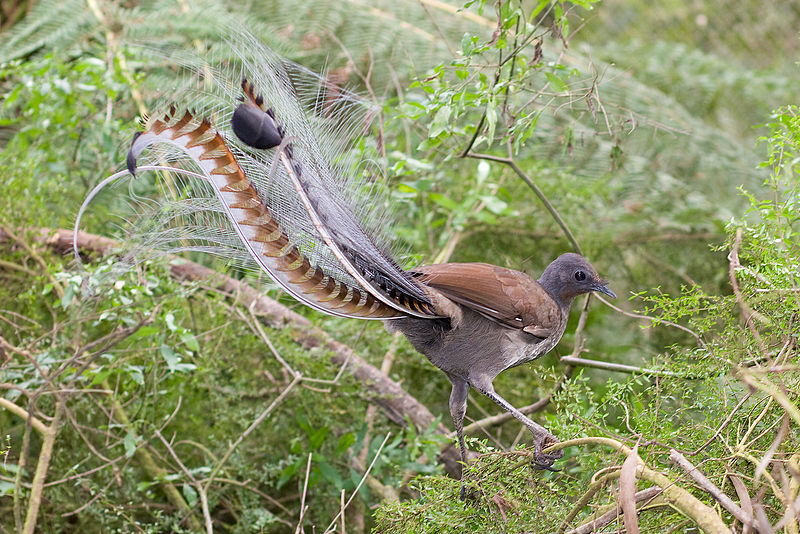
Australia has some amazing species of birds; one such example is the Superb Lyrebird.  The name “Lyrebird” comes from the resemblance of the male’s tail to a Greek lyre, especially when he is on full display (a Lyre is a type of a harp often seen in ancient Greek frescoes or pottery such as the photo below).

The only other species of Lyrebird, called Albert’s Lyrebird, has a more subdued version of the Superb Lyrebird’s tail.  They of course use their tails in courtship displays.  The rest of their body is quite drab, a brownish gray coloration. 
Male Superb Lyrebird in full display
During mating season, males will defend their territory against other males.  They are polygamous, meaning they will mate with more than one female, and display to as many females as possible.  The ladies will check out several different males before choosing to mate.  During courtship, the male will stand on a platform made of soil.  He will sing and dance and display his beautiful tail.  He inverts his tail over his head, fanning out his feathers to form a silvery white canopy.

The vocalizations of the Lyrebird are very impressive.  It has species-specific noises but most of its song consists of mimicry of other birds, animals, and other sounds.  The Lyrebird's syrinx (vocal organ) is the most complexly muscled of the songbirds, giving it amazing skill, unrivaled in song and mimicry.  The Lyrebird is capable of imitating almost any sound.  They have been recorded mimicking human caused sounds such as camera shutters, car alarms, and chainsaws, as seen in this video.  They have also been heard to mimic rifle shots, dogs barking, crying babies, music, and even the human voice.

Lyrebirds are among the largest of the passerines or songbirds (order Passeriformes, which includes warblers, sparrows, and even crows).  They are fairly long-lived birds and can live up to thirty years old.  They also start breeding later in life than other passerine birds.  Females are sexually mature at five to six years and males not until six to eight years of age.  Females typically lay a single egg in a ground nest and are the sole caretakers of the chick.

Lyrebirds find their food on the ground by scratching their feet through the leaf litter.  They eat a wide range of invertebrates such as cockroaches, beetle larvae, earwigs, fly larvae, moths, centipedes, spiders, earthworms, lizards, frogs and occasionally, seeds.
Male Superb Lyrebird foraging

The Superb Lyrebird, once seriously threatened by habitat destruction, is now classified as common.  Albert's Lyrebird has a very restricted habitat and had been listed as Vulnerable by the IUCN (International Union for Conservation of Nature), but due to careful management of the species and its habitat the species was downgraded to Near Threatened in 2009.

Even so, lyrebirds are vulnerable to feral cats (house cats that were allowed to wander outside and went wild), house cats allowed to wander outside, and foxes.  It remains to be seen if habitat protection schemes will stand up to increased human population pressure.

Never let your pet cats wander outside.  In addition to the fact that cats kill millions of birds, rodents and other wildlife every year, allowing them to wander outdoors shortens their life spans by exposing them to disease, attacks by other animals, and the danger of being injured or killed by collision with vehicles.  


Submitted by Sara Oliver, World Bird Sanctuary Naturalist


Wednesday, January 9, 2013

Juggernaut of the Skies - Argentavis Magnificens


Known as the largest flying bird to ever be discovered, the Argentavis magnificens or the magnificent Argentine bird  lived on the mountainsides of Argentina six million years ago.
The photo above shows a silhouette of A. magnificens for size comparison with a human

The Argentavis magnificens is closely related to the Andean Condor, but it is speculated that Argentavis magnificens could also actively hunt and take live prey, as well as feeding on the remains of the deceased.  With a wingspan of twenty-three feet and weighing up to one hundred and seventy pounds this juggernaut of the sky had to use the energy provided by the atmosphere to get airborne.

A. magnificens had wings that were too long to just jump up and fly off into the sky, so like many other very large flying birds A. magnificens used a few tricks to get the lift needed to get off the ground.  Just like a hang glider A. magnificens probably took advantage of the headwinds and updrafts associated with high elevations to get its massive body off the ground.  Once in the air A. maginificens would have ridden the thermals to stay aloft just like birds today.

A. magnificens stood at around six feet tall and had a bill designed like an eagle rather than the modern day vultures and condors.  Because of the fossilized bone structure, the legs were probably big and strong, suggesting that A. magnificens was well adapted to walking long distances and living on the ground as well as soaring high in the sky.  It is theorized that A. magnificens would patrol the skies of the open grasslands feeding primarily on the carcasses of land animals.

A. magnificens also was an active hunter at times, when the opportunity presented itself.  A. Magnificens would probably have a hunting technique unique among other birds of prey because of its immense size.  It would most likely have to catch its prey off guard by swooping in from behind and picking it up and eating it without ever leaving the sky.  
A. magnificens was truly a big animal and pushed the size limit to the edge for flying.  To give you an idea of the mass of A. Magnificens--in comparison to the Bald Eagle, A. magnificens was about sixteen times heavier and had a wing span triple that of the Bald Eagle.

For a more in-depth description of this magnificent bird Click Here to read a paper written by Dr. Kenneth E. Campbell published by the Natural History Museum of Los Angeles County in 1980.

In my humble opinion A. magnificens was one of the most impressive creatures that walked or flew on our planet.

Submitted by Adam Triska, World Bird Sanctuary Field Studies Coordinator

Monday, January 7, 2013

Rustle, the Nine-banded Armadillo


Rustle, the Nine-banded Armadillo, has quickly found a way into my heart and has become one of my favorite animals at WBS.  Over this last year I have come to know and love this little 9 lb wonder of an animal.

It all started last fall when I let him get some time out of his enclosure.  He started digging at another animal’s water bottle, so I gave him some water, thinking he was thirsty.  This is when it all started.  He dumped the water all over the floor and created his own slip and slide.  Then he proceeded to roll like crazy in the water. 

Following his lead, we began to provide Rustle with his own water tub in which to take a daily bath.  This behavior and his fun in the water led to a You Tube video that has made Rustle famous-- even in Japan!  We have also discovered his love for warm water.  When you get him out for his daily run he is usually sleepy and if you set him in the water he will rest in the water with all four feet stretched out, like having his own warm water spa.

Since Rustle runs daily we have worked very hard on handling him and just making him very comfortable around people.  He loves his run time and explores shoes, bags left on the floor, a jacket he can pull down to the floor, etc.  Anything at ground level is something to be explored. 

For an animal that does not see very well Rustle definitely knows where and when to be present.  If a cabinet opens in the animal food prep room he is there in a heartbeat, especially if it contains towels.  If a refrigerator door opens he is ready to jump in.  Rustle loves his produce--tomatoes, watermelon, bell peppers, grapes, peaches, and will try anything he is given and quickly makes a mess with it.

When Rustle is out and about for his daily run we often use a scrub brush that we stroke his back with.  As he gets his back scratched with the brush Rustle’s tail actually wags, like a dog.  It is very cute and makes us smile every time we see this behavior--who knew? 

One day while he was out running, Rustle started pushing around the plastic lid to our trashcan, so I placed it on top of him.  He was not afraid of this, and in fact ran around with it on his back for some time, came out, then worked very hard at getting back under the lid.  Now, when placing the lid on the floor, Rustle can get under it within a matter of seconds.  He will run around with the trash can lid on his back for 30 or more minutes when you let him.  Who knew a trashcan lid was so entertaining?

Rustle recently did his first display at the St. Louis Science Center and demonstrated many of these fun characteristics.  He continues to educate his trainers on the amazing behaviors that Armadillos can exhibit.

Submitted by Cathy Spahn, World Bird Sanctuary Naturalist

Saturday, January 5, 2013

Crows


As I was browsing the internet this past week I was intrigued by a film that looked at the behavior and the intelligence levels of Crows. 
 Because of the Corvid family's intelligence Hugnin teaches audiences that..."even a bird can recycle"
The film focused on a study being conducted at the University of Washington where John Marzluff and his team have been studying the Crows’ abilities to facially recognize humans.

John Marzluff and his team in Seattle have been conducting some very interesting studies on the Crows in the Seattle area.  In the past Marzulff has estabished that the Crows that had been tagged at the University have not forgotten their experience.  He is reminded of this when he puts on the mask that he wore when the Crows were tagged.  At first the Crows that were tagged would harass him when he walked by with the mask on, but he noticed that over time not only did the original birds remember, but that individuals also spread the word to other birds.
 
This left Marzluff with some interesting questions about what we truly know about Crows.  To prove (or disprove) his theory he designed a study to put the Crows’ facial recognition and cultural transmission skills through a simple experiment.  What he planned on doing was seeing if Crows were able to pass on information from not just one adult Crow to another, but from one generation to the next.  This ability has only been found in primates and humans.  Marzluff did this by banding adult breeding pairs in 5 different locations. While the Crows were being banded the team wore a mask so the bird would recognize them as a threat.

As the baby Crows developed the team would walk through the area with the assigned mask.  What they were hoping to accomplish by doing this was to have the babies see and remember what their parents did when the masked man was around.
 John Marzluff and one of the Crows he has been studying
 As the study progressed the babies were banded, and tracking monitors were attached by Marzluff and his team without the mask on, so Marzluff and his team could observe the development of the young Crows. Marzulff had a total of 8 young Crows in the study and by November of the Crows’ hatch year only one had survived. Marzluff was able to locate this Crow and could run the last test in the study.

Marzluff first walked by the crow to record a normal reaction to an unmasked human, and the bird responded by doing almost nothing to acknowledge his presence.  However, when Marzluff put on the mask the reaction was much different. The Crow took very much interest in Marzluff with the mask on, and after a few minutes the Crow became so upset that it let out an alarm call.

Marzluff was successful in showing that Crows are capable of passing on vital information from one generation to the next.  This means they are able to change and adapt to their environment.
 Because of the Corvid family's intelligence, Hugnin, a White Naped Raven has learned to accept donations

When you think about it are we so different from Crows?  Crows and humans are social, adaptive, intelligent, opportunistic, and omnivores. The building blocks of higher intelligence are not exclusive to just humans; other organisms have also had success by using their head.
   
When visiting the World Bird Sanctuary be sure to take a walk down the display line where several corvids (the family that includes Crows and Ravens) are housed.

Submitted by Adam Triska, World Bird Sanctuary Field Studies Coordinator 
      

Thursday, January 3, 2013

Barn Owl Coloration


 Blog reader John Foehner recently submitted the following comment on our blog article "Barn Owl Fun Facts: Part 1": “Great info!  Barn owls are one of my favorite birds. Here's a question for you that I've never had answered... Barn owls are beautiful birds with an awesome design on their light golden/tan/white feathers.  Why?  It doesn't seem to be used for camouflage and a largely nocturnal bird wouldn't seem to need special coloring for ID or courting?  Although most birds are pretty in one way or another, I can't figure out why barn owls look the way they do.  So, why? “
Just a few of the color pattern variations here at WBS--left to right are Moonshine, Farnsworth, Dawn & Abby
I’ll have to admit that even though I have taken hundreds of photos of the Barn Owls at WBS, I had simply taken their beautiful feather patterns for granted as just another part of what makes this species so fascinating. 

John’s question sent me into a fury of researching the whys and wherefores of Barn Owl coloration. 

There are approximately 35-40 known subspecies of Barn Owls--the exact number is arguable, depending on which expert source you are reading at the moment.  Since Barn Owls are found on every continent except Antarctica (and some islands), their territories sometimes overlap resulting in some sub-species that interbreed—thus the discrepancy in the number of listed sub-species. 
Our sweet little Tobin, a European Barn Owl, was so light colored that when viewed from below he might easily have been mistaken for a Snowy Owl
Among the multitude of sub-species there is a wide variety of differences in the coloration and shading of individuals—some being so light when viewed from below that they are sometimes mistaken for a Snowy Owl, and others having a buffy or beige coloring on the underside. 
Note how well this Barn Owl blends in when seen from above...even though this is not a natural environment
Even though Barn Owls are largely nocturnal, they are also crepuscular (active at dusk and dawn).  Hence the need for camouflage.  When viewed from above—they are universally a blend of dark grey/brown backs and wings.  This difference in coloration (light underside and dark backs and wings) is an example of “counter shading”—an adaptation used for concealment.  When in flight it allows them to take full advantage of the interplay between light and dark—enabling them to “disappear” as they change direction in flight, thus avoiding other predators who might be looking for a Barn Owl snack.

As a general rule, the white/light colored feathers on the breast are spotted—in some individuals the spotting is so light that from a short distance the breast appears to be solid white.  However, in other individuals the breast is heavily spotted.  The females are more heavily spotted than the males.
Abby is a good example of the heavier spotting on the female....
One of the most interesting theories that came to light in my research is that the spotting may indicate the quality of the female.  One study found that the more heavily spotted females get fewer parasitic flies and may be more resistant to parasites and diseases.  Also, in another experiment when some females’ spots were removed their mates fed the nestlings less often than for heavily spotted females.  As a general rule, most of my research sources concurred that it appears that heavily spotted females are healthier.
....whereas Moonshine is a classic example of the lack of spotting in the males
Another study showed that female Barn Owls with larger spots have a greater success in mating, whereas large dark spots on the breast appears to hurt male Barn Owls’ reproductive success.

And, finally, another study indicated that nestling Barn Owls frequently feed their siblings.  This behavior predominates in individuals displaying a female-like plumage trait (spots).

To see some of these color variations when visiting the World Bird Sanctuary be sure to check out the color patterns on the various Barn Owls on display.

Submitted by Gay Schroer, World Bird Sanctuary Volunteer/Photographer


Tuesday, January 1, 2013

New Year Rituals


The World Bird Sanctuary—staff, volunteers and interns—wishes one and all a happy and healthy New Year. 

Many of us humans have certain rituals for ushering in the New Year—a party with friends and family, a champagne toast, tooting horns and noisemakers of all kinds, eating a chunk of pickled herring, watching a New Years Day parade, etc. 
 All that hooting signals the commencement of a Great Horned Owl's mating season
Some of our feathered friends have rituals that take place over the New Year also.  For owls this is the time of year when love is in the air.  Triggered by the Fall reverse photo period (shortened day lengths) Owls begin claiming their territories and finding mates in late Fall and through the winter months.  This is when they are the most vocal.  If you are lucky enough to have an owl near your home you may have heard their calls more frequently after dusk.  These calls in the Winter are their territorial calls—somewhat like the old gold miners “staking their claim”. 

By the first of the year our feathered Lotharios are still hooting—but these are now “come hither” calls for any female in the area who may be interested.  If you hear his deep booming call and an answering higher pitched call you may have a mated pair calling to each other.  By the end of January they will most likely be sitting on eggs.
 By the end of January the female will be sitting on eggs
If you would like to learn more about these fascinating creatures (and meet some of them up close) join us for one of our evening Owl Prowls. One of our Naturalists will give a 30-minute presentation featuring live flying owls, followed by an easy night hike around our grounds.  You will have the opportunity to try your hand at “hooting” as we try to find wild Barred Owls and Great-horned Owls who are busy setting up territories and finding mates for the winter owl breeding season!   You may be the lucky person to coax an answer from one of our local wild owls.

Owl Prowls have been very popular this year and have filled up quickly, but we still have a limited number of openings available for remaining Owl Prowls.  So don’t delay--book today to avoid last minute disappointment.  We have openings remaining on the following dates:

February 1
February 23
March 1
March 9

All Owl Prowls start at 7pm.

To reserve a spot call our Education Center at 636-225-4390 ext. 0.

$9 per adult; $7 per child under 12
.
Friends of World Bird Sanctuary receive a 10% discount.

Groups of 10 or more pay $7 per adult and $7 per child.

Remember to dress appropriately for the weather and wear comfortable walking shoes.

Sunday, December 30, 2012

Ginger


It is with a sad heart that we must tell you that Ginger, our little red Bantam Cochin Chicken, passed away suddenly last week. 

Ginger had some big shoes to fill when she took over the post of “official greeter” at WBS’s Visitor Information Center, but she was quickly becoming a favorite in her own right. 

She will be sorely missed by staff, volunteers and guests alike.

Friday, December 28, 2012

The Rookie Files: Training Clark


I’m sure I’ve mentioned Clark the Bald Eagle in previous blogs, but he is one of my favorites.
 Clark, one of our magnificent flying Bald Eagles
I know, I know, parents aren’t supposed to have favorite kids, and trainers are not supposed to have favorite birds--but we often do, and Clark is one of mine.

My Clark fan club membership was recently renewed because I got to work one on one with him for the first time in years.  The first year I worked with Clark I was but a young rookie myself.  Fresh off my second internship and summer at Grant’s Farm I was told we were going to fly Clark at Silver Dollar City, Branson, Missouri, in the fall of 2009.

When he first arrived for preliminary training at WBS’s Milwaukee County Zoo bird show (where many of the staff who would eventually work at WBS’s Silver Dollar City bird show were stationed) I was a little on the nervous side.  A Bald EAGLE was going to be flying towards me!  It was a little unnerving to say the least.
 A Bald Eagle in full flight heading straight toward you can be a little unnerving!
Luckily for me at that point in my career, Clark was first trained by our excellent Bald Eagle trainer, Roger Wallace, and then continued his education with our amazing ETC supervisor; so no Bald Eagle landing on MY head!  …well, there was that one time when he didn’t really understand that we were calling him to a stump rather than the glove, but that was a fluke.  He was amazing to fly at Silver Dollar City, never missed a beat, and had the most incredible flights!

I was able to work with Clark a few more times over the next couple winters.  I only heard about his great double flights with Lewis the Bald eagle, but overall I did not work with Clark in a show capacity again until the summer of 2012.  We flew Clark at WBS’s Stone Zoo bird show in Stoneham, Massachusetts, near Boston.

This time I was the one in charge of Clark for the summer--his training, his pattern, his health and wellness.  To be honest, I was a little apprehensive, but felt confident that I was up to the challenge.  And then I remembered all of Clark’s delightful little quirks that I had completely forgotten about during the winter!  Clark loves to rip, tear and shred—it doesn’t matter what, just as long as he can turn it into a chew toy.

As I mentioned in my earlier Enrichment blog we had to provide Clark with a variety of different things to distract him at night so that he would not destroy his anklets or jesses.  Due to his “chewtastic” nature, Clark has to have special woven, nylon jesses instead of the usual leather ones.
 The goal was to get Clark to cue to the word "feathers"--and only to "feathers"
Clark is also very smart and very good at picking up on patterns.  At the beginning of the show we would ask the audience a question, the answer to which was the word “feathers!”. Once this guess was confirmed by the speaker, Clark would be cued for his exit.  Clark first picked up on the connection between the audience speaking and his cue for food.  When the audience would guess incorrectly, Clark would still try to leave.  Clark then learned that his food cue was connected to the word “feathers” itself.  By the end of the season, Clark would be ready to exit if the audience yelled “feathers”, but only “feathers”.  If, for instance, they yelled “wings” Clark would sit patiently until they guessed correctly; only then would he be primed to leave!
 Clark launching himself from the second story window of our Nature Center
Clark also started to anticipate his end pattern and became bored with it, forcing us to come up with new and exciting patterns to keep him engaged.  Birds of prey may not be as intelligent as some parrots or corvids (crows, ravens, jays), but don’t ever let anyone tell you that Bald eagles are dumb.  Fortunately it was this pattern recognition and intelligence that allowed us to be able to do an incredible release for WBS’s Open House this year--flying Clark out of our Nature Center’s second story window and out over the audience in our amphitheater!
 Our Open House audience experiencing a Bald Eagle flying just a few feet overhead
Clark and I have both come so far since we first met.  I became a supervisor and trainer in my own right; he flew in tandem with another Bald eagle and before a Saint Louis Blues hockey match.  He is a challenging bird who keeps me on my toes, and for enrichment purposes, I keep him guessing as well.  We may not always be working together due to scheduling conflicts, but when we do I think Clark and I bring out the best in each other.

Submitted by Leah Tyndall, World Bird Sanctuary 

Wednesday, December 26, 2012

A Trainer Always In Training


In order for anyone to run a successful business it is very important to first show all the employees exactly what needs to be done for the business.
 Scoop the Pelican knows that by hitting his mark he will receive a reward
When the employees fully understand what needs to be done, or are fully trained, the business will usually compensate the employee for their time spent training and working for the company.  At WBS this concept is used not only for the staff, interns, and volunteers but also for the birds themselves.

Positive reinforcement is something that is utilized in day-to day life, many times unknowingly, and is a part of behavioral training in almost any possible situation.  It is also the most used method of the World Bird Sanctuary. 

When first becoming an intern, I was trained to clean and feed the correct way and was positively reinforced by being allowed more and more privileges with the birds as I understood more procedures.  Then, once I was a trainer in Boston, in order to train the stars of the show, I first needed to be coached on how to properly guide them to the correct behaviors, with everything revolving around positive reinforcement.
 How do you teach a Seriema to "slam" a rubber snake?....baby steps!
Unfortunately, birds do not understand English so what speaks louder than words?  Food, of course!  Normally people would say, “Actions speak louder than words,” but when it comes to birds of prey (and many people) a sure way to the heart is through the stomach.  So for every behavior that needs to be achieved, a step-by-step (most of the time baby steps) process needs to slowly take place in order for the bird to catch on, or achieve the goal behavior.  Every time the bird completes one of the small steps, it should be immediately positively reinforced with food so that the bird understands that that exact action will get them food.
 This Barn Owl knows there is a tasty morsel waiting on this perch
The immediate and consistent reward is crucial for proper training to make sure that the correct behavior is reinforced.  While training one of the sanctuary’s newer Bald Eagles, Lina, to step to the leather glove that we wear, there is a fine line between stepping to the glove and footing the glove, or grabbing aggressively for food.  So, instead of rewarding her immediately for putting her foot on the glove (whether it be aggressive or not), she must be rewarded for stepping and only stepping on the glove, and not for footing the glove.  By doing this, we can minimize any confusion she might have about what gets her food, and will also help to keep her from accidentally learning that footing the glove is the behavior the trainer wants. 
 This American Kestrel knows there is a tasty morsel waiting for him in the other trainer's glove
Taking small steps to eventually accomplish the goal behavior and being careful to reinforce only the exact action desired are the two main pieces to the puzzle of training.

Submitted by Teresa Aldrich, World Bird Sanctuary Naturalist/Trainer ETC

Monday, December 24, 2012

MERRY CHRISTMAS


From all of us....Staff, interns, volunteers and animals….

To all of you….guests, supporters, donors who make our work possible in a thousand different ways….

MERRY CHRISTMAS!

Saturday, December 22, 2012

Xena--A Most Impressive Bird


The next bird that I want to introduce to you is such a wonderful animal that I am positive that you will fall in love with her just as I did.  Her name is Xena and she is a Eurasian Eagle Owl (Bubo bubo).
Xena is a favorite with guests because of her regal bearing and piercing eyes
Eurasian Eagle Owls are native to Europe, Asia, and Northeast Africa.  They live in mostly wooded habitats like coniferous forests, farmlands, grasslands, and even some deserts.  Of the 287 owl species in the world, Eurasian Eagle Owls are the largest!

Depending if it’s a male or female, they stand from two to two and a half feet tall and weigh from four to seven pounds.  Their wingspan ranges from five to seven feet!  As in most birds of prey, females are about a third larger than males.  This is believed to be because greater size can help them better defend their clutch (a group of eggs or chicks) and nest and to also incubate the clutch better with increased surface area of the body. 

Their diet is variable and consists of mammals, reptiles, birds, amphibians, and sometimes fish.  The largest animal they have been known to prey upon is small roe deer, which are about 30 pounds in weight!  They of course could not pick up a 30 pound deer and fly away with it.  A good rule of thumb is that usually a bird of prey can pick up a third of its own body weight.  Eagle owls have large orange eyes, disks of feathers around each eye, feather tufts on top of their head, black and various shades of brown feathers covering their body, eight sharp talons, and a sharp curved upper beak. 

Take a look at Xena in the photo above, isn’t she just beautiful?  Do you notice the feather tufts on her head? They may look similar to the tufts you’ve seen on another owl--the Great Horned Owl.  Strangely enough, these two owl species that live oceans apart are actually closely related!

Breeding season for owls is during the winter.  Eagle owls will start laying eggs in January and February.  They nest on high rocky cliffs and generally lay from one to four white eggs per clutch.  The male will do most of the hunting while the female will stay at the nest and feed and protect the clutch.  The female will incubate the eggs for 31-36 days.  After the eggs have hatched, the chicks will stay in the nest for 7-8 weeks.  When they fledge (leave the nest), the parents will still care for them for another 20-24 weeks.  The chicks will be on their own around 8 months old. 

A Eurasian Eagle Owl’s lifespan in the wild can be up to 20 years—and even double that or more in captivity.  Xena was hatched in captivity in 1999 at the World Bird Sanctuary, so she is 14 years old this year. The longest Eurasian Eagle Owl lifespan on record in captivity is 60 years old. 

The Eagle Owl call is described as a monotonous “oohu-oohu-oohu” and will also make an “oo-hooh” call as well.  The females will make a “kraah” sound during mating season.  The males have a deep voice and the females have a higher pitched voice. The first time I heard Xena call, I couldn’t believe it!  She is such a big gorgeous bird and the sound that came out of her didn’t seem to belong.  It was such a high-pitched sound that it made me laugh in amazement! 
Xena has been the feature bird for the photo op at many WBS special events
Xena is part of the Education Department at the World Bird Sanctuary (WBS).  She helps educate people at programs either on site at WBS, off site in a neighboring town, or even out of state!  Xena has also been in numerous parades in St. Louis, MO and St. Genevieve, MO, and even the Tournament of Roses Parade in Los Angeles, CA!  She is a seemingly easy- going bird that seems to like standing on the ground next to her perch outdoors, or take a bath in her water bowl when it’s raining.  She likes to eat rabbit, chicks, mice, and venison, but her favorite food is rat!  Yummy!   Because of her easy-going disposition she has often been the feature bird for the photo op at WBS special events.

Xena is available for adoption in our Adopt a Bird program.  To find out more information, call 636-861-3225.  All adoption donations are tax deductible.  She can be seen at the Monsanto Environmental Education Center at the World Bird Sanctuary, which is open daily from 8am-5pm.

Xena is a very mesmerizing bird.  You will be drawn toward her as soon as you see her!  You should stop on by and visit her!

Submitted by Lisbeth Hodges, World Bird Sanctuary Naturalist

Thursday, December 20, 2012

Hazel


 It is with much sadness that we let you know that our sweet little Hazel, the Mini Rex Rabbit passed away last Thursday, 12/13.  She was five years old.

On Tuesday, 12/11 her handlers noted that she seemed to be having trouble eating—often a sign in animals that something is wrong.  They immediately consulted our vet and scheduled her to be seen. Our vet examined her in the morning and was concerned that Hazel could have a cancer.  We continued to give her supportive therapy, but by that afternoon Hazel had passed on.  

A necropsy showed that Hazel succumbed to uterine cancer.  Unfortunately, animals are very good at masking illness and injury since in the wild, if they show signs of illness, this would make them easy prey for predators and even attacks by their own kind.  No matter how sharp-eyed their caretakers are it is often too late by the time the animal exhibits symptoms.

Hazel was a huge favorite with staff and visitors—especially the youngsters.  She was extremely tolerant of the many small hands that loved to stroke our “Velveteen Rabbit”.  Some rabbits are very skittish at being stroked and handled—not so Hazel, who seemed to truly enjoy the human contact.

Hazel will be sorely missed by our staff and the thousands of youngsters who make the bunny enclosure one of their first stops when visiting the Nature Center.
