Saturday, November 20, 2010

Learning to Appreciate Snakes

At the World Bird Sanctuary most people would not expect to find snakes.  However, we have many different snake species.
Dundee, a Green Tree Python
When I started with WBS back in 2000 I worked with a satellite program we called Care for Critters.  Care for Critters was sponsored by Roundy’s Pick ‘N Save and the Zoological Society of Milwaukee.  This was a mixed animal program that traveled around Wisconsin and parts of Northern Illinois. 

When I arrived in Milwaukee I found out I would be working with 3 large snakes.  The smallest was Aurora who was 5 ft long and 20-25 pounds, the largest was Kahn--both Burmese Pythons.  At that time Kahn was 30-40 pounds and about 9 ft. long.  Back then I was like many people--not very fond of snakes.  I was never like many people who are utterly terrified of them.  I was just not terribly fond of them.  However, I began working with them and soon found I did not mind handling the large snakes.

Every year, starting at the end of May, we would change themes for the show.  In 2001 our theme was Pets through the Ages.  That year we had two bull snakes and two corn snakes.  As I worked with the smaller snakes, especially the corn snakes, I found myself getting more comfortable with handling the reptiles.

I also started reading about snakes and reptiles to better educate myself about them.  As I spent more and more time learning about snakes and how they benefit mankind I developed a greater appreciation of these species.
Yoda, my Okeetee Corn Snake
This process, and working with the corn snakes, led me to now owning 2 corn snakes of my own.
It now takes two naturalists to handle Kahn for shows
Kahn, the Burmese Python mentioned earlier in this article, now weighs 51 pounds, is 13 feet long, and is still growing!  To see Kahn and many of the other reptiles that call the World Bird Sanctuary home you can visit our Nature Center 363 days of the year (we are closed on Christmas and Thanksgiving).

To learn more about these fascinating creatures consider booking a Creatures of Myth and Legend or other mixed species program for your next group function.

 For more information about the many different programs available for your group Click Here for our web page, and search under the “Programs” dropdown menu, or call 636-225-4390, Ext. 0.

Submitted by Cathy Spahn, World Bird Sanctuary Field Studies Coordinator

Thursday, November 18, 2010

Flip Update: On The Move

A few months ago I introduced you all to Flip, the Red-shouldered Hawk I had begun training.   He is a bird that came into our Rehabilitation facility as a juvenile in May 2009 with a wing injury which turned out to be permanent.  My training goal at that point was manning Flip, or getting him comfortable sitting on the glove, and introducing him to being in front of the public.

Since then, Flip has had some big changes and some milestones!  First of all, he looks super-different now.  Flip has since molted and his adult plumage has grown in.   This new plumage is affectionately referred to as his “big boy feathers.”  With his rust shoulder patches, rusty breast feathers and black and white striped tail, he looks just like the adult birds you would see in a field guide.

I have only heard him make the typical Red-shouldered Hawk call a couple of times, though.  He’s still pretty squeaky, especially when I’m around.  Flip has also started to do some education programs for us, both here at the Sanctuary and out in the world.  His first show was in our amphitheater in May for a group of 12 people.  He did very well in front of the group on the glove, and was very good about going in and out of his crate.

Throughout the summer, whenever I had a program that was close to the Sanctuary or was a shorter show, I made sure to get Flip out there.  He has now done a show all the way in Ste. Genevieve, MO, quite a car trip for a new guy.  Flip actually seems the most relaxed when he’s in the car travelling to and from the show.  I mean, I know I like sitting back and watching the scenery while someone drives me around, but I didn’t know if he would feel the same way!  Seriously though, being a good traveler is such an important part of the lives of our education animals, I’m so pleased with Flip’s immediate comfort in the vehicle.
 
Flip is just one of the awesome birds you can see when you come visit the Sanctuary.  When you’re walking through the different areas, you might see perches that are empty.  Those birds are travelling with the education department on that particular day, teaching young and old alike.  Because of Flip’s excellent progress, you may see his perch open more often then not over the summer.  But it means that soon people all over the country will be getting to enjoy this awesome little bird with the adorable squeak.  He’s a wonderful example of a bird you might see in your own backyard and that is an indispensible teaching tool!  


Submitted by Dana Lambert, World Bird Sanctuary Naturalist

Tuesday, November 16, 2010

Aquarena

When my husband and I were in Texas for vacation, we found a very interesting place just off the highway between San Antonio and Austin.  A few miles down the road we came across an interesting bit of history (and nature) called the Aquarena.
 One of the abandoned structures 
The Aquarena was a huge tourist attraction from the 1940’s through the mid 1990’s.  It was built on the San Marcos springs and Spring Lake.  These springs bubble up from under the ground to form the head of the San Marcos River.  The area started out with a beautiful hotel at the edge of Spring Lake in 1928, built by Arthur Rogers, a San Marcos resident.  A year later, in 1946, his son added onto the popular hotel by offering tours of the lake in a glass-bottom boat.  This brought in many more tourists and in 1951 an underwater submarine theater was added.  Visitors could go into this theater (it looked just like a submarine) and watch the mermaid girls and underwater clowns as they fed fish, swam through the water and even ate food and drank from soda bottles while underwater (a very difficult trick to learn, according to one of the girls who used to work there).

 The water shows became so popular that a new star joined the group in 1969 – “Ralph” the swimming pig.  Yes, a pig.  The park would train baby pigs to follow a milk bottle through the water as soon as they were old enough to learn and eventually they learned to love the water – diving enthusiastically into the lake when it was their turn!

The park was very popular and, from looking at the postcards and posters, a very fun place to visit.  They had a restaurant, a sky tower and even a sky ride across the lake.
One of the glass bottomed boats still in operation
But by the mid-1990’s the Aquarena just wasn’t as big an attraction anymore.  The underwater shows, sky rides and poor “Ralph” weren’t bringing in the crowds and the Aquarena was sold to the University of Texas.  UT stopped all the old shows and rides and started to put the area back to its natural state.  The underwater theater and rides were abandoned and ignored, but the glass-bottom boats are still in operation to allow visitors to see the springs bubbling up at the bottom of the clear lake.  Students now study the habitat, wildlife and history of the area as part of their curriculum and the Aquarena is still open to the public, but now it is for learning and wildlife appreciation, not profit and swimming pigs.

While we were there, we visited the small aquarium that UT has put together with native fish, reptiles and amphibians that you can find around the springs.  We wandered the grounds and admired the old rides and theater that are still there.  It felt a lot like a ghost town with the overgrown equipment and abandoned restaurant, but it was a lot of fun to try and imagine the ghost families walking around, riding the rides, seeing the shows and having a fun family vacation.
 A Great Blue Heron patiently waiting for "lunch" to swim past
One of the really nice areas is a boardwalk through the edge of the lakeshore.  It is a great way to see some of the wildlife there.  We saw turtles sunning themselves, fish moving through the crystal clear water, a Great Blue Heron fishing and, best of all, a Green Heron walking through grasses and catching a dragonfly for lunch! 
This Green Heron has just caught "lunch"
All in all, it’s a neat little piece of history that hasn’t been lost.  The Aquarena did its time as a family-oriented tourist attraction, and now it is back to nature, the students learning about it and those of us who appreciate it.


Submitted by Laura MacLeod, World Bird Sanctuary Education Coordinator

Sunday, November 14, 2010

How to Make an Insect Collection

Collecting insects and learning to identify them can be a fun and educational activity that anyone can do!  You can learn much more about them by collecting and handling them than by reading about them in books.  You may decide to catch and release the insects or you may want to make a collection of preserved specimens.  In either case, remember to treat each insect with respect and limit your catch.

*Photo 1: Insect collection*

Basic equipment needed is an insect net, a jar, tweezers, insect pins, a box with a Styrofoam bottom to pin the specimens, and labels to indicate where and when each was collected.  Insect field guides, which can be found in most book stores and libraries, can help to identify them, usually down to what family they are in.  There are over 1 million species of insects and identifying them down to species is a very big challenge.

No matter where you live or what you do, you will be able to find insects.  They live in just about every habitat on earth.  There are a few different ways to catch them.  Using an insect net to brush along grass, bushes, or in tree branches is the simplest way.  Also look under rocks and logs, replacing them as they were when you’re done.  You can spread a white sheet under a shrub and then shake the branches vigorously.  When disturbed, many insects will feign death and fall to the ground.  At night, a white sheet can also be hung by a porch light.  Many insects navigate by the moon and get confused by bright lights and fly towards them instead.  Many different kinds, especially moths, will land on the sheet. 

Tweezers can be used to pick up the insects from the sheet and placed in a jar.  Before killing them, it is important to identify what the insect is, since there are endangered insects in most parts of our country.  If the insect is endangered or protected, let it go immediately.  To kill an insect you can legally preserve, put alcohol or nail polish remover on a cotton ball and place it in the jar with the insects for about 20 minutes.  After you have finished collecting for the day, it is wise to go ahead and put them on insect pins.  Don't wait until the next day because the insects may become dry and brittle, and parts of the insect may break off when you try to pin them.  It is best to use special insect pins, No. 2 or No. 3 size, which can be bought online from websites like bioquip.com, compleatnaturalist.com, or educationalscience.com. Also special insect display cases can be found there as well.  However, a simple shoe box with a Styrofoam board on the bottom works well for amateur collectors.

Gently run the pin through the thorax (middle segment) of the insect a little to the right of the midline of the body.
 
*Photo 2: Top view of stink bug with correct location of pin circled in blue*

Leave about 1/4-inch of the pin visible above the insect allowing enough room to pick it up without touching the insect. This will also leave enough room on the pin under the insect to add labels.

*Photo 3: Side view of Japanese beetle with labels*

*Photo 4: Side view of grasshopper with labels*

Soft-bodied insects such as aphids, caterpillars and aquatic larvae can go into a vial filled with 70-75% alcohol.  The vial can be pinned in place on the Styrofoam board on the bottom of your box.  The label can be pinned next to it.

*Photo 4: Vial with dobsonfly larva*

The first label you can add under each insect is the location the insect was caught, the date caught and the name of the collector.  This can be typed in a very small font like Times New Roman size 6 or 7, printed on index cards or cardstock and cut out.  The second label to add is the family name of the insect that you determined using your field guide.  If you don’t want to go that far in identifying, you can determine which order the insect is in (recall from science class that there are 7 ranks in the organization of naming living things: Kingdom, Phylum, Class, Order, Family, Genus, and Species).  There are only 32 orders of insects whereas there are around 600 different families to choose from!  Arrange the insects in your box in separate sections for the different orders you identified.  One label for each order can be made and put above each section.

*Photo 5: Notice black thread separating the different orders of insects*

If you are concerned about killing insects for your collection, remember this: insects often have short life spans and reproduce quickly, so collecting adult insects will have very little impact on the population as a whole.  Just don’t collect more insects than you need, and be sure to take time to label, arrange and store specimens correctly so there are good records for future generations to use. 

Submitted by Sara Oliver, World Bird Sanctuary Naturalist

Wednesday, November 10, 2010

Pelagic Birding in Illinois

The weekend of September 18 and 19 I joined The St. Louis Audubon Society’s annual trip to Carlyle Lake near Carlyle, IL, for a weekend of warblers and then pelagic birding out on the lake.

On Saturday the 18th the weather was beautiful. This day was dedicated to land birds.  We started the day off by meeting at the local McDonald’s at 7:30 am and then headed to the swimming beach to watch the gulls.
Ring-billed Gulls following the boat looking for a handout
Most people I know think that all gulls are the same, but there are actually 55 species in 6 genera.  On the beach we spotted the most common gull in the region, the Ring-billed Gull.  We also saw another semi-common gull the Herring Gull.  The best find on the beach with the flock of gulls was a Lesser Black-backed Gull.  The Lesser Black-backed Gull is common across Europe and is an uncommon species in North America, but we get annual visitors during the fall and winter months.  While looking around we also found Forster’s Terns, Mallards, and a Canada Goose Nest.
A Yellow Billed Cuckoo - often heard, but seldom seen
The group then headed to Eldon Hazlet State Park to spot birds that call the wood their habitat.  The weather that morning was perfect, but the birds were not moving in big numbers.  We spotted a nice variety, including: Yellow-billed Cuckoo, Rose-breasted Grosbeak, Blue-gray Gnatcatcher, Wood Thrush, Tennessee and Nashville Warblers, a Northern Parula, Chestnut-sided, Bay-breasted, Black-throated Green, Black and White, Magnolia and Blackburnian Warblers, a Common Yellowthroat, an American Redstart and Philadelphia, Red-eyed, White-eyed and Yellow-throated Vireos.

Our next stop was on the other side of the lake.  This location had a nice lookout point that allowed us to survey the lake to see what we could find and what might be possible for Sunday.  After some careful looking I spotted a Jaeger that had been seen a day earlier.  It was a nice juvenile Parasitic Jaeger.  Jaegers prey upon other birds, especially their babies, but are not true birds of prey.  Jaegers have long, pointed and angled wings, They breed in the arctic regions and migrate to southern regions for the winter. In the fall Jaegers frequent the Great Lakes and are considered casual visitors inland.  We were looking over this area to try to find this bird and another specialty, the Sabine’s Gull, which a few of us confirmed was on the lake, but extremely far out, even with good telescopes.

Day two, Sunday, began at 7:00am meeting at the McDonald’s again, but instead of nice weather we had lots of rain and chilly weather.  Since the morning’s intended birding was delayed for a while, we headed for a shelter in Eldon Hazlet State Park where we could look out over the lake to see what we could find and also observe the swallow flock.  We were looking for a Cave Swallow that had been seen the day before. 

The Cave Swallow is special because it is normally found in Southern Texas and Florida.  Over the years more Cave Swallows have turned up in other parts of the country in the fall.  We looked for the bird, but with the lighting and the large number of other swallows we never located this particular swallow. 

We moved around to different locations during the morning hours trying to locate any birds we could find in the misting to heavy rain.  At our last stop before heading to the boats we did have a great find--a Merlin.  Merlin’s are a smaller falcon that nests in more northern climates and migrate through the region in fall and winter.

The weather finally cleared and we were off to Pelagic Birding.  Pelagic Birding is where you take a boat out onto a body of water like a large lake or ocean and search for bird species that live in open waters rather than along the shore.  The St. Louis Audubon Society rented 3 party boats for this purpose.  We then split into groups and headed out onto the lake to see what we could find. 

As we were riding along we tossed popcorn off the sides of the boats.  This brings the gulls in closer to the boats and allows for super views and great photography.  The first target species was the Parasitic Jaeger.  One of the boats located the Jaeger and the word was spread from there.  The boat I was on was the last to arrive, but we still had nice passes by the Jaeger.
A beautiful Sabine's Gull showing his beautiful markings
The next target species was the Sabine’s Gull.  The Sabine’s Gull is an arctic species that migrates to the Southern Hemisphere for the winter.  I believe this is one of the prettiest gulls.  As adults they have a dark gray head, yellow and black bill, and a striking black, gray and white wing pattern.  Juvenile birds lack the dark gray head, but have a soft gray brown crown and nape, black bill, and black tail band.  The juvenile’s wing pattern is not as striking as in an adult, but is still very beautiful.  We had seen the bird on Saturday off in the distance, and then on Sunday the call came out.  We went racing from our location over to see this bird.

While slowly moving into position we also spotted five Red-necked Phalaropes, but most of us were more interested in the gull.  This was not my first Sabine’s Gull, but it is always a pleasure to see because they are just so beautiful.  We watched the bird for several minutes. I was able to get some nice photos, both in-flight and sitting on the water.  Just being able to see this bird up close and to watch it in flight is always a joy. 

I am already looking forward to next year's trip!!!

Submitted by Cathy Spahn, World Bird Sanctuary Field Studies Coordinator

Monday, November 8, 2010

Roadkill Shiver


This is the name of one of our songs on the "Save the Future" CD (Click the link to hear a sample). 

It's also a feeling that you can avoid.
 Armadillos have become a more common roadkill sight in Missouri lately
During migration many birds and other animals are active in areas where you may not have seen them during the summer.  Creeks, riverways, small wooded areas and greenbelts connect the wildlife community just like highways connect our metro areas.  We need to be aware of these wildlife highways and that sometimes they cross our own asphalt highways.  During migration periods there is increased activity as birds move south in the Fall and north in the Spring. 

During the Fall and Spring migrations we see a large increase in the numbers of owls and migrating hawks (like Broadwinged Hawks) in our wildlife hospital.    They are worn out from flying long distances and are sometimes slow to get out of the way of our cars.  Some birds may also be eating fresh roadkill on the side of the road and may not be quick enough to get out of our way – they end up becoming roadkill themselves. 
 Liberty, the Bald Eagle, was a victim of a collision with a vehicle.

How many of you have met Liberty, one of our education Bald Eagles?  Liberty was hit by a car while eating a dead animal on the road.  He was rehabilitated and released back into the wild.  He did well for about a year, and then was hit by a car again while eating roadkill on the road.  His injuries from his second accident were such that he would not have survived on his own in the wild.  Most animals hit by cars are not as lucky as Liberty and do not survive a collision with a car or truck.

With this increased activity we ask that you exercise more caution than usual when driving on our roads.  I think that we can all remember to drive a little more slowly than usual and be more aware of what is going on around us.

We use humor in the "Roadkill Shiver" song to remind ourselves about the dangers facing animals out there and to remind us to use a little more caution and take a little more time to keep our birds safe.

You can buy the Raptor Project CD featuring "Roadkill Shiver" here: 

Submitted by Joe Hoffmann, World Bird Sanctuary Manager. 

Saturday, November 6, 2010

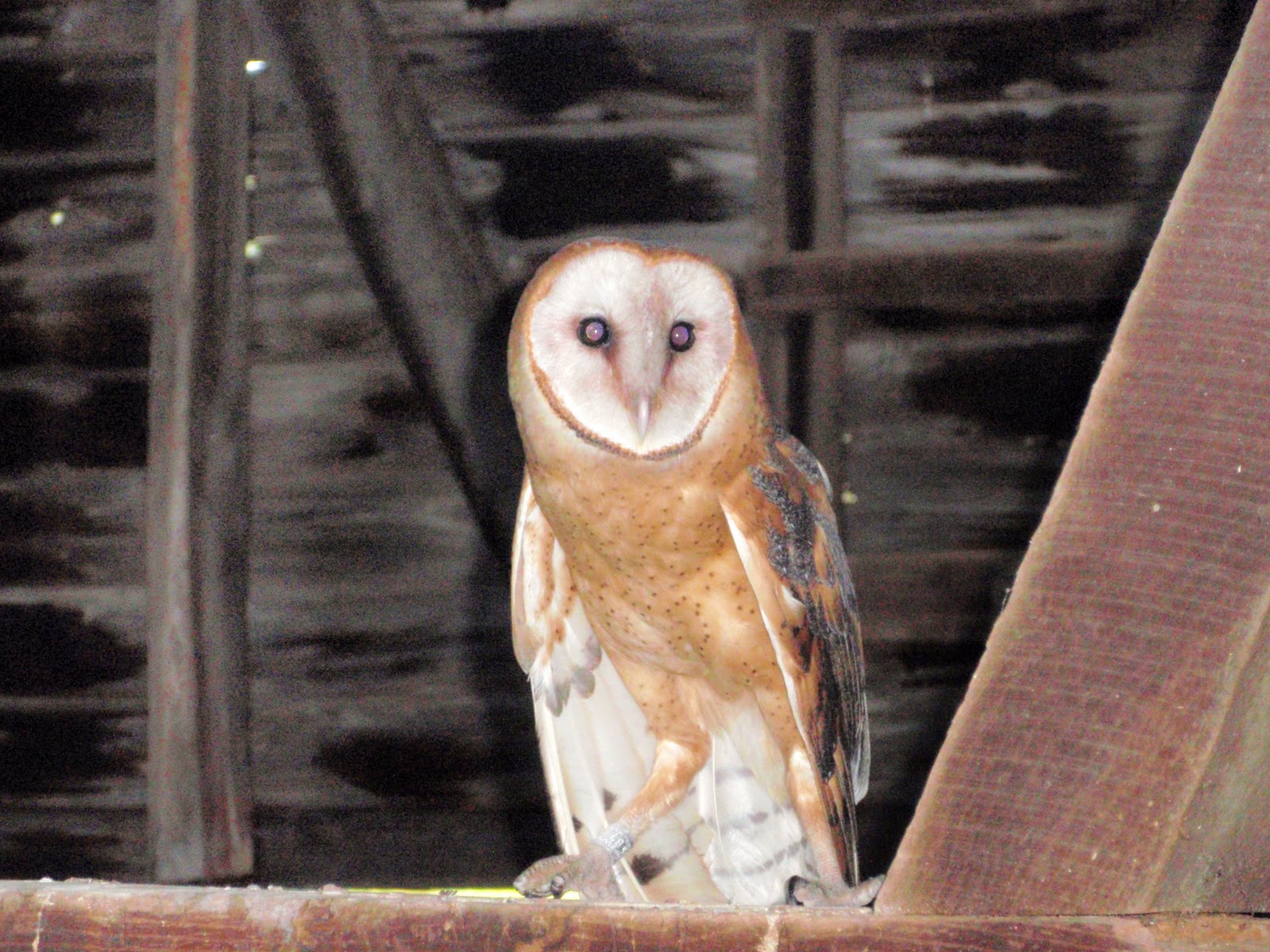
Eight Barn Owls Released

Last month, the World Bird Sanctuary released eight Barn Owls into the wild that had hatched in our propagation building.  
One of the young Barn Owls surveying his new home.
Seven of the owls hatched this Spring in two clutches, the eighth hatched a year before.  When the owls were very young, their parents, Athena and Wentworth, worked very hard to keep them warm and well fed.  We did not want the young Barn Owls to become accustomed to humans, so we avoided entering their mew as much as possible.  Instead, I had the privilege of observing the owls’ activities on the closed circuit camera that hung over their nest box, also known as “Owl TV”.
 
The Common Barn Owl, Tyto alba, lives on every continent in the world, except for Antarctica.  However, Barn Owls have become fairly rare in many parts of Missouri due to habitat destruction and poisoning.  Barn Owls forage for small rodents as they silently fly over open meadows, certain crops and the edges of woods.  They have the best sense of hearing in the animal kingdom, and they rely on this to locate prey.  Barn Owls tend to avoid heavily wooded areas because they sometimes become prey for the Great Horned Owls that often occupy those types of habitats.  Barn Owls make their nests in hollow trees, but they often use man made structures such as barns, grain silos and specially built nest boxes.

When the owls became old enough to survive on their own, Jeff Meshach, Assistant Director of the World Bird Sanctuary, and I loaded them into crates and drove them to Fredericktown, Missouri.  We arrived on the property of Jim and Jean Priday, whose property provides ideal Barn Owl habitat.  He had an old red barn, built in the early part of the last century, that we could use to help the owls transition into the wild.  We released the Barn Owls into the barn, but Jim sealed the windows with welded wire, so they could not leave quite yet.  Every morning, for five days, Jim put the mice we provided for him on the floor of the barn.  The Barn Owls learned that they could obtain food in the barn.  However, they did not think of the barn as a great place to stay because they always saw humans around.  After five days, Jeff removed the welded wire that sealed the windows of the barn.  One by one, the owls left the barn.  Jim continued to place food in the barn for several more days.  In case any of the owls had trouble finding their own food in the wild, they could come back to the barn and get a meal.

Hopefully, all eight Barn Owls have found success in their new habitats and will make a positive impact on the population of Barn Owls in Missouri.

Plans for building your own Barn Owl nest box can be found at the Missouri Department of Conservation’s Guide on Building a Nest Box.

Submitted by Leah Sainz, World Bird Sanctuary Naturalist

Thursday, November 4, 2010

How long can a Chicken live?

This question...I ponder every day that I work at our Environmental Education Center.
Dumpling, our 15 year old Cochin chicken
We have a chicken named Dumpling. She is 15 years old and counting. To my knowledge, we (World Bird Sanctuary) have never had another chicken live that long. I tell guests how old she is and the response is unanimous surprise. Wow! The guest then says "I had no idea that a chicken could live that long." I cannot believe it myself.

Do any of you "Show" chickens? And do you have a chicken that is older? Send us a picture of your chicken and it’s life story.  I have tried to find the longevity of chickens on the web...but cannot find a chicken that is older than 7 years.

We have 2 kinds of chickens on display at World Bird Sanctuary.  You can come in and pet Dumpling or Daisy our Cochin Chickens.  The chickens are a favorite with kids of all ages.  Actually, almost everyone loves to pet the chickens.  Usually they say "I didn't know that chickens were that soft".  The white feathers on Dumpling and Daisy are very soft.
What has funny looking cheek adornments, no tail, and blue feet? ...an Araucana chicken of course.
We also have Araucanas on display.  They are located down past the hospital beyond most of the Eagle exhibits.  The Arauacanas are here because they had been so intensely interbred with domestic chickens that they were in danger of being bred into extinction.  Our flock is a longterm program that is attempting to breed them back to the original species.   (This is a subject for another blog in the future).

Cochin chickens were originally raised in China.  Araucanas were originally raised in Chile.

Many of you raise chickens or have raised chickens.  Some of your parents or grandparents may have raised them.  Come in and see our chickens and tell us about yours.

Some one please tell me about chicken longevity...How long can a chicken live?

Submitted by Michael Zeloski, World Bird Sanctuary Naturalist

Tuesday, November 2, 2010

Owl Prowls Are Here!


Looking for a fun and unusual outdoor activity before the weather turns nasty?  We have just what you're looking for -- Owl Prowls!
 Jake, one of the World Bird Sanctuary's Great Horned Owls
Beginning this week the World Bird Sanctuary will be introducing guests to those amazing birds that prowl at night.  

First you will gather in our Nature Center to meet some of our resident owls and learn some of the amazing adaptations that make them such efficient mousetraps.  Then you will learn to speak their language--sometimes called "the hoot".  To top off the evening one of our naturalists will lead you on an easy night hike through our grounds where you will be given the opportunity to try your hand at "hooting" to see if you can get a response from one of the wild owls that call the surrounding area home.

Owl Prowl Dates:
 *  November 5, 13, 19
*  December 4, 10, 18
*  January 21, 28
*  February 11, 19, 26

*  7-9 pm
*  $9 for adults, $7 per child under 12
*  Groups of 10 or more:  $7 per person regardless of age

Advance reservations required.
Call 636-225-4390, ext. 0 to make your Owl Prowl reservation today!

The outdoor portion of this program lasts approximately one hour.  Be sure to dress appropriately for the weather.


Sunday, October 31, 2010

The Rookie Files: Crate Training 101:

Or How I learned to love restricted space

One of the easiest ways to transport birds from one location to another, be it cross country or between WBS buildings, is a crate. During initial training, or when they learn how to sit on the glove or become used to people, they learn how to go into a crate. All of our birds crate, from kestrels all the way to Dorothy our Andean Condor. Of course they all have different sized crates.
Crates come in all different sizes
Some birds, like Barn Owls and American Kestrels that nest in cavities and therefore are used to small, enclosed areas, are usually no problem to train to go into a crate.  With some birds, like hawks, eagles and ravens, crates could look rather frightening. It is our job as trainers to turn entering a crate into a positive experience.  We do this by using the great motivator--food! First we remove the door from the crate so that the bird does not feel trapped, then we place food just inside the lip of the crate. 
A White Naped Raven approaching the "food box"
In order to eat that piece of food, the bird has to begin to step into the crate, and once it does, it is rewarded with that piece of food. Gradually the piece of food is moved further back until it is all the way in the back of the crate, causing the bird to step all of the way inside the crate. Once the bird is comfortable going all of the way into the crate the door is put back on the crate and phase two begins.
It has food in it--it must be good!
Phase Two is all about increasing the amount of time a bird can spend in the crate. Now when the bird steps all of the way into the crate we very briefly shut the door, usually for only a few seconds at a time. As the bird becomes more relaxed in the crate it can be left in the crate for longer durations of time. In order to reinforce staying in the crate for longer periods of time, similar to the length of a program, we feed the bird small tidbits of food through the crate window to help keep the experience a positive one. Some birds become so relaxed in the crate that they rush into the crate the first chance they get. Riley the Barn Owl loves his crate so much that we sometimes have trouble getting him to come back out, and Mesquite dives headfirst into his. Buddy the Double Yellow Headed Amazon thinks his crate is the best place ever to nest and babble.

Now that the bird is OK with being in the crate it is time for phase three. Key to transporting a bird in a crate is moving that crate while they are in it. This is easier said than done, since birds usually move under their own power, they decide when to fly or walk. It can be frightening to them to be moving without it being their decision. In order to make this transition more comfortable we place carpets in the crate to prevent the bird from sliding around. Just like in the previous phases we start small and work up to moving the crates long distances, rewarding the bird as we go. In the beginning the crate is lifted only a few inches off the ground, keeping it as level as possible and then it is placed back on the ground. Gradually we increase the distance until the crate can be lifted onto shelves. Then we walk with the crate, a few feet at first, and then all around a building. Eventually the bird feels safe enough in the crate that we can begin taking it on field trips around the site.

Crating is beneficial not only for transporting birds, but for keeping them safe during shows and programs. Sometimes we need to stash birds during shows or programs where they will be safe from each other and curious people. During the flood in 2008 we had to keep several birds in crates after evacuating the ETC. Crates also make perfect “nests” for owl chicks. The small space imitates the nest cavity of many species of owls, so it is a safe place to keep them when they outgrow their brooders.
A "birds eye view" of a crate
Crates come in all shapes and sizes, from the small wooden box crates we use for kestrels to the XXL crate we use for Dorothy, our Andean Condor. Some crates have perches to protect a bird’s tail; some have cutouts in the back for depositing treats, a crate has to be big enough for the bird to stand up comfortably, but small enough to easily transport and stack in small spaces, like the backs of vans. Regardless of shape or size, crate training is perhaps the most important part of a bird’s training. The more positive a crate is to a bird, the easier it is on the bird to be transported, or stored in case of emergency. This is why we make every effort to turn what could be a negative experience to the happy, fun, “box of food”.


Submitted by Lean Tyndall, World Bird Sanctuary Naturalist

Friday, October 29, 2010

Effects on the Environment - #5


In article #1 of this series World Bird Sanctuary volunteer, Jennifer Jones, talked about one specific pesticide—rodent poison.  Here she discusses pesticides in a more general overview.

Pesticides cause significant bird mortality each year. Of the five billion pounds of pesticides that are applied worldwide every year, 20% are used in the United States (U.S. Environmental Protection Agency [USEPA], 2004). Approximately 40 pesticides still used in the U.S. are documented to have caused bird die-offs. The U.S. Environmental Protection Agency (the U.S. government agency responsible for regulating pesticides) has recorded more than 1,700 incidents of bird kills - many including hundreds of individual birds - attributable to pesticide use.

 Pesticide effects may be lethal, sublethal, acute, chronic, habitat related, or there may be no effect at all. A sub lethal effect is usually from a repeated exposure to some pesticides and though it does not kill the bird it affects it in other ways.  These effects are hard to detect but nevertheless can produce dramatic species declines over time.  Other effects of sublethal are weakening and behavorial.

An acute effect is a sudden, short exposure to high levels of pesticides.  Responses of birds to acute exposure can vary significantly.  Acute exposure to organophospates often leads to death of the bird within 30 minutes after symptoms of feather fluffing, labored breathing, muscle tremors and convulsions. Effects from acute exposure can be immediate or delayed. 

Chronic effects are defined as long-term exposures.  The problem with these exposures is that because the poisoning takes place over a prolonged period birds are more likely to become scattered over a wider geographical area and may never be seen.  If they are recovered it is much harder to correlate the death with specific pesticide applications.  Chronic exposure produces delayed effects.  One such effect is the decrease in breeding success, such as we saw with the pesticide DDT.

Habitat Related effects include loss of seed set or berry production in vegetation if bees are killed by pesticides.  Also, runoff into wetlands reduces the number of aquatic insects essential to the growth and development of aquatic birds.  The use of insecticides on lawns reduces the number of earthworms, which affects the American Robins in particular.

In general, insecticides are more toxic to fish and wildlife than herbicides or fungicides; though some herbicides may harm wildlife by damaging the habitat in which it is found.

Insecticides work by interfering with the central nervous system of insects.  The central nervous systems of fish and wildlife that ingest tainted insects may also be affected.

Wildlife can be exposed to pesticides directly by eating contaminated food or water, breathing pesticides or by skin absorption.  Young birds that are fed infected insects are at great risk of suffering lethal pesticide exposure effects.

One such chemical was banned back in 1972; it was the reason why the Bald Eagle and the Peregrine Falcon were on the endangered species list.  The chemical called DDT caused the eggs that were laid to have eggshells so thin that when the eggs were incubated, they were crushed by the weight of the parent bird.   Since the ban of DDT both the Bald Eagle and the Peregrine Falcon have made a comeback and are no longer on the endangered species list.  This is a prime example that we can right what we have done wrong.

When you purchase any pesticide, be sure to read the label to determine whether it is considered toxic to humans and wildlife.  Most chemicals are now required to state this on the label.

Submitted by Jennifer Jones, World Bird Sanctuary volunteer

Monday, October 25, 2010

Owl Prowls

Have you seen the latest hit movie The Legend of the Guardians: the Owls of Ga’Hoole?  


Do you want to discover more about those amazing birds?  Your chance to learn about and see live owls is coming soon at the World Bird Sanctuary! 
A Barn Owl in flight
Starting in November join us for Owl Prowls where first you will be shown different species of owls up close, a few flying mere inches above your heads!  A sanctuary naturalist will talk about their characteristics, behaviors, and their unique hoots and calls, which you will learn how to imitate.  After the presentation, the naturalist will guide you on an easy night hike through the sanctuary.  You can hoot calls of native owls and try to lure a wild one in closer.
The classroom portion of an Owl Prowl 
The most common owls one may hear at night in Missouri are great horned owls, barred owls, and Eastern screech owls.  Another owl that inhabits Missouri is the common barn owl.  Despite the name, they are not very common anymore due to loss of their habitat and secondary poisoning.  Rare winter resident owls are the long-eared owl and Northern saw-whet owl, an uncommon winter resident is the short-eared owl, and very rarely snowy owls will migrate far enough south to winter in this area. 

Most people do not realize that owls have many different vocalizations other than just hooting.  For example, great horned owls are known for their booming hoots, but they also squawk, chitter, and bark.  Their appearance is very different than that of a barred owl.  Great horned owls have two feather tufts on the top of their head, and barred owls don’t.  Great horned owls have bright yellow eyes, and barred owls have dark brown.  Great horned owls have a white neck patch, and barred owls do not.
 Great horned owl - Note the feather tufts that resemble ears,  and the white throat patch
 
The typical call of a barred owl is a series of eight hoots ending in oo-aw, with a downward pitch at the end, sometimes with a gurgle sound.  The most common mnemonic device for remembering the call is "who cooks for you, who cooks for you all."  They also will make other types of calls and variations of each, some almost sounding monkey-like.  While calls are most common at night, they do call during the day as well.
  A Barred owl - note the round facial disk and lack of feather tufts

Eastern screech owls don’t necessarily screech, but make more of a whistled trill or a high pitched horse whinny.  Also, when they are annoyed they will make a rattling sound.  Eastern screech owls are the twelfth smallest owl out of around 200 species (is this world wide?) and are more often heard than seen.  They have excellent camouflage and when tucked away in tree cavities are almost invisible.   
 Acorn, an Eastern screech owl in the process of molting
 Owls and other birds use sound to attract and bond with a mate, pronounce and defend territories, beg for food and express alarm. Many owls will also hiss when they feel threatened or don’t want to be bothered.  There can also be differences between male and female calls and between adult, juvenile, and chick calls.  Often young owls do not hoot but make screeches or squawks when begging for food.  The common barn owl cannot hoot at all, even as an adult.  They produce eerie screams and will also make chirping noises.
 Goblin, a common barn owl
 During the Owl Prowl presentation, you will also be shown a few non-native species of owls as well as the ones discussed above.  The best time to hear owls or to call a wild one in is during fall and winter when they are establishing territories, and finding and courting mates.  The Owl Prowls at the sanctuary cost $9 for adults and $7 for children under 12, groups of 10 or more $7 regardless of age.  

Owl Prowls take place on the following dates:
November 5, 13, 19
December 4, 10, 18
January 21, 28
February 11, 19, 26

Owl Prowls begin at 7 pm and last approximately 2 hours.

Our trails are not paved, so wear comfortable walking shoes and dress appropriately for the weather, since we will spend about an hour outside.

Advanced reservations are required.  Call 636-225-4390 ext. 0 to make your Owl Prowl reservation today!

Submitted by Sara Oliver, World Bird Sanctuary Naturalist

Saturday, October 23, 2010

Creatures of Halloween


What’s fun and entertaining for the little ones…features those creatures of the night that fly, creep, slither and crawl…and is educational as well? 

Why, it’s World Bird Sanctuary’s Creatures of Halloween presentation, of course!

It’s not too late to make your reservation for this ghoulishly entertaining program which takes place on October 29, 2010 from 7-9 pm.  Advance reservations are required for this special Halloween program.

Don’t miss this opportunity to meet our naturalist ghoul from the past and some of her “special friends”!


COST:   $7.00 for children, $9.00 for adults
               For groups of 10 or more cost is $7.00 per person regardless of age

DATE:   Friday, October 29, 2010

TIME:    7 pm – 9 pm

ADVANCE REGISTRATION REQUIRED

MAKE YOUR RESERVATIONS NOW!
CALL 636-225-4390 to register

Tuesday, October 19, 2010

Open House

Thanks to all of our loyal supporters for making this year's Open House a huge success!

We couldn't do it without you!  Events such as Open House, Birds in Concert, the Fiesta Fundraiser, Fete du Feather, and the many other fundraisers held throughout the year, make it possible for us to do the job we love--educating people about the environment.

Even though your contribution, in the grand scheme of things, may seem small or insignificant to you,  when we put them all together they add up.  No amount is too small.  From the child who collects pennies at his school to help the hospital, to the corporations who so generously support us with grants, to the first time casual visitor who wanders onto our site to see what we're all about -- THANK YOU!

Sunday, October 17, 2010

FIESTA FUNDRAISER AT CASA GALLARDO!

Casa Gallardo Mexican Restaurants in St. Louis are generously hosting a fundraiser for World Bird Sanctuary's Wildlife Hospital on Thursday, October 21st.

When you present a copy of the fundraiser flyer to your server at any Casa Gallardo restaurant in St. Louis between 11am and 10pm on Thursday, October 21st, they will donate 25% of your total food bill to the WBS Wildlife Hospital.

So, mark your calendars for lunch and dinner on October 21st  - then encourage your family, friends and colleagues to print off this flyer and eat at Casa Gallardo!

It couldn't be easier, and will benefit our wildlife hospital.  World Bird Sanctuary receives no local, state or federal funding.  Our hospital relies entirely on donations from members of the public.  All donations received from this fundraiser will go directly towards helping us pay for medical supplies and food for the birds in our hospital.

NOTE: NO FLYER, NO DONATION - so CLICK HERE to print the flier today! 

Please feel free to print and copy as many of these flyers as you need to hand out at work and to your families and friends!