Friday, October 10, 2014

I would like a Dreamsicle, No wait, a Creamsicle please.


When I first started working at World Bird Sanctuary I was not very knowledgeable about snakes and was not very interested in them either. 

Over the years I became more acquainted with the different types of education snakes in our Office of Wildlife Learning Nature Center.  We have a Green-tree Python, Albino Burmese Python, Colombian Boa Constrictor, two Bull Snakes, a Royal Python, and a Creamsicle Corn Snake, Pantherophis guttatus, which I must admit is my favorite.  She is so friendly and beautiful!  I know you’ll fall in love with her too after you read this blog about her and her species.  Her name is Maize and I think she is just a wonderful animal!


Corn Snakes are found in the eastern and southeastern areas of the United States; they are carnivores, which means they eat other animals. Their diet in the wild varies, depending on age and surroundings.  Young Corn Snakes feed on lizards and tree frogs, but adult Corn Snakes will eat bats, birds, mice and rats.  In captivity, they are fed rats or mice, depending on their size.  Maize is given frozen then thawed mice, and she loves to eat!  She snatches the first one very quickly from the food tongs and swallows it whole.  With the others, she generally takes her time but will eat all the mice we offer her.  We normally give her 5-6 mice depending on their size, and we feed Maize once every two weeks.  She is currently 4 feet long.  Corn Snakes can reach up to 6 feet in length and up to 300-400 grams (approximately 10.5 – 15 oz.) and are usually orange to brownish-yellow, with large, black-edged red blotches in the middle of their back.  They have kernel shaped markings that look like Indian corn, or maize, on their belly, and that’s how they came by their name.

Nesting sites include rotting stumps, or piles of decaying vegetation. The clutch (group of eggs) size ranges from 10-30 oblong white eggs.  The eggs are laid during May through July and then hatch during July through September. The hatchlings are only 10-16 inches long.  The parents do not care for them at all.  The female simply lays the eggs and leaves.  Lifespan in captivity is 23-25 years and 4-5 years in the wild.  Maize is 3 years old this year.  She was hatched in 2011 by a Missouri snake breeder.  Maize came to WBS to be an education animal.  She travels and appears in many World Bird Sanctuary educational programs, including Reptales, Birdday parties, Amazing Animal Encounters, and many more!

Corn Snakes come in numerous natural color morphs, such as Normal (wildtype), Miami Phase, Okeetee, Candycane, Reverse Okeetee, Fluorescent orange, Sunglow, Bloodred, Crimson, Anerythristic, Charcoal, Caramel, Lavender, Cinder, Kastanie, Hypomelanistic, Ultra, Ultramel, Dilute, Sunkissed, Lava, and Stargazing.  There are also different pattern morphs, such as Motley, Stripe, Diffusion, Sunkissed, Aztec, Zigzag, and Banded.  All these natural color morphs make corn snakes camouflaged in their environment, for they are preyed upon by many mammals and birds of prey.  There are also compound morphs, which are produced by captive breeders by placing certain natural color morphs together.  There are tens of thousands of compound morphs, but I'm only going to list a few of the most popular ones.  These include Snow, Blizzard, Ghost, Phantom, Pewter, Butter, Amber, Plasma, Opal, Granite, and Fire. 

And finally there are hybrids, meaning captive breeders cross corn snakes with other snakes in the Pantherophis, Lampropeltis, or Pituophis family.  These corn snakes can produce color and pattern variations called Jungle, Tri color Jungle Corns, Turbo Corn, Brook Korn, and finally, a Creamsicle Corn snake, which is what our Maize is. 


So, as you can see from above, there are many different types out there.  Creamsicle Corn Snakes are a hybrid that is the result of breeding an Emory’s Rat snake with an albino Corn Snake.  I recommend looking online to see the other color morphs that are out there.  Below is a picture of Maize and some other ones:

Maize is available for adoption in our Adopt a “Bird” (in this case “Snake”) program.  To find out more information, call 636-861-3225.  All adoption donations are tax deductible.  This season she can be seen at the Nature Center at the World Bird Sanctuary which is open daily from 8am-5pm. 

Maize is a very beautiful snake.  You can even pet her!  Just ask one of the Naturalists. 

Submitted by Lisbeth Hodges, World Bird Sanctuary Naturalist


Wednesday, October 8, 2014

Bird Talk


Here is another whimsical poem about a conversation with birds by World Bird Sanctuary guest author Marge Biermann.

Juvenile Cooper's Hawk (photo: Gay Schroer)
Bird Talk

The sky is your highway, no traffic problem there.
No toll roads or bridges to request a fare.
Anyway, it’s kind of difficult for you to carry change.
I guess even using a credit card would seem strange!

Refueling simply means you find a worm or, maybe, a mouse.
And you usually live in a nest or, sometimes a house.
There’s no need to worry about a leaky roof,
You’ve solved the problem of weather proof.

Most of your brothers live in high rises, strong and tall,
Sheltered by leaves like a great granny shawl.
Your voices are heard in a variety of tones.
No monthly fees….you never need phones.

But life isn’t always as simple as that,
You’re always on watch for a hungry cat.
And accidents happen….then what to do?
You’ll need a friend to take care of you.


You need gentle hands to mend a broken wing,
So you can feel better and continue to sing.
I believe the World Bird Sanctuary is the place to go,
And then maybe you could help them with a show.

They educate people about how you live,
How we can help and the assistance we can give.
Living together, all of us….man and beast,
To keep the balance, none should be counted as least!

Submitted by Marge Biermann, World Bird Sanctuary Guest Author

Monday, October 6, 2014

Year Three; 365 Photo Project- August 2014


This August I had some vacation time with the family and I spent it in Northern Wisconsin at the family cottage. 

Most of the trip was rather quiet since the weather was cloudy and cool.  The temperatures were a nice change from the heat of St. Louis.  Even with the weather the way it was I still managed to get a few very nice photos that I would like to share here. 

My most favorite photo was from a trip to Whitefish Lake in the Upper Peninsula of Michigan.  It is a very nice hike through the woods to the lake.  Birds were rather quiet except for a Barred Owl my Dad called in.  We took lots of photos on the walk, mainly of mushrooms and toads.  Once at the lake I wandered around a little.  I happened to look over and suddenly found this adorable Chipmunk sitting in a cavity of a tree base.  At one point it was almost like he was posing for the photo, so of course I took a few photos of this adorable little guy.

The next two photos I want to share go together; I took these the last morning at the cottage.  It was a very brisk 39 degrees out, so the lake was all foggy.  I walked down to the lower deck and started to take photos of the lake when over towards my cousin’s dock I heard a commotion in the water.  I looked and saw a Bald Eagle fly up from the water and land on the dock with a good size fish.  It sat for a few moments then walked down the dock with the fish clasped in its foot.
I took a ton of photos of the eagle and of course of the beautiful fog.  If you look closely at the photo with the fog on the lake you will see a dot on the dock and that is the eagle.  Of course I have also included a closer photo of the eagle on the dock.


The last photo I would like to include is one that brings up the feeling of complete relaxation.  One day we actually had very nice weather and the temperature actually made it to 84 degrees.  That evening the sunset over the lake was just gorgeous.  I took several shots then backed up and took the sunset with our chairs and tables in the photos and I just get this overall feel of relaxing peace.
 
I hope everyone enjoys these photos.  It was hard to pick just a few.  I took so many photos that it was hard to choose, but these were a few of my favorites.

Submitted by Cathy Spahn, World Bird Sanctuary Naturalist

Saturday, October 4, 2014

Eagles of the World: The Congo Serpent Eagle


The Congo Serpent Eagle is a special bird of prey that is found in Western and Central Africa.
Range of the Congo Serpent Eagle (from the wikipedia files)

Its range stretches anywhere from Sierra Leone south to Angola and west to the Democratic Republic of the Congo.  These birds can be found in dense primary  forests below 3,000 ft. elevation, where they are skilled at hunting the dark understory.

Illustration above from the wikipedia files 

A few distinct characteristics help to identify this raptor.  The Congo Serpent Eagle is known for its short rounded wings and long rounded tail.  It is a medium sized bird, characterized by a white breast covered with dark circular speckles.  Its wingspan reaches a total length of about 37-42 inches across.  The feathers on its head are slightly pointed, giving this raptor a slight crest.  They have yellow legs, a light brown tail with about 5 or 6 broad black stripes, and talons that are short and sharp.  On average, females are about 3% larger than the males.  Juvenile Congo Serpent Eagles have a more pale grayish-brown appearance when it comes to their heads and tails.  In addition, they tend to be more darkly barred than the adults.

This particular bird of prey is also known for its vocalization in that it has one of the most heard vocalizations among species in its habitat.  This raptor is known for its cat-like meowing sound.  It also has a low, mournful, nasally “cow-cow-cow” at intervals over extended periods of time.
Congo Serpent Eagles hunt from a perch in the understory (photo: the wikipedia files)

These raptors, being Serpent Eagles, have a different diet than the Sea and Fish Eagles I have previously discussed.  They prey on snakes, lizards (a favorite being chameleons), toads, and even some small mammals.  Their keen vision helps them to hunt with extreme precision in the dark understory.  In order to capture their prey they perch at an elevated level in the understory, swoop down, and then ambush their prey.  The Congo Serpent Eagle will then strike their prey with their feet repetitively to make sure it’s dead before devouring their kill.

These birds of prey breed any time between June and December throughout their range, although little else is known about their reproduction habits.  They rank as a species of least concern on the conservation status scale due to their increasing population and vast range.


Submitted by Callie Plakovic, World Bird Sanctuary Outreach Coordinator

Thursday, October 2, 2014

Staff Spotlight: Trina Whitener


 he World Bird Sanctuary would not be able to properly care for our birds without the help of our staff and volunteers. They are hardworking, dedicated, and most of all passionate about everything they do.  To show our appreciation, we want to spotlight individuals who make day-to-day operations at the World Bird Sanctuary run smoothly.
Trina and two young fans (photo: Joel Kichline) 

Trina Whitener’s love and passion for animals began the moment she heard about Lonesome George. Lonesome George was the last Pinta Island Tortoise on the Earth. While in captivity at the Charles Darwin Research Station on Santa Cruz Island, Pinta Island Tortoises were declared functionally extinct. Even though Trina was only in kindergarten when she heard about George, she knew at that young age that she didn’t want another animal to go through what George did as the last of his species. She realized it was her mission in life to help protect wildlife.
Trina preparing to catch a Eurasian Eagle Owl (photo: Gay Schroer)

Growing up, Trina had a lifelong interest in raptors of all kinds, including dinosaurs. As a kid, Trina’s father was interested in falconry, so birds of prey were always a part of her life. It wasn’t until May of 2003, however, that Trina became aware of the World Bird Sanctuary. While playing Dungeons and Dragons with a friend, she was informed about the internships at the World Bird Sanctuary. Trina applied for the internship and was given the opportunity to intern for three months. Afterwards, she volunteered for about four months before being given a position as a Naturalist Field Specialist in February of 2004.
One of Trina's passions--teaching kids about reptiles (photo: Gay Schroer

Trina’s passion radiates around her. When talking with her about the birds at the Sanctuary, or any animal in particular, it is obvious that Trina puts her heart and soul into her work. Trina loves animals, and she loves that her work allows her to share her passion about wildlife and inform the public about what we can do to save them. Trina firmly believes that if she can influence just one person, then she has done her job for the day.

Trina herself is influenced by one of our Golden Eagles at the Sanctuary--Mariah. Currently, Mariah is the oldest bird at the Sanctuary. Trina has known Mariah for years, way back to when this magnificent bird was still used for education.

Trina’s favorite thing about Mariah is her personality. According to Trina, Mariah is tough, cool, sweet, independent, and smart. When she first met Mariah, Trina admired that she wouldn’t take flack from anyone; she has a “personality” all her own.

Mariah’s part in education also influences Trina. Before being retired, Mariah educated thousands of people who have come to the World Bird Sanctuary. She has taught them so much about how to save the wildlife and educated them about birds in general. Trina’s goal is to one day be on Mariah’s level as an educator. If she can influence and educate the amount of people Mariah has, then she has completed her purpose in life.

We at the World Bird Sanctuary are extremely lucky to have staff and volunteers who are devoted to the care of all our birds. Thank you Trina for everything you do for the World Bird Sanctuary!

Submitted by Mary Beth St. Peters, World Bird Sanctuary Social Media and Fundraising Intern

Tuesday, September 30, 2014

Meet the Neighbors


There are many challenges when doing a zoo show program.  Weather has to be taken into account, wind speeds compensated for, and the crowd carefully monitored to make sure no one tries to stand up during the show.  These challenges I was always prepared for; one thing I never took into account was the neighbors.

By neighbors I mean the wild (or semi-wild) birds that call the zoo home.  When our birds first move into the neighborhood in the spring they are generally ignored by the wild birds unless they end up in a tree while learning their new patterns.
Many zoos and theme parks release peafowl such as this albino Peacock  (photo by Gay Schroer at Magnolia Plantation)
The biggest problem we have when we first arrive is the peafowl.  Peafowl are not native, and are intentionally released by zoos and theme parks for their guest’s enjoyment.  The fowl quickly call wherever they are released home, and rarely wander off grounds.  Both Milwaukee County Zoo and Grant’s Farm have free ranging Peacocks and Peahens that consider the entire zoo their territory.  In the winter months they have free range of the exhibits where we keep our birds, so they are often surprised and upset when they suddenly cannot cross into “their” territory.  They wander into the theaters during practices and we have to stand guard in the weathering area (the outdoor area where we keep our birds on display) to prevent Peahens from charging our poor birds.  Peafowl may look ridiculous, but they have strong kicks and they could do a fair amount of damage to our birds, especially the Peacocks, which have spurs on their legs.  After a while the peafowl start to realize they cannot enter certain areas, but we still have to stay on guard because peafowl are not the only birds that are not pleased with our birds’ presence.
A Peahen wandering under our bleacher seating 
Songbirds, understandably, are not thrilled when a group of predators move into their territory--especially during breeding season.  Once songbirds have eggs in their nests they begin to display a behavior called mobbing.  They will gather in groups and dive bomb large birds of prey to “encourage” them to leave the area.  Unfortunately, these birds do not realize that our birds have little interest in them or their young—our birds get three free meals a day.

The worst offenders are the Common Grackles, black songbirds that leave nothing to chance.  I am especially bitter about them because they chased a kestrel I worked with into the woods.  Every time he tried to fly back into the theater they chased him further into the woods (don’t worry we got him back…it just took a while).

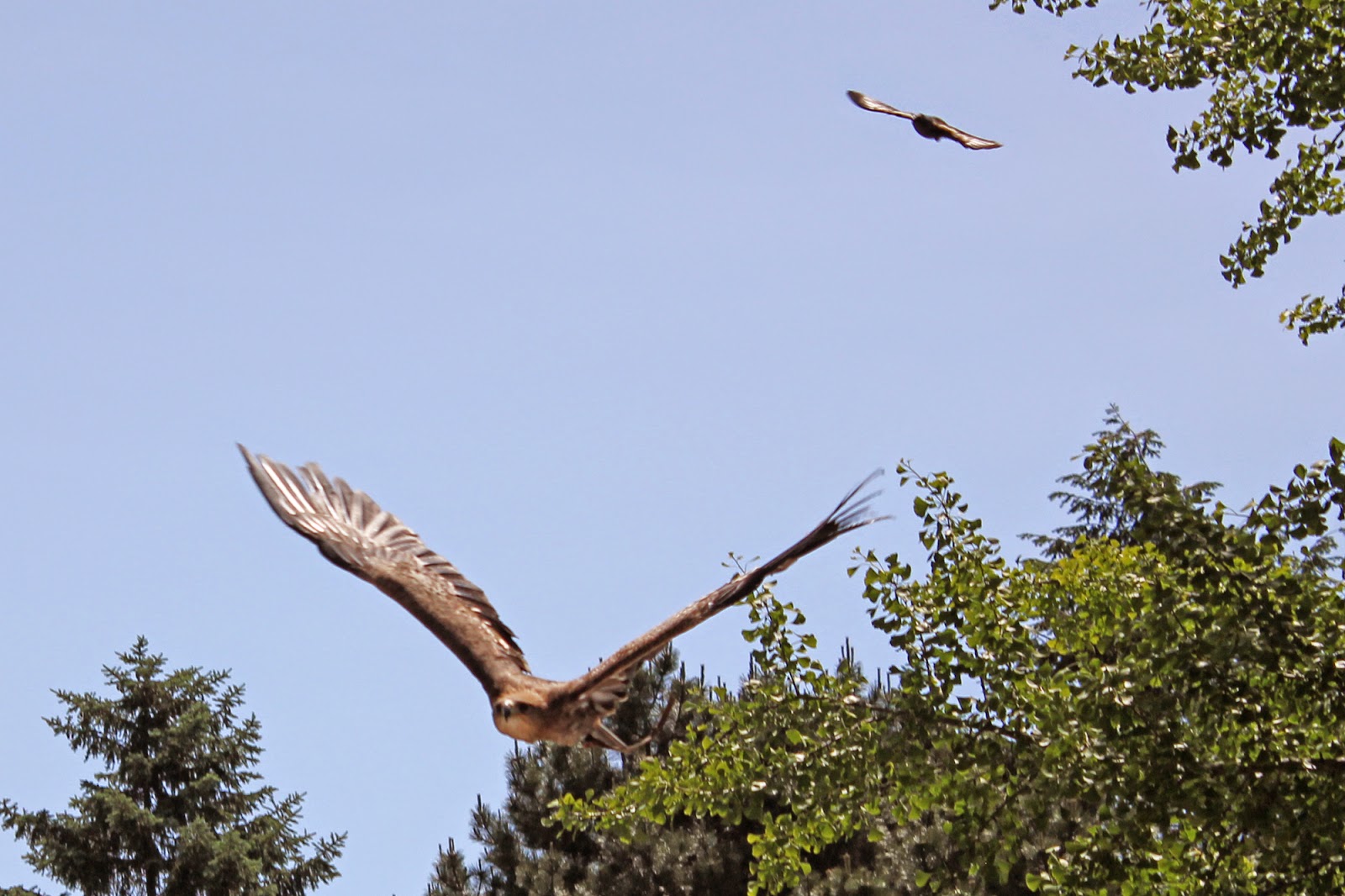
The grackles this year were especially numerous.  Diablo (a Tawny Eagle), Reese (Great Horned Owl) and Clark (Bald Eagle) got the worst of it.  Both Reese and Diablo had clouds of five to seven grackles following them throughout their patterns.  We used the grackles’ natural fear of humans to our advantage, strategically placing ourselves between them and our birds or flying our birds into the crowd.  Robins, especially juveniles, will also harass our birds--often lurking in the trees above the weathering area in wait.
 The scariest scenario is wild raptors who chase our birds (photo: Laura Bailey)
The scariest case of wild bird interaction however did not involve songbirds, but a wild juvenile Cooper’s Hawk who wanted to chase our Military Macaws my first year doing shows.  Suddenly instead of two birds doing loops around the theater there were three!  Luckily we were able to call our birds down to safety and we never saw the young hawk again.

Despite all of the trouble wild birds cause, I will admit there is no better way of finding a bird that has flown off or been blown out of the theater by wind.  Just follow the sound of angry songbirds and nine times out of ten we find our bird.  Although sometimes we find wild birds of prey!

There are many challenges to face during zoo show programs, but none quite as unpredictable as the local bird population.  They can be an annoyance, an amusement and even aid you, assuming they did not cause the bird to seek shelter in a tree in the first place.  Regardless, they certainly keep us on our toes!

If you live in or are visiting the Milwaukee, Wisconsin area this summer be sure to visit the Milwaukee County Zoo, and in particular the bird show presented by the World Bird Sanctuary.

Submitted by Leah Tyndall, World Bird Sanctuary’s 2014 Milwaukee Zoo Show Supervisor

Sunday, September 28, 2014

Really Weird Birds: King-of-Saxony Bird-of-Paradise


The King-of-Saxony bird-of-paradise is found in the rain forested mountains of New Guinea.  This species was first described and named in 1894.  It received its common name and scientific species name (alberti), to honor the then king of Saxony, Albert of Saxony. 

There are 41 species of birds-of-paradise, mostly found in New Guinea and its surrounding islands.  Males of the species exhibit some of the most unusual and beautiful feathers in the world.  The King-of-Saxony bird-of-paradise has feathers unlike any other.

Illustration from the wikipedia files
The bird’s body is about 8.5 inches long.  Males have a black head, back, wings, and tail, and a white and yellow front.  The most unusual part of the male is the two very long head plumes, or ornamental feathers sprouting from behind each eye.  These feather structures are more than twice the length of the bird’s body, almost 20 inches long!  In the right light, they look light blue on top and reddish-brown underneath.  The plumes have lost their normal feather structure.  There are 40 to 50 small flag-shaped structures positioned on one side of the shaft.  Males have evolved these through sexual selection; yep, girl attractants.  The bland looking brown females choose the male with the most impressive head plumes.
Male King-of-Saxony Bird-of-Paradise (photo: The wikipedia files)
King-of-Saxony birds are polygamous.  During courtship males perform their displays in one large area called a lek.  They are all attempting to impress the on-looking females.  The male’s display has two main parts.  First, he will try to attract females to his spot by “singing” a hissing rattle sound while perched up in the canopy.  He also moves and waves his head plumes and raises the feathers on his neck.  When a female approaches, he flies down to a vine in the under-story where he perches below the female.  He repeats his display and also bounces up and down on the vine.  Click here for a short video of a male King-of-Saxony bird courtship display.  When approaching the female for mating, the male wags his head back and forth while hopping up the vine towards her.  Afterwards, the female leaves and the male continues to attract other females.

Males take no part in the rearing of their offspring.  Females lay only one egg and care for the chick themselves.  This species mainly eats fruit, therefore helping with seed dispersal in their rainforest habitat.  They are not considered endangered or threatened.  They are only found in a small range, but are very common throughout that range.

Submitted by Sara Oliver, World Bird Sanctuary Naturalist


Friday, September 26, 2014

Height: Help or Hindrance


I'm easy to pick out of a crowd, and I've heard the question, "How tall are you," too many times to count.  My height (I'm 6'6") has been helpful for most of my life, but when I started working for World Bird Sanctuary’s bird show at the Milwaukee County Zoo, I considered it more of a hindrance at times.

I started volunteering at WBS’s nature center in February 2014 because I could work with both the birds and reptiles there, and at the same time interact with the public.  I found my niche in the daily chores, but I wanted to help more with the animals, especially the birds.  Once I started handling the birds, I wanted to participate more in their flying exercises.  When Jeff noticed my thirst for knowledge and drive to help out more, he recommended I try the bird show.  That is how I ended up becoming a trainer in Milwaukee for the summer.

Being tall has many perks when it comes to bird shows.  During the initial setup, it helped in the construction of the outdoor bird enclosures, since I could reach on top of them without any problems.

When it came time to shape birds’ flying patterns, I got designated the "official creance tester" (creance being a long line used in initial raptor free flight training), since during later training I could place birds on high perches others couldn't reach.  The main advantage I utilize every day is that I don't have to use a step stool to reach into the raptor's night stalls (picture below).  This helps me get them out of their stalls faster and easier during the morning weigh/change and later during shows for faster transitions.

Cleaning the stalls (photo by Erika Fenske) 
While being tall has some advantages when working with the birds, it also has some  disadvantages when it comes to training and doing shows with them.  My size tended to intimidate/scare a lot of the birds at first (and still does for some), so I have to limit my interactions with them during the initial stages of training.  When it comes to shows I have learned to adjust my height a lot, because the fence covering the behind the scenes area is only 6' in most places.  So, I have to crouch a lot to hide my movements from both the audience and the birds on stage. 

"Hidey ho neighbor"–A Wilson quote from the Tim Allen Show, Home Improvement (photo: Erica Fenske)
I have accepted the fact that I'm tall and I can't do anything about it.  That just means I have to devise new techniques to work with the World Bird Sanctuary’s amazing birds while doing bird shows.

Submitted by William Oberbeck III, World Bird Sanctuary’s Milwaukee Zoo Bird Show Trainer/Naturalist

Wednesday, September 24, 2014

Birds in Concert 2014


Another season of concerts was a great success at the World Bird Sanctuary.  Special guest musicians Javier Mendoza, Babaloo and a band named Fowl Play filled this year’s schedule. 
The Raptor Project takes to the stage (photo: Gay Schroer)

We had wonderful sponsors that helped us make this event happen.  Ameren Missouri partnered with the World Bird Sanctuary’s education department to sponsor the concerts and many of the other events on our yearly schedule.  Other sponsors were Sprout and About, Whole Foods Market and the Hendrickson insurance group.  We appreciate all the support of these sponsors.
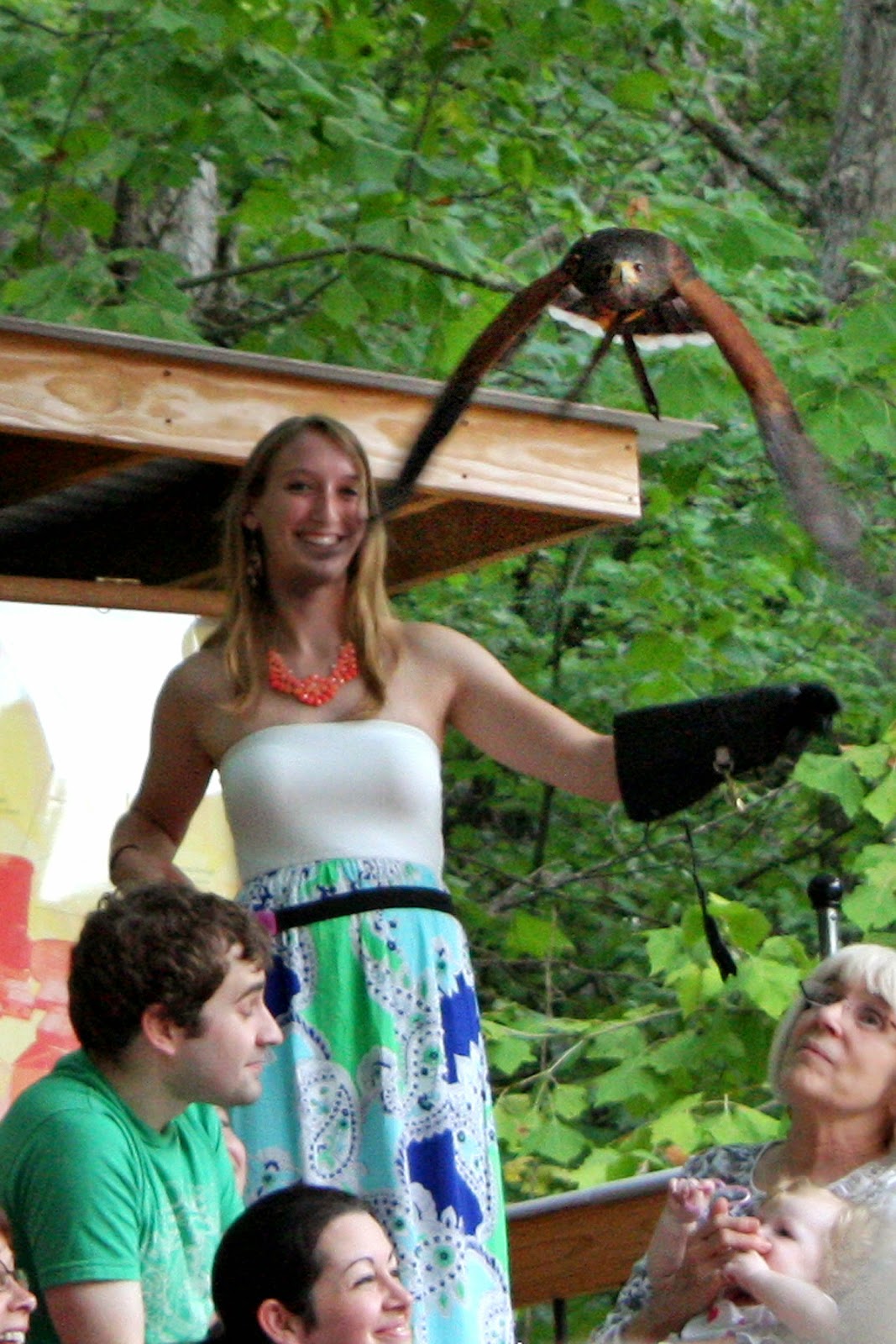
Naturalist JoHanna Burton releases a Harris' Hawk during a musical number (photo: Gay Schroer)

Enthusiastic audiences turned out to enjoy an evening of unique music mixed with flying birds, snake parades and a stage full of bubbles.  The World Bird Sanctuary’s band “The Raptor Project” performed each Thursday night.  Many of the songs played were from the band’s first two CDs, which were produced to benefit the Kathryn G. Favre wildlife hospital.  This year we performed 7 new songs, which were not previously released. 

The band’s soundman, volunteer Rusty Wandall, was able to set up recording equipment to start production of a live album.  Older songs from the first two CDs will be chosen after we listen to the tapes from all the shows to figure out what sounds best.  This will be a long process and we hope to have a digital release of a live CD sometime in the spring of 2015.  We just hope the tapes reflect the great fun we had at the concerts this year.

Thanks again to everyone involved. 

Submitted by World Bird Sanctuary's Sanctuary Manager, Joe Hoffmann    

Monday, September 22, 2014

Save $100 - Avian Training Workshop


Only a few days left to take advantage of the early registration bonus for the World Bird Sanctuary Avian Training Workshop!  By registering before October 1st you can save $100.  After that date registration will be the full fee of  $750.

What is an Avian Training Workshop you may ask, and what do I get for my registration fee?  
Workshop students learning to do a necropsy

The WBS Avian Training Workshop is an intensive 4-day workshop, which covers all aspects of housing, training, feeding and caring for raptors, parrots, corvids and many other species.  The workshop includes both classroom and hands-on training.
Students learn to weigh and weight manage a raptor (in this case an American Kestrel)

Subjects covered in the classroom section include:  
*  Establishing your own program--permits, insurance, facilities, staff & volunteers
*  Working with and training your bird--manning and positive reinforcement, desensitizing
*  Choosing the correct species to work with
*  Transportation--crates, permits, driving, flying, shipping
*  Housing--mews, jumpboxes, A-frames, flight cages, climate, hotwiring enclosures, substrates
*  Perch types--bow, platform, screen, etc.--which perch works best for which species
*  Diets--food types, frozen vs. live, storage, prep, raising food colonies, vitamins
*  Training your birds for flying--weight management, base weights, target weighs, flyer food
A Workshop student flying a Harris' Hawk

Everybody's favorite--the hands-on section:
Our staff believes one of the best ways to learn is through the hands-on experience of doing things yourself.  At our workshop you will have the opportunity to actually do the following:
*  Make jesses and anklets
*  Practice imping feathers
*  Experience coping and trimming of a raptor
*  Participate in simple public speaking games and learn how different elements make you a better public speaker
*  Fly a Harris' Hawk and/or Barn Owl with WBS staff
*  Help train a new behavior with a White-necked Raven (continues throughout the workshop)
*  "Be the Bird" in our training game
*  Participate in emergency medical care and do a gross necropsy on a raptor

The workshop also includes an extensive tour of WBS' facilities and opportunities to see birds and housing up close.

RESERVATIONS REQUIRED.  Workshop has a minimum of 10 participants and a maximum of 20.

WHEN:  Thursday, October 30th through Sunday, Nov. 2nd

EARLY REGISTRATION:  Sign up by October 1st - Cost - $650
LATE REGISTRATION:  Sign up after October 1st - Cost - $750

$100 non-refundable deposit required by October 1st for early registration, balance due by October 15th.

Registration fee includes lunch each day.

Transportation to and from St. Louis, hotel accommodations and breakfast & dinner are the responsibility of each participant.

To download a registration form CLICK HERE

Further questions?  Contact Melissa Moore, 636-225-4390, ext. 0 or email workshop@worldbirdsanctuary.org


Saturday, September 20, 2014

Really Weird Birds: Standard-winged Nightjar


The Standard-winged Nightjar is found in African dry savannah and scrub habitats.

Nightjars are divided into two subfamilies: “typical nightjars” with about 70 species located in Africa, Europe, Asia, and Australia; and “nighthawks” with about 9 species located in North and South America.

 Male standard-winged nightjar in breeding plumage. (Photo by Jan Steffan from the wikipedia files) 
Nightjars have very long pointed wings, short legs, small feet and very short beaks.  However their beaks are much wider than they are long and they can open their mouth very wide, both vertically and horizontally, in order to catch and consume insects in flight.  These birds are either nocturnal or crepuscular (active at dusk and dawn) and have very large eyes on the sides of their heads, increasing its field of vision.  They have soft feathers that are camouflaged to resemble dead leaves or bark while roosting.

The Standard-winged Nightjar is about 8-9 inches long, with a fairly short tail.  The peculiar trait of this species is that during breeding season, the males grow an extra-long primary feather on each wing reaching up to 15 inches long! The first 7-8 inches of this feather is just bare shaft.  While in normal flight, the two long feathers flutter behind and almost look like two other birds chasing the nightjar!  Click here to see what I mean.

When the males are displaying for females, the two extra long feathers are raised vertically like flags.  He will also sing an insect-like song.  Any receptive females will join in the display flight.  The male will eventually lose the ornamental feathers after breeding season; they either fall off or are broken off.  The males and females will then look the same.

This species doesn’t build nests and just lay one to two pink eggs in dirt or dead leaves.  The female incubates the eggs during the day while the male roosts nearby, and then at night they take turns incubating.  Once the chicks hatch, the male usually guards and defends the chicks.  He will hover near the nest with his body vertical and tail spread out.  Both parents will feed their young regurgitated insects.

Standard-winged Nightjars exist in a very broad range in the wild and are not considered to be an endangered or threatened species!  

Submitted by Sara Oliver, World Bird Sanctuary Naturalist 

Tuesday, September 16, 2014

Photo Project Year 3 - July


July was a slower month for photos for me.  I do have three very different highlights for the month. 

This being July, I started out with making an attempt at photographing some 4th of July fireworks.  This year I used my camera on a monopod.  I did use the fireworks function on my camera, but I am still learning, and with the camera I have that is the best route. 

Fireworks display (photo: Cathy Spahn) 
I took many photos of the fireworks, some of which did not work. It took a few shots to get the timing down.  I did get several shots that show nice colors and burst.  One photo in particular demonstrates color and a few different bursts.  The other challenge I ran into at this location was either trees in the way, or as I found this time, a light that managed to get into all of my shots.  If I go to this location again I have to get there earlier to locate a spot away from the trees and lights.  However, I still really like this shot even with the light in part of it.

Watching the baby European Barn Owl being fed (Hailey closest to the camera/Madilynn closest to the owl) (photo: Cathy Spahn)

The second photo for the month of July was when my sister, brother-in-law and nieces came for a visit.  During the course of the day they were here we did many things, and of course one of them involved visiting the World Bird Sanctuary.  One of the best experiences I was able to give my nieces was for them to get a chance to meet a few day old European Barn Owl.  My nieces just fell in love with the baby owl.  Of course the big thing was she wanted to pet the owl, but once she got to see staff member Roger Wallace try to feed the baby owl she sat quietly and they all watched closely.

Sunflower and bees (photo: Cathy Spahn) 
The last photo I took at the very end of the month.  I was out birding, just wandering around to see what I could find.  I took many photos that day, and amazingly my favorite shot is not of a bird, but rather a sunflower with bees.  I came across this beautiful field of sunflowers. Most of the flowers were beyond peak, but a few were just right.  This one flower was just beautiful and I set my camera on continuous shoot mode because I saw the bees in the area.  I was concentrating on the bees on the sunflower, but when I looked back through my shots I found this photo with the bees flying into the flower.  I just love it.

Keeping a camera with you as you go out and about can lead to many very interesting and beautiful photos.  Sometimes you get them, sometimes you don’t, but that is half the fun of photography.

Submitted by Cathy Spahn, World Bird Sanctuary Naturalist